South Korea’s Special Counsel Inspects Island Marine Facility, Raising New Questions About Alleged Detention Planning
A remote military site moves to the center of a national reckoning
A team of South Korean special prosecutors said this week that a detention facility at a Marine Corps unit on Yeonpyeong Island appears physically capable of holding large numbers of people in prolonged isolation from the outside world, a finding that has intensified scrutiny of what investigators believe may have been more than a stray note in a former military intelligence chief’s notebook.
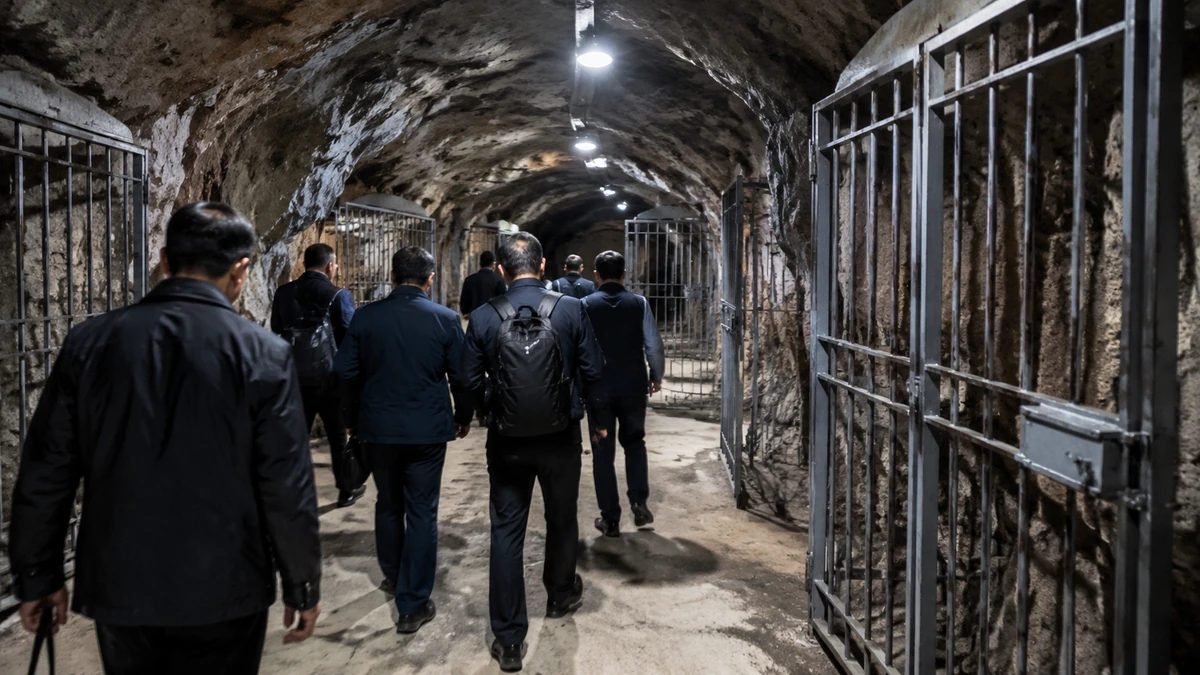
The inspection, conducted Wednesday by the special counsel team led by Kwon Chang-young, focused on a Marine unit on Yeonpyeong, a small and heavily fortified island near the disputed maritime border between North and South Korea. After visiting the site in person, the investigators said the space could be controlled in a way that cuts it off from the outside and that it offered “sufficient physical possibility” for the long-term confinement of multiple people.
That phrase is doing a lot of work in South Korea’s public conversation. Investigators did not say a crime had been proved. They did not announce that anyone had, in fact, been imprisoned there. Instead, they said something more measured but still deeply unsettling: that the physical environment matches, at least in practical terms, the kind of use suggested in a notebook memo tied to a widening investigation.
For American readers, the distinction is important. Think of the difference between finding a troubling plan on paper and then discovering an actual location with locks, barriers and capacity that could make the plan real. In legal terms, that does not settle intent or guilt. In political terms, however, it can transform a case from abstract suspicion into something much more concrete.
That is why the Yeonpyeong inspection has drawn such intense attention in South Korea. The issue is no longer only what was written or said behind closed doors. It is whether a state-controlled space connected to the military could plausibly have been used for mass detention. In a country with vivid memories of authoritarian rule, that is not just another scandal headline. It touches a raw nerve about how power can be imagined, organized and possibly operationalized.
What investigators were looking for — and why the notebook matters
The immediate trigger for the site inspection was a memo in the notebook of Noh Sang-won, a former commander of South Korea’s Defense Intelligence Command. The key term under scrutiny is “sujipso,” a Korean word that can be rendered roughly as “collection center” or “holding center.” By itself, the word is ambiguous. In another context it might sound bureaucratic, even bland. But in the context of a criminal investigation involving allegations of conspiracy, it carries a far darker implication.
Special prosecutors went to Yeonpyeong to test whether the notebook entry might correspond to a real place, not just a theoretical one. According to South Korean reporting, the inspection was part of an investigation into allegations against Noh that include preparatory conspiracy to commit crimes tied to an insurrectionary purpose. That is an extraordinary charge in any democracy. It suggests investigators are examining not merely abuse of office or procedural misconduct, but whether there was planning connected to the use of force or illegal detention on a scale large enough to threaten constitutional order.
Authorities reportedly found multiple barred structures in underground tunnels at the Marine facility, with capacity to hold hundreds of people. That detail has given the case its symbolic and emotional force. A notebook word can be debated. A subterranean detention-like structure with bars and large holding capacity is harder to dismiss as rhetorical fog.
In many countries, including the United States, major investigations often turn on a combination of documents, witness testimony and physical evidence. South Korea is no different. What makes this moment especially consequential is that investigators have moved from examining text to examining space. They are effectively asking whether the architecture of confinement existed in a form that could support the scenario implied by the memo.
That shift matters because it narrows the field of speculation. If no such place existed, defenders could argue the memo was vague, hypothetical or meaningless. If such a place does exist — especially one that is isolated, securable and large enough for many detainees — then the entry begins to look less like a random scribble and more like language anchored to a practical possibility.
Why Yeonpyeong Island carries such heavy symbolism in South Korea
To understand why this story resonates so strongly, it helps to understand Yeonpyeong itself. The island sits close to the maritime boundary with North Korea and is one of the most militarily sensitive locations in South Korea. Americans who remember the 2010 North Korean shelling of Yeonpyeong may recognize the name; the attack killed both soldiers and civilians and underscored just how precarious life can be on front-line islands in the Yellow Sea.
In South Korean public memory, Yeonpyeong is associated with national security, sacrifice and constant readiness. It is not an ordinary military base tucked away from public consciousness. It is part of the geography of Korean division — the still-unfinished legacy of the Korean War and the tense standoff that has defined the peninsula for decades.
That is precisely why the allegations now under review are so politically charged. Military spaces near the North are expected to defend the country against an external threat. The suggestion that such a space might also have been considered, planned for or discussed as a place to confine people internally touches on one of the deepest anxieties in democratic societies: that institutions built for national defense could be turned inward.
For American audiences, there are rough historical parallels, though none are exact. The broader principle recalls moments when emergency powers, wartime fear or intelligence structures have collided with civil liberties. In the United States, those conversations can evoke everything from the internment of Japanese Americans during World War II to post-9/11 debates over detention, surveillance and executive power. South Korea’s history offers its own distinct reference points, especially the era of military-backed governments in the late 20th century, when state security and political repression were often entangled.
That context helps explain why the current investigation is not being received simply as a procedural legal development. To many South Koreans, it raises a more elemental question: What kinds of state action were being contemplated, and how close did those ideas come to practical implementation?
What “physical possibility” means in plain English
The special counsel team’s wording has been cautious. That caution is not accidental. Prosecutors are not supposed to leap from a site inspection to a final legal conclusion, and in high-profile cases they often choose language built to survive courtroom scrutiny rather than cable-news spin.
Still, their phrasing points to the center of the case. “Physical possibility” means the investigators believe the facility’s design, layout and degree of isolation are compatible with long-term detention. In everyday English, the place seems capable of doing what the notebook language may have envisioned.
That assessment likely includes several practical factors: whether the site can be sealed off from outside contact, whether access can be tightly controlled, how many individuals it could hold, whether holding areas are divided or barred, and whether the location is remote enough to make outside monitoring difficult. These are not abstract design features. They are the nuts and bolts of confinement.
Just as important is what the phrase does not mean. It does not establish who ordered what, whether the facility was formally designated for unlawful detention, or whether any planned operation ever moved beyond discussion. Those questions require additional evidence, including testimony, chain-of-command records, communications and proof of intent.
But investigators are clearly signaling that one major threshold has been crossed. They are no longer dealing only with the semantics of a notebook entry. They are dealing with a real, inspectable place whose structure appears compatible with the alleged concept.
That can significantly alter the trajectory of a major case. When a public scandal consists only of competing statements, it often dissolves into partisan trench warfare. One side says the accusations are exaggerated; the other says the danger is being minimized. Physical evidence changes that rhythm. It gives investigators — and eventually courts — something more stable than political rhetoric.
Why special counsel investigations carry unusual weight in South Korea
South Korea’s special counsel system, often referred to in English as a special prosecutor or independent counsel mechanism, occupies a distinctive place in the country’s democracy. These teams are typically formed to investigate politically sensitive allegations that ordinary prosecutors may be seen as unable or unwilling to handle with full independence. In a political culture where prosecutors themselves are powerful public actors, special counsel probes can become major tests of institutional credibility.
This latest inspection is reportedly part of a follow-up effort to address unresolved suspicions remaining after earlier special investigations. That detail matters. It suggests the case did not emerge from nowhere and is not being treated as an isolated anomaly. Instead, it sits within a broader landscape of unanswered questions that prior inquiries did not fully put to rest.
South Korean audiences tend to watch these investigations not only for their findings but for their method. Was a search warrant obtained? Did investigators go to the site themselves? Did they speak carefully in public? Did they distinguish between confirmed facts and allegations? These procedural signals matter in part because South Korea has seen many politically explosive cases in which investigative legitimacy became almost as important as the underlying evidence.
The image of special prosecutors boarding a helicopter near the government complex in Gwacheon to execute an inspection warrant on Yeonpyeong was therefore more than logistical color. It conveyed seriousness, distance and state authority. A team was not merely reviewing files in Seoul. It was crossing water to inspect a military site firsthand, under legal process, in a place few civilians ever see.
For a U.S. audience, the closest analogy may be the political weight carried when an independent investigator personally inspects a secure federal or military site central to a public controversy. The act itself does not determine the outcome. But it tells the public that the inquiry has reached the stage where physical reality, not just paper trails, is being tested.
A democracy haunted by memories of authoritarianism
No account of this case makes sense without acknowledging South Korea’s political memory. The country is today a vibrant democracy, a technological powerhouse and a major cultural exporter, known globally for everything from K-pop and Oscar-winning films to advanced semiconductor manufacturing. But living memory still holds the decades when generals wielded immense power, dissidents were monitored and national security was often invoked to justify extraordinary state action.
That history does not mean every contemporary allegation will prove true. It does mean South Koreans have strong reasons to pay attention when military-linked spaces, intelligence figures and possible mass detention enter the same sentence.
The language at issue here also lands differently because Korea’s modern history includes repeated struggles over arbitrary arrest, coercive detention and the abuse of institutions in the name of order. Older South Koreans, especially those who came of age before the democratic transition of the late 1980s, do not need a civics lecture on why secrecy and confinement can become tools of political control. They have historical reference points of their own.
That is part of why the Yeonpyeong inspection has exceeded the bounds of a niche legal story. Even if the final case turns on technical evidentiary questions, the imagery is larger than law: a notebook reference to a “collection center,” underground tunnels, barred holding areas, a remote military island and a special counsel team publicly saying long-term mass confinement was physically feasible.
In any democracy, those details would be alarming. In South Korea, they revive old questions about how robust democratic guardrails really are when faced with the hidden capacities of security institutions.
What remains unproven — and where the investigation is likely headed next
For all the drama surrounding the site inspection, important elements remain unresolved. First, investigators still need to determine what exactly Noh intended when he wrote the notebook entry. Words in private notes can be shorthand, speculation, planning language or something else entirely. Context matters: who he was speaking with, what other materials exist and whether the term was tied to specific operational discussions.
Second, prosecutors must establish how directly the inspected facility relates to that note. Similarity is not the same as linkage. A site can be physically suitable for detention without having been designated for that use in any concrete plan. Bridging that gap will require more than an architectural match. It will likely require witness statements, internal records, operational documents or communications that connect the memo to the location.
Third, any eventual criminal case will need to prove intent and action, not just capability. Courts generally do not convict people for what a place could theoretically do. They look for evidence of what suspects meant to do with it, what steps were taken and whether those steps satisfy the elements of the charged offense.
Still, this inspection gives the investigation a new anchor. From here, the underground tunnels, barred structures, isolation from the outside world and estimated holding capacity are likely to become recurring reference points in testimony and legal argument. Witnesses may be asked whether they knew of the site, discussed it, inspected it or considered it for any particular role. Defense teams, meanwhile, may challenge the prosecution’s interpretation of the facility and argue that military infrastructure can be misread when viewed through the lens of suspicion.
That is how serious democratic investigations often proceed: not in one cinematic reveal, but through the slow accumulation of corroborating or contradictory facts.
Why this story matters beyond South Korea
Even readers with no deep familiarity with Korean politics should pay attention to what this case represents. It is, at its core, a story about whether institutions entrusted with national defense can be examined rigorously when there are allegations they may have been contemplated for domestic repression. That is not a uniquely Korean question. It is a democratic question.
It also speaks to how modern societies judge truth in high-stakes public scandals. Documents matter. Testimony matters. But physical evidence often becomes the hinge. A memo might be explained away. A structure on the ground is harder to ignore. By moving the inquiry from text to terrain, South Korea’s special counsel team has changed the terms of public debate.
The country’s news consumers are also watching this case as part of a broader shift toward evidence-based accountability in major public controversies. On the same day as the Yeonpyeong inspection, a witness in an unrelated court proceeding involving a highway project reportedly testified that he had not received instructions from the transport ministry. The two cases are different, but the pattern is familiar: public trust increasingly turns on whether claims can be tied to specific records, specific sites and specific acts.
That trend may sound universal, but in South Korea it carries particular urgency. This is a society that combines hyper-modern media culture with deep partisan division, robust civil activism and a long institutional memory of both democratic struggle and state overreach. When investigators say they have verified not merely an allegation but the physical plausibility of a disturbing scenario, people listen.
For now, the most responsible conclusion is also the most restrained one. The inspection does not prove the full allegation. It does, however, establish that the environment under review appears compatible with the type of confinement implied in the notebook. That is enough to elevate the stakes significantly.
In the days ahead, South Koreans will be looking for the next layer of proof: who knew what, who discussed what and whether the apparent capability of this remote military facility was ever connected to a deliberate plan. Until then, the image likely to linger is stark: on a tense island near the North Korean border, investigators descended into underground spaces and emerged saying the architecture of prolonged isolation was not hypothetical. It was there.
Comments
Post a Comment