
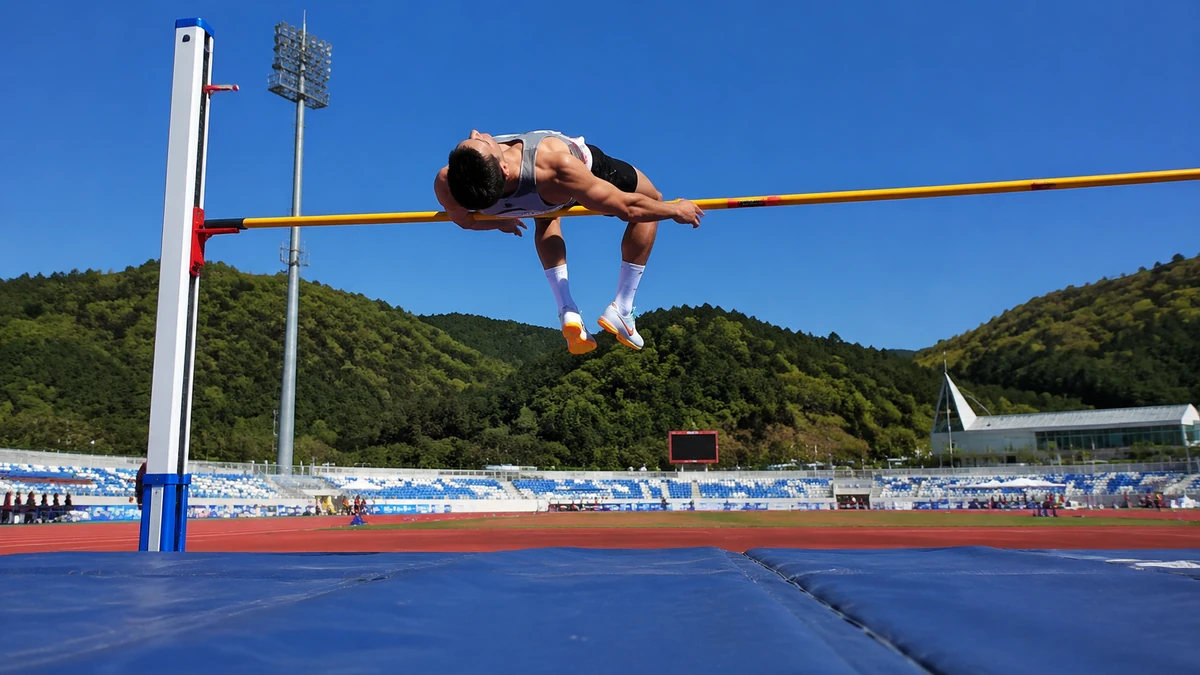
A steady jump in an unsteady season
For elite track and field athletes, spring is usually about rhythm. It is the stretch of the calendar when training gives way to competition, when the body adjusts to the feel of real stakes, and when coaches begin to learn whether winter plans will hold up under pressure. For South Korean high jumper Woo Sang-hyeok, that rhythm was supposed to take shape this month on the international circuit in Doha, Qatar. Instead, global events intervened.
Competitions Woo had targeted early in the outdoor season were disrupted by conflict in the region, erasing the kind of high-level meet experience that matters in a technical event like the high jump. Yet when Woo finally did step into competition on Sunday at South Korea’s national athletics championships in Jeongseon, he looked like an athlete who had not let a broken schedule become a broken season. He cleared 2.27 meters, or about 7 feet 5 1/4 inches, to win the men’s high jump and secure a place in qualification for the 2026 Asian Games in Aichi and Nagoya, Japan.
On paper, it was a domestic title. In practice, it was much more than that. The win gave Woo the first formal checkpoint he needed in pursuit of what would be a career-first Asian Games gold medal. It also reassured South Korean track fans that one of the country’s most dependable medal hopes remains on course even after an unexpectedly chaotic start to his outdoor campaign.
That kind of result can be easy to underestimate from afar. American readers are used to seeing Olympic and world championship stars tested on the Diamond League circuit or at U.S.-style Olympic trials, where every meet is loaded with names and television stakes. South Korea’s national championship does not necessarily carry that same international profile. But within the Korean sports system, these meets matter enormously. They are where athletes not only win titles but also claim national-team spots, validate training decisions, and prove they can deliver when there is no room for error.
Woo did exactly that. At a moment when his season could have felt stalled, he provided the clearest possible answer: keep the bar high, and clear it anyway.
Why this meet mattered beyond the medal stand
To understand why Woo’s victory drew so much attention in South Korea, it helps to understand his place in the country’s sports culture. South Korea is a nation with deep international sporting success, but much of that identity has historically centered on sports such as archery, short-track speedskating, taekwondo, baseball, soccer and golf. Track and field, especially in globally competitive terms, has often been a different story. Medals have been scarcer, and genuine world-class stars have been rare.
Woo changed that calculus. Over the past several years, he has emerged as one of the most recognizable figures in Korean athletics, not simply because of his results but because of the way he competes. He is expressive, emotional and visibly engaged with the crowd, a style that makes him especially easy to market and easy for fans to rally around. Think of the way some American fans gravitate toward athletes whose personalities are inseparable from their performances — someone who can turn a technical event into a show without undermining the seriousness of the competition. Woo occupies that kind of space in South Korea.
So when he entered the 80th Korean National Athletics Championships, the storyline was not just whether he would win another domestic event. It was whether he would confirm that he remains the country’s most bankable field-event star heading into the next major cycle. The 2026 Asian Games may still be ahead, but selection pathways begin long before the opening ceremony. Sunday’s competition represented the first official gate on that path.
In Korean sports coverage, there is often strong emphasis on the idea of a “first gateway” or “first hurdle” in a major campaign. That framing reflects both the structure of national-team selection and the high expectations placed on top athletes. A place on the team is not treated as automatic, even for stars. It is something to be earned repeatedly. Woo’s victory fit that pattern perfectly: he did not just preserve his status, he reaffirmed it.
That is why this result resonated. It was not dramatic in the upset sense. It was dramatic because it showed continuity. In sports, reliability is often less flashy than a breakout performance, but for medal contenders it may be even more important. South Korea did not need to learn whether Woo is capable of greatness; it needed evidence that, amid disrupted plans, he is still unmistakably himself.
How Woo managed a season thrown off course
The most intriguing part of Woo’s performance may be what happened before he ever reached Jeongseon. Earlier this month, he was expected to open his outdoor international season in Doha at the What Gravity Challenge, an event that would have offered an ideal early-season measuring stick. He also had been set for competition connected to the Doha Diamond League schedule. Instead, geopolitical instability in the region scrambled those plans.
For athletes in precision-based events, that kind of disruption is more than a scheduling inconvenience. The high jump is not only about vertical ability. It is about timing, approach, body control and confidence at specific heights under competition conditions. A canceled meet means lost chances to test runway rhythm, sharpen decision-making, and learn how the body responds when adrenaline rises. Coaches can simulate some of that in training, but not all of it.
Anyone who follows elite sports in the United States can recognize the challenge. It is a little like a top quarterback losing preseason reps, or an ace pitcher missing spring tune-up appearances. Practice still matters. Conditioning still matters. But there is a difference between being in shape and being game-ready. That distinction can be especially sharp in technical track and field events where tiny adjustments decide outcomes.
Woo’s answer was to lean on private training rather than panic over lost competition. According to the Korean account of his season, he used the interruption to manage his condition and arrived in Jeongseon prepared to produce the one thing the moment demanded: a result. That may sound simple, but it speaks to a maturity elite athletes spend years developing. When schedules shift unexpectedly, some performers chase competition too aggressively and lose form. Others become tentative and overthink. The best athletes preserve structure even when the calendar does not.
That is what made his win feel significant beyond the number on the bar. His performance suggested not only fitness but stability. In a year when outside factors already have altered part of his roadmap, that composure may prove as valuable as his jumping height.
The jump itself and what 2.27 meters says
Woo’s series in Jeongseon reflected control from the start. He cleared 2.15 meters on his first attempt, then went over 2.21 on his first try as well, quickly establishing the kind of clean progression coaches want to see from a favorite. In the high jump, misses are not just statistical blemishes. They can be clues. Early misses may suggest technical hesitation, uneven approach speed or trouble settling into the competition. Woo avoided that kind of noise.
The defining height came at 2.27 meters. By then, he had effectively secured the win, but the clearance still mattered because it pushed the performance beyond mere qualification and into a range that offers a credible reference point for international competition. He cleared 2.27 on his second attempt and celebrated on landing, a familiar image for anyone who has watched him compete at his best.
For American audiences, metric jumps can be hard to visualize instantly, but 2.27 meters is elite territory. It does not represent his lifetime best, nor does it guarantee future podium finishes, but it is the kind of mark that signals competitive readiness rather than simple domestic superiority. In other words, this was not just a star showing up and beating a local field on talent alone. It was a star producing a height that says the bigger goals remain realistic.
That distinction matters because track fans often look beyond placement to process. A high jumper who survives a mediocre field with a modest winning height may still leave questions unanswered. A jumper who handles lower bars efficiently and then clears a meaningful height under pressure leaves a different impression. Woo’s competition in Jeongseon fell into the latter category.
There is also something revealing in the fact that his best clearance came after a disrupted build-up. Outdoor-season debuts are often about rust removal. Athletes are reacquainting themselves with weather conditions, wind, competition pacing and a different visual environment from indoor arenas. To produce 2.27 in that context suggests his seasonal floor is still relatively high, which is exactly what a national program wants to see from a projected medal contender.
As much as the headline number matters, the pattern mattered just as much: few signs of wobble, clean execution at lower heights, and enough composure at the key moment to finish the job. That is the profile of an athlete still in command of his event.
The larger goal: an Asian Games gold that still eludes him
For all of Woo’s accomplishments, the Asian Games hold special significance. The event, often described as Asia’s equivalent to a continental Olympics, brings together the region’s top athletes in a multisport setting that can be both prestigious and emotionally charged. For Korean athletes, it also carries extra visibility because of the broader national attention such events command. The Asian Games are not merely another meet; they are one of the marquee stages on which athletes are expected to deliver for country as well as career.
Woo has become one of South Korea’s most accomplished track and field figures, but an Asian Games gold medal would still mark a new milestone. That is part of why Korean coverage framed this victory as the first checkpoint toward a bigger destination. It is not just about qualifying for a roster. It is about moving one step closer to a title that would strengthen his legacy at home.
Multisport games are tricky in ways that one-day or one-event meetings are not. Athletes must deal with village life, uneven schedules, layered media attention, national expectations and rounds of waiting that can disrupt routines. In jumping events, those variables can matter as much as raw ability. Woo’s value to South Korea lies partly in the belief that he can bring not only talent but competitive poise into that environment.
That helps explain why a May national-championship result can feel so consequential. The Asian Games are still ahead, but the path there is not abstract. It is built through performances like this one, in which a leading athlete shows he can absorb uncertainty, arrive when required and turn a pressured qualifying meet into something close to routine. The better Woo can make these stages look ordinary, the more dangerous he becomes when the stage gets bigger.
And there is a broader emotional dimension too. Fans do not simply want stars who post impressive numbers in scattered meets. They want athletes whose seasons feel legible, whose goals are visible and whose progress can be followed over time. By winning in Jeongseon and taking the first formal step toward Aichi-Nagoya, Woo gave Korean fans a storyline they can invest in from now until the Games begin.
The numbers behind the confidence
Woo’s result in Jeongseon did not emerge from nowhere. His 2026 season already included evidence that his form was building. In February, he opened his campaign at a World Athletics Indoor Tour Silver meet in Hustopece, clearing 2.25 meters and finishing fourth. Later that month, he cleared 2.30 meters at another indoor meet in Banska Bystrica and took bronze.
Those marks matter because they establish range. Athletes can occasionally produce one standout result that flatters a season, but sustained competitiveness across multiple meets tells a more dependable story. Woo’s indoor marks suggested that his upper-end ability remained intact well before the outdoor season began. Sunday’s 2.27-meter victory slots naturally into that progression.
Of course, any responsible analysis has to note the differences between indoor and outdoor conditions, and between domestic and international competition. Indoor venues eliminate wind and can create more controlled approach environments. Domestic meets may not provide the same competitive pressure as a Diamond League field. Numbers cannot always be transferred directly from one setting to another.
Still, trends matter. A season that includes 2.25, 2.30 and now 2.27 is not the profile of an athlete searching for answers. It is the profile of an athlete operating from a stable base, even if peak form is still to come. That kind of consistency is why South Korean observers interpreted his national-title performance as a sign of trustworthiness rather than just success.
For fans accustomed to following world-level track, the takeaway is straightforward: Woo is not simply surviving the season’s early complications. He is preserving enough competitive shape to remain relevant in the bigger conversations to come. In a sport where confidence often rides on repeatable execution, that is a meaningful place to be in May.
A bigger moment for South Korean track and field
Woo’s victory also comes at a moment when South Korean athletics appears to have multiple points of intrigue, not just one. At the same national championships, attention also focused on sprinters Burewesa Daniel Gasama and Namadi Joel Jin, two athletes seen as major hopes for the country’s men’s sprint program. Their recent times have fueled conversation about whether South Korea can become more competitive across events, from the track to the field.
That matters because sports ecosystems change when success stops feeling isolated. For years, Woo’s rise has stood out partly because Korean athletics had so few stars with realistic international medal potential. Now, there are signs — at least signs, if not guarantees — that the country may be nurturing broader ambition. When a program starts imagining records, finals appearances and medals in multiple disciplines, expectations shift.
American readers have seen this dynamic in other sports and countries. One breakthrough athlete can capture public attention. Several contenders arriving around the same time can begin to change a sport’s place in the culture. South Korea may not be at the point of a full-scale track renaissance, but the current mood around athletics is notably more energetic than it has been in many previous cycles.
In that environment, Woo’s role becomes even more important. He is not just a medal hope; he is the standard-bearer. His job is not only to win but to make winning in athletics feel imaginable for those around him. That is part of what this weekend represented. While other Korean athletes push toward national records and Asian Games consideration in sprinting, the country’s most proven field star delivered the result he was supposed to deliver.
There is value in that kind of predictability. Sports programs need trailblazers, but they also need anchors. Woo remains both. He is the athlete younger competitors can point to as evidence that Korean track and field success is possible, and he is still producing enough to keep the larger project credible.
Why this result travels beyond South Korea
The appeal of this story is not limited to Korean sports fans. At its core, this is a familiar and universally compelling sports narrative: an elite athlete loses key opportunities because of events outside his control, adjusts without public drama and then responds with exactly the performance required. The details are Korean. The drama is global.
That is one reason Woo continues to resonate beyond his home country. His style is visually engaging, his event is easy to understand, and his storyline connects to something sports audiences everywhere appreciate — the idea that the best competitors do not always control circumstances, but they do control preparation. On Sunday in Jeongseon, that preparation was visible.
No one should overstate a single domestic result in May. The road to the 2026 Asian Games is still long. International competition will harden, seasonal peaks will need to be timed correctly, and the event itself will present its own pressures. But if the question was whether Woo Sang-hyeok remains firmly on track after an unstable start to the outdoor season, Jeongseon offered a convincing answer.
He cleared 2.27 meters. He won the title. He secured the first gateway on the path to the Asian Games. And in doing so, he reminded South Korea — and anyone paying attention abroad — that high-level sport is often less about avoiding disruption than about refusing to let disruption define you.


0 Comments