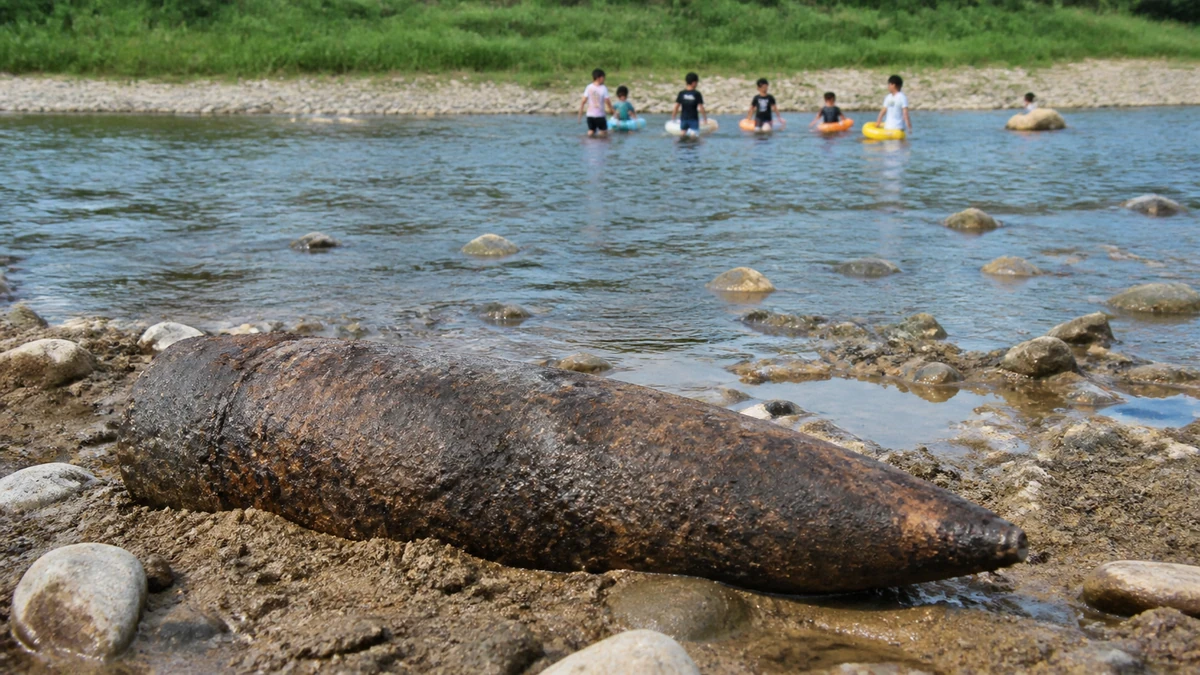
Unexpected Discovery Along a Tranquil Korean Stream
On May 5th, a routine afternoon at SaChangcheon, a modest river in Daegu's Gunwi County, took a tense turn when children playing by the water spotted an unusual object. The initial report came in at 2:35 p.m., describing a suspicious item located roughly 50 meters downstream from Masagyo Bridge. While the scene was initially a place of leisure, it quickly became a focal point for public safety authorities.
In Korea, rivers like SaChangcheon are often informal gathering spots where families relax during warm weather. What might appear to outsiders as a harmless recreational scene, however, became a moment that underscored the unpredictable ways in which everyday environments can harbor hidden hazards.
Children as First Responders in Safety Awareness
Remarkably, the first eyes on the object were those of children. Their curiosity and attention to the unfamiliar item transformed a typical playtime into a crucial public safety alert. In societies around the world, it is often adults who are assumed to notice and respond to danger. Yet here, it was the youngest members of the community who catalyzed the safety response, highlighting how awareness can arise in unexpected ways.
This scenario also points to the challenges of safety management in natural public spaces. Unlike urban centers or controlled indoor environments, riversides receive less systematic surveillance, making them more prone to unrecognized hazards. A small, inconspicuous object can pose significant risks, especially in areas where citizens freely interact with the environment.
Swift Mobilization of Explosive Ordnance Disposal Teams
Following the initial report, South Korean military Explosive Ordnance Disposal (EOD) teams were dispatched to assess the potential threat. The rapid activation of a specialized response unit illustrates the structured approach to public safety in Korea: initial civilian observation triggers a coordinated professional evaluation.
From an American perspective, EOD teams function similarly to bomb squads or specialized military units that are trained to handle explosive threats safely. The immediate involvement of these teams prevented any civilian from interacting with the object, demonstrating the critical interface between public vigilance and institutional expertise.
Identification: A Soviet 76mm High-Explosive Shell
Upon inspection, the object was confirmed to be a Soviet-era 76mm high-explosive shell. While initially reported as a generic suspicious item, the discovery was formally classified as a military-grade explosive. Such ordnance is not uncommon in Korea, particularly in the northern and central regions, due to remnants from past military activity and regional conflicts.
The term "76mm high-explosive shell" conveys more than technical detail; it signals the real, tangible danger that existed alongside ordinary play. The confirmation of the shell's identity highlights the importance of verification: while anyone might mistake a rusty metal object for trash, trained professionals can ascertain its true risk, underscoring the role of specialized knowledge in hazard mitigation.
Lessons in Public Safety and Civic Responsibility
This incident illuminates broader themes in civic life and public safety. First, ordinary citizens play a pivotal role by recognizing and reporting anomalies rather than attempting to handle them independently. Second, the effectiveness of emergency response systems hinges on rapid verification and controlled intervention, preventing potential escalation into a larger incident.
For international readers, the situation may resemble cases in the U.S. where unexploded ordnance from World War II is occasionally discovered in coastal or rural areas. The pattern is familiar: unexpected finds in everyday settings demand careful management to protect public well-being, balancing curiosity with caution.
Reflecting on Risk in Everyday Spaces
Ultimately, the SaChangcheon discovery serves as a reminder that public safety is not confined to dramatic accidents but is also maintained in the small, often overlooked moments of daily life. The combination of alert citizens and professional response teams created a controlled resolution: the children were unharmed, and the hazardous shell was secured without incident.
This event emphasizes that risk can manifest in ordinary settings, and maintaining a functioning safety system depends equally on public vigilance and trained intervention. It also showcases how a community’s routine environment—riverside play areas, in this case—can rapidly become the scene of a safety operation, demonstrating the seamless interplay between civilian awareness and institutional readiness.
Comments
Post a Comment