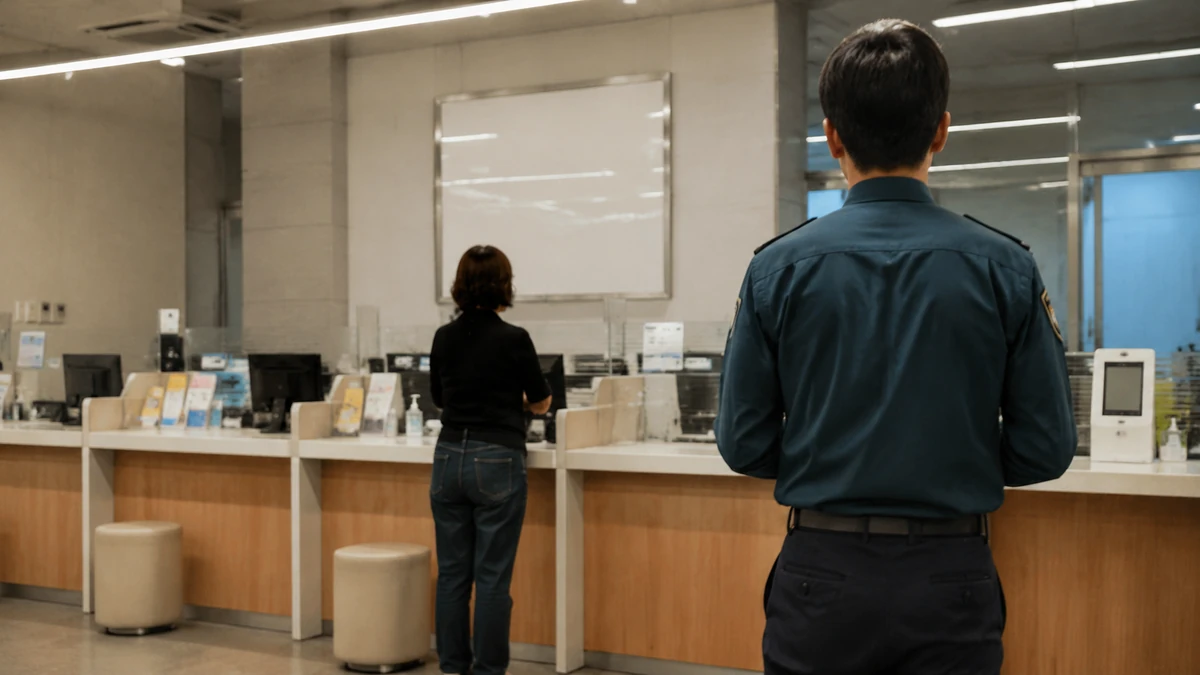
A routine wall display turned into a test of public trust
What might sound, at first glance, like a minor housekeeping lapse inside a provincial police office in South Korea has turned into something much larger: a question about bureaucratic discipline, political symbolism and the public’s trust in state institutions. According to Yonhap News Agency, South Korea’s National Police Agency has opened an internal inspection into why a poster in the public service office of the North Chungcheong Provincial Police Agency was not replaced on time after a change in government messaging.
The focus is not on the content of a criminal investigation or a major corruption scandal. Instead, it is on a poster listing the prior administration’s national policy goals that remained in a public-facing office longer than it should have. On the surface, that may sound trivial to American readers used to seeing outdated flyers linger in city hall hallways or old campaign stickers survive on a filing cabinet. But in South Korea, where visual symbols in government spaces can carry heavy political and institutional meaning, the delay has prompted scrutiny from police headquarters and fresh debate over how state agencies project neutrality and competence.
On the 14th, the National Police Agency sent two inspection officials to North Chungcheong to examine the circumstances surrounding the delayed replacement. The inspection reportedly centers on the police administration division and the civil affairs office, known in Korea as the minwon office, where ordinary residents go for reports, consultations, document requests and other face-to-face interactions with government. In practical terms, it is one of the most visible front desks of the state.
That is why this case has drawn attention beyond a simple facilities-management issue. A poster on a wall, especially in a public service area, is not just decoration. It signals which administration is in office, whether a public institution is keeping pace with official directives and whether internal controls are functioning as they should. In a country where public agencies are expected to move quickly and uniformly once central guidance is issued, a delay can be read not just as sloppiness but as a sign of a larger administrative gap.
For American audiences, the closest comparison may be a federal office in a politically charged moment continuing to display outdated executive messaging after a transition in Washington. Even if the lapse were clerical, people would still ask what it says about management, chain of command and whether public officials are being appropriately careful in shared civic spaces. That is essentially the question now facing police authorities in South Korea.
What happened, and why the timeline matters
The chronology is unusually clear, and it helps explain why the matter is now under inspection. According to the Korean news summary, attorney Kim So-yeon visited the North Chungcheong Provincial Police Agency’s public service office on April 27 and saw a poster displaying the policy goals of the Yoon Suk Yeol administration still hanging on the wall. That means the previous government’s poster was visible to the public at least through that date.
The police agency’s public service office then removed that poster on the 30th of the following month. A new poster displaying the policy goals of the Lee Jae-myung administration was installed on the 8th. Separately, the National Police Agency reportedly instructed police agencies across the country on the 6th to check whether their posters had been replaced with the new version. By the 14th, two inspection staff members had been dispatched to North Chungcheong.
That sequence is important because it suggests a mismatch between events on the ground and oversight from the center. The older poster remained visible in a public-facing space past the point when many would have expected it to be taken down. It was then removed before the new one was posted, creating a gap period. Meanwhile, national police officials were issuing instructions to regional agencies to confirm whether the switch had been completed. The inspection now appears aimed at figuring out not simply whether a replacement happened, but why it was delayed, how the lapse was handled internally and whether reporting or supervision broke down along the way.
In bureaucratic systems, dates tell their own story. They reveal whether frontline staff were waiting for materials, whether midlevel managers followed up, whether written guidance was clear and whether national leadership had to step in after the fact. Those questions matter in almost any government. In South Korea, where highly centralized administrative coordination is often expected, they matter even more.
The case also underscores how public administration is often judged not by grand reform plans but by small visible details. A resident walking into a police office is unlikely to know the fine points of interagency procedure. But that resident will notice what is on the wall. If the wall appears out of step with the current administration, the institution can look inattentive at best and politically tone-deaf at worst.
Why a public service office carries special weight in Korea
To understand why this has become a social and political story, it helps to understand the role of the minwon office in Korea. The term does not have a perfect American equivalent, but it generally refers to a public service or civil affairs counter where citizens handle routine but important interactions with the state: filing complaints, seeking assistance, requesting certificates, asking procedural questions or reporting problems. In many Korean public institutions, this is the most direct point of contact between ordinary people and government authority.
That matters because the issue here did not arise in a back office, a staff break room or an internal corridor. It arose in a room designed for the public. The summary provided by the Korean article emphasizes that this is one of the places where citizens encounter the state most directly. In a country with a highly digitized bureaucracy but still significant in-person administrative traffic, the public service office functions as a kind of civic storefront. What appears there can shape how people feel about the institution itself.
For Americans, think of the symbolism attached to the public-facing areas of a courthouse, DMV office, city clerk’s counter or local police headquarters lobby. These spaces are not politically neutral in the sense of being empty; they are filled with seals, signage, portraits, notices and mission statements. Those details help communicate order, legitimacy and continuity. If one of those symbols appears outdated, especially during a sensitive transition, people may start to wonder whether that mismatch is simply neglect or part of a deeper institutional problem.
In South Korea, this sensitivity is heightened by the speed with which public institutions are expected to reflect changes in administration. National goals, slogans and official posters are not mere branding exercises. They are seen as visible manifestations of the state’s current direction. When a new administration comes in, public offices are generally expected to update materials accordingly. Failure to do so can be interpreted not as passive delay but as a lapse in official discipline.
That does not mean every delay is political. In fact, the summary is careful not to go beyond the confirmed facts. There is no definitive public evidence, based on the summary alone, that the poster remained because of ideological resistance or deliberate obstruction. It may have been simple administrative delay. But that is precisely why the inspection matters: it exists to determine whether the cause was ordinary oversight, a reporting failure or something more significant in organizational terms.
How one visitor’s photo helped make the issue public
The controversy appears to have gained traction not through a leaked memo or a formal whistleblower complaint, but through something more common in contemporary civic life: a visitor saw something, took note of it and shared it publicly. According to the summary, attorney Kim So-yeon posted a photo of the poster on social media after seeing it in the public service office, along with an emotional reaction to the image.
That detail matters because it illustrates how government accountability now often unfolds in plain sight. In earlier eras, a poster in a regional government office might have remained a local curiosity unless an inspector happened to visit. Today, nearly every public-facing space exists under a form of ambient observation. Visitors carry smartphones. Photos circulate instantly. A seemingly minor detail can become a public issue within hours if it touches on politics, state symbolism or public trust.
This is not unique to South Korea. Americans have seen similar dynamics when a classroom display, a courthouse plaque or a local government social media post suddenly becomes a flashpoint. What once might have been dismissed as a small oversight can now trigger national conversation because the public record is created in real time by the people passing through a space. The difference in this case is that the symbol at issue was tied directly to the identity of a national administration and was displayed in a law enforcement setting.
There is also a deeper lesson for public institutions. The line between internal order and external reputation has grown thinner. A wall display intended as a routine administrative marker can quickly become evidence in a broader conversation about competence, neutrality and responsiveness. That is particularly true in South Korea, where public discourse can move rapidly and institutional symbolism is often closely watched.
The inspection of the North Chungcheong police office therefore serves two functions at once. On the narrow level, it seeks to determine why a poster switch was delayed. On the broader level, it signals that national police leadership understands the reputational stakes of the incident. The message is that even a modest lapse in a public service area can reflect on the credibility of the institution as a whole.
What the case says about neutrality and discipline inside public institutions
Police agencies occupy a particularly sensitive place in any democracy. They are not just another branch office processing paperwork. They are the face of state authority, entrusted with law enforcement and expected to serve the public without partisan favoritism. That is why a delay in replacing an official government poster in a police building can resonate beyond the specifics of the poster itself.
The Korean summary frames the issue as one involving public neutrality and institutional discipline. That framing is important. The concern is not merely whether a wall was updated on time. It is whether the agency maintained the kind of administrative precision that the public expects from a police organization. If an institution charged with enforcing rules appears casual about its own basic procedures, even in a symbolic matter, that can weaken confidence.
In the American context, debates over the political neutrality of law enforcement have long been intense. From sheriffs making overt partisan endorsements to disputes over messaging in federal agencies, the broader principle is familiar: the public wants assurance that institutions exercising coercive power are operating according to rules, not political preference. South Korea has its own version of that expectation, shaped by its history of strong central government, rapid political change and close scrutiny of public agencies.
The summary also notes that the issue should be read less as an election or party conflict than as a social affairs story centered on what a state institution displayed in a place where citizens come and go. That distinction matters. This is not, at least on the available facts, a dispute over campaign activity or partisan messaging in the usual sense. It is about whether a public office accurately reflected the current state of official administration.
That may sound like a modest standard, but modest standards are often the foundation of institutional trust. The public usually does not judge agencies only by dramatic crises. It also judges them by whether they get the basics right: paperwork, signage, access, timeliness and adherence to procedure. In that sense, the inspection is a reminder that bureaucratic credibility is built through a thousand small acts of maintenance, not just through major policy pronouncements.
A window into South Korea’s centralized administrative culture
This episode also offers a revealing glimpse into how administration works in South Korea. The Korean state, while democratic and often intensely contested politically, still operates through a system that places substantial emphasis on centralized guidance and uniform execution. When a national agency directs regional offices to check whether official materials have been updated, there is an expectation that the instruction will be carried out promptly and consistently.
The report that the National Police Agency told police bodies nationwide on the 6th to verify whether the new policy-goals poster had been posted is a key detail. It shows that the matter was not confined to one office. Rather, police headquarters was concerned enough to ask agencies across the country to review their compliance. North Chungcheong drew attention because its handling of the transition became a specific case for inspection.
For American readers, this may be somewhat different from the looser administrative culture often seen across the United States, where local offices may have considerable variation in how quickly they update displays or public messaging after a change in federal leadership. In South Korea, the expectation of a more synchronized national rollout can be stronger, especially in agencies with a clear chain of command like the police.
That makes delays more conspicuous. A local lag is not just a local lag; it becomes evidence of slippage between the center and the field. In bureaucratic terms, the poster becomes a diagnostic tool. It raises questions such as: Did the relevant office receive guidance in time? Was there a delay in distribution of materials? Did managers fail to check? Was anyone responsible for confirming completion? Was the matter treated as too minor to prioritize until it became public?
Those are the kinds of procedural questions inspections are designed to answer. And although they may sound mundane, they can carry real consequences inside a hierarchical organization. Even if no intentional wrongdoing is found, an inspection can still expose weaknesses in internal controls, communication or responsibility lines that leadership may want to tighten.
Why symbolic administration can become a major news story
To outsiders, especially those not steeped in Korean politics, it may seem surprising that the delayed replacement of a poster would warrant national attention. But symbolic administration often matters precisely because it is so visible, so basic and so easy for the public to understand. It is one thing to parse a complicated budget dispute or a technical policy memo. It is another to see an old government poster still hanging on the wall of a police office visited by residents every day.
South Korea’s modern political culture has long placed weight on signals, protocol and visible alignment between institutions and the current order of government. That does not mean every symbol is ideological. It means symbols are treated as part of governance. A poster listing national priorities is administrative material, but it is also a representation of the state’s present identity. When it remains in place after that identity has shifted, it can invite interpretations that reach beyond office management.
There is also a reason this story sits naturally in the social affairs category rather than purely political coverage. It speaks to daily citizenship. The ordinary citizen encountering the state is not reading abstract policy treatises. That citizen is walking into a room, looking at a counter, taking a number and scanning the wall. If what the citizen sees appears outdated, the resulting impression is immediate and concrete.
In that sense, this case belongs to a broader global pattern. Trust in public institutions often depends on small experiences: whether the office seems orderly, whether information is current, whether staff appear in control and whether the physical environment signals professionalism. These details are mundane until they fail. When they do, they become stories not because they are dramatic on their own, but because they reveal the texture of governance in everyday life.
The outcome of the inspection has not been established in the material provided. It remains unclear whether investigators will conclude that the delay was merely an administrative oversight, a failure in internal reporting or a sign of broader management weakness. But even before a formal conclusion, the incident has already made one point clear: in South Korea, as in many democracies, the credibility of public institutions can hinge on the smallest visible markers of whether they are current, attentive and accountable.
What comes next
For now, the confirmed facts remain limited but significant. The old Yoon administration poster was still visible in the North Chungcheong police public service office as of at least April 27. It was removed on the 30th of the following month. A new poster for the Lee administration was posted on the 8th. On the 14th, two National Police Agency inspection officials were sent to examine what happened, focusing on the police administration unit and the public service office.
Any stronger conclusion would go beyond the facts currently available. There is not enough in the summary to say the delay reflected intentional political signaling or institutional defiance. At the same time, there is enough to say that police headquarters considered the lapse serious enough to warrant direct inspection. That alone tells us something about the standards public agencies are expected to meet and the sensitivity surrounding symbolic materials in citizen-facing spaces.
In the United States, bureaucratic symbolism can sometimes be dismissed as superficial compared with policy outcomes. But symbols and procedures are often the first way the public encounters the state, and they shape confidence in whether larger promises can be trusted. South Korea’s poster controversy, small as it may seem, is a vivid example of that principle at work.
Ultimately, this is a story about more than one poster in one room. It is about how governments maintain legitimacy in the details, how public institutions are judged in the spaces where citizens actually meet them and how, in an age of instant visibility, even routine administrative upkeep can become a measure of whether the state is doing its job. In that respect, the wall of a police service office in central South Korea has become a surprisingly clear mirror of a larger democratic truth: competence is often most visible in the little things.
Comments
Post a Comment