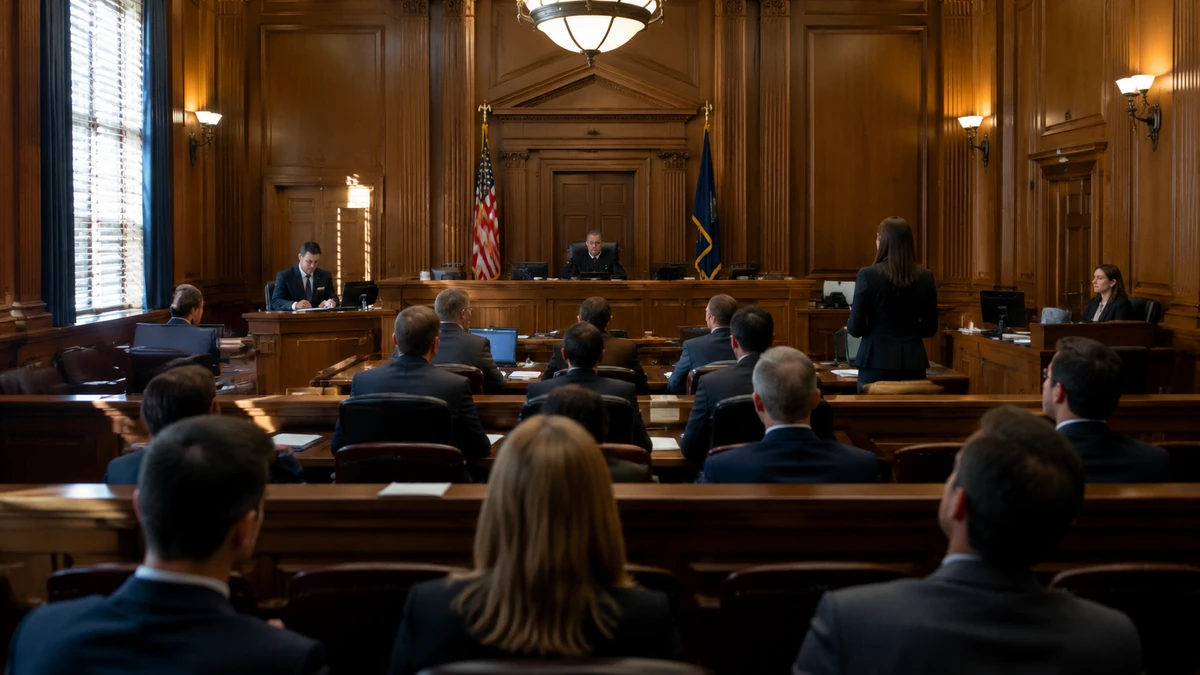
A K-pop hit faces an American legal test
For years, K-pop’s rise in the United States has mostly been told as a story of cultural breakthrough: sold-out arena shows, Billboard chart runs, brand deals, festival appearances and the steady normalization of Korean pop acts in the American mainstream. But the globalization of K-pop does not just bring bigger audiences and larger paychecks. It also brings legal scrutiny, competing claims over creative ownership and disputes that play out under U.S. law rather than in the court of online opinion.
That is why a newly reported copyright lawsuit involving NewJeans has drawn such close attention in South Korea’s entertainment industry. According to Korean media reports citing Billboard and Yonhap News Agency, the girl group and related parties are facing a copyright infringement case in the United States over the song “How Sweet,” released in May 2024. Four songwriters, including Audrey Amacost, allege that the track copied elements of a demo song titled “One of a Kind.”
At the center of the dispute is not simply a vague claim that two songs share a similar mood, tempo or style. The plaintiffs argue more specifically that similarities appear in the first-verse melody and structure of the released song, even though a topline they had previously proposed was not adopted. In pop-music terms, a topline typically refers to the vocal melody and lyrical phrasing laid over an instrumental track — often the part listeners remember first and the part most closely associated with a song’s identity.
That distinction matters. Copyright fights in music can easily get lost in fuzzy language about “vibes” or aesthetic resemblance. This case, at least as described so far, appears to be aimed at concrete musical features that are more likely to matter in court: melody, arrangement of sections and the relationship between an earlier demo submission and the final commercial release.
For American readers, the broader significance is straightforward. This is not just another internet argument among fan bases, and it is not only a Korean entertainment story. It is a test of what happens when one of K-pop’s most internationally visible acts becomes subject to the same kinds of authorship disputes that have long shaped the U.S. music business, from pop and hip-hop to country and R&B.
What the lawsuit appears to claim
Based on the Korean summary of the case, the plaintiffs are not asking only for public recognition or a correction of the record. They are seeking royalty allocation — in other words, a share of the economic proceeds tied to the song. That makes this a dispute about money, credit and ownership, not just reputation.
In the modern music industry, those issues are inseparable. Songwriting credits determine who gets paid when a song is streamed, licensed, performed or otherwise monetized. They also affect professional standing. A credit on a major K-pop release can help open doors to future work across labels, publishing companies and international markets. Conversely, being left off a song one believes drew from one’s work can become a serious commercial grievance.
The structure of the allegation is also notable. The songwriters reportedly say they had submitted musical ideas to NewJeans’ side, including a topline, but that those ideas were not formally accepted. Their claim is that despite that rejection, the later-released track still bears meaningful similarities to their demo. That introduces one of the thorniest questions in music copyright law: when does exposure to a prior work, followed by overlap in a finished song, cross the line from coincidence or genre convention into unlawful copying?
American courts have seen many variations of this problem. In some cases, artists are accused of borrowing from songs they almost certainly heard. In others, the defense argues that the similarities involve standard building blocks of pop music rather than protectable expression. Because Western pop, hip-hop, R&B and K-pop all draw from a relatively finite set of chord progressions, melodic contours and rhythmic patterns, lawyers often end up debating not whether two songs feel alike in the abstract, but whether the allegedly copied elements are sufficiently original and sufficiently similar to merit legal protection.
That is one reason this case is getting attention. The plaintiffs appear to be framing their complaint in a way that tries to move beyond broad impressions. They are reportedly pointing to a specific section — the first verse — and to specific musical components — melody and structure. Whether that argument will succeed is another matter entirely, but the legal posture itself is more precise than a routine plagiarism accusation on social media.
How NewJeans’ label is responding
NewJeans’ agency, ADOR, has pushed back clearly. According to the Korean summary, ADOR said it had confirmed with producer BANA, who handled composition and production of the song, that there was no plagiarism. The company said it and the group’s members would respond to the lawsuit in line with that position.
That response is important for several reasons. First, it is a direct denial rather than a carefully vague corporate statement. In entertainment disputes, agencies sometimes avoid strong language in the early stages, preferring to say they are “reviewing the facts” or “monitoring the situation.” Here, the reported position is much firmer: the creators involved deny copying occurred.
Second, the response places the actual creative process at the center of the defense. By highlighting the producer and composer’s view, ADOR appears to be signaling that its argument will rest not just on legal technicalities but on the integrity of how the song was made. In copyright cases, that can matter a great deal. Documentation of drafts, production files, communications, timestamps and iterative revisions can become crucial evidence in showing independent creation.
Third, ADOR’s statement that it will respond alongside the members underscores how deeply these disputes can affect an idol group’s public identity, even when the members themselves are not the people composing every note in the studio. In K-pop, artists are brands as much as performers. Their names sit atop a tightly coordinated business involving labels, producers, choreographers, stylists, publishers, marketers and global distribution partners. A legal challenge to a song can therefore ripple outward, shaping public trust in the act, the agency and the broader production system that supports them.
For American audiences less familiar with that system, it helps to understand that K-pop is often far more collaborative and industrialized than the singer-songwriter model many U.S. listeners instinctively imagine. Songs may pass through camps of international writers, multiple rounds of revision and several layers of executive approval before release. That does not make K-pop uniquely vulnerable to copyright problems; if anything, it resembles how large-scale pop music is frequently made everywhere. But it does mean that disputes can become complicated quickly, especially when demos circulate among numerous intermediaries across countries and companies.
Why this matters more because it is NewJeans
If this were a lesser-known act, the lawsuit would still be meaningful within industry circles. Because it involves NewJeans, it becomes a much larger story. The group has been one of the defining names of the current K-pop era, praised for a sound and image that helped reset the tone of the genre’s girl-group market. Their songs have traveled widely outside the traditional K-pop fandom ecosystem, reaching casual listeners who might not follow Korean entertainment closely but recognize the group’s name through streaming playlists, fashion campaigns or social-media clips.
That visibility changes the stakes. When a globally recognized act faces a copyright suit in the United States, the case becomes a window into how far K-pop has integrated into the global music economy. In effect, the same system that now gives K-pop unprecedented access to U.S. listeners, American festival crowds and international licensing revenue also places Korean acts under the same microscope that American pop stars have long faced.
There is also a symbolic dimension. In South Korea, NewJeans is not simply another successful group. The act has often stood as shorthand for K-pop’s current global sophistication — an industry capable of producing music that feels both specifically Korean and fully embedded in transnational pop trends. A U.S. copyright dispute involving such a group therefore resonates as more than one song’s headache. It raises questions about process, transparency and standards in an industry that increasingly wants to compete not just in Asia, but everywhere.
That is why the case is being read in Korea as a story about the state of K-pop itself. The industry’s expansion has internationalized not only its earnings, touring and fan communities, but also its liabilities. Success abroad brings exposure abroad. The bigger the market, the more formalized the disputes.
Understanding the topline issue
Among the most important terms in the reporting is “topline,” a phrase common in music production but not always familiar to the general public. A topline is usually the main vocal melody sung over an existing instrumental or track. In some songwriting workflows, one person or team builds the beat, chords and arrangement, while another writer develops the melody and lyrics that listeners end up singing back in the car or at a concert.
That makes the topline especially sensitive. In practical terms, it is often the song’s most recognizable feature. People may not remember every production choice in a mix, but they remember the melodic hook. So when a lawsuit focuses on melody — especially in a specific section of a song — it cuts close to what many listeners intuitively understand as a song’s core identity.
The plaintiffs reportedly argue that although their proposed topline was not adopted outright, the released work still reflects similarities to their demo in the first verse and structural design. The defense says there was no plagiarism. That clash gets at a longstanding tension in pop music: how to distinguish genuine creative overlap from unlawful appropriation when everyone works within shared conventions.
This is not a new puzzle in American culture. Music fans in the United States have seen headline-grabbing lawsuits involving claims over melodic resemblance, rhythmic feel and songwriting lineage. The legal outcomes have varied, and the debates often leave musicians uneasy, especially when courts appear to police not just literal copying but broader stylistic echoes. For that reason, cases like this can reverberate far beyond the parties involved. Industry professionals watch them closely because they help define where the boundary lines are.
It is also worth resisting the temptation to oversimplify. Not every similarity is theft. Pop songs are built from limited raw materials, and parallel ideas can emerge independently. On the other hand, not every alleged resemblance should be dismissed as coincidence, especially when there is a documented chain of access to earlier material. The key question is usually not whether listeners can hear some overlap, but whether the overlap concerns protectable original expression and whether the evidence supports copying rather than independent creation.
K-pop’s global growth has global consequences
One of the most revealing aspects of the NewJeans case is what it says about the business model behind contemporary K-pop. The genre is no longer a regional export that occasionally breaks through overseas. It is now woven into the machinery of the global music business: U.S. distribution, multinational publishing, brand partnerships, world tours, social-video marketing and songwriting pipelines that stretch from Seoul to Los Angeles, Stockholm and London.
That global infrastructure creates enormous opportunity. It also creates more points of friction. Demos are pitched across borders. Producers work remotely. Publishing splits can become complicated. Creative teams may include people with different legal assumptions and contractual expectations. And once a song becomes a hit, the financial incentive to revisit old sessions and disputed contributions rises sharply.
For American readers, there is an easy analogy in Hollywood. As film and television production became more global, disputes over backend points, writing credits, remake rights and intellectual property also became more international and more complex. K-pop is experiencing something similar on the music side. The cultural export boom brings with it a need for rigorous rights management, careful documentation and strong internal controls over who contributed what and when.
That is partly why this lawsuit is being treated in Korea as more than a celebrity controversy. It is also an industry governance story. However the case ends, it highlights the need for clear procedures around demo submissions, topline proposals, revision tracking and royalty negotiations. Those may sound like dry back-office matters compared with flashy comeback promotions and viral dance challenges, but they are increasingly central to how global pop operates.
In that sense, the lawsuit serves as a reminder that the K-pop phenomenon is not just powered by fan enthusiasm and polished performance. It also rests on contracts, credits, rights clearance and a legal framework capable of surviving scrutiny in major overseas markets.
What comes next — and what not to assume
At this stage, what is established is relatively narrow: a lawsuit has been filed in the United States, the plaintiffs say “How Sweet” copied from “One of a Kind,” and ADOR, relying on producer BANA’s account, says there was no plagiarism. That is enough to make the case significant. It is not enough to predetermine the outcome.
Readers should be cautious about treating a filed complaint as proof, just as they should be cautious about assuming that a forceful denial settles the matter. Copyright disputes often turn on technical musical analysis, documentary evidence and legal standards that are not obvious from public summaries alone. Expert testimony can matter. So can internal production records. So can the exact way claims are framed under U.S. law.
Still, even before a ruling, the case may carry real consequences. For NewJeans and ADOR, there is the burden of defending creative legitimacy in a global spotlight. For the plaintiffs, there is the challenge of proving that similarity amounts to infringement rather than mere resemblance. For the wider K-pop field, there is the reputational pressure that comes whenever a flagship act becomes the face of a broader structural issue.
And for observers outside Korea, the case is a useful lens on what K-pop has become. It is now large enough, valuable enough and deeply enough integrated into the American music economy that its disputes no longer stay confined to fan forums or domestic headlines. They can land in U.S. legal venues, involve royalty claims with real financial stakes and shape how international partners think about collaboration with Korean labels.
That may be the most important takeaway. The story here is not simply that NewJeans is facing a lawsuit over one song. It is that K-pop’s biggest stars are now operating in a world where international success and international accountability arrive together. The same globalization that turns Korean artists into household names abroad also demands that the industry meet the procedural, legal and ethical expectations of the markets it hopes to dominate.
For years, K-pop’s American narrative centered on visibility: Could these artists break through? Could they sell records, fill venues and move beyond niche fandom? Those questions have largely been answered. The next phase is about durability. Can the industry scale its rights management, creative oversight and legal infrastructure at the same pace as its cultural influence? The NewJeans lawsuit, whatever its final result, suggests that this may now be one of the defining questions facing Korean pop music on the world stage.
Comments
Post a Comment