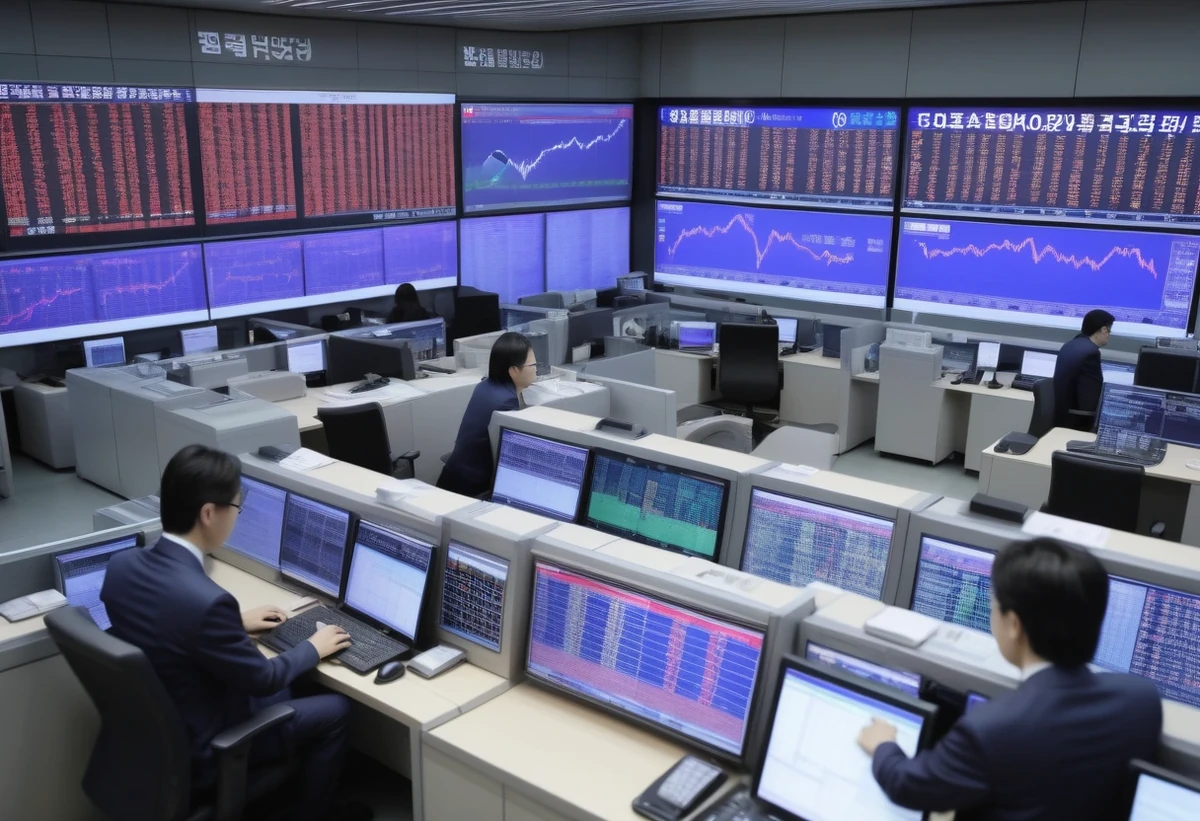
A revealing week for one of Asia’s most closely watched economies
South Korea is about to get one of those dense, number-heavy weeks that economists love and ordinary readers often skip past. But this time, the coming batch of data deserves wider attention. Over the next several days, officials are set to release a series of indicators that, taken together, will offer one of the clearest snapshots yet of where the country’s economy stands: household debt at the end of the first quarter, April producer prices, May consumer sentiment, and regional data on production, employment and inflation.
On paper, these are routine statistical releases. In practice, they function more like a stress test for the broader economy. South Korea, the world’s 13th-largest economy and a crucial node in global supply chains, sits at the intersection of several pressures familiar to Americans: elevated household borrowing, stubborn questions about housing affordability, anxiety over inflation and uncertainty about whether consumers still feel confident enough to spend.
That mix sounds recognizable because it is. In the United States, investors parse reports on consumer prices, retail sales and mortgage trends for clues about the economy’s trajectory and what the Federal Reserve might do next. South Korea’s version of that ritual is coming all at once. And because the country’s economy depends heavily on both exports and domestic consumption, the significance of these numbers goes beyond Seoul’s financial district.
The key question is not simply whether any single figure rises or falls. It is whether the data, viewed together, tell a coherent story. Are households still leaning on credit despite government efforts to rein in property-related lending? Are price pressures at the producer level easing before they hit shoppers more directly? Do consumers feel resilient, or are they becoming more cautious as debt burdens and living costs weigh on them? The answers matter not only for South Korean policymakers, but also for foreign investors, multinational companies and anyone trying to read the direction of Asia’s fourth-largest economy.
That is why this week’s releases are drawing attention. They may not have the drama of a central bank shock or a corporate megadeal. But they could reveal something more useful: whether South Korea is stabilizing, straining or simply stuck in a complicated middle ground.
Why household debt remains the number to watch
If one number is likely to command the most attention, it is household debt. That is because in South Korea, as in the United States, household borrowing is about far more than personal finance. It is a window into housing demand, consumer spending power, bank stability and the effectiveness of government policy.
At the end of last year, South Korea’s household credit balance stood at roughly 1,978.8 trillion won, just shy of the psychologically significant 2,000 trillion won mark. Converted loosely into U.S. terms, that is a massive debt load for an economy of South Korea’s size. The figure itself is striking, but what matters even more is what it represents: a long buildup of borrowing tied in large part to real estate, a high-cost urban housing market and a financial system that has made credit broadly accessible.
For American readers, the closest parallel may be the way U.S. housing data can influence everything from Wall Street sentiment to Main Street confidence. In South Korea, however, the relationship between debt and property can be even more intense. Home ownership carries enormous economic and social weight, especially in the Seoul metropolitan area, where apartments are both places to live and key stores of wealth. As a result, mortgage borrowing has an outsized influence on how people feel about their financial future.
The government has been enforcing tough rules on property-related lending, attempting to cool speculation and prevent financial imbalances from worsening. That makes the upcoming debt release especially important. If household borrowing has slowed meaningfully, officials may claim that tighter regulations are working. If borrowing remains resilient, markets may conclude that demand for credit is still strong despite official restraints, or that borrowing pressure is finding alternative channels.
That distinction matters because South Korea’s policymakers are trying to balance competing goals. They want to reduce systemic risk without choking off consumer activity or destabilizing the housing market. It is a difficult line to walk. Clamp down too hard, and you risk hurting households already facing weak wage growth or rising costs. Loosen up too much, and you risk fueling another round of debt-driven housing inflation.
Even small changes in the data can have an outsized psychological effect. When debt levels are already near record highs, markets tend to treat marginal movements as signals about direction, not just arithmetic. A modest drop could be read as evidence that the state’s lending curbs are finally biting. A modest increase could be interpreted as proof that underlying demand remains powerful and potentially difficult to contain. Either way, the report is likely to shape expectations about consumption, financial conditions and future policy.
In that sense, household debt serves as a kind of report card on the Korean economy’s vulnerabilities. It shows how much room families have to keep spending, how exposed lenders might be if conditions worsen and how much leverage policymakers really have over an economy where real estate remains central to household behavior.
Producer prices offer an early read on inflation pressure
The second major piece of the puzzle is the producer price index, or PPI, which tracks prices at the production stage rather than at the checkout counter. For readers more familiar with U.S. data, think of it as an upstream inflation gauge — a measure of what businesses are paying or charging before those costs fully filter through to consumers.
That matters in South Korea because the country remains a manufacturing powerhouse. It is home to globally important industries spanning semiconductors, automobiles, batteries, shipbuilding, petrochemicals and consumer electronics. When input costs move in Korea, the effects can ripple through factory margins, export competitiveness and, eventually, international supply chains.
If producer prices are rising, companies may face pressure on profitability unless they can pass those costs on. If producer prices are easing, businesses may get some breathing room, and the inflation outlook could become more manageable. Either outcome has implications beyond Korea’s borders. American consumers may not closely follow Korean inflation reports, but they almost certainly interact with products and components touched by Korean industry — from memory chips and smartphones to electric vehicle supply chains.
This is one reason economists pay such close attention to producer prices in export-oriented economies. Consumer inflation tells you what households are already feeling. Producer inflation can hint at what might be coming next. If cost pressures are building in manufacturing, they can show up later in consumer prices, earnings reports and trade performance. If they are softening, that can signal relief before households fully notice it.
There is also a competitiveness angle. South Korea’s exporters operate in intensely contested global markets. Higher production costs can weaken pricing power, especially at a time when demand in major overseas markets may be uneven. Lower or stable producer inflation can help preserve margins and make it easier for firms to compete internationally. For a country whose economic identity is still deeply tied to exports, that distinction is not academic.
The timing of the release also matters. With global supply chains having weathered pandemic disruptions, energy shocks and geopolitical uncertainty in recent years, every major manufacturing economy is trying to gauge whether price pressures are truly normalizing or merely pausing. South Korea’s April producer data may offer a useful clue. Not a definitive answer, but an early signal about whether inflationary stress in the industrial pipeline is cooling, persisting or changing shape.
Consumer sentiment could reveal the mood behind the numbers
If household debt reflects hard obligations and producer prices capture business costs, consumer sentiment offers something more elusive but no less important: how people feel. And in economics, sentiment matters because feelings often become behavior.
South Korea’s May consumer sentiment reading will be watched for signs of whether households believe the economy is improving, stagnating or becoming more difficult to navigate. In many countries, sentiment surveys can seem squishy compared with concrete data such as employment or inflation. But they are useful precisely because they can move before spending patterns do.
American policymakers and investors often look at surveys such as the University of Michigan consumer sentiment index or the Conference Board’s confidence measure for a similar reason. People do not make major purchases based solely on spreadsheets. They respond to job security, prices at the grocery store, mortgage rates, headlines about the future and the general sense of whether life is getting better or harder. South Korean households are no different.
What makes this reading especially meaningful is the context in which it will arrive. If debt burdens remain high and consumers feel squeezed by living costs, weak sentiment could reinforce concerns about domestic demand. Households may scale back discretionary spending even if the labor market appears stable on the surface. On the other hand, if sentiment proves sturdier than expected, that could suggest that consumers are adjusting better than feared to tight financial conditions.
The real value comes in pairing sentiment with the debt numbers. Rising debt does not automatically mean strong demand; it can also reflect households stretching to maintain existing spending. Likewise, stable debt does not necessarily signal caution if confidence remains healthy and incomes are holding up. The interaction between these indicators is what gives them explanatory power.
For policymakers, that interaction can complicate decision-making. A cooling debt trend may be welcome from a financial stability perspective, but if it coincides with deteriorating consumer confidence, the result could be weaker growth. Conversely, resilient sentiment alongside easing price pressures could offer reassurance that the economy can keep moving without excessive overheating. In a country trying to navigate both domestic strains and external uncertainty, that balance is crucial.
Consumer sentiment also carries political weight. Economic confidence affects not only spending but public tolerance for policy choices, especially when governments are asking households to endure tighter credit conditions in the name of long-term stability. If consumers feel the pain of restraint but do not see corresponding benefits, pressure can build quickly. That makes sentiment more than a mood indicator. It is also a measure of how sustainable current policy feels to ordinary households.
Regional data may show a more divided economy than national averages suggest
National economic statistics can be useful, but they often smooth over the differences that define everyday reality. That is why South Korea’s upcoming regional economic trends report may be one of the most revealing releases of the week. It is expected to include data on production, employment and consumer price inflation by region for the first quarter.
For outsiders, South Korea is sometimes viewed too narrowly through the lens of Seoul — its capital, political center and cultural engine. But the country’s economy is not a single-speed machine. Manufacturing hubs, service-oriented cities, industrial port areas and smaller regional economies can all be moving at different speeds at the same time.
This is not unique to Korea. The United States has its own regional divergences: tech-driven optimism in some metropolitan areas, industrial strain in others, and very different inflation experiences depending on housing costs, wages and local labor conditions. South Korea’s regional breakdown can similarly reveal whether apparent national stability hides pockets of weakness or strength.
If production is stronger in manufacturing-heavy regions but employment is lagging elsewhere, that would suggest an uneven recovery or an economy driven by specific sectors rather than broad-based momentum. If consumer prices are rising faster in some areas than others, that could indicate regional cost-of-living strains that national inflation averages fail to capture. And if local employment is softening despite respectable national figures, that may alter how economists interpret the broader outlook.
These distinctions matter for investors and businesses as well. Foreign companies looking at South Korea as a market often focus on the national headline numbers, but local conditions can shape demand, labor availability and commercial risk. A retailer, manufacturer or logistics provider may find that opportunities and constraints differ sharply by region. The regional report helps fill in that map.
It also offers a subtle corrective to the tendency to reduce Korea’s economy to a single story line — usually exports, semiconductors or housing. In reality, the country contains multiple overlapping economies. Some areas are tied more closely to heavy industry, others to services and consumption. Some may be benefiting from industrial investment, while others feel more pressure from higher prices or softer hiring. Those granular differences will help determine how durable any national trend really is.
In a moment when analysts are asking not just whether South Korea is growing but how it is growing, the regional data could prove especially valuable. Broad averages tell you the temperature. Regional detail tells you where the fever is, and where it is not.
What policymakers and markets will be looking for
The significance of this week’s data lies not only in the individual releases but in how they interact. Policymakers, banks and investors will be trying to assemble them into a single narrative. That narrative may not be neat.
One plausible scenario is that household debt growth slows while consumer sentiment weakens. That would likely be seen as a mixed result: good news for financial stability, but a warning sign for domestic demand. Another possibility is that producer price pressures ease while confidence holds up, a combination that could suggest a relatively constructive environment for both households and businesses. A less comfortable outcome would be persistent borrowing, sticky producer inflation and softening sentiment — a blend that could imply continuing stress with few easy policy responses.
For the government, the household debt figures will be especially important as a referendum on regulatory strategy. South Korean authorities have leaned heavily on lending controls to limit property-related risk. If the numbers suggest those measures are taking effect without crushing confidence, officials may feel vindicated. If not, pressure could mount for recalibration.
Markets, meanwhile, will be looking for clues about the broader policy path. Inflation-related data can influence expectations about interest rates and financial conditions, while debt and sentiment readings can shape views on bank exposure, consumption and growth. The goal is not simply to know where the economy has been, but to infer where it may be headed over the next several months.
There is also a messaging challenge. When economies are shaped by several moving parts at once — debt, prices, sentiment, regional disparities, exports and housing — no single statistic can settle the debate. That is particularly true in South Korea, where domestic conditions are closely tied to global trade cycles. A soft patch at home may look different if export demand is strengthening. A strong industrial report may matter less if consumers are pulling back.
That complexity explains why this week’s data is being treated as more than a calendar event. It is a chance to test competing interpretations of the Korean economy: that regulation is working, that households remain overstretched, that inflation pressures are moderating, that consumers are more cautious than headline growth suggests, or that regional divides are becoming more important. The data may not settle all those questions, but it should narrow the field.
Why this matters beyond South Korea
For readers in the United States or elsewhere in the English-speaking world, it is fair to ask why a set of Korean economic indicators deserves attention. The answer is simple: South Korea is too important to the global economy for its internal signals to be dismissed as local trivia.
It is a major exporter, a manufacturing leader and a country deeply embedded in industries that affect the everyday lives of consumers far beyond Asia. It plays an important role in semiconductors, advanced electronics, autos, batteries and industrial supply networks. When Korean firms face changing costs, when Korean consumers pull back, or when Korean lenders confront rising risk, the effects can travel.
There is also a broader lesson here. South Korea often functions as a useful case study in pressures that many advanced economies face at once: high household debt, expensive housing, policy efforts to contain risk without crushing growth, and the challenge of reading inflation signals in a globally connected manufacturing economy. In that sense, Korea is not an outlier. It is a sharp, concentrated example of tensions playing out across much of the developed world.
The coming week’s releases may therefore offer insight into more than one country’s outlook. They may show how a highly urbanized, export-driven democracy is managing the trade-offs between credit control and economic momentum, between price stability and consumer confidence, between national averages and regional realities. Those are issues Americans understand well, even if the Korean context has its own distinctive features.
That is what makes the data worth watching. The headlines may focus on trillions of won, percentage changes and survey readings. But underneath those figures is a more human story about whether households feel secure, whether businesses can absorb costs, whether policies are landing as intended and whether growth is broad enough to last. In the end, that is not just a Korean story. It is a global one.
And so while the week ahead may not deliver a single dramatic turning point, it is likely to provide something just as valuable: a clearer sense of where South Korea stands right now. For policymakers in Seoul, investors in New York and companies everywhere that depend on Asia’s industrial heartbeat, that is information worth having.
Comments
Post a Comment