
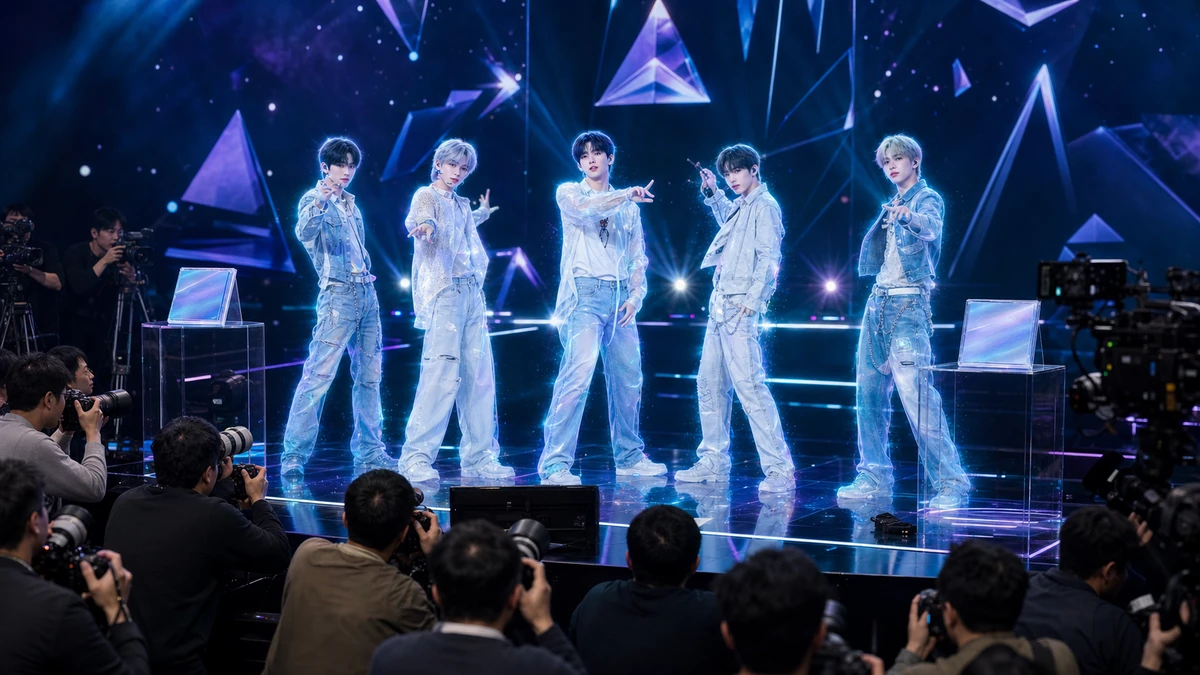
A virtual debut arrives in a very real K-pop race
South Korea’s K-pop industry, long defined by painstaking trainee systems, polished live stages and fan rituals built around physical proximity, has a new contender that barely fits the old script. A five-member virtual boy group called Miiwan Sonyeon has officially debuted with its first album, Middle.i, according to its agency, Abyss Company. The release arrived June 16, with the company publicly confirming the debut the following day.
For American readers used to thinking about pop groups in terms of concert footage, red carpets and late-night TV appearances, the phrase “virtual boy group” may sound like something halfway between an animated franchise, a video game property and a traditional music act. In South Korea, though, the idea lands inside a music business that has spent years stretching the definition of what an idol can be. K-pop already asks fans to invest not only in songs, but also in personalities, fictional lore, serialized content and community participation. A virtual group simply pushes that logic further.
Miiwan Sonyeon enters that landscape at a time when rookie K-pop acts face unusually high expectations. A catchy single is no longer enough. New groups are now expected to arrive with a fully formed brand identity, visual language, social media strategy, fan engagement model and, increasingly, a “worldview” or narrative universe that fans can decode over time. In that respect, Miiwan Sonyeon is not rejecting K-pop’s debut formula so much as rewriting it for a digital-native era.
The group consists of five members: Maha Jin, Naisen, An Seokwoo, Won Ju-yul and Im On. Their name, Miiwan Sonyeon, carries much of the project’s core message. In Korean, the word “miwan” usually suggests something unfinished or incomplete. But the group’s storytelling reframes that idea, drawing a contrast between one Chinese character for “not yet” and another for “beauty,” presenting the members not as incomplete in a deficient sense, but as moving together toward beauty, growth and eventual completion. That kind of wordplay is classic K-pop concept design: compact, symbolic and built for fans to unpack.
Even before listeners hear much of the music, the concept tells them how to read the group. Miiwan Sonyeon is not being introduced as a finished product dropping from the sky. It is being sold as a journey. In American pop, artists often try to project confidence and arrival from the start. K-pop, by contrast, has long excelled at making the audience feel like witnesses to an unfolding coming-of-age story. That emotional architecture matters because fans are not only buying songs. They are buying into progress.
Why “unfinished” can be a powerful pop idea
One reason this debut stands out is that it openly centers a word that might otherwise sound like a weakness. “Incomplete” is not usually the kind of branding language a major pop rollout embraces. But in K-pop, vulnerability, aspiration and growth can be just as marketable as polish. A rookie group is almost always presented as being on the way to something larger, whether that is musical maturity, emotional depth or chart dominance. Miiwan Sonyeon’s concept makes that trajectory explicit.
The debut album’s title track, also called “Miiwan (Beauty-Complete) Boy,” appears to build directly on that theme. The title plays with Korean and Chinese character meanings in a way that can be difficult to fully reproduce in English, but the broad effect is clear: the group is turning a term associated with incompletion into one associated with beauty and fulfillment. That is more than a naming gimmick. It is a mission statement.
For readers outside Korea, this is a useful example of how deeply language itself is embedded in K-pop branding. Group names, album titles and slogan phrases often carry layered meanings that reward close attention. American audiences may think of this the way superhero fans parse a cinematic universe for clues, or the way Taylor Swift fans scrutinize lyrics, visual motifs and easter eggs for bigger narrative patterns. K-pop fans do something similar, except the clues may span music videos, album packaging, live streams, fictional backstories and even the meanings of names.
That helps explain why a group like Miiwan Sonyeon can generate intrigue with relatively little concrete information. At debut, the publicly emphasized facts are straightforward: five members, one album, a title track, another group song called “PLUMA” and solo songs for each member. But inside K-pop culture, that is already enough material for interpretation. Fans will ask why the album is called Middle.i. They will look for links between the members’ names and their possible character identities. They will compare the group tracklist with the project’s larger message of development and beauty.
The “unfinished” framing also dovetails with a broader shift in entertainment culture, especially among younger audiences who are comfortable following characters and creators across multiple platforms at once. People who grow attached to streamers, VTubers, game avatars or fictional social media personas are already familiar with forms of attachment that do not depend on a flesh-and-blood celebrity appearing in the traditional way. In that environment, the promise of growth can matter more than old-fashioned realism.
What makes a virtual idol work, and what still has to be proven
A virtual idol group operates differently from a conventional K-pop act, but not as differently as outsiders might assume. Traditional groups build intimacy through years of trainee mythology, reality content, music-show appearances, fan sign events and live performance clips that circulate online. Virtual groups cannot rely on body language in exactly the same way, at least not without animation, motion capture or carefully produced video assets. Instead, they lean more heavily on design, voice, story consistency and the audience’s willingness to participate imaginatively.
That does not automatically make the format easier. If anything, it raises the bar in a different direction. A weak song is still a weak song. A confusing concept is still a confusing concept. And if fans do not find the characters emotionally convincing, the digital wrapper will not save the act. The novelty of being virtual may attract curiosity, but novelty has a short shelf life in a saturated pop market.
That is why Miiwan Sonyeon’s debut package matters. By including both group songs and individual solo tracks on its first album, the project seems designed to introduce not only a collective identity but also distinct member identities from day one. That is a smart move. One challenge for any new group, especially a virtual one, is lowering the entry barrier for potential fans. A listener may like a title track but still struggle to tell the members apart. Solo songs offer a shortcut. They invite fans to begin associating each member with a specific tone, mood or persona.
The strategy resembles what entertainment companies in the United States often do with ensemble franchises: introduce the team, then quickly give each character an angle the audience can remember. Marvel movies do it. Reality competition shows do it. So do boy bands. What changes in K-pop is how systematically that differentiation becomes part of fan culture. Members are not just singers in a group; they are narrative units, each with a symbolic role in the larger machine.
Still, significant questions remain. The available information does not yet establish each member’s position, vocal color, specific character traits or long-term plot function. It is not clear how much of the group’s appeal will depend on music videos, interactive content, social media communication or eventual performance technology. It is also not clear whether Miiwan Sonyeon will lean toward the anime-adjacent aesthetics that have helped some virtual acts find global traction, or whether it will build a look more closely aligned with mainstream K-pop idol visuals.
Those unknowns are not necessarily a weakness. In K-pop, withholding details can itself be part of the rollout. But the group’s future will hinge on how naturally its stated theme of moving from incompletion toward beauty can be repeated and expanded without becoming repetitive. Fans will tolerate ambiguity early on. They will be less forgiving if the concept feels shallow six months from now.
The album as an introduction to both team and character
The debut album, Middle.i, appears carefully designed as a first chapter rather than a one-off release. Even the title suggests an in-between state, a middle point, a self still in formation. That fits neatly with the group’s core message. In American pop marketing, first projects are often framed around arrival: the breakthrough, the statement, the big entrance. In this case, the album title implies process instead of finality.
The title track “Miiwan (Beauty-Complete) Boy” carries the burden of explaining the group to the audience in a single phrase. It tells listeners what kind of emotional and symbolic territory the act wants to occupy. The additional track “PLUMA,” while not yet fully described in public detail, broadens the package beyond one slogan. And the inclusion of individual member songs suggests that the company understands a basic truth of fandom: people may enter through the group, but they often stay because of a favorite member.
That has always been true in K-pop, where “bias” culture — the fan practice of identifying a preferred member within a group — is central to how audiences organize their loyalty. For readers unfamiliar with that term, think of it as a cross between choosing a favorite Beatle, picking a preferred member of *NSYNC or One Direction, and investing in a character arc on a long-running TV show. Fans are not only selecting a voice they like. They are choosing a point of emotional identification.
For a virtual group, that process may be even more important. The absence of conventional physical celebrity cues means the act must create recognition through other channels: names, voices, design details, personal lore and musical differentiation. One member’s name, Won Ju-yul, is especially striking because it can also be read in Korean as the term for the mathematical constant pi. That kind of unusual naming choice is likely to spark nicknames, fan theories and inside jokes — all crucial ingredients in fandom formation.
At the same time, it would be premature to overstate what any one name means. The currently available information is limited, and responsible reporting requires separating what is confirmed from what fans may eventually infer. What can be said with confidence is that the group’s debut structure is optimized for layered consumption. First, the audience gets the team identity. Then it gets a chance to sort through the members individually. That is exactly how many successful K-pop fandoms take shape.
Why this matters beyond one rookie group
Miiwan Sonyeon’s arrival says something larger about where K-pop is headed. The industry has spent the past decade proving it can compete globally not just on music, but on format. It has turned comeback cycles into event programming, fan communities into organized international networks and behind-the-scenes content into a core part of the product. Virtual idols are best understood as another stage in that evolution.
To American audiences, the comparison points may include Gorillaz, the animated band co-created by Damon Albarn and Jamie Hewlett, or the rise of virtual creators on YouTube and Twitch. But K-pop’s version is structurally distinct. It is less about ironic distance or art-world experimentation and more about industrialized fandom design. The goal is not merely to create a fictional act. It is to create a sustainable idol ecosystem around it.
That ecosystem now exists in a global platform environment where a new act is instantly competing not just with domestic peers, but with every other piece of entertainment available on Spotify, YouTube, TikTok and short-form video feeds. The same music news cycle that introduced Miiwan Sonyeon also highlighted another K-pop group, Cortis, surpassing 800 million cumulative streams on Spotify. That figure is not directly about Miiwan Sonyeon, but it does illustrate the scale of the market new entrants face.
For rookie groups, the challenge is no longer simply to debut. It is to convert momentary curiosity into repeat listening, repeat viewing and sustained fan participation. In other words, the task is not to go viral once. It is to build habits. That is where virtual groups may have an advantage if executed well. Characters can be adapted across formats, storylines can continue between releases, and fan interaction can be extended beyond the limits of traditional in-person schedules.
There is also a transnational advantage. Some aspects of Korean idol culture can be highly specific and rooted in domestic media routines, such as weekly music-show promotions or fan sign traditions. A virtual act, by contrast, may travel more easily across language barriers if its core appeal is character-based and digitally mediated. A fan in Chicago, Manila or Sao Paulo can engage with lore, music videos and social content without needing access to a Seoul studio audience. That does not erase the importance of music quality, but it can widen the runway.
What American audiences should watch next
The most interesting part of Miiwan Sonyeon’s debut may be that it refuses the old pop fantasy of instant perfection. In a culture that often demands fully optimized stars from the outset, the group is selling process. It is asking fans to be there not just for a polished image, but for an arc. That is savvy not only because it aligns with K-pop fandom habits, but because it reflects how younger audiences increasingly consume entertainment: as a long-term relationship rather than a one-time transaction.
Whether that strategy works will depend on what comes next. Can the group’s music stand on its own when the novelty wears off? Can each member emerge as a memorable presence, even within a virtual framework? Can the “unfinished to beautiful” message evolve into something deeper than a launch slogan? And can the company maintain coherence across songs, visuals and fan communication?
Those are not small questions. But they are the right questions to ask of any K-pop debut in 2026, whether the members are physically on stage or rendered through digital personas. The genre’s most successful acts are rarely the ones with only one strong song or one eye-catching gimmick. They are the ones that make people feel they are part of a story still being written.
That, ultimately, is where Miiwan Sonyeon may find its opening. The group’s very name invites audiences to see possibility instead of deficiency. Its debut album positions identity as something in motion. Its member rollout suggests a careful balance between team cohesion and individual attachment. And its virtual format, rather than distancing fans from the act, may actually intensify the participatory side of fandom if the storytelling is strong enough.
American listeners who have only a passing familiarity with K-pop sometimes assume the genre’s appeal rests mainly on synchronized dancing, high-concept fashion and internet-friendly visuals. Those elements matter. But they are not the whole story. K-pop also thrives because it knows how to serialize emotion. It understands that fans want to watch ambition take shape over time. Miiwan Sonyeon’s debut is one more sign that the industry is now testing how far that emotional model can extend beyond the limits of the human stage.
For now, Miiwan Sonyeon remains a newcomer with more questions than answers, which is precisely the point of its branding. It is not promising that the work is done. It is inviting the audience to witness how completion might happen. In a K-pop marketplace crowded with instant hooks and constant reinvention, that may be one of the more compelling stories a rookie act can tell.


0 Comments