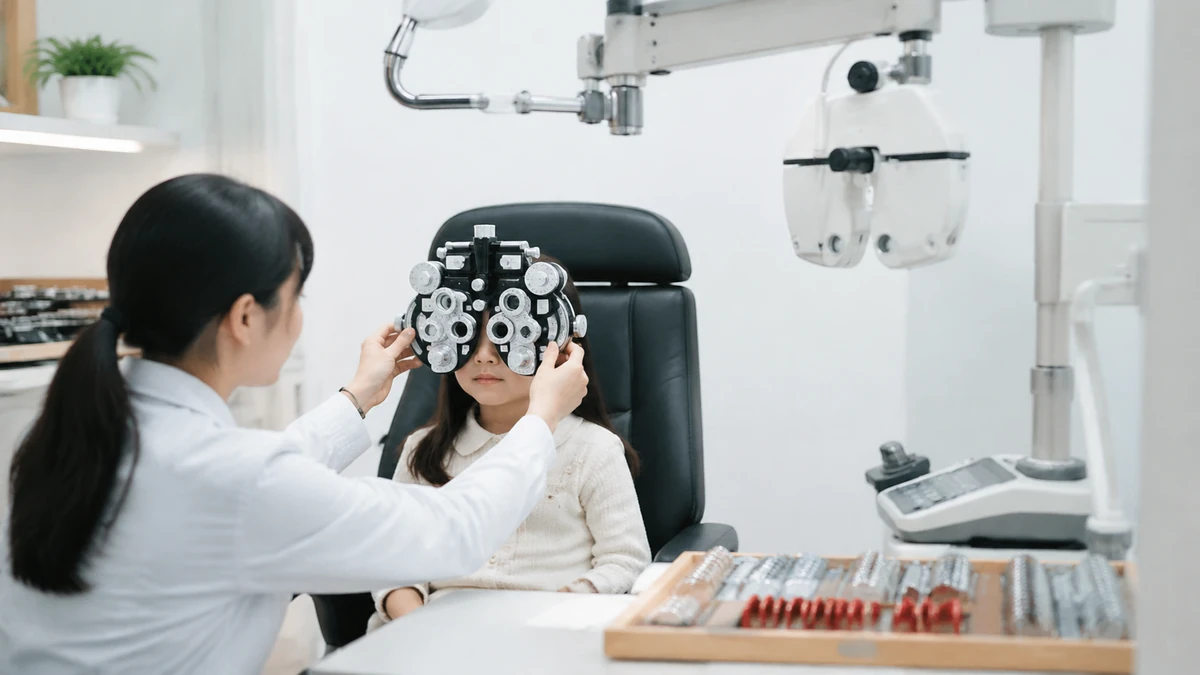
A city program turns a routine family expense into a public health issue
Seoul is reopening applications for a city-backed children’s eye health program that pairs vision screenings with discounts on eyeglasses, an approach that may sound modest but reflects a bigger public health idea: making it easier for families to act on problems before they grow worse.
The Seoul Metropolitan Government said it will accept a second round of applications from July 12 through July 18 for what it calls the “Seoul Children’s Eye Health Guardian Project,” according to the South Korean news agency Yonhap. Families who apply and are selected will receive a coupon by text message on July 26. The coupon can be used at a participating optical shop chosen during the application process, where children can get a vision check and buy glasses at up to 20% off.
For American readers, the closest comparison may be a city or school district teaming up with local optometrists and retailers to make sure children not only get screened, but also leave with a realistic path to getting corrective lenses. In the United States, pediatric vision care often falls into a familiar gap: parents may know a child is squinting at the board or struggling with reading, but follow-through can be delayed by cost, scheduling or the simple hassle of figuring out where to go next. Seoul’s program is built around reducing exactly that kind of drop-off.
That is part of why the initiative has drawn attention in South Korea as more than a simple retail promotion. It links two steps that are often separated in practice: checking a child’s eyesight and actually obtaining the glasses needed to correct it. Public health experts frequently note that access is not just about whether a service exists. It is also about whether families can move from recognition to action without too many obstacles in the way.
In this case, city officials are not promising cutting-edge medicine or a sweeping overhaul of the health care system. Instead, they are targeting one of the most ordinary but important needs in family life: making sure children can see clearly enough to learn, read and function comfortably in school and at home.
Why vision matters so much in South Korea’s education-driven culture
To understand why a municipal government would devote attention to eyeglasses for children, it helps to understand the role education plays in South Korean daily life. South Korea is known for a highly competitive academic culture, one in which students often spend long days in school and then continue studying into the evening, sometimes at private academies known as “hagwons.” Those after-school cram schools are a well-known part of modern Korean life and are often discussed as a symbol of the country’s intense focus on educational achievement.
In that environment, eyesight is not a small matter. Reading textbooks, staring at classroom screens, doing homework on tablets or laptops and commuting between school and after-school programs all put a premium on clear vision. Parents tend to be highly attentive to anything that could affect a child’s academic performance or everyday comfort. While that concern is hardly unique to South Korea, it can carry particular urgency in a society where school performance is often seen as closely tied to future opportunity.
At the same time, the issue resonates far beyond Korea. American parents know their own version of the problem. Children spend increasing amounts of time on screens, whether for schoolwork, entertainment or both. Teachers may be the first to notice that a student is having trouble seeing materials in class. A child who cannot see well may appear distracted, reluctant to read or academically behind when the underlying problem is actually straightforward and treatable.
That is one reason vision screening has long been a basic part of school health efforts in many places. But screenings alone do not solve much if families do not then obtain follow-up care or corrective lenses. Seoul’s program appears designed around that practical reality. Rather than treating the exam and the purchase of glasses as separate worlds, it combines them into a single, more seamless experience.
South Korean officials did not frame the latest announcement as a response to a specific crisis. Still, the structure of the program reflects a widely shared view in child health: it is better to catch vision issues in everyday life through regular checks than to wait until the child complains, falls behind or develops habits that compensate for poor eyesight.
What the program offers, and what changed in this second round
The program’s most visible feature is the discount. Seoul said children can purchase eyeglasses at up to 20% off. That discount can apply not only to new glasses, but also in cases where a child keeps an existing frame and replaces only the lenses, a practical detail that matters in many households. Children’s prescriptions can change as they grow, and families do not always need or want to buy an entirely new pair every time lenses need updating.
The city also said some products sold at regular prices would be eligible for discounts of up to 20%, while already discounted promotional items could receive an additional 5% off. The structure is a little more nuanced than a one-size-fits-all coupon, and that likely reflects how families actually shop. Not every household chooses the same style, brand or price range. A program that recognizes differences in purchasing patterns may stand a better chance of being used.
The bigger story, however, may be the administrative changes. Seoul said that for this second application round, it has simplified the process by integrating separate application links used by different participating businesses into a single link. On paper, that can sound like a minor technical update. In reality, small changes in application design often make the difference between a benefit people appreciate in theory and one they successfully claim in practice.
The city also added a text-message alert feature that can notify interested families when the application window opens and again two days before it closes. That kind of nudge has become common in modern public services because it acknowledges a simple fact of ordinary life: many people mean to apply for a program but forget, get busy or miss the deadline in the blur of work, school and caregiving responsibilities.
For American readers, it may be useful to think of this as a user-experience update to a public benefit. The benefit itself matters, but so does the ease of access. In the United States, families regularly encounter friction in systems that are technically available but practically cumbersome, whether they are dealing with school forms, tax credits, health coverage or local aid programs. Seoul’s move suggests the city understands that successful social policy depends not just on what is offered, but on how easily people can reach it.
The timeline is relatively straightforward. Applications open July 12 and close July 18. Families who apply will receive coupons by phone text on July 26, and the coupon can be used only at the optical retailer selected during the application process. That clear sequence, application, vendor selection, coupon delivery, then use, appears aimed at reducing confusion and helping families understand exactly what comes next.
The public health logic: reducing the gap between diagnosis and follow-through
At its core, Seoul’s initiative is about access to action. Health systems, whether in South Korea or the United States, often struggle with a familiar problem: identifying a need is easier than making sure people follow through on it. A child may be screened at school, told to have a formal eye exam or encouraged to get glasses. But between that recommendation and an actual pair of lenses, there may be cost concerns, scheduling conflicts, transportation issues or simple procrastination.
By tying the screening and the purchase of corrective eyewear together, Seoul is trying to shrink that gap. The family does not just learn whether the child’s vision needs attention; they are also given a price incentive to act promptly. That matters because health behaviors are often delayed not for dramatic reasons but for routine ones. The more steps required, the more likely some families are to postpone or abandon the process.
This is particularly true for children’s vision because the condition often unfolds quietly. A child may not recognize that their vision is impaired, especially if the change has been gradual. Parents may attribute headaches, irritability, reading avoidance or poor classroom focus to something else. Teachers may spot signs, but schools cannot usually solve the problem on their own. Somewhere between noticing and remedying, children can lose time that matters.
Public health officials often talk about prevention not only as vaccines or disease control, but also as making routine maintenance easier. Eye health falls squarely into that category. For many children, what is needed is not a hospital visit or specialized treatment but timely screening, a correct prescription and affordable access to glasses. A city that can lower the friction around those steps may improve daily quality of life in ways that are less dramatic than emergency medicine but no less meaningful.
The program also reflects an important shift in how governments think about health support. Instead of focusing only on treatment in clinical settings, cities increasingly look at the spaces where people live their ordinary lives: schools, neighborhoods, pharmacies, community centers and retail health partners. Vision care is especially suited to that model because it is both medical and practical. A diagnosis matters, but so does whether the family can walk out with a usable solution.
Seoul’s announcement did not include long-term outcome data or detailed projections about how many children will ultimately benefit in this round. Even so, the design itself sends a message. It suggests that policymakers see early checking and quick correction as a better strategy than waiting until a problem becomes disruptive, more expensive or harder to ignore.
A small discount, perhaps, but a meaningful household signal
A discount of up to 20% may not sound transformative on its own, especially to readers more used to national health debates involving insurance premiums, prescription drug costs or hospital bills. But for families managing the steady accumulation of child-related expenses, routine costs matter. Glasses can become one more recurring purchase added to school supplies, meals, transportation, tutoring, medical appointments and everything else that comes with raising children.
That is especially true when a child needs repeated lens changes but not an entirely new frame. By allowing discounts on lens-only replacements, the program recognizes the economics of childhood more realistically than a promotion geared solely toward brand-new purchases. Children outgrow shoes, clothes and sometimes prescriptions faster than adults do. Policies that account for that rhythm can be more useful than flashy one-time offers.
There is also symbolic value in the city’s involvement. When a local government publicly supports something as everyday as children’s glasses, it helps frame vision care as a community concern rather than a purely private burden. That framing can matter. It tells parents that routine eye health is not cosmetic or optional; it is part of a child’s ability to participate fully in school and daily life.
In the United States, debates around child health often become polarized when they touch on large-scale spending or mandates. But there is usually broad agreement on simpler principles: children should be able to see the board, read their assignments and move through the day without avoidable barriers. Programs like Seoul’s show how local governments can act on that consensus through practical design rather than ideological argument.
There is, of course, a limit to what a discount program can do. It does not replace comprehensive health coverage, and it does not address every reason a family might delay care. Still, in public administration, incremental measures can have real effects if they address a common point of friction. A family that might have postponed buying new lenses for another month may decide to do it now. A parent who intended to schedule an eye check “sometime soon” may do it within the coupon window. For a child struggling to see clearly, that timing can matter.
The program’s design also hints at a larger governing philosophy that is increasingly common in East Asian cities known for strong administrative systems: social support does not always arrive in the form of sweeping entitlement. Sometimes it arrives as a tightly targeted, carefully timed intervention meant to solve a specific everyday problem well.
What the streamlined application process says about modern government
If there is a broader lesson in Seoul’s latest announcement, it may lie less in the discount itself than in the city’s emphasis on convenience. Officials highlighted the consolidation of application links and the addition of reminder texts, changes that suggest they are thinking seriously about the user experience of public policy.
That may sound like the language of a tech company rather than a city hall, but the concept has become central to effective governance. A program can be generous on paper and still underperform if the application process is fragmented, confusing or easy to forget. Anyone who has tried to navigate online government services, in the United States or elsewhere, knows how often that happens.
In that sense, Seoul’s update reflects a wider trend in public administration: measuring success not simply by the existence of a benefit but by completion rates, participation rates and the ease with which ordinary people can move through the system. That is especially important for family-oriented programs, where the intended users are often busy parents balancing work schedules, school calendars and household logistics.
The city’s reminder feature is a good example of this thinking. Missing a deadline is rarely a sign that a benefit is unneeded. More often, it means life got in the way. By sending an alert at the start of the application window and another reminder two days before it closes, Seoul is treating behavioral reality as a design condition, not a moral failing. That may sound obvious, but many public programs still fail to do it.
For American audiences, there is a familiar parallel in the movement toward automatic enrollment, deadline reminders and simplified online forms in programs ranging from school meal assistance to tax benefits. The common principle is that reducing administrative burden can be as important as increasing nominal aid. A smaller benefit that is easy to claim may have more real-world impact than a larger one hidden behind paperwork and complexity.
Seoul appears to be betting that better design will increase take-up. That is a smart bet. Public trust in government programs often depends on whether they feel workable in everyday life. When people can understand what to do, when to do it and what they will receive, participation tends to rise. When the process feels opaque, even worthy programs can fade into the background.
Why this local Korean story resonates internationally
On one level, this is a straightforward municipal announcement about application dates, coupons and eyeglass discounts. On another, it speaks to a much broader challenge facing cities around the world: how to translate public health goals into small, usable actions that families can actually take.
That is part of what makes the story noteworthy beyond South Korea. Children’s eye health is universal. So is the problem of delayed follow-through. Whether the setting is Seoul, Chicago, Los Angeles or London, families often navigate health needs in the midst of packed schedules and competing costs. A city that can reduce those burdens, even in a limited domain, offers a useful case study in practical governance.
The story also serves as a reminder that health news is not only about new drugs, surgical breakthroughs or disease outbreaks. Sometimes the most consequential policy decisions are the quiet ones that affect how people manage ordinary life. Better access to vision checks and more affordable glasses may not generate the same headlines as a major medical innovation, but for the child who can suddenly see the classroom clearly, the effect is immediate and profound.
Seoul’s program is not a cure-all, and city officials have not presented it that way. Rather, it is a targeted effort to make a basic aspect of child health more reachable, more affordable and easier to act on. That may be its strongest quality. Instead of promising to solve everything, it tries to solve one common problem with a clear sequence and fewer points of friction.
As local governments worldwide search for ways to show tangible value to residents, that approach may be instructive. Not every successful public health intervention needs to be grand in scale. Sometimes it needs to be timely, understandable and close to the rhythms of daily life. Seoul’s children’s eye health initiative fits that description.
For parents, the takeaway is simple enough: if a child’s vision needs attention, earlier is usually better than later. For policymakers, the lesson may be equally plain: support works best when people can actually use it. In that respect, this Seoul program is less about glasses than about something bigger, designing public services around how families really live.
Comments
Post a Comment