A Seoul Apartment Lottery Draws Heavy Demand, Offering a Window Into South Korea’s Housing Pressures
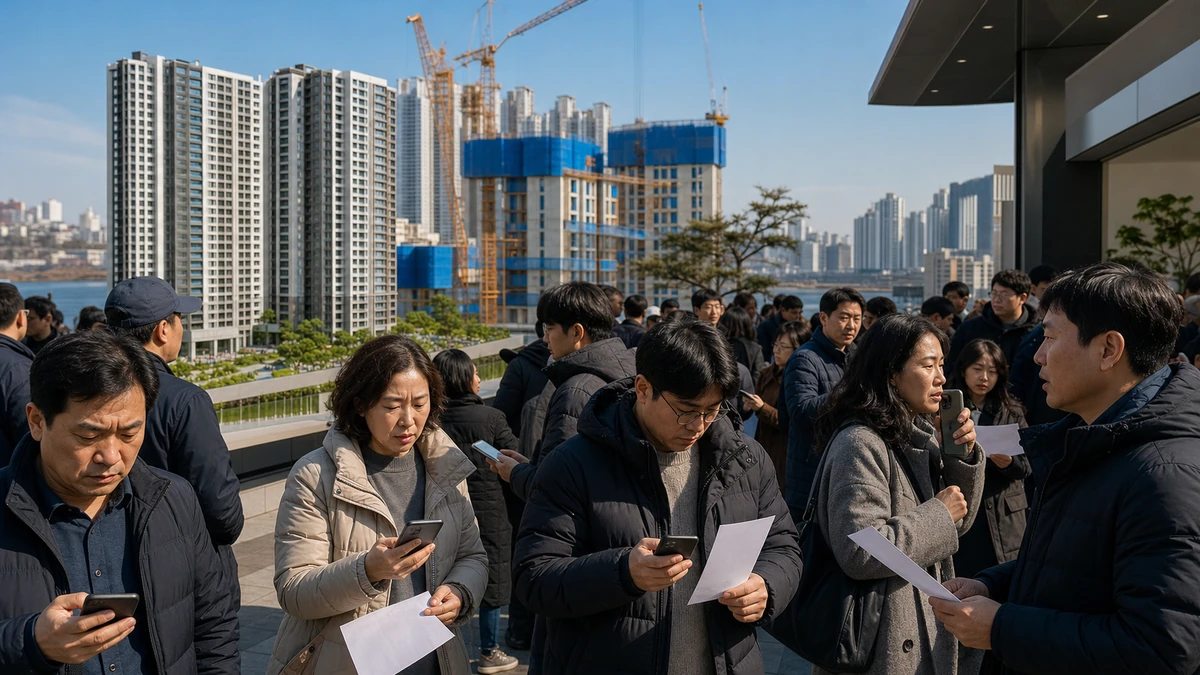
Why a Single Apartment Launch Matters in Seoul
A redevelopment apartment complex in southern Seoul has posted the kind of subscription numbers that, in South Korea, instantly become economic news. The project, called D-Fine Artia, recorded a 16.52-to-1 competition rate in the first round of applications reserved for eligible local residents, according to figures released through Korea’s official housing subscription platform. In plain terms, 1,437 people applied for 87 units.
To an American reader, that may sound less like a standard home sale and more like a hybrid of a housing waitlist, a government-administered lottery and a highly regulated preconstruction release. That is essentially what South Korea’s apartment subscription system is. Instead of simply putting newly built units on the market one by one, developers of many new apartment projects sell them through a formal application process known as “cheongyak,” or housing subscription. Applicants compete for the right to buy, and the odds themselves become a barometer of market sentiment.
The numbers around D-Fine Artia suggest that demand for new housing in Seoul’s core urban districts remains intense even amid broader questions about affordability, household debt and the long-term direction of the property market. The complex is part of the Noryangjin 2 district redevelopment project in Dongjak, a borough on the south side of the Han River that sits within commuting distance of some of the capital’s major business, education and transit hubs.
For South Koreans, especially in Seoul, real estate is not merely about shelter. It is deeply tied to household wealth, social mobility, marriage planning, education choices and retirement security. That is one reason a subscription result like this can resonate far beyond the 87 units in question. It is read as a signal about what buyers still want, what neighborhoods they still trust and where demand remains strong enough to overwhelm limited supply.
The D-Fine Artia case also underscores something that urban economists and policymakers have wrestled with for years in South Korea: when a newly built apartment in a desirable Seoul location comes onto the market, competition can remain fierce even if the national housing conversation is clouded by uncertainty. In that sense, this is not just a story about one building. It is a snapshot of how one of Asia’s most tightly watched housing markets continues to function.
How South Korea’s Housing Subscription System Works
South Korea’s apartment subscription structure can be unfamiliar to readers in the United States, where buying a newly built home usually means negotiating directly with a developer or seller. In Korea, especially for apartment towers in major urban areas, many units are allocated through a structured public application system. Buyers do not simply show up first with financing and sign a contract. They apply through a centralized platform, and their eligibility, category and rank can determine whether they get a chance to purchase.
The first-priority local round referenced in the D-Fine Artia results is one such stage. It is typically reserved for applicants who meet certain requirements and already live in the area or jurisdiction. The idea is to give local residents a better chance before opening competition more broadly. There are also “special supply” categories, which are policy-based allocations aimed at groups the government considers to need added support, including newlyweds, first-time homebuyers and families with multiple children.
In the case of D-Fine Artia, interest was already evident before the main first-priority round. The special supply offering drew 5,242 applicants for 522 units, a competition rate of 10.04 to 1. That matters because it shows that demand was not confined to one policy-favored buyer segment or one narrow eligibility lane. By the time the first-priority local round also came in at a double-digit competition rate, the project had effectively demonstrated broad-based interest across multiple stages of the allocation process.
Americans might think of this as a little like a city releasing a limited number of below-market or high-demand homes through a heavily managed application pipeline, except here the units are not necessarily subsidized housing. They are new apartments sold within a regulatory framework that makes the application process itself central to the market. The result is that subscription rates become headline numbers, not unlike mortgage rates, inventory levels or bidding-war statistics in the United States.
That does not mean subscription ratios tell the whole story. A high application count does not automatically translate into completed contracts, long-term price gains or trouble-free financing. Some applicants may apply strategically, hoping for a chance to buy in a favored district, while others may later walk away. But even with those caveats, subscription data provides one of the fastest public snapshots of demand in Korea’s new-housing pipeline. In markets like Seoul, where supply is scarce and location matters enormously, those numbers carry real weight.
What the D-Fine Artia Numbers Show
The headline figure, 16.52 applicants per available unit in the first-priority local round, is striking on its own. But the more revealing details may be found in the breakdown by apartment size. Smaller units attracted especially fierce demand, a pattern that says much about affordability constraints and buyer preferences in Seoul.
For the 59A unit type, 501 applicants competed for 10 homes, producing a subscription rate of 50.10 to 1. Another unit in the same general size range, the 59B type, drew 367 applicants for 10 homes, or 36.70 to 1. A 51C type, with only five units available, attracted 392 applicants, translating to roughly 78 to 1.
Those size labels refer to square meters, a standard Korean measurement for apartments. A 59-square-meter unit is roughly comparable to about 635 square feet, though exact usable space can vary depending on layout and how common areas are counted. For American readers accustomed to larger homes, those dimensions may seem compact. But in Seoul, where land is scarce, apartment living dominates and proximity to jobs and transit commands a premium, these sizes are considered highly practical and often attractive to working households, couples and smaller families.
The strong response to those smaller layouts points to a familiar urban-market dynamic seen in global cities from New York to Singapore: buyers may be willing to compromise on space to secure a newer home in a better-located neighborhood. It also suggests that “real demand,” as Korean market watchers often call owner-occupier demand, is concentrating in unit sizes that are still within financial reach for more households.
That is an important distinction. In overheated property markets, interest is often driven by a mix of speculative buying and genuine end-user demand. In Seoul, policymakers have spent years trying to cool speculation while still encouraging housing supply. When smaller units in a redevelopment complex draw outsized application numbers, analysts often interpret that as evidence that people who actually intend to live there are closely watching opportunities in the city’s limited pipeline of new apartments.
There is also a more mechanical explanation for some of the extreme ratios: scarcity. When only five units are available in a certain type, the competition rate can spike quickly. Still, that does not erase the broader takeaway. Multiple unit categories posted eye-catching numbers, and the demand was not limited to a single outlier floor plan. Across the project, applicants appeared to respond strongly to the combination of new construction, redevelopment upside and a Seoul address.
Noryangjin’s Redevelopment and the Value of Location
The location of this project is central to understanding its appeal. Noryangjin is a neighborhood long known to many South Koreans for exam-prep academies, dense low-rise housing and a strategic position within the capital. It sits in Dongjak District, an area that offers access to central Seoul without always carrying the same international name recognition as places like Gangnam, the affluent district often invoked in global coverage of Korean real estate and pop culture.
But to Seoul residents, a neighborhood does not need to be Gangnam to be desirable. What matters is the web of everyday convenience: subway access, commute times, school options, shopping, hospitals and whether a family can stay within an established “living zone,” a concept in Korea that refers to the practical geography of daily life. Redevelopment projects can be especially appealing because they promise something rare in mature urban districts: a brand-new apartment community without forcing residents to abandon established routines and infrastructure.
That is what makes projects like Noryangjin 2 significant. Redevelopment in South Korea often involves replacing older, denser and sometimes physically deteriorating housing blocks with modern apartment towers and updated public infrastructure. It is not simply a cosmetic refresh. These projects can reshape the social and economic profile of a neighborhood, boost local land values and alter who can afford to stay.
American cities know versions of this story. In places from Brooklyn to Los Angeles, redevelopment can bring safer buildings, new tax revenue and improved amenities, while also raising concerns about displacement and affordability. Seoul’s version is structured differently, often more centrally managed and more apartment-focused, but the underlying tension is familiar: how do cities modernize aging housing stock without making urban life even less affordable for the people already there?
In the Korean context, redevelopment apartments often carry an additional premium because they pair new construction with centrality. New housing built on the suburban edge may increase supply, but it cannot always replicate the value of a home close to entrenched transit networks, jobs and schools. That helps explain why urban redevelopment launches can trigger strong application volumes even when the national market appears mixed.
D-Fine Artia appears to fit that pattern. The project offers applicants the chance to buy into a refreshed residential complex in an established Seoul district rather than in a newly built satellite community farther out. For many households, particularly those thinking long term about commuting, children’s education or resale value, that difference is substantial.
What This Says About Seoul’s Housing Market
The broader signal from this subscription result is that demand in Seoul’s key residential zones remains resilient. That should not be mistaken for a blanket verdict on all of South Korea’s housing market. Real estate conditions can diverge sharply by region, product type and price tier. Smaller cities and provincial areas may face very different dynamics from the capital, and even within Seoul, not every project attracts this level of competition.
Still, Seoul occupies an outsized place in the national economy and imagination. It is the country’s political capital, business center and dominant cultural hub. More importantly for the housing market, it is where many of the jobs, elite universities, major hospitals and transportation links are concentrated. In that sense, Seoul housing behaves less like a local real estate niche and more like a national asset class with social consequences.
That makes subscription data worth watching. In South Korea, housing is deeply connected to family balance sheets. Property appreciation has historically played a major role in wealth accumulation, and the pressure to secure a home in Seoul can shape decisions about marriage, childbirth and career choices. When competition for new apartments stays high, it reinforces the perception that central-city supply remains constrained relative to demand.
The D-Fine Artia numbers also speak to the enduring appeal of “new apartments,” a category with special cachet in Korea. Newer complexes are often associated with better security, parking, energy efficiency, community amenities and school-district prestige. In many cases, they also carry a social status dimension. As in the United States, not all housing stock is viewed equally, and buyers frequently place a premium on modern units with reliable management and strong resale potential.
At the same time, these results should be interpreted with caution. A competition ratio measures interest at the application stage, not the final health of the market. It does not reveal how many applicants were stretching financially, how many will follow through to closing or whether prices in the surrounding district will continue rising. Nor does it settle larger debates over whether Seoul needs more housing, more regulatory reform or a different balance between redevelopment and affordability protections.
What it does show is immediate revealed preference. Faced with a chance to buy new housing in a redeveloped Seoul neighborhood, a large number of applicants entered the system. That simple fact is why the story matters. In a data-rich housing market, behavior often tells a clearer story than commentary does.
Why International Readers and Investors Pay Attention
For readers outside Korea, it may be tempting to view an apartment subscription result as a niche domestic item. But Seoul’s real estate market has significance well beyond local homebuyers. South Korea is the world’s fourth-largest economy in Asia, a major technology exporter and a country where household finances are closely intertwined with property. That means housing indicators can offer clues about consumer confidence, lending conditions, construction activity and political pressure points.
Global investors and analysts often monitor Korean property trends for exactly that reason. They are not necessarily focused on a single building in Dongjak District. They are watching what projects like this imply about urban demand, supply bottlenecks and the public appetite for centrally located housing. A redevelopment complex that posts double-digit competition rates in both special supply and first-priority applications suggests that city-core demand remains alive, even if affordability concerns continue to mount.
There is also a policy angle. Governments around the world are searching for ways to increase housing supply in expensive cities without triggering political backlash. Seoul’s redevelopment model offers one example of how a city can add or renew housing stock inside existing neighborhoods rather than relying only on outward expansion. But it also illustrates the limits of supply policy when demand is concentrated in a handful of highly valued districts. New units help, yet they can still be overwhelmed by the number of households competing for them.
For American readers, the closest comparison may be to the intense interest that greets new condo launches or affordable-housing lotteries in parts of New York, San Francisco or Washington. The systems are different, the ownership structures are different and Korea’s apartment culture is more dominant than in most U.S. cities. But the underlying issue is recognizable: too many people chasing too few homes in the places where opportunity is concentrated.
That is why a 16.52-to-1 application ratio is more than a flashy statistic. It is evidence that, despite years of policy intervention and a sometimes uneven national market, Seoul remains a place where the promise of a new apartment in the right neighborhood can still set off a wave of demand. The same holds for the smaller-unit categories that saw competition levels soar far above the overall average. Buyers, or at least applicants, are making finely tuned calculations about size, price, location and future value.
As South Korea continues trying to balance affordability with urban renewal, numbers like these will remain closely watched. They do not provide all the answers. But they do offer a clear and immediate message: in Seoul, demand for well-located new housing is still powerful enough to turn a redevelopment release into a national economic talking point.
The Message Behind the Double-Digit Competition
There is a reason Korean financial news outlets treat apartment subscription results with the urgency that American outlets might reserve for inflation data or monthly jobs numbers. In South Korea, housing sits at the intersection of politics, class, family planning and consumer psychology. A double-digit competition rate can therefore serve as shorthand for several things at once: pent-up demand, limited supply, persistent faith in the value of Seoul real estate and the continuing importance of new construction in older urban neighborhoods.
In D-Fine Artia’s case, the message was especially clear because the project performed strongly in more than one stage of the sales process. Special supply registered a 10.04-to-1 competition rate, and the first-priority local round climbed to 16.52 to 1. Several smaller unit types saw much higher pressure. That pattern suggests the interest was not accidental or narrowly technical. It was broad enough to show up repeatedly and concentrated enough to reveal buyer preferences.
None of that guarantees what happens next. Contract completion rates, financing conditions and the medium-term direction of Seoul home prices will matter more than one day’s application count. But the initial market response appears unmistakably strong. In a city where housing demand is constantly filtered through regulation, scarcity and social aspiration, the public numbers around one redevelopment project have once again offered a glimpse into the bigger forces shaping urban Korea.
For foreign readers trying to understand why housing remains such a central Korean story, this is a useful place to start. The system is formalized, the terminology can be technical and the apartments themselves may be smaller than what many Americans imagine as family housing. Yet the underlying story is universal: people want to live near jobs, schools and transit, and when a city does not build enough desirable homes in those places, competition becomes intense.
That is the real meaning behind the D-Fine Artia figures. They are not just a measure of interest in one apartment complex. They are a numerical portrait of the pressure surrounding urban life in Seoul, one of the world’s most densely developed and economically important cities.
Comments
Post a Comment