Nearly all South Korean teens have tried AI chatbots, and many are turning to them for emotional support, survey finds
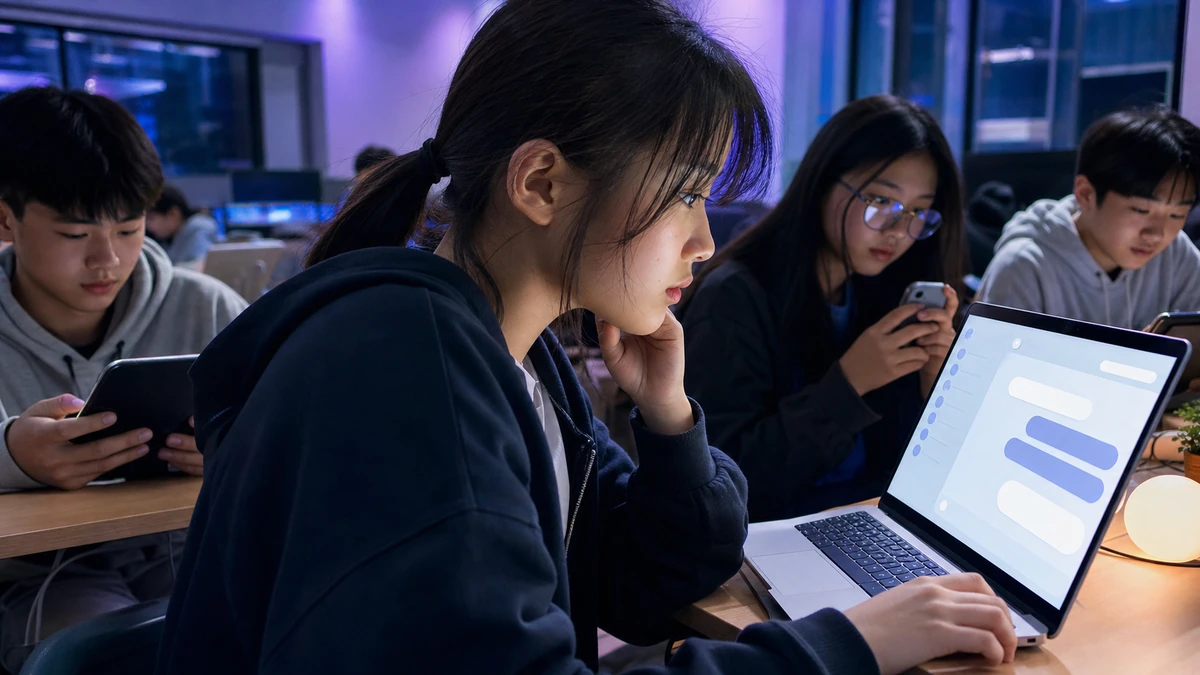
AI is no longer a novelty for South Korean teenagers
A new survey in South Korea suggests that generative artificial intelligence has moved well beyond the stage of being a flashy new gadget for young people. It is now part of everyday life — not just for homework help or quick answers, but increasingly as something closer to a conversation partner.
The findings come from Green Umbrella, a major South Korean child welfare organization, which said 94.4% of children and teenagers age 14 and older reported having used a generative AI chatbot. The survey, based on responses from 3,300 young people nationwide, was published in an issue brief with a striking title: “A Dangerous Conversation With My Friend.”
That headline reflects the central tension in the data. On one hand, South Korean teens appear to be embracing AI at extraordinary scale. On the other, many are using it in ways that raise uncomfortable questions for parents, educators, tech companies and policymakers. Nearly half of respondents — 49.5% — said they felt AI understands them. About 32.3% said they had actually talked with AI when they were struggling or feeling depressed.
For American readers, the numbers may sound like an accelerated version of a trend already visible in the United States. Teenagers in both countries are growing up with smartphones in their hands, group chats always open and algorithms shaping much of what they see and do online. But South Korea, one of the world’s most connected societies, often acts like a high-speed preview of where digital habits may be heading elsewhere. When nearly all surveyed teens in a country are already using AI chatbots, and one in three says they have used them during emotionally difficult moments, the conversation is no longer about whether AI will become a part of adolescent life. It already is.
That helps explain why the survey has drawn attention in South Korea’s technology sector. The headline figure — that 94.4% of teens have tried AI chatbots — matters, but the more important finding may be what those teens think the technology is for. This is not just a story about students using AI as a souped-up search engine. It is about young people treating software like something that listens.
From study aid to stand-in listener
The most revealing part of the survey may be the shift in how teenagers relate to AI. A chatbot, in technical terms, is simply software that responds to users in natural language. But that sterile definition does not capture the emotional role the technology can begin to play, especially for adolescents who are lonely, stressed or reluctant to open up to adults.
In the Green Umbrella survey, almost half of respondents said they felt understood by AI. That is a remarkable number, not because it proves chatbots are truly empathetic, but because it shows how easily conversational software can be experienced as emotionally responsive. For teenagers — who may already be accustomed to texting feelings instead of speaking them aloud — the leap from “tool” to “listener” is not especially large.
That shift is not unique to South Korea. In the U.S., teachers, parents and mental health professionals have already been grappling with the reality that teens may ask AI for advice about friendship, identity, school pressure and anxiety. What stands out in the South Korean case is the scale and clarity of the numbers. More than three in 10 surveyed youths said they had talked to AI when they were having a hard time or felt depressed. Put differently, about one in three had, at some point, turned to a machine during an emotionally vulnerable moment.
That does not necessarily mean these teens preferred AI over people in every case. It may mean something subtler but still significant: that AI has become available in the exact moments when a human being is not. A chatbot is awake at 2 a.m. It does not appear judgmental. It does not interrupt. It does not tell a teenager to put the phone away. For a young person afraid of burdening friends, disappointing parents or being misunderstood by teachers, those qualities can feel comforting even if the underlying system has no emotions at all.
There is also important social context here. South Korean students often grow up under intense academic pressure, with long school days, private tutoring and fierce competition surrounding college admissions. That does not mean every teenager is miserable, but it does mean many operate within a culture where performance is closely watched and emotional vulnerability can be difficult to express. In that environment, an AI chatbot may seem less like a risky technology than a low-stakes place to vent.
American audiences may recognize the pattern even if the educational system differs. In the U.S., teens also face social comparison, digital pressure and rising concern over anxiety and depression. The difference may be one of degree and speed rather than kind. South Korea’s experience suggests that once AI becomes easy to access, emotionally available and linguistically smooth, adolescents may quickly begin using it for far more than schoolwork.
What teens are telling the machines
If the emotional dimension of the survey is unsettling, the privacy findings may be even more concrete. As chatbot use expands, the issue is no longer simply how often young people use AI. It is what they type into it.
According to the survey, 45% of respondents said they had entered their age into a chatbot. Another 32.8% said they had entered their name. Some provided school or organizational affiliation, 19.4%, and 14.1% said they had entered where they live. Those details alone would concern many privacy advocates, especially when the users are minors or young people just past childhood.
But the more sensitive disclosures were especially notable. Nearly 23.9% said they had entered information about their health or mental condition. Another 15.9% said they had entered personal secrets.
Those numbers help explain why child welfare advocates and digital safety experts are alarmed. A teenager telling a chatbot, “I’m anxious,” “I think I’m depressed,” “I hate my school,” or “I can’t tell anyone this” is not using AI in the same way someone might use a calculator app or even a standard search engine. They are leaving behind fragments of a deeply personal inner life.
For U.S. readers, this concern echoes long-running debates over what happens to data collected by social media companies, search engines and apps used by children. But AI intensifies the issue because the interaction feels private and conversational. A teenager may understand, in theory, that an app collects data. What they may not fully grasp is how much personal information can be embedded in what feels like casual talk: a school name here, a medical symptom there, a confession folded into a late-night question.
That matters because generative AI systems are not therapists, guidance counselors or legally protected confidential spaces. Depending on the service, conversations may be stored, reviewed, used to improve products or handled under terms of service that few teenagers ever read. Even when companies claim to protect user data, the larger point remains: adolescents may be disclosing sensitive information to systems built first as products, not public services.
South Korea’s broader social environment adds another layer. Young people there, like their peers elsewhere, navigate pressure from school, family expectations and peer dynamics. If AI becomes a default outlet for emotions, the question is not merely whether the technology is helpful in the moment. It is also whether young users understand that deeply personal exchanges may persist as digital records inside systems they do not control.
Trust comes easily. Verification does not.
The survey also found a substantial gap between trust and scrutiny. About 77.7% of respondents said they tend to trust chatbot answers. Among them, 66.5% said they trust those answers sometimes, while 11.2% said they trust them all the time. Only 15.3% said they do not really trust chatbot responses, and 6.9% said they do not trust them at all.
Just as significant, 20.7% said they do not separately check whether the chatbot’s answers are true.
That combination — high trust and limited verification — may be one of the most important takeaways in the entire report. Generative AI systems are designed to sound natural, confident and helpful. That polished tone can create the impression of authority even when the answer is incomplete, misleading or flatly wrong. Adults fall for that, too. Teenagers, who are still developing judgment and digital literacy, may be particularly vulnerable.
In American schools, educators have been wrestling with similar concerns under the broader banner of media literacy: how do students distinguish a reliable source from a persuasive-looking but inaccurate one? AI raises the stakes because it does not just present a list of links. It generates a direct answer in a conversational voice. For a teenager used to asking a phone for directions, music recommendations or weather updates, it may feel natural to treat an AI response as similarly dependable.
That can be harmless when the question is simple. It becomes riskier when the subject is health, mental well-being, relationships or identity. A chatbot can deliver bad advice with exceptional fluency. It can mirror feelings without understanding them. It can encourage dependency simply by being consistently available.
The survey’s findings point to a challenge many governments and school systems are only beginning to confront: AI literacy is not just about teaching students how to use a new tool. It is about teaching them what the tool is, what it is not, why it sounds convincing and when it should not be trusted on its own.
That is especially urgent in a country like South Korea, where adoption of new digital services tends to happen quickly and at scale. But the lesson is broader. The same question is already relevant in the U.S., where schools, libraries and parents are still trying to figure out how to talk about generative AI in concrete terms. The old advice to “check your sources” may no longer be enough when the source feels like a chatty companion rather than a website.
Why South Korea offers an early warning for the rest of the world
South Korea often occupies a distinctive place in global technology stories. It has one of the world’s most wired populations, high smartphone penetration and a culture that tends to adopt digital platforms quickly. It is also a country whose popular culture — from K-pop to K-dramas — has helped shape global youth trends. That makes its digital behavior particularly worth watching, not because Korea is identical to the U.S., but because it can reveal how rapidly new habits take hold when infrastructure and social acceptance align.
In many ways, this survey captures a wider global shift. Generative AI is entering young people’s lives all at once: as a study helper, a search substitute, an entertainment device and an emotional outlet. That convergence matters. Earlier technologies often played more limited roles. A search engine retrieved information. A messaging app connected people. A diary kept private thoughts. AI chatbots blur those categories. They can do some of each, which is part of what makes them so attractive — and so hard to regulate.
For American readers, there is a temptation to view South Korea as technologically ahead but culturally distinct. Yet the core issues here are broadly familiar: adolescent loneliness, algorithmic intimacy, privacy trade-offs and the challenge of teaching skepticism in a digital environment that rewards speed and convenience. If anything, the Korean case compresses those concerns into clearer statistical form.
The numbers tell a story of normalization. If 94.4% of surveyed teens have used generative AI, then public debate framed around banning it outright may already be disconnected from reality. The technology has crossed the threshold from optional experiment to ordinary habit. That is true in South Korea, and it may soon be true in many other places if it is not already.
That is one reason the survey’s implications extend beyond Korea’s borders. When policymakers, school administrators and parents elsewhere ask what AI use among teens could look like in practice, South Korea is offering a real-world snapshot: near-universal experimentation, meaningful emotional engagement, significant trust in answers and widespread sharing of personal information.
Those are not abstract risks. They are signs of a social technology becoming embedded in adolescent development.
The policy debate is shifting from restriction to guardrails
Green Umbrella’s recommendation was notable for what it did not emphasize. Rather than calling first for blanket restrictions on generative AI, the organization argued that building a safe environment for use should come before attempts at prohibition. That distinction matters.
Once a technology is already woven into daily life, “just don’t use it” rarely works as policy. American parents learned that lesson with social media. Schools learned it with smartphones. Governments learned it with the internet itself. South Korea now appears to be confronting the same reality with AI chatbots.
If teenagers are already using these systems to study, ask questions and process emotions, then the more practical policy question becomes: What guardrails should be built around that behavior? The survey points to several obvious areas.
First is privacy design. Platforms used by young people may need stronger, clearer warnings about what should not be entered into a chatbot, especially names, school information, addresses, health concerns and other personally identifying details. Those warnings would have to be written plainly enough for teenagers to understand, not buried in legal language.
Second is verification. Schools and youth organizations may need to treat AI literacy the way earlier generations approached internet literacy: as a basic survival skill. Students need to know that fluent answers are not automatically accurate answers, and that emotionally reassuring responses are not the same thing as qualified guidance.
Third is crisis response. If young people are disclosing sadness, depression or distress to chatbots, platforms must confront a difficult question: What should happen when a user appears to be in danger? This is not a simple issue. Companies do not want to overreach, yet doing nothing can also carry risk. American readers will recognize a parallel in how social platforms have struggled with self-harm and suicide-related content. AI now adds a conversational layer that can feel more personal and immediate.
Fourth is accountability. The survey underscores that the responsibility does not fall only on parents or teens. If companies build products that invite emotional disclosure, they cannot pretend the tools are neutral. Design choices matter. Safety prompts matter. Default settings matter. So does transparency about how data is handled and how systems behave when users seek emotional support.
In the U.S., these questions are already being asked in courtrooms, state legislatures and school board meetings. South Korea’s data adds urgency by showing how quickly the issue can move from theoretical to routine. The debate is no longer about whether kids might someday talk to AI as if it were a friend. Many already do.
What this moment says about teenagers, technology and trust
It would be easy to read the South Korean survey as a warning about gullible teenagers and manipulative machines. But that interpretation would miss something important. The findings are also about unmet needs.
When nearly half of young respondents say AI feels understanding, that does not only reveal the persuasiveness of the software. It may also suggest that many teenagers are hungry for spaces where they can speak freely, ask awkward questions and admit vulnerability without fear of embarrassment or punishment. A chatbot cannot truly know them, but it can simulate attentiveness in a way that feels accessible.
That should concern adults for reasons that go beyond tech regulation. If AI is becoming a fallback confidant, then the issue is partly technological and partly social. Are schools providing enough support? Are families able to talk openly? Do young people have trusted adults they can reach? Those questions are as relevant in the United States as they are in South Korea.
At the same time, the survey makes clear that trust in AI is arriving faster than the social rules needed to manage it. Teens are experimenting with a powerful technology in the absence of settled norms. They are testing boundaries, confiding sensitive information and relying on answers that may or may not be accurate. That is not necessarily irrational behavior. It is often what societies do with new tools before institutions catch up.
South Korea’s AI news, then, is not just a national technology story. It is a case study in what happens when conversational AI becomes ordinary for the first generation to encounter it during adolescence. The country’s numbers — 94.4% with chatbot experience, 32.3% using AI during difficult emotional moments, 77.7% tending to trust chatbot answers — compress a much larger global dilemma into a single snapshot.
The dilemma is straightforward to state and hard to solve: If young people are already talking to AI, what would it take to make those interactions safer, more transparent and less likely to replace human care when human care is what is actually needed?
That question is now sitting in front of South Korea. It is also sitting in front of every other digitally connected society, including the United States. The technology is moving faster than the rules, and faster than the cultural conversation around it. Teenagers, meanwhile, are not waiting. They are already typing.
Comments
Post a Comment