South Korea names Han Seong-sook as prime minister, marking only the nation’s second woman in the post
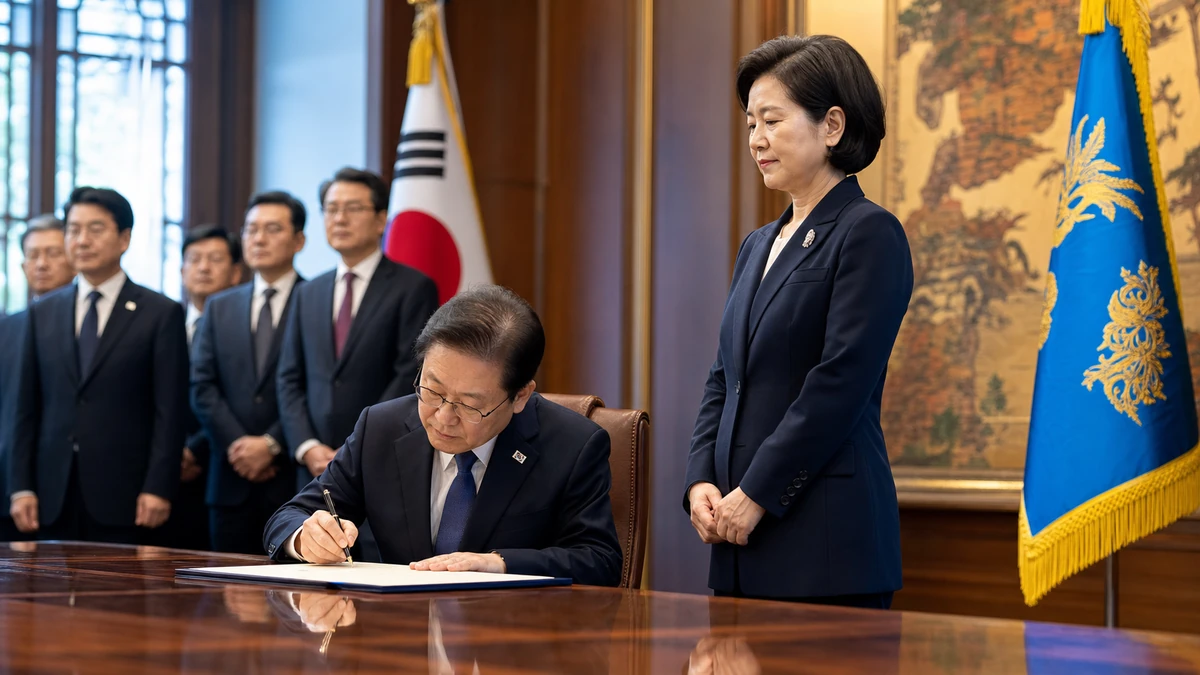
A new prime minister takes office in a familiar but politically charged transition
South Korean President Lee Jae-myung has formally approved the appointment of Han Seong-sook as prime minister, elevating her to one of the most powerful positions in the country’s government and making her only the second woman ever to hold the job. The move, finalized June 30 after the National Assembly approved her nomination, places Han at the center of a new phase for Lee’s administration at a moment when South Korea is balancing political polarization, questions about government legitimacy and the everyday demands of running a highly wired, globally important democracy.
For many Americans, the title can be confusing at first glance. South Korea has both a president and a prime minister, but it is not a parliamentary system like Britain, Canada or Japan. The president remains the dominant political figure and head of government. The prime minister, however, is far from ceremonial. The post serves as the president’s top administrative lieutenant, helping oversee ministries, coordinate policy across the bureaucracy and manage the mechanics of government. In periods of political friction or crisis, the office can become especially important as a stabilizing channel between the presidential office, the cabinet and the legislature.
That is one reason Han’s confirmation matters beyond the symbolism of her becoming the second woman to hold the office. In South Korea, where questions of hierarchy, institutional order and political accountability often carry unusual weight in public life, the prime ministership is both a practical governing role and a signal of how a president intends to run the state. Lee’s quick approval of Han’s appointment immediately after the parliamentary vote suggested that his administration wanted no prolonged vacancy and no visible interruption in the chain of executive management.
Han now becomes the 50th prime minister in South Korean history and the second to serve under Lee’s government. Her elevation followed a relatively fast process: she was nominated by the president earlier this month, underwent a confirmation battle in the National Assembly and was formally installed after lawmakers gave their consent. The speed of the transition underscores a point Korean officials appeared eager to emphasize: whatever the political noise in Seoul, the executive branch intends to project continuity.
That continuity was highlighted in a visual and political handoff that would resonate in Washington as well as Seoul. Outgoing Prime Minister Kim Min-seok spent his final day in office visiting police and fire officials, thanking front-line public servants and stressing that public safety work must continue regardless of political change at the top. It was a carefully chosen closing act, conveying that while leadership headlines dominate the news cycle, the state still has to keep the trains running, respond to emergencies and maintain public trust.
Why the appointment is historic for women in South Korean politics
Han’s appointment carries outsized symbolic importance because South Korea has had so few women in its highest executive posts. The first woman to become prime minister, Han Myeong-sook, took office in 2006. Two decades later, Han Seong-sook becomes only the second. In a country that is a global leader in technology, pop culture and manufacturing, political leadership has often remained more male-dominated than many outsiders might expect.
That gap is not unique to South Korea, of course. Americans do not need to look far for parallels. The United States has yet to elect a woman president, and women remain underrepresented in many top executive and legislative roles. But in South Korea, the symbolism operates within a political culture that can be especially formal and status-conscious, where appointments to elite state offices still carry deep social meaning. A woman’s rise to prime minister does not by itself change the structures that have historically limited women’s representation, but it does create a visible benchmark in a system where such milestones are rare.
The cultural significance is heightened by South Korea’s broader public debate over gender, generational change and social power. In recent years, the country has seen fierce arguments over workplace inequality, family expectations, falling birthrates, feminism and backlash to feminism. Those debates have played out not just in activist circles but in presidential campaigns, television commentary and online political communities. Any high-profile female appointment therefore tends to be interpreted in multiple ways at once: as a genuine breakthrough, as a political signal and as a test of whether symbolic progress translates into institutional change.
For Han, that means her historic status will be impossible to separate from her actual performance. She will be measured not just on the fact of her appointment but on whether she can manage cabinet coordination, navigate the National Assembly, respond to controversy and maintain administrative discipline. South Korean voters, like American voters, often grow skeptical when political leaders lean too heavily on representation without delivering visible competence. The symbolism may open the story, but it will not determine the ending.
Even so, the appointment matters. In democratic systems, representation is not a superficial concern. It shapes which faces the public sees as legitimate holders of power, which career paths appear realistic to younger generations and how institutions adapt to social change. In that sense, South Korea’s second female prime minister is not merely a historic footnote. It is a sign of how slowly, and sometimes unevenly, political norms are shifting in one of Asia’s most important democracies.
A confirmation fight reveals South Korea’s partisan fault lines
Han did not arrive in office through bipartisan acclaim. Her nomination passed the National Assembly, but the main conservative opposition, the People Power Party, boycotted the vote, arguing that she was unfit for office. The party pointed to allegations involving an unauthorized building expansion tied to a property in Seoul’s Jongno district and criticism related to a personal data leak in a startup initiative during her earlier tenure as minister of SMEs and startups.
For American readers, the procedural setup may sound a little like a hybrid of Senate confirmation politics and presidential appointment power. In South Korea, the president nominates the prime minister, but the appointment requires the consent of the National Assembly. That means the job cannot be filled by presidential will alone. The legislative vote is not a symbolic courtesy; it is a necessary step. Once lawmakers approved Han, Lee’s formal signoff completed the process.
Still, the opposition boycott leaves a political mark even if it does not block the appointment. Boycotts in South Korean politics are both a tactic and a message. They can be used to deny legitimacy to a process, dramatize protest and energize a party base that sees compromise as surrender. Americans have their own equivalents in walkouts, procedural brinkmanship and confirmation theater, though Korean parliamentary culture can make such gestures feel even more explicitly performative. In Han’s case, the boycott signaled that conservatives intend to keep questioning not only her record but the governing style of the Lee administration itself.
The confirmation process also exposed how personnel fights in South Korea often become proxy battles over broader legitimacy. Was Han a qualified administrator who had weathered a standard round of political attacks? Or was she a problematic nominee pushed through by a governing bloc determined to ignore ethical concerns? The answer depends heavily on party affiliation, which is precisely why such appointments matter. They become early indicators of whether a new or reconfigured administration can convert institutional control into durable political authority.
For Lee, securing Han’s confirmation despite the boycott demonstrates governing momentum. For the opposition, refusing to participate allows it to preserve a narrative that the new prime minister begins her tenure under a cloud. Both sides can claim something from the outcome. But the practical reality is that Han now takes office with unresolved political baggage. That does not make her position untenable, but it does mean that any stumble may be interpreted through the lens of a disputed confirmation.
What a South Korean prime minister actually does
To understand what comes next, it helps to understand what the office is designed to do. In the United States, the closest comparison might be a role somewhere between a chief operating officer for the federal government and a senior political coordinator with cabinet-level authority. The analogy is imperfect, but it gets at the heart of the position. South Korea’s prime minister is expected to oversee the general administration of ministries, coordinate central government agencies and support the president in carrying out national policy.
That can sound technocratic, but in practice it is deeply political. South Korean governments often face pressure to move quickly on economic policy, labor disputes, public safety issues, industrial strategy and regional diplomacy. The prime minister may not outrank the president, but the office often becomes the place where broad presidential priorities get translated into bureaucratic execution. When ministries compete, when implementation stalls or when parliament demands explanations, the prime minister’s office can become the central node of coordination.
How much clout a prime minister has depends on the president, the political environment and the crises of the day. Some prime ministers function mainly as loyal managers. Others emerge as visible public problem-solvers or political firewalls, absorbing pressure that might otherwise land directly on the president. In a polarized climate, the job also requires persuasion: not only internal management of ministries but external management of perception.
That is why Han’s first tests are likely to be judged on two fronts at once. Can she keep the machinery of government moving smoothly? And can she establish enough credibility to be more than an embattled appointee? Those are different challenges. Administrative competence may win respect inside government. Political credibility must be earned in public, under scrutiny, often while dealing with issues that are not of one’s choosing.
The timing of her appointment makes those tasks even more immediate. She succeeds Kim Min-seok without a long gap, reinforcing the government’s desire for uninterrupted administration. In practical terms, that matters because South Korea’s executive state, like any modern bureaucracy, depends on momentum. Budgets, safety operations, interagency directives and legislative negotiations cannot pause simply because one prime minister leaves and another arrives. The smoothness of the handoff is itself a statement about state capacity.
The message behind Kim Min-seok’s final day on the job
Kim’s last public schedule as prime minister may prove to be one of the more revealing details of this transition. Rather than end his tenure with a self-congratulatory farewell or a high-level political event, he visited police and fire agencies, including a station in Seoul’s Songpa district, to encourage front-line officials. He reportedly noted that his term would end at midnight and explained that he wanted to spotlight the work public servants do to protect citizens.
In any country, that would be a useful image. In South Korea, it carries additional weight because the public has become acutely sensitive to the competence of official institutions during crises. Questions of state response, emergency management and bureaucratic accountability can linger for years in the national consciousness. Visits to police and fire officials therefore are not just ceremonial gestures; they are signals about what government leaders want to foreground as proof of responsible governance.
For Americans, the equivalent would be a departing cabinet official making a final stop with emergency responders rather than on cable news. It is a reminder that beneath the factional politics and leadership intrigue lies a simpler governing compact: public officials are expected to keep people safe, keep systems functional and maintain order. Kim’s farewell message appeared designed to emphasize that the turnover at the top should not interrupt the ordinary but essential work of the state.
That framing also helps the Lee administration. A seamless transition from one prime minister to the next can reassure markets, civil servants and foreign partners that the government is not entering a period of administrative drift. South Korea is too strategically important, and too economically integrated into global supply chains, for leadership vacuums to be treated lightly. Whether the issue is semiconductor policy, trade strategy, national security coordination or domestic disaster response, continuity matters.
Han steps into that continuity narrative, but she will also have to own it. The public will now look to her not merely as a historic appointee but as the person responsible for ensuring that ministries stay aligned and that controversies do not distract from core state functions. In that sense, Kim’s final-day optics may end up serving as the first implicit benchmark for Han’s tenure: steady, practical, focused on administration rather than drama.
Why the world is paying attention to a domestic personnel move in Seoul
At one level, this is a classic domestic political story: a president nominates a top official, parliament fights over the choice, the opposition protests and the administration pushes ahead. But South Korea is not just any democracy. It is the world’s 10th- or 12th-largest economy, depending on the measure, a treaty ally of the United States, a critical player in advanced manufacturing and a cultural superpower whose music, television, film and beauty industries shape global trends. Political developments in Seoul can no longer be treated as regional footnotes.
That is especially true at a time when Americans are more familiar with South Korea than ever before. K-pop, Korean dramas and Oscar-winning films have brought many U.S. audiences into contact with Korean society, but pop culture can flatten political complexity. It can create the illusion of familiarity without much understanding of institutions. Stories like Han’s appointment are reminders that South Korea is not just the producer of global entertainment hits; it is also a robust, intensely contested democracy with its own constitutional architecture, partisan habits and debates over representation.
The appointment also offers a window into how democratic legitimacy is assembled. Han’s rise required several elements: presidential nomination, parliamentary consent, public scrutiny, opposition challenge and final executive approval. Even critics who rejected her candidacy were participating in a system that channels conflict through formal institutions. That does not make the process clean or universally trusted, but it does make it legible as democratic politics rather than opaque elite bargaining alone.
For foreign observers, the story also raises a broader question: how do democracies balance the symbolic value of representation with the practical demands of governing? That question is as familiar in the United States as it is in South Korea. A barrier-breaking appointment can inspire pride and criticism at the same time. Supporters may see overdue progress; detractors may accuse leaders of using identity to shield a nominee from scrutiny. Both impulses are part of democratic life. What ultimately matters is whether the officeholder can turn a symbolic beginning into a credible record.
Han’s appointment is therefore significant not because it resolves South Korea’s debates over gender, power or executive leadership, but because it places those debates inside one office at one pivotal moment. Her tenure will be watched for what it says about Lee’s government, about the capacity of Korean institutions to manage division and about whether historic representation can coexist with hard-nosed administrative performance.
Han’s first challenge: proving symbolism and governance can coexist
Now that the formal process is complete, the political honeymoon, if it exists at all, is likely to be brief. Han begins with history on her side and controversy at her back. She takes office as the second woman ever to become South Korean prime minister, but also as a nominee whose confirmation exposed deep partisan mistrust. The burden is now on her to show that her appointment was more than a milestone and more than a political calculation.
That means demonstrating competence in the unglamorous work that often defines successful prime ministers: coordinating ministries, supporting presidential priorities without becoming politically invisible, engaging lawmakers without appearing captive to them and managing day-to-day state functions that most voters only notice when something goes wrong. In a system where the president remains the dominant figure, the prime minister’s effectiveness often depends on a mix of loyalty, discipline and independent stature.
The opposition’s boycott suggests that Han will face continued questioning over both ethics and judgment. Those issues may reemerge in future legislative sessions, media reports or opposition messaging campaigns. If they do, her response will matter as much as the underlying facts. South Korean politics, like American politics, often turns on whether a public official appears candid, defensive, dismissive or in command.
Still, the immediate reality is straightforward. The National Assembly approved the nomination. The president signed off. Han Seong-sook has taken office as South Korea’s 50th prime minister and the second woman ever to serve in the role. The transition happened quickly, the government avoided a prolonged vacancy and the symbolism is impossible to ignore.
What happens next will determine whether this moment is remembered chiefly as a historic first-in-a-generation breakthrough or as the beginning of a difficult, closely scrutinized term. For now, South Korea has entered a new chapter in its executive leadership, one that combines a milestone for women in politics with the familiar democratic tensions of partisanship, legitimacy and the stubborn demands of governing. In Seoul, as in Washington, history may open the door. Performance decides how long it stays open.
Comments
Post a Comment