A routine weather bulletin with a larger story behind it
A forecast for scattered afternoon showers might sound like the most ordinary kind of news. In the United States, it is the sort of update many people glance at on a weather app before deciding whether to bring an umbrella to work, move a Little League game indoors, or postpone a backyard cookout. In South Korea, though, a seemingly modest forecast can reveal something larger about how closely daily life is tied to fast-changing summer weather — especially in a country where dense cities, mountain terrain and a highly mobile population can make even a short burst of rain feel consequential.
South Korea’s weather agency said Tuesday, June 30, is expected to bring cloudy skies and localized showers in many parts of the country, according to Yonhap News Agency. The key detail is not a long, nationwide rain event of the sort associated with the East Asian monsoon season, but rather the kind of brief, concentrated summer showers that tend to arrive between the afternoon and evening hours. Forecast target areas include inland parts of Seoul and Gyeonggi Province, inland and mountainous parts of Gangwon Province, inland areas of the Chungcheong region, eastern inland parts of North Jeolla Province, and inland sections of North Gyeongsang Province.
That distinction matters. A day of all-day rain changes plans in obvious ways. A day of hit-or-miss summer showers changes behavior more subtly, but often more frequently: commuters time their trip home differently, office workers decide whether to walk to dinner or take the subway one stop, hikers rethink a mountain trail, and families weigh whether a short outdoor outing is worth the risk of getting caught in a downpour.
For American readers, an easy comparison might be the pop-up thunderstorm pattern familiar in places like Florida, the Mid-Atlantic or parts of the Midwest in summer. The difference is that in South Korea, those choices often play out in a much denser physical environment. Apartment towers, crowded business districts, mountain parks and transit hubs sit close together, and a large share of people move through their day on foot or through public transportation. That means even a 20- or 30-minute stretch of hard rain can ripple through city life more noticeably than the same weather might in a more car-dependent American suburb.
As of June 29, 2026, the forecast is not being framed as a major disaster story. It is a reminder of something more ordinary and, in some ways, more telling: South Korean summer weather is not just a background condition. It is part of the rhythm of the day, shaping how people move, meet, work and travel.
Why timing matters as much as rainfall totals
One of the most notable parts of the forecast is the time window. The Korea Meteorological Administration said showers are expected in some places from the afternoon into the evening. In practical terms, that means the weather is most likely to intersect with some of the busiest hours of the day — the commute home, after-school movement, errands, appointments and evening social plans.
That timing may matter as much as the total rainfall. Forecast accumulations vary by region. Inland areas of Seoul and Gyeonggi, inland and mountain areas of Gangwon, the Daejeon-Sejong-Chungcheong inland belt, and eastern inland North Jeolla are expected to see roughly 5 to 40 millimeters of rain. Eastern inland South Jeolla and inland parts of North Gyeongsang are forecast to receive around 5 to 20 millimeters.
To an American audience, those numbers may not sound dramatic at first glance. Five millimeters is little more than a nuisance, the kind of brief rain that leaves sidewalks slick and umbrellas dripping in store entrances. But 40 millimeters falling in a short period is another story. That can overwhelm a casual walk home, slow traffic, drench bus riders between stops and create rapidly changing conditions on roads, trails and low-lying paths.
And because these are localized showers, the practical question for residents is often not just “How much rain is expected?” but “Where exactly will it hit, and when?” One neighborhood may remain merely overcast while another gets a sudden cloudburst. In mountainous or inland terrain, weather can shift fast enough that people in nearby areas experience very different conditions at the same hour.
That is a familiar challenge in many parts of the world, but it has particular resonance in South Korea, where the distance between a central business district, a suburban neighborhood and a hiking trail can be relatively short. The country’s geography compresses a lot of different ways of living into a compact space. A worker leaving an office in Seoul, a traveler crossing inland expressways, and a family spending part of the afternoon near a riverbank or mountain valley may all be dealing with the same weather system in very different ways.
That helps explain why weather coverage in South Korea often functions as practical life news, not just environmental reporting. A short-lived weather event can trigger a chain of small decisions that add up across millions of people.
Cloudy nationwide, but not one single weather story
The forecast also underscores a point that outsiders sometimes miss about South Korea: It is a relatively small country geographically, but not one that can be reduced to a single weather experience on any given day. The national picture for June 30 is broadly cloudy, yet regional conditions are expected to differ. The central region is forecast to be mostly cloudy at times, while southern areas are expected to start with plenty of clouds before turning more overcast later in the day.
That may sound like a subtle distinction, but subtle shifts matter in a place where weather can change the feel of a city or region within hours. South Korea’s capital region, which includes Seoul and surrounding Gyeonggi Province, is one of the most densely populated urban areas in the world. Any weather change there is experienced at scale. A burst of rain does not just inconvenience a few drivers. It affects pedestrians streaming out of office towers, commuters descending into subway stations, delivery workers on tight schedules and restaurant districts waiting for the evening crowd.
Gangwon Province, by contrast, is often associated with mountains, ski resorts, scenic routes and outdoor travel. Weather in inland and mountainous Gangwon can feel sharper and less predictable because of topography. In American terms, it is the difference between forecasting for downtown Washington and for the foothills of the Appalachians, except compressed into a much smaller national map.
The inclusion of inland areas across Chungcheong, North Jeolla and North Gyeongsang in the shower forecast also reinforces that this is not just a coastal or capital-area story. It is a pattern extending across multiple inland corridors of the Korean Peninsula. That makes it emblematic of summer weather in South Korea: not a single front marching uniformly from one side of the map to the other, but a patchwork of local effects shaped by terrain, heat buildup and atmospheric instability.
For travelers, that can be especially important. A tourist might leave central Seoul under a gray but dry sky, take a train or bus toward a regional destination, and encounter a very different weather picture by late afternoon. In a country where domestic travel is fast and common, even routine weather forecasts carry logistical significance.
What a warning for gusts, lightning and hail really means
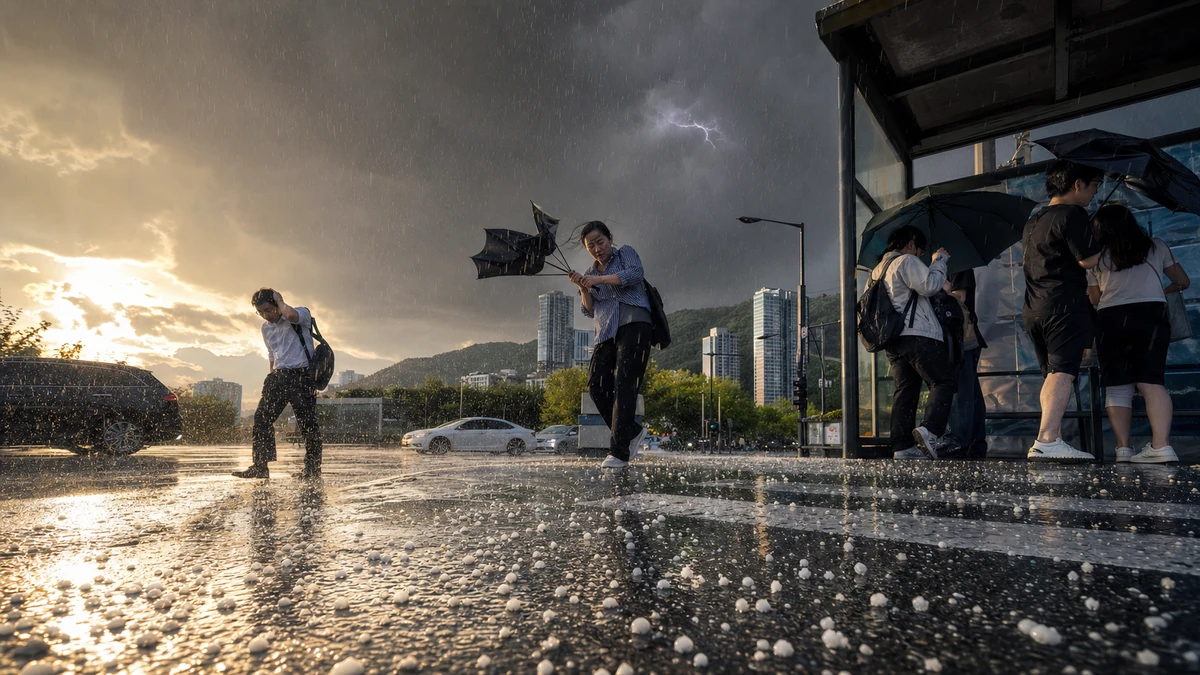
The forecast did not stop at rain. Weather officials also warned people to watch for strong wind gusts, thunder and lightning, and even hail. That broadens the story from inconvenience to safety.
In American weather coverage, hail warnings often immediately suggest damage to cars, roofs or crops, especially in parts of the Plains or Mountain West where large hail is a familiar seasonal hazard. In South Korea, hail is less about a stereotypical severe-storm identity and more about surprise — one more example of how a seemingly ordinary summer shower can abruptly become disruptive. Pedestrians, parked vehicles and outdoor facilities can all be affected, especially if people are caught off guard because the day began merely cloudy rather than stormy.
Thunder and lightning add another layer of concern in a country where outdoor activity is woven into everyday life. South Koreans make heavy use of neighborhood parks, riverside walking paths, mountain trails and open-air commercial streets. Even after work, cities remain active well into the evening, with restaurants, cafes and shopping districts filling up quickly. When a forecast specifically flags the period from afternoon into evening, it is speaking directly to the busiest transition in the social day.
This is where weather in South Korea becomes a story about urban habits. Office workers often leave buildings at roughly the same time. Students and families are in motion. Delivery services are active. Businesses with street-facing foot traffic depend on weather-sensitive patterns. A thunderstorm warning during that window is not just a meteorological detail; it is a practical signal to adjust plans, leave earlier, choose indoor routes or delay outdoor activity.
For U.S. readers, it may help to think of how a sudden summer storm affects a downtown corridor in Manhattan, Chicago or Boston at rush hour, when thousands of people are on sidewalks rather than in private driveways. South Korea’s major cities function more like that kind of environment than the sprawling, car-centered landscapes many Americans know best. Rain is felt collectively, in public space.
The mention of gusty winds also matters in mountain and inland areas, where weather can turn quickly and where streams, valleys and trails can become risky faster than visitors expect. The official takeaway is straightforward: This is the kind of forecast that calls for flexibility, not panic. Bring rain gear, check updates and think twice about exposed or weather-sensitive plans.
How South Korea’s localized alerts shape public awareness
The June 30 shower forecast is also easier to understand in light of weather alerts issued the day before. On June 29, the Korea Meteorological Administration said it would issue a heavy rain advisory for Jangsu in North Jeolla Province beginning at 6:45 p.m. Under South Korean criteria, a heavy rain advisory is issued when rainfall is expected to reach 60 millimeters in three hours or 110 millimeters in 12 hours.
That same day, a heavy rain advisory for Hoengseong in Gangwon Province was lifted at 8:30 p.m. The quick issuance and lifting of alerts in different places illustrate how South Korea handles summer weather at a highly localized level. One area can be easing out of dangerous conditions while another is entering them. That is not unusual in countries with variable summer weather, but the Korean system’s fine-grained, place-specific nature is a useful reminder that national forecasts often sit on top of a much more detailed local warning structure.
In Jangsu, authorities also warned residents and visitors to watch for hazards such as swollen valleys and overflowing streams. That kind of advisory points to another important part of Korean summer weather culture: Inland and mountainous leisure spaces can become dangerous quickly. A streamside rest stop, a valley campsite or a riverside path that feels calm in fair weather may become hazardous after a short period of heavy rain upstream or nearby.
Americans may recognize the parallel from flash-flood warnings in canyon country, foothill areas or low-water crossings. The principle is the same. A rainfall event does not have to feel apocalyptic to become dangerous. A sudden concentration of water in the wrong place at the wrong time is enough.
That is why even a relatively routine shower forecast carries a kind of public-service message. It tells people not only whether they might get wet, but also whether they should rethink where they are going, how late they stay out, or whether a scenic outdoor detour is worth it.
What this means for commuters, businesses and travelers
For residents, the most immediate effect of a forecast like this is on movement. In Seoul and surrounding cities, where commuting patterns are dense and predictable, late-day showers can slow an already crowded system. The subway usually keeps moving, but the experience around it changes: station entrances become congested, umbrellas collide on sidewalks, buses run a little slower and people looking at the sky make rapid decisions about whether to walk, wait or pay for a taxi.
For businesses, especially small restaurants, cafes and neighborhood shops, weather can influence customer flow in surprisingly direct ways. South Korean commercial districts often rely heavily on foot traffic. If a shower strikes right before dinner hours, the result may not be dramatic enough to make national economic news, but it can still matter to individual businesses, shifting crowds by blocks or by the hour.
Students and families also feel these forecasts in practical ways. Summer in South Korea involves after-school academies, evening classes, errands and family outings that often continue into the later part of the day. A warning for thunderstorms and hail in the afternoon-to-evening window is effectively a warning aimed at one of the busiest periods in household scheduling.
For foreign visitors, especially those unfamiliar with Korean summer weather, the main lesson is not to overreact but to stay adaptable. South Korea is easy to navigate, and much of urban life is built around excellent public transportation and dense infrastructure. But that same walkability means short bursts of rain can interrupt plans more than some travelers expect. A visitor moving between palace grounds, shopping districts and cafes in Seoul; heading to a mountain area in Gangwon; or making a regional trip through inland provinces could find that a brief shower meaningfully alters the day’s route and timing.
The available information does not indicate any specific festival cancellations, transit shutdowns or facility closures. That is important. Good weather reporting distinguishes between what is known and what is speculative. In this case, what is known is that many parts of the country could see localized showers from the afternoon into the evening, with risks including gusty winds, lightning and hail. Beyond that, the sensible conclusion is simply that people should leave room in their plans for change.
A small forecast that captures the feel of a Korean summer
There is a reason a modest weather item can feel revealing. Summer in South Korea is often discussed abroad in broad seasonal terms: heat, humidity, monsoon rains and typhoon season later in the year. Those are real features of the climate, but they do not fully capture how weather is actually experienced on the ground. Much of summer is made up of smaller decisions — whether to bring an umbrella, whether to leave now instead of later, whether to keep a hike short, whether to choose the subway over a longer walk.
This forecast, in that sense, says less about catastrophe than about tempo. A short shower can slow the pace of a city for an hour. It can make a riverside path feel risky instead of relaxing. It can turn a routine commute into a damp scramble. Then it can pass, leaving behind steam rising from pavement and a skyline that looks almost unchanged, even though the day’s rhythm has shifted.
That is part of what makes weather such effective social reporting. It shows not only what the atmosphere is doing, but how people live within it. In South Korea, where public life is dense, schedules are tight and geography changes quickly from urban core to mountain interior, weather forecasts are often less about abstract climate data than about real-time choices.
For an American audience, the broader takeaway is easy to understand. Just as a summer thunderstorm in Atlanta or Washington can rearrange an evening commute, a line of pop-up storms in South Korea can reset the tone of a day. The Korean version is shaped by different transit habits, denser cities and a landscape where mountains are never too far away, but the human story is familiar: people look up, check the forecast and adjust.
That is why Tuesday’s forecast matters. Not because it predicts a sweeping national emergency, but because it offers a clear, ordinary portrait of how a country moves through summer — one shower, one commute and one changing sky at a time.
Comments
Post a Comment