Ozone Alert in South Korea’s Greater Seoul Area Offers a Window Into How a Hyperconnected Society Manages Everyday Risk
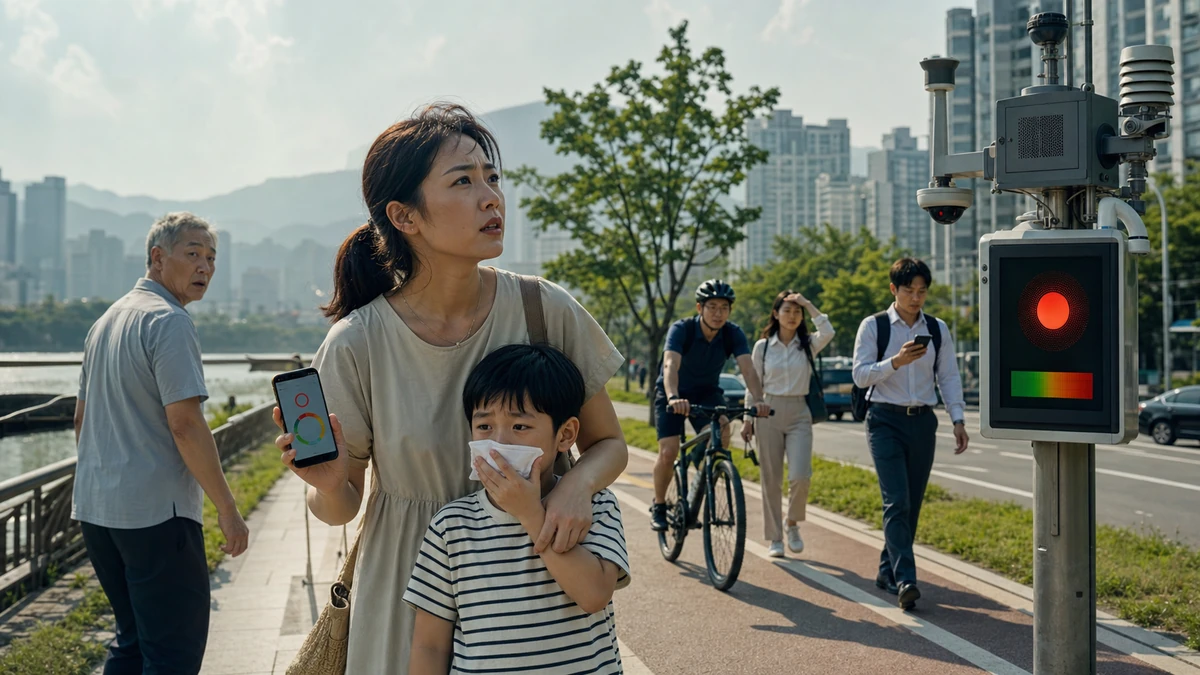
An afternoon air alert ripples across eastern Gyeonggi Province
South Korea on Tuesday afternoon issued an ozone advisory for seven cities and counties in the eastern part of Gyeonggi Province, the densely populated region that surrounds Seoul, according to the Ministry of Environment and the Korea Environment Corp. The alert took effect at 3 p.m. local time and covered Seongnam, Namyangju, Gwangju, Hanam, Guri, Yangpyeong and Gapyeong — a cluster of communities that, while administratively separate, function for many residents as part of one broad daily living zone tied to the capital region.
The reported one-hour average ozone concentration in the area reached 0.1264 parts per million, just above the 0.12 ppm threshold that triggers an ozone advisory under South Korean standards. That number may look technical, even minor, to readers used to skimming weather data or Air Quality Index notifications on their phones. But in South Korea, where public alerts are integrated tightly into everyday urban life, it is enough to change how people move through the day: whether children spend extra time outside after school, whether older adults go for an afternoon walk, whether joggers postpone a run, and whether families decide to keep windows shut a little longer.
For Americans, the closest comparison may be the way heat advisories, wildfire smoke warnings or severe thunderstorm alerts increasingly shape daily decisions in cities from Los Angeles to Chicago to Atlanta. South Korea’s air-quality alert culture works in a similar way. It is not just an environmental policy matter or a niche concern for scientists. It is consumer information, public-health guidance and civic infrastructure all at once — the kind of thing commuters, parents and office workers check alongside the forecast and transit updates.
The latest advisory was not the highest level in South Korea’s warning system. Under the country’s guidelines, an ozone warning is issued at 0.30 ppm and a severe ozone warning at 0.50 ppm. Still, the Tuesday alert signaled a level high enough for authorities to urge caution, especially for children, older adults and people with respiratory or heart conditions.
That makes the development more than a routine environmental bulletin. It is also a snapshot of how South Korea, one of the world’s most wired and urbanized societies, has built a habit of translating invisible environmental conditions into real-time instructions for daily life.
What an ozone advisory means — and why ozone is different from the ozone layer
For many English-speaking readers, the word “ozone” may call to mind the ozone layer high in the atmosphere, the protective shield that helps block harmful ultraviolet radiation. But the ozone that triggers local public-health alerts is something different: ground-level ozone, a pollutant formed when emissions from vehicles, industrial facilities and other sources react in sunlight and heat.
In practical terms, that means ozone problems often intensify on warm, sunny afternoons, especially in metropolitan areas with dense traffic and industrial activity. Ground-level ozone can irritate the lungs, worsen asthma, trigger chest discomfort and make outdoor exertion harder even for otherwise healthy people. For vulnerable groups, the risks are more immediate.
That is why South Korean authorities advise children, older adults, and people with heart or lung disease to limit outdoor activity when an ozone advisory is in effect. Officials also recommend that the broader public avoid prolonged outdoor activity or strenuous exercise. In other words, this is not the kind of alert reserved only for people with severe preexisting health conditions. It is meant to shape routine behavior more broadly, especially during the hours when ozone concentrations peak.
American readers may find the concentration figure — 0.1264 ppm — harder to interpret than the color-coded scales often used in U.S. weather apps. But the logic is familiar. Just as U.S. cities issue alerts on poor air days tied to wildfire smoke, smog or extreme heat, South Korea uses threshold-based public messaging to prompt quick behavior changes before conditions worsen. The number itself matters mainly because it crosses a line set by public-health regulators. Once it does, that threshold becomes a signal to schools, families and residents that the air is no longer simply a background condition.
And that is a key point in understanding modern South Korean urban life: air quality has become part of the daily information ecosystem. It is not unusual for people to monitor pollution levels in near real time, much as Americans increasingly follow pollen counts, hurricane tracks or smoke maps. In South Korea, where the population is concentrated in and around major metropolitan areas and environmental conditions can shift quickly, that habit has become deeply normalized.
The seven communities reflect one shared metropolitan lifestyle
The advisory area itself helps explain why this kind of announcement resonates beyond a single municipality. The seven places named in Tuesday’s alert stretch across eastern Gyeonggi Province, the broad belt surrounding Seoul. Some, like Seongnam and Hanam, are closely tied to the capital’s urban economy and commuter networks. Others, such as Yangpyeong and Gapyeong, are better known to many Koreans for greener landscapes, weekend getaways and a more relaxed atmosphere outside the city core.
Yet the advisory grouped them together because air does not observe municipal boundaries, and because South Korea’s greater Seoul region functions as a tightly linked everyday ecosystem. Residents commute across city lines, students travel between districts, and families treat the larger region as a single practical living space. This is one of the defining features of life around Seoul: the map may show many jurisdictions, but daily routines often unfold across them seamlessly.
For Americans, a useful comparison might be the way people experience the New York metropolitan area, Southern California or the Washington region. Air conditions in one county can affect people well beyond that county if commuting patterns, weather systems and shared infrastructure bind those places together. South Korea’s capital region operates in much the same way, though often at an even more compressed and interconnected scale.
That makes this kind of advisory especially consequential. It reaches office workers leaving buildings in Seongnam, parents planning pickup routines in Hanam, retirees considering a walk in Guri, and families heading toward leisure areas in Gapyeong or Yangpyeong. The warning does not distinguish between dense city neighborhoods and scenic outskirts. Instead, it turns a regional atmospheric condition into a local decision point for many different kinds of communities at once.
It also carries a useful message for foreign visitors, including American tourists who may be planning side trips from Seoul. Travelers often think first about train schedules, restaurant reservations, popular filming locations from Korean dramas, or mountain and riverside destinations outside the capital. But local air-quality advisories can also shape whether a day trip is comfortable or advisable, particularly for young children, older travelers or anyone with asthma or cardiovascular concerns. In that sense, South Korea’s environmental alert system is not just a domestic convenience. It is part of the practical knowledge needed to navigate the country safely.
Why air alerts have become ordinary public information in South Korea
One of the most striking aspects of this story is not simply that an ozone advisory was issued, but how ordinary such messaging has become. In South Korea, environmental notices increasingly sit alongside weather forecasts, transit information, emergency texts and school updates as part of the daily flow of civic communication. The state, local governments and public agencies have invested heavily in turning environmental data into actionable information that can be distributed quickly and broadly.
That reflects broader patterns in South Korean society. The country is known internationally for its high-speed internet, smartphone penetration, efficient public transit and tech-savvy public services. Those same strengths also shape how people encounter risk. Whether the issue is fine dust, heavy rain, heat, cold snaps or poor ozone conditions, information is expected to move fast, arrive clearly and help people make immediate choices.
For American readers, this may sound familiar in concept but distinctive in intensity. In the United States, push alerts for weather and public safety are common, but environmental notifications can still feel fragmented across apps, local governments and media outlets. In South Korea, there is often a stronger expectation that public institutions will provide timely, standardized guidance that residents can fold into everyday routines. It is part of a broader public culture in which data-driven alerts have become woven into the rhythm of urban living.
This also helps explain why a relatively modest-looking news item can carry broader significance. The ozone advisory is not a dramatic disaster story. It is a small but telling example of how an advanced urban society manages low-visibility risks before they become emergencies. The system is built not around spectacle but around calibration: measure the condition, classify the level, notify the public and adjust behavior.
That is especially important for groups who are disproportionately affected by air pollution. When authorities say children and older adults should cut back on outdoor activity, they are doing more than offering a generic caution. They are signaling whose health matters most in a preventive public-health framework. It is a reminder that the quality of a city is not measured only by skyscrapers, cultural exports or transit efficiency, but also by how well it protects people who are least able to absorb environmental stress.
A familiar issue in a country better known abroad for pop culture
For many Americans, South Korea is most visible through the global success of K-pop, Korean film, television dramas, beauty products and consumer technology. Those industries have helped make the country feel culturally close, even to audiences who have never visited. But stories like this one offer another side of contemporary South Korea: a highly urban, densely networked society grappling with the same environmental and public-health pressures that shape life in other advanced economies.
That matters because the Korean Wave, or “Hallyu,” often exports polished images of modern city life — sleek neighborhoods, efficient infrastructure, fashionable cafes, dramatic skylines and mountain views just beyond the urban edge. Those elements are real. But so are the practical challenges of living in a region where traffic, climate conditions, industrial activity and population density can combine to create episodes of poor air quality.
In that sense, South Korea’s ozone advisory is not an isolated local oddity. It belongs to a global urban story. Cities around the world are learning that climate-related and pollution-related risks do not always arrive as headline-grabbing catastrophes. Often they show up as ordinary warnings on ordinary afternoons: smoke in one region, extreme heat in another, unhealthy ozone in yet another. The public-health challenge is making sure those warnings are legible, trusted and acted upon.
South Korea’s system suggests one answer: build a culture where environmental data is treated as everyday life information rather than specialist knowledge. People do not need to become atmospheric scientists. They simply need reliable, accessible signals that tell them when to change plans.
That may be one reason this kind of story resonates beyond Korea. Americans, too, are becoming accustomed to checking the air before heading outside, especially in areas affected by wildfire smoke, industrial pollution or summer smog. What once felt exceptional is increasingly routine. South Korea’s advisory therefore reads not only as foreign news but as a recognizable feature of 21st-century metropolitan life.
How the alert was reported also says something about modern newsrooms
Another detail in the original reporting is worth noting: the news item was based on public data from the Ministry of Environment and the Korea Environment Corp. and was automatically generated before being reviewed by an editor. That combination — machine-assisted drafting plus human editorial oversight — reflects a broader transformation in how news organizations handle time-sensitive service journalism.
Air-quality alerts are a good candidate for this approach because speed matters. If ozone levels cross an advisory threshold at 3 p.m., the information is most useful right then, not hours later after a fully reported feature has been assembled. Automation can help convert structured public data into readable, timely copy. Editorial review, meanwhile, helps protect against errors and places the information in appropriate context.
American newsrooms are moving in similar directions, especially for elections, market summaries, weather data, sports results and public-service alerts. The challenge is balancing efficiency with trust. When the information affects health or safety, readers need to know not only that it is fast, but that it has also been checked.
In this case, the process underscores how environmental reporting is evolving. Not every important story begins with an interview or a dramatic scene. Sometimes it begins with a threshold in a government dataset and ends with thousands of people making slightly different decisions about school pickup, exercise, commuting or caregiving. That is still journalism, particularly when the role of the newsroom is to turn technical information into public understanding.
It is also part of a larger media shift in South Korea, where public-service information often moves quickly through digital platforms and audiences expect updates in real time. For foreign observers, that detail may sound procedural. But it speaks to the infrastructure behind modern public awareness — an infrastructure that is increasingly as important as the alert itself.
A small story that reveals a great deal about contemporary Korea
On its face, Tuesday’s ozone advisory in eastern Gyeonggi Province is a modest local bulletin. No roads were closed. No evacuation was ordered. No single dramatic event unfolded. Yet that is precisely why the story is revealing. It shows how a modern society governs the in-between space between normalcy and crisis, where public well-being depends on subtle adjustments rather than emergency response.
In South Korea, that means treating air as something to be monitored, interpreted and translated into daily instructions. It means recognizing that a reading of 0.1264 ppm, while not catastrophic, is still meaningful enough to alter plans for children, older adults and people with underlying health conditions. It means understanding that the boundaries between city and suburb, downtown and leisure area, commuter belt and retreat destination do not protect anyone from regional air conditions.
And it means seeing information itself as a form of public infrastructure. A good city is not just one with roads, rail lines and apartment towers. It is also one that can tell residents, in time to matter, when the air has become a problem and what they should do next.
For American audiences trying to understand South Korea beyond entertainment headlines and geopolitical flashpoints, that may be the most useful takeaway. The country’s sophistication is visible not only in its exports or its technological reputation, but in the fine-grained systems it uses to manage everyday life. An afternoon ozone advisory may not seem like major international news. But it offers a clear, grounded picture of how contemporary Korea works: fast, data-rich, highly organized and acutely aware that even invisible environmental shifts can shape the rhythm of an ordinary day.
As cities around the world confront rising heat, pollution and other climate-linked pressures, that lesson is likely to feel increasingly familiar. South Korea’s warning this week was local. The story it tells is global.
Comments
Post a Comment