South Korea Opens First Formal Listening Session for Indian Businesses, Signaling a More Practical Phase in Seoul-New Delhi Ties
A quieter diplomatic milestone with bigger economic implications
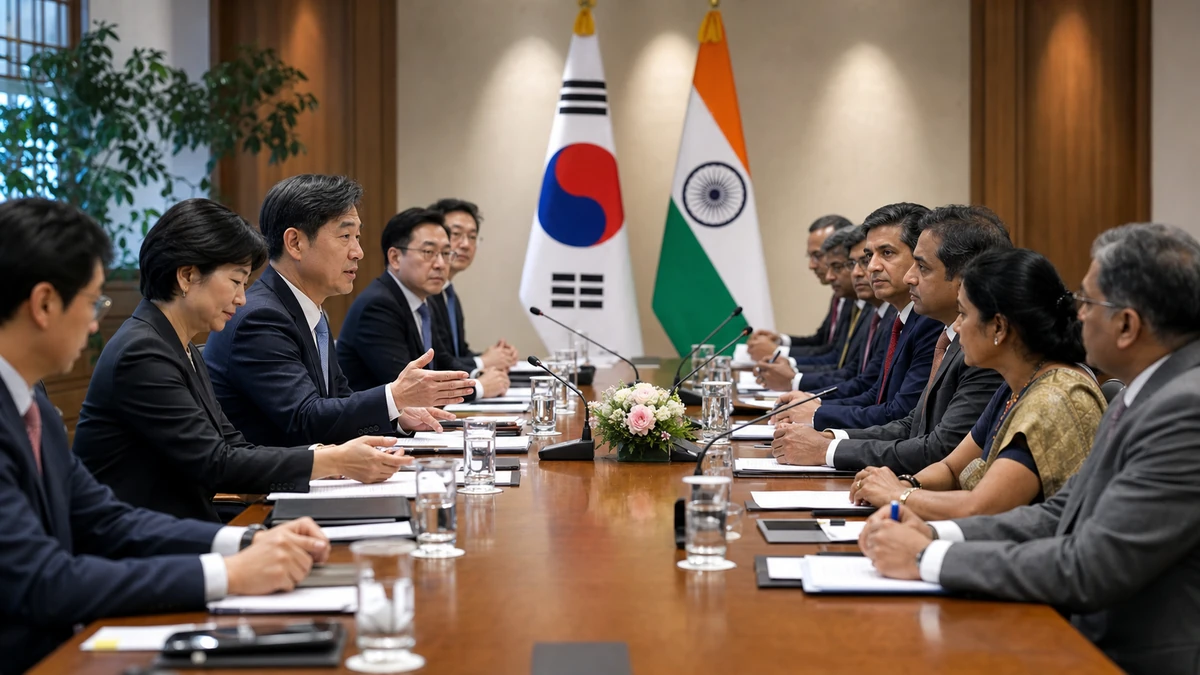
South Korea’s Foreign Ministry this week held its first formal roundtable with Indian companies operating in the country, a modest-sounding event that nonetheless says a great deal about where Seoul’s relationship with New Delhi is headed. According to South Korean officials, the meeting was organized jointly with the Indian Chamber of Commerce in Korea and focused on a simple but important question: What obstacles are Indian businesses running into on the ground, and what can the Korean government do about them?
That may sound procedural, even bureaucratic. In Washington terms, it is the kind of meeting that might not make front-page news but often matters more than the grand rhetoric of a state visit. When governments begin asking foreign businesses not just to invest, but to spell out what is making investment difficult, it usually means the relationship is maturing from symbolism into systems. That appears to be the case here.
The roundtable comes after South Korean President Lee Jae-myung’s state visit to India in April, which both governments have framed as a turning point for economic cooperation. If summit diplomacy is the headline, this week’s gathering is the fine print. And in trade and investment, the fine print often determines whether political promises turn into actual factories, supply contracts, research partnerships or jobs.
What makes the meeting especially notable is that South Korea’s Foreign Ministry said it was the first time the government had separately convened Indian companies doing business in Korea specifically to hear their concerns and recommendations. That “first” matters. It suggests that Seoul is beginning to treat Indian firms inside Korea not as a side issue but as a constituency in the bilateral relationship, one worthy of structured consultation.
For American readers, a useful comparison might be the way U.S. officials court foreign semiconductor, auto or battery investors with tailored outreach, promising faster coordination across agencies when red tape threatens a strategic investment. South Korea, one of the world’s most export-driven economies, appears to be moving more deliberately in that direction with India.
From summit optics to working-level diplomacy
South Korea’s relationship with India has long been described in broad strategic terms: two Asian democracies, both wary of supply-chain vulnerabilities, both looking to diversify economic partnerships beyond overdependence on China, and both interested in expanding cooperation in manufacturing, technology and defense. But those talking points only go so far if companies on either side struggle with visas, certification rules, customs procedures, local compliance or simply figuring out which government office to call when a problem emerges.
That is why the language surrounding this meeting is so significant. South Korean Foreign Minister Cho Hyun, in welcoming remarks, pointed to a reciprocal step taken by India: the Prime Minister’s Office recently launched what officials described as “Korea Business Week,” a forum designed to hear directly from South Korean companies about their difficulties operating in India. Seoul’s new meeting with Indian firms was presented explicitly as a response to that effort.
In diplomatic language, that is reciprocity. In practical language, it is governments saying: if you listen to our companies in your market, we will listen to yours in ours. That may seem basic, but in international economic relations it can be a meaningful signal of seriousness. Too often, governments frame market access issues as complaints coming from one side only. A more balanced structure acknowledges that friction exists in both directions and that trust grows when each country is willing to examine its own business environment, not just criticize the other’s.
This is also a reminder that modern diplomacy is no longer limited to treaty negotiations and high-level security talks. Much of today’s statecraft happens at the intersection of commerce, regulation and geopolitics. Countries compete to attract investment, secure strategic industries and position themselves in new supply chains. In that environment, helping a foreign company navigate licensing or regulatory bottlenecks is not just administrative housekeeping. It is part of economic diplomacy.
South Korea, which has spent decades transforming itself into a global manufacturing and technology power, is particularly attuned to this. The country knows from experience that foreign investors want more than a welcoming speech. They want predictability, fast-moving agencies and clear channels for raising concerns when something goes wrong.
Why Indian companies in Korea matter now
The timing of this outreach reflects a larger shift in how India is viewed in Seoul and across much of the industrialized world. India is no longer seen only as a vast consumer market or a back-office technology hub. It is increasingly treated as a strategic economic partner, a source of capital, talent and manufacturing cooperation, and a country whose companies could play a larger role in sectors ranging from pharmaceuticals and IT services to advanced manufacturing and logistics.
For South Korea, there is an obvious strategic logic. Korean companies have long sought deeper access to India’s huge and growing market, even as they have encountered familiar frustrations: regulatory complexity, infrastructure bottlenecks and the uneven pace of reform across sectors. Supporting Indian firms in Korea may help build the goodwill and institutional habits needed to smooth those same issues for Korean firms in India.
But there is also a more direct domestic interest. Korea, like many advanced economies, is competing for investment in a more fragmented global economy. Supply chains are being reconfigured. Companies want alternatives to single-country dependence. Governments from the United States to Japan to the European Union are using industrial policy and targeted incentives to pull investment into sectors they consider strategic. South Korea does not want to be left out of that contest.
If Indian firms can establish successful operations in Korea, Seoul could strengthen its role as a regional base for research, partnerships and market entry into Northeast Asia. That may be particularly attractive for Indian companies looking to connect with Korean manufacturing ecosystems, technology firms or high-value consumer markets. It also fits into Korea’s broader ambition to remain a central player in the industries shaping the next decade, from chips and electric-vehicle batteries to biotech and digital services.
South Korean officials made that ambition fairly plain. The Foreign Ministry said it hopes Indian companies’ successful operations in Korea will lead to more Indian investment in the future. That is a forward-looking statement, but it is also a candid one. Seoul is not just trying to solve isolated business complaints. It is trying to create a better reputation among Indian investors.
In the United States, state governors and federal agencies routinely make this case to foreign manufacturers: if your first plant or office succeeds here, more investment follows. South Korea is making a similar pitch, but with an explicitly diplomatic framework attached.
What “listening sessions” can reveal about a country’s business climate
Officials did not publicly detail the specific grievances raised by Indian companies at the meeting. That is not unusual. Businesses often speak more freely when they know complaints will be channeled quietly through official channels rather than aired in full detail. Still, the likely list is familiar to anyone who has covered cross-border investment.
Foreign companies entering a new market often run into overlapping challenges: understanding labor rules, winning approvals, interpreting tax obligations, navigating customs procedures, handling product certification, securing visas for key personnel and dealing with communication gaps across ministries or local authorities. Even in highly developed countries, these frictions can discourage expansion if no one in government is clearly empowered to help coordinate solutions.
That helps explain why Lee Min-kyung, director general of the Foreign Ministry’s Asia-Pacific bureau, said the ministry would consult with relevant agencies to explore solutions to the concerns raised. The Foreign Ministry itself cannot rewrite every domestic regulation or fix every administrative problem. But it can serve as a convener, connecting business complaints to the ministries actually responsible for labor, justice, industry, customs or local permitting.
This kind of interagency coordination may sound mundane, yet it can be decisive. In many countries, investors are less frustrated by the existence of rules than by fragmentation between offices that each control one part of the process. If Seoul can turn the roundtable into a repeatable mechanism for troubleshooting across ministries, the impact could be larger than the event’s low-key public profile suggests.
There is another layer here as well. South Korea’s Asia-Pacific bureau is one of the key offices handling regional diplomacy. The fact that its chief took part and spoke in terms of cross-ministry follow-up underscores that this is not being treated as a narrow commerce issue alone. It sits in the overlap between foreign policy and domestic economic management. In other words, Korea is signaling that how Indian companies experience the Korean market has become part of the bilateral relationship itself.
That is an important evolution. For years, many governments tended to separate diplomacy from the nuts and bolts of business conditions. Today those categories are converging. Whether a foreign investor can hire employees, move goods, obtain clearances and resolve disputes efficiently is increasingly viewed as a matter of national competitiveness and international credibility.
A relationship becoming more balanced and more institutional
Perhaps the most telling part of the story is not that South Korea held one meeting, but that the meeting fits into a wider pattern. The Foreign Ministry has said it has been holding consultations with Korean companies operating in India since 2024. Now it has expanded that conversation to include Indian companies operating in Korea. That creates a more balanced architecture: each side’s firms are being heard in the other side’s market.
This may sound like a small administrative step, but institution-building is often how durable bilateral relationships are made. One summit can generate headlines. A recurring consultation channel can generate habits of cooperation. Over time, those habits can make a trade dispute easier to defuse, an investment delay easier to resolve or a new partnership easier to launch.
That is especially valuable in the South Korea-India relationship, which has at times been described as high in potential but uneven in execution. The two countries have often spoken warmly about strategic alignment, yet many analysts have noted that business ties have not always advanced as quickly as the political rhetoric might suggest. Part of the reason is structural: India and Korea have different regulatory cultures, different market dynamics and different corporate ecosystems. Part of it is simply that big relationships take work at the working level.
The new roundtable suggests Seoul wants more of that work to happen systematically. It also reflects a more mature understanding of reciprocity. Supporting Korean companies in India while ignoring Indian companies in Korea would create an imbalance, one that could undercut Seoul’s credibility when asking New Delhi to address Korean business concerns. By listening to Indian firms on Korean soil, South Korea strengthens the argument that cooperation should run both ways.
For American readers, think of it as the difference between complaining about barriers abroad and also being willing to examine your own barriers at home. Countries that do both tend to be taken more seriously by investors and trading partners.
There is also a symbolic dimension that should not be overlooked. Indian businesses in Korea are still a smaller and less publicly visible community than, say, American, Japanese or Chinese firms. Holding a dedicated session sends a message of recognition. It tells those companies that Seoul sees them as participants in Korea’s economic future, not merely guests in its market.
What this says about South Korea’s broader diplomatic style
For outside observers, this episode offers a useful window into how South Korean diplomacy is evolving. Korea is often covered internationally through the lens of security: North Korea’s weapons programs, the U.S. alliance, tensions with China, or regional military coordination with Japan. Those issues remain central, of course. But Korea’s diplomatic machinery is also increasingly engaged in a less dramatic, highly consequential form of statecraft: helping shape the business conditions that underpin strategic partnerships.
That shift mirrors broader global trends. As governments worry about resilient supply chains, technological competition and economic coercion, foreign policy ministries have become more involved in commerce-related problem-solving. What used to be considered a technical business issue now often carries strategic weight. A delayed customs process or a licensing bottleneck might affect not just one company’s profits but a broader effort to diversify production or strengthen a bilateral partnership.
South Korea’s outreach to Indian companies should be understood in that context. India is too large, too important and too central to future Asian growth for Seoul to treat the relationship as a ceremonial partnership alone. If the two countries want deeper ties, they need channels that can absorb everyday friction and convert it into policy follow-up. That is what this roundtable is meant to begin doing.
The approach also fits with Korea’s reputation for pragmatic governance. Korean institutions, whether in industry or government, are often at their strongest when they move from broad ambition to implementation. The challenge, as always, will be consistency. A first meeting can be meaningful, but only if it is followed by additional sessions, measurable responses and a willingness to bring multiple ministries to the table when problems span several jurisdictions.
Should that happen, the payoff could extend beyond the bilateral relationship. It would reinforce the message that South Korea is serious about being a hospitable, strategically minded destination for foreign investment from a wider range of partners, not just its traditional economic counterparts.
The bigger test comes after the meeting
In one sense, this week’s event was only a conversation. No major agreement was announced. No list of reforms was released. No dramatic headline emerged from the room. But in another sense, that is precisely why it matters. The real measure of economic diplomacy is often not the signing ceremony; it is what happens after officials sit down with businesses and promise to follow up.
If South Korea can translate the concerns raised by Indian firms into concrete coordination with other ministries, the roundtable could become the foundation for a new consultation channel. If the process becomes regular, it may help identify recurring obstacles before they harden into deterrents to investment. And if Indian companies come to see Korea as a government that listens and responds, Seoul could gain both economically and diplomatically.
The same is true on the Indian side. New Delhi’s own outreach to Korean firms suggests both governments are beginning to recognize that business complaints are not irritants to be managed quietly, but useful data points in building a stronger partnership. That is a more modern and arguably more effective approach to bilateral ties.
For the United States and other countries watching Asia’s economic map being redrawn, the development is worth noting. South Korea and India are not simply talking about closer ties. They are starting, however incrementally, to build the administrative habits that make those ties functional. In a world where supply chains, technology alliances and investment decisions are shaped as much by process as by policy, that may prove more important than it first appears.
There is a Korean phrase often invoked in political and business settings: listening to voices from the field. It means paying attention not just to what leaders declare, but to what practitioners encounter in real life. This meeting was an example of that instinct being applied to diplomacy. And if Seoul and New Delhi keep at it, the result could be a more grounded, more reciprocal and ultimately more durable economic relationship.
That may not have the drama of a summit handshake or the urgency of a security crisis. But for companies deciding where to invest, expand or hire, it is the quieter developments like this one that often matter most.
Comments
Post a Comment