A summer forecast that does more than predict the weather
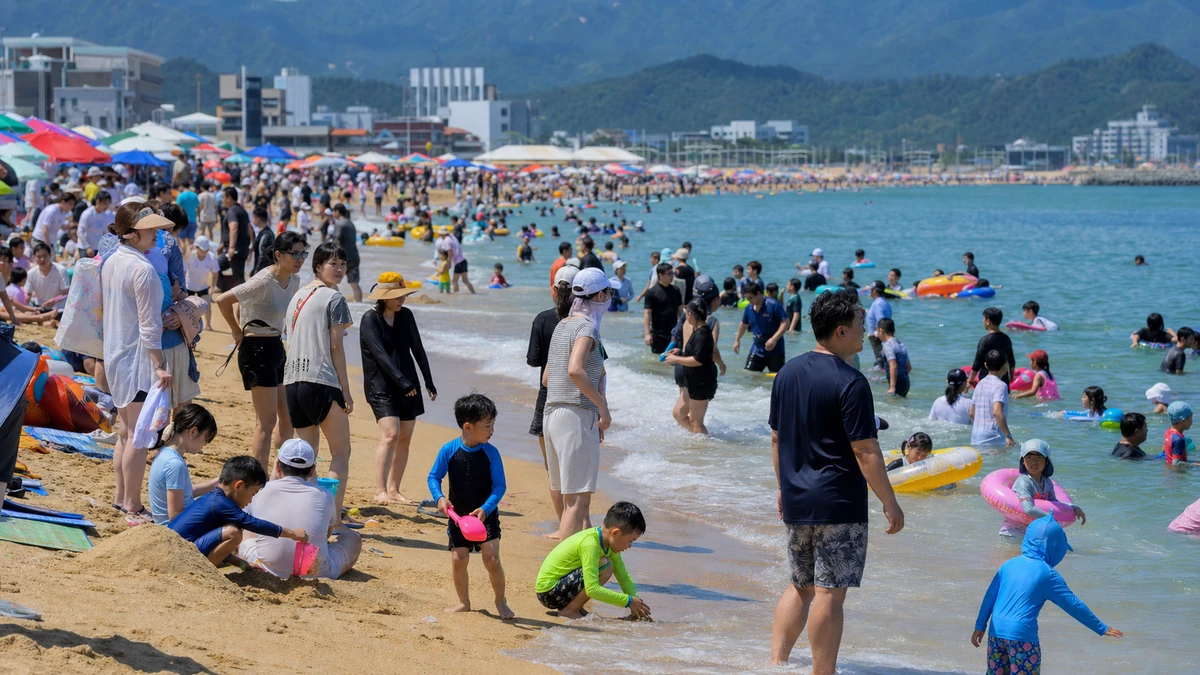
When the forecast says 90 degrees, Americans know what often comes next: packed pools, beach traffic, ice cream lines and a scramble to make outdoor plans before the hottest part of the afternoon. South Korea is moving into a similar rhythm this weekend, as temperatures are expected to climb as high as 32 degrees Celsius, or about 90 Fahrenheit, across broad parts of the country. Along the way, one familiar summer scene has already emerged: crowds gathering at Sokcho Beach on the country’s northeast coast to escape the heat of the city.
According to South Korean weather forecasts cited by Yonhap News Agency, Sunday’s temperatures are expected to range from 16 to 21 degrees Celsius in the morning, with daytime highs between 26 and 32 degrees Celsius. In many major cities — including Seoul and Suwon in the greater capital area, as well as Daejeon, Cheongju, Jeonju and Daegu farther south and inland — highs are expected to exceed 30 degrees Celsius, the point at which summer in Korea begins to feel less like a season and more like a collective adjustment.
That adjustment is visible not only in what people wear or when they step outside, but in where they go. On Saturday, Sokcho Beach and surrounding areas in Gangwon Province were crowded with vacationers and day-trippers seeking relief from the muggy urban heat. The image is instantly recognizable to anyone who has watched New Yorkers pour into the Hamptons, Angelenos head for Santa Monica or Chicagoans rush to Lake Michigan on the first truly hot weekend of the year. But in South Korea, the move from city to seaside happens with its own speed, scale and cultural texture.
This is not a story about a dangerous heat wave or a natural disaster. It is, in many ways, a story about ordinary life. Yet that ordinariness is exactly what makes it revealing. A forecast of 32 degrees can reset a weekend in South Korea, shaping travel, leisure, shopping, dining and the way people use public space. The crowds in Sokcho are not just a reaction to weather. They are also a snapshot of how modern Korean life responds to the seasons.
For international readers who mostly encounter South Korea through K-pop, hit dramas or geopolitical headlines, the weekend beach rush offers a different window into the country. It shows a highly urbanized society negotiating heat through mobility, habit and a strong culture of short, efficient getaways. The result is a version of summer that feels both globally familiar and distinctly Korean.
Why Sokcho matters in Korea’s summer imagination
Sokcho is one of those places that means more than its size might suggest. Located on South Korea’s eastern shoreline, it is a well-known coastal city in Gangwon Province and one of the easiest beach destinations for people traveling from Seoul and the surrounding metropolitan region. In American terms, it functions a bit like a classic weekend shore town within manageable reach of a major population center — not necessarily the nation’s biggest tourism hub, but a place with an outsized role in seasonal memory.
The city’s appeal lies in a combination that Korean travelers know well: beach access, ocean views, seafood, walkable tourist districts and a reputation as a quick East Coast escape. South Korea’s east-facing shoreline along the East Sea — internationally also known as the Sea of Japan — is especially popular in summer. Compared with inland cities, the coast offers both a psychological and literal sense of relief. The beach is not just a place to swim. It is a place to reset.
That matters in a country where population density is high, apartment living is common and many people spend their weekdays in intensely urban settings. Seoul, home to nearly 10 million people, can feel especially unforgiving during a hot spell, with dense development, heavy transit flows and long stretches of concrete amplifying summer heat. Under those conditions, the idea of heading east toward open water carries an obvious emotional pull.
Sokcho has long been part of that pattern. So have other beach destinations along Gangwon’s eastern coast, including Gangneung, Donghae, Samcheok, Yangyang and Goseong. Their beaches begin opening in sequence around mid-June, signaling the start of the summer tourism season before the peak vacation period fully arrives. In practice, that means a weekend like this one can bring heavy beach traffic even before the calendar reaches the height of July and August.
In Korea, the formal opening of a beach is more than a bureaucratic notice. It is a seasonal marker. It tells residents, business owners and travelers that summer has entered a new phase. Restaurants adjust. Lodging demand rises. Convenience stores stock more cold drinks, towels and sunscreen. Families start planning overnight stays, while younger travelers may opt for short, social trips built around the beach, photos, coffee shops and late-night food. A beach opening is, in effect, a public announcement that summer is now operational.
How heat changes the weekend in one of Asia’s most urbanized societies
Weather often shapes behavior quietly rather than dramatically. This weekend in South Korea is a good example. A forecast calling for highs above 30 degrees Celsius in major cities does not shut society down. Instead, it subtly rearranges how people move through the day. Outings begin earlier. Plans shift toward water, shade or air conditioning. Shopping malls, cafes and department stores become more attractive not simply because they sell things, but because they are cool and comfortable. At the same time, beaches and riverside areas grow more appealing as places where heat can be turned into leisure.
In South Korea, these choices are heightened by geography and infrastructure. The country is compact enough that a change in destination can happen quickly. A resident of the Seoul metropolitan area can decide that a hot weekend deserves a trip to the east coast, then set out with family or friends by car or bus. That ease of movement has helped create a culture in which weather is not just something people endure; it is something they answer with action.
For American readers, it may help to think of this as the intersection of climate and convenience. Korea’s cities are large and intense, but the country’s internal travel times can make weekend escapes surprisingly plausible. That contributes to a social pattern where a forecast itself can redirect leisure demand. If city temperatures are expected to top 30 degrees Celsius, beaches do not merely sound attractive. They become the obvious alternative.
The cultural significance goes beyond cooling off. In South Korea, summer leisure is deeply social. A beach trip can include swimming, long walks, shared meals, coffee stops, convenience store snacks, photo-taking and a kind of curated togetherness that would be familiar to users of Instagram anywhere in the world. The beach is a backdrop for friendship, romance and family time, but also for the visual culture that has become central to modern travel. People are not only escaping heat. They are making a weekend.
That helps explain why a story about temperatures and beach crowds can resonate widely inside Korea. It reflects a common lived experience: the way seasonal heat filters into everyday decision-making. What sounds like a simple forecast doubles as a national mood board — hot cities, crowded coasts, packed cafes and people recalibrating their day around the atmosphere outside.
Showers in the forecast, and the Korean habit of planning around them
Sunday’s weather is not expected to be defined only by heat. Forecasters also say showers are possible from the afternoon in parts of the central region, including the Seoul metropolitan area, inland and mountainous sections of Gangwon Province, and northern parts of South Chungcheong Province. That detail may sound minor, but in Korea’s summer routine, a passing shower can be enough to reshape plans.
Summer showers in South Korea often arrive as short, localized bursts rather than all-day washouts. They can briefly cool the air, ease the stickiness and offer relief from direct sun. But they can also disrupt what would otherwise be ordinary weekend activities: a riverside walk, an outdoor meal, a neighborhood shopping trip, a visit to the mountains or a drive to the coast. In a country where people often move efficiently between tightly scheduled stops, even a limited spell of rain can matter.
That sensitivity to changing skies is especially strong in and around the capital region, where large population density means small weather shifts affect a lot of movement. An afternoon shower forecast can influence whether families choose an indoor mall over a park, whether couples stick with a cafe date instead of a walk, or whether urban residents leave earlier for an out-of-town destination. It can also affect what people carry: lightweight clothing, umbrellas, portable fans and the kinds of small practical items that make hot-weather movement easier.
Anyone familiar with East Asian city life will recognize the choreography. Weather is integrated into the day with unusual precision. Transit apps, radar maps and real-time forecasts are not background tools; they are part of how many people organize meals, departures and social plans. In that sense, a shower forecast is not merely meteorological information. It is logistical information.
The broader picture is one of adaptation. Koreans heading into a hot Sunday are being asked to prepare for two conditions at once: high temperatures that encourage beach travel or indoor cooling, and patchy rain that can complicate late-day plans. That combination creates a distinctly summer dilemma — dress light, carry an umbrella, stay flexible. It is a familiar instruction in many parts of the world, but in South Korea it plays out against a highly mobile, fast-moving urban culture that turns small forecast changes into collective behavioral cues.
The opening of east coast beaches signals more than tourism
The fact that Gangwon’s east coast beaches have been opening in stages since mid-June offers another clue about what is happening. This is not simply a matter of vacation infrastructure coming online. It is also an annual shift in the rhythm of regional life. When beaches open, a seasonal economy begins to wake up more fully.
Beach towns benefit first and most visibly. More visitors mean more foot traffic near seaside roads, lodging areas, seafood restaurants, coffee shops and convenience stores. Transportation patterns become more seasonal. Public spaces take on a different pace. The coastline starts to operate less like a scenic local resource and more like a temporary national commons, drawing in people from elsewhere who use it intensely for a few weeks or months.
To be clear, the available reporting here does not provide hard visitor counts or quantified economic impact. It simply establishes three things: Sokcho Beach was crowded on Saturday, more heat is expected Sunday, and beaches along Gangwon’s east coast have been opening progressively since mid-June. Even without detailed numbers, those facts suggest the start of a familiar annual cycle in which weather and tourism reinforce one another.
This is important because summer tourism in South Korea often begins before the most famous vacation weeks arrive. The opening phase matters. It is when pent-up demand meets rising temperatures, and when beach destinations begin reminding city dwellers that the coast is available again. In the United States, the equivalent might be the first beach weekends after Memorial Day, when people start testing the season even before the biggest holiday rush. The beaches may not yet be at peak capacity for the year, but the social signal is unmistakable: summer has begun.
For Gangwon’s coastal communities, that signal carries emotional as well as economic weight. The summer season can define how a place is experienced by outsiders. It changes the relationship between residents and visitors, between everyday life and seasonal spectacle. In that sense, an image of a crowded beach in Sokcho is not just a weather response. It is part of a repeating national ritual in which the coast temporarily becomes central to Korea’s summer identity.
What this says about modern Korean lifestyle beyond the headlines
There is a reason this kind of story travels well beyond weather coverage. It reveals how ordinary Koreans live, move and consume their leisure time. For much of the outside world, South Korea is often framed through export culture — K-pop stars, Oscar-winning films, high-end skincare, blockbuster streaming dramas — or through security concerns involving North Korea. Those stories are real, but they can flatten the country into spectacle or tension. A report about a hot weekend and a crowded beach offers something rarer: a sense of texture.
It shows a society where climate and lifestyle are closely intertwined. Summer in South Korea influences office attire, commuter comfort, cafe traffic, shopping habits and the use of public outdoor space. It also reveals something about aspiration. Leisure in modern Korea is often compressed into short windows — weekends, day trips, overnight escapes — and people make those windows count. A hot forecast therefore becomes an invitation to optimize enjoyment, not merely survive discomfort.
That ethos helps explain why the beach remains such a strong cultural setting. It is a place where several strands of Korean life come together at once: family leisure, youth culture, food, domestic tourism, social media aesthetics and the practical need to cool down. The sea is functional, social and symbolic all at once.
There is also a subtle contrast here with some American assumptions about beach culture. In the United States, beach identity is often heavily regional — Southern California surf culture, Florida tourism, Jersey Shore nostalgia, Cape Cod family traditions. In South Korea, beachgoing is tied less to large, sprawling coastlines and more to the concentrated movement of people out of dense cities toward a set of recognized seasonal destinations. The distances are shorter, the transitions can be faster, and the relationship between forecast and travel can feel more immediate.
That is part of what makes the scene in Sokcho notable. It is not extraordinary, and it does not need to be. It is compelling because it is so normal. In a country known for fast broadband, trend-setting entertainment and hypermodern cities, summer still turns on timeless fundamentals: heat, water, movement and the human urge to gather where the air feels easier to breathe.
A weekend story with a wider meaning
By Sunday, much of South Korea is expected to be living under the same broad summer condition: heat that pushes many urban areas past 30 degrees Celsius, with a chance of afternoon showers in some central regions. On paper, that is simply a routine forecast. In practice, it is the kind of forecast that changes how the country spends a day.
Some people will stay in the city, shifting toward malls, movie theaters, cafes or evening outings after peak heat. Others will head for the coast, where places like Sokcho promise not just lower stress but a full seasonal experience built around sand, water and the pleasure of being somewhere that feels temporarily outside ordinary routines. The crowds already seen at Sokcho Beach suggest that choice is well underway.
For readers abroad, especially in the United States, the scene may feel comfortingly familiar. Summer still has a remarkable ability to reorganize daily life, whether in Boston, Atlanta or Seoul. People search for water, shade, cold drinks and a break from concrete. They rearrange plans when rain threatens. They use the weekend to create the version of the season they want to remember.
Yet the Korean version carries its own distinct signature. The density of city life, the accessibility of east coast destinations, the sequencing of beach openings and the social habit of turning even short trips into full experiences all shape how summer unfolds. Weather here is not just backdrop. It is an organizing force in public life, quietly directing crowds, commerce and the emotional map of the weekend.
That is what makes this otherwise modest report so telling. A high of 32 degrees, a crowded beach in Sokcho and scattered showers in parts of the central region do not amount to a national crisis or a major political event. But they do illuminate a nation in motion, reacting to the season with routines that are practical, communal and deeply recognizable. If you want to understand South Korea beyond its global exports, you could do worse than start with a hot Sunday and a beach full of people who had the same idea: get out of the city and head for the sea.
Comments
Post a Comment