In South Korea’s Seaside City of Sokcho, a Debate Over a Lake Becomes a Test of What Development Should Look Like
A local forum with national resonance
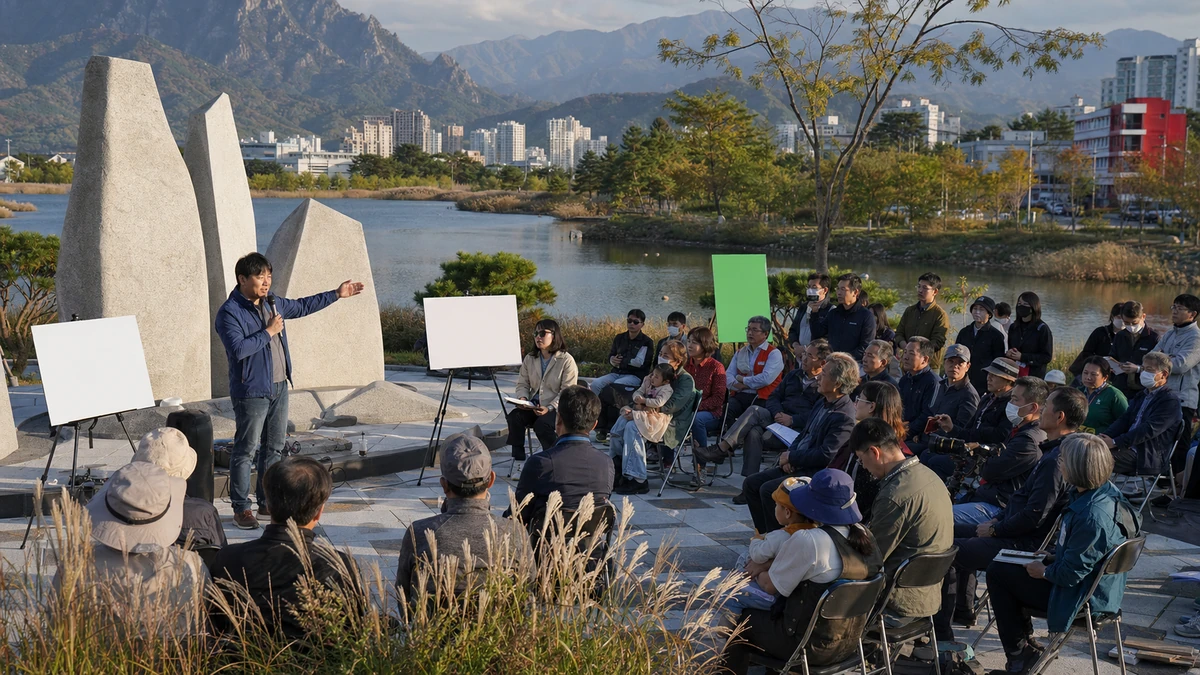
On a breezy stretch of public space in Sokcho, a city on South Korea’s northeast coast better known to many travelers for seafood markets, beach views and easy access to the mountains, residents gathered this week to argue about the future of a lake. On paper, that may sound like a small municipal matter. In practice, it has become something larger: a debate over who gets to shape urban nature, what counts as public good and how far a tourism-driven city should go in remaking one of its most recognizable landscapes.
The forum, organized by a civic group called “People Hoping for a Green Park at Yeongnang Lake,” asked a deliberately blunt question: Is Yeongnang Lake a park for citizens, or a site for destructive development? The discussion was held near the Chung Hon Memorial in Sokcho’s Dongmyeong neighborhood, according to Yonhap News Agency, and brought together people concerned with the ecological value of the lake, preservation strategies, public green space and whether natural conservation can coexist with tourism and urban growth.
For American readers, the closest analogy may be the kind of fight that erupts around a beloved waterfront, urban park or wetland edge — the sort of place residents see as part backyard, part civic inheritance, part economic asset. Think of the long-running tensions in cities from Austin to Miami to Chicago, where natural spaces are expected to do several jobs at once: protect habitat, absorb growth, welcome visitors and improve quality of life for those who live nearby. What makes Sokcho’s debate notable is not just the familiar clash between preservation and development, but the way local residents are trying to widen the frame beyond a simple yes-or-no fight.
That matters in South Korea, where compressed urban growth, fast transportation networks and intense seasonal tourism often put unusual pressure on scenic places. A lake in a Korean regional city is rarely just a lake. It can be a daily walking route for retirees, a photo stop for domestic tourists, a marketing image for city branding, a habitat for birds and aquatic life and a political battleground over how local governments define progress. Yeongnang Lake now sits at that intersection.
Why Yeongnang Lake matters in Sokcho
Sokcho occupies a distinctive place in the South Korean imagination. It is one of those cities where mountains, sea and inland water sit unusually close together. Visitors can eat breakfast by the East Sea, spend the afternoon near the trails of Seoraksan National Park and end the day strolling by a lake. That compact geography has helped make Sokcho a major domestic tourism destination, especially for residents of the Seoul metropolitan area seeking a weekend trip. But the same geography also makes land-use decisions feel especially consequential.
Yeongnang Lake is part of that local identity. It is not merely scenery in the abstract. For residents, lakeside space functions as a lived environment — where people walk, exercise, rest and orient themselves within the city. When civic activists speak of the lake as a “citizens’ park,” the phrase carries more than aesthetic meaning. In the Korean context, public green space is often discussed as essential urban infrastructure, especially in dense built environments where accessible nature can be limited. A park is not just a recreational luxury; it is a statement about who a city is for.
That helps explain why the language of the forum mattered. To label one possible future “destructive development” is to argue that not all growth deserves the name progress. To invoke a “citizens’ park” is to insist that common use, ecological value and everyday life should be central to planning. The point is not that Sokcho must reject all change. It is that residents are resisting a narrow definition of development in which the primary measure of success is how many visitors can be attracted, how quickly land can be repurposed or how visibly a city can signal modernization.
This is a recurring tension in South Korea’s regional cities. Local revitalization is often discussed in terms Americans would recognize: boosting foot traffic, reviving commercial districts, drawing outside investment and competing for tourists. But in Korea, those pressures are frequently intensified by demographic anxiety. Many smaller cities and provinces face aging populations, youth outmigration and economic concentration in and around Seoul. Under those conditions, visible development projects can become politically appealing symbols of action. The question Sokcho residents appear to be asking is whether that model still works when the asset at stake is a fragile natural space.
Beyond a simple preservation-versus-development fight
One of the more interesting features of the Yeongnang Lake discussion is that participants did not appear to frame the issue solely as a binary choice between freezing the landscape in place and building over it. According to the summary of the event, those gathered considered domestic and international examples of ecological parks, national gardens, urban green policies and ways to balance conservation with regional development. That suggests an effort to move from slogan to design principle — from “for” or “against” development to the harder question of what kind of public use preserves a place rather than diminishes it.
In American planning debates, this distinction often gets lost. A wetland trail, for instance, is a form of development. So is habitat restoration, shoreline access design or the construction of visitor infrastructure that channels traffic in less harmful ways. Conversely, a project marketed as eco-friendly can still erode the character and ecological function of a place if scale, traffic, noise or commercial intensity overwhelm the landscape. The same appears true in Sokcho. The real issue is not whether humans will use Yeongnang Lake, but how that use is structured, governed and limited.
That is especially important in a tourism city, where public officials are routinely tempted to equate popularity with sustainability. More visitors can mean more spending, but they can also mean more waste, more pressure on ecosystems and a slow transformation of civic space into consumable spectacle. American readers have seen versions of this in communities from mountain towns in Colorado to coastal destinations in California and Maine. Local residents often support economic vitality, but not if it turns the places they live into stage sets optimized for outsiders.
At the Sokcho forum, the discussion of green-space policy suggests another possibility: that preservation and access can reinforce each other when carefully planned. Urban green belts, restored ecological corridors, low-impact walking infrastructure and publicly owned parkland can make a city more attractive without reducing nature to a product. That is a harder route than headline-grabbing construction. It requires patience, management and a willingness to accept limits. But it also tends to produce spaces that residents continue to value long after the ribbon-cutting ends.
The Suncheon Bay model — and why it cannot simply be copied
One reference point raised in the discussion was Suncheonman National Garden, often cited in South Korea as a successful example of linking ecology, gardens and tourism. For many Koreans, Suncheon Bay represents a best-case scenario in which environmental assets become civic pride, educational space and economic draw all at once. It is the kind of case local officials elsewhere may point to when making the argument that conservation-minded development can pay off.
But the Sokcho discussion, as described in the source material, appears to have treated that example with some caution. That is wise. Success stories in one city are often turned into planning templates for another, even when geography, visitor patterns, environmental sensitivity and local habits differ sharply. Americans have seen the same thing when cities try to import the “High Line effect,” the “Bilbao effect” or some other signature model, only to discover that what worked in one place does not automatically translate elsewhere.
Yeongnang Lake is not Suncheon Bay, and Sokcho is not Suncheon. Each place has its own terrain, ecological pressures and urban rhythm. A lake embedded in a coastal city with heavy leisure traffic and a distinctive relationship to nearby mountains raises different questions than a nationally celebrated garden destination. The challenge, then, is not to reproduce another city’s landmark project but to identify principles that fit the site: protect ecological integrity, preserve public access, prevent overcommercialization and treat the landscape as part of everyday urban life rather than a standalone attraction.
That is where the Yeongnang debate becomes more sophisticated than a standard anti-development protest. The presence of case studies from Korea and abroad suggests that residents and advocates are not simply saying no. They are asking what kind of planning language can replace the older, more mechanical version of local boosterism. Can a city improve amenities without privatizing atmosphere? Can it welcome visitors without flattening the distinction between shared space and commercial space? Can it define progress in terms of livability, resilience and public use rather than sheer construction?
Those are not uniquely Korean questions. They echo across urban politics in the United States, where public trust in development rhetoric has eroded in many places. Residents increasingly ask whether new projects actually serve the community, whether “activation” is just another word for commercialization and whether “underused” is often a coded way of describing open space that has not yet been monetized. Sokcho’s lake debate fits squarely into that global conversation.
What “a park for citizens” means in the Korean context
For readers unfamiliar with South Korean civic language, the phrase “citizens’ park” deserves a closer look. In Korean public discourse, the idea of a park is closely tied to democratized access. It suggests a place not reserved for a private development, elite membership or heavily ticketed consumption, but one woven into ordinary life. Green space in Korean cities carries special weight because so much daily life unfolds in dense apartment neighborhoods, commercial corridors and transit-rich built environments. The value of a publicly accessible natural area is therefore both ecological and social.
That is why the use of public green space around Yeongnang Lake became such an important point in the forum. Public green areas are not just amenities. They are part of a city’s health, social cohesion and visual breathing room. They affect how children encounter nature, how older residents move through the city and how communities absorb the stress of urban life. In many U.S. cities, planners now talk about parks as public health infrastructure. South Korea, though denser and more centralized in its urban patterns, has increasingly arrived at a similar understanding.
There is also a cultural layer here. South Korea’s rapid postwar development transformed the country with stunning speed, lifting living standards but often prioritizing growth, concrete expansion and visible modernization. In recent years, however, public values have been shifting. Quality of life, environmental sustainability and neighborhood-scale livability now carry greater political and cultural force than they once did. Debates like the one in Sokcho reflect that change. They show a society asking not only how to grow, but how to live well inside the spaces growth has created.
The forum’s tone, at least from the available summary, suggests that this is not yet a settled policy battle with a final plan on the table. It is a public conversation over first principles. That distinction is important. The significance of the event lies not in any single decision announced, but in the fact that local civic actors created a public arena for discussing the lake’s future before it is defined solely by official process or project logic. In that sense, the gathering was as much about democratic habit as environmental policy.
A broader test for Korean regional cities
The questions raised around Yeongnang Lake reach beyond Sokcho because they touch a larger issue facing South Korea’s regional cities: how to remain economically viable and socially attractive without sacrificing the natural features that make them distinctive in the first place. In places outside the Seoul capital region, local governments often walk a narrow line. They are under pressure to generate revenue, bring in tourists and show development momentum. Yet their competitive advantage frequently lies in landscape, culture and a slower pace of life — assets that can be damaged by overuse or overbuilding.
Sokcho exemplifies that tension. Its appeal comes not from becoming interchangeable with any other leisure city, but from the unusual convergence of coast, mountain and lake. Once those relationships are eroded, they cannot easily be recreated. That is why the future of Yeongnang Lake carries symbolic weight. The lake debate asks whether local growth strategies can evolve past a 20th-century mindset in which nature is either scenery for development or land awaiting improvement. It proposes a more current understanding: that ecological value, daily public use and long-term city identity may themselves be the development asset worth protecting.
There is also something telling about the way this discussion emerged. It was not described as a final administrative announcement or a top-down planning decree. It was a civic forum organized in a public setting, with residents exchanging views on cases, policies and values. That kind of public deliberation does not guarantee consensus, and it can sometimes slow formal action. But it also broadens legitimacy. Decisions about a city’s defining natural spaces tend to last decades; citizens want a role in setting the terms.
For an American audience, that may be the most recognizable part of the story. Across the United States, communities have learned that once waterfronts, wetlands or urban green corridors are remade at large scale, reversal is difficult and expensive. The fiercest local disputes often arise not because people oppose all change, but because they suspect a false urgency in the way change is presented. Sokcho’s residents appear to be insisting on a different tempo — one that starts with public conversation, ecological understanding and a clearer definition of civic benefit.
Nothing in the available account suggests that the debate over Yeongnang Lake is over, or that a single consensus has emerged. What is clear is that the conversation itself has become meaningful. By asking whether the lake should function as a public park rather than a site of destructive development, organizers pushed a local land-use issue into a larger moral and political register. What kind of city should Sokcho be? Who is urban nature for? How should tourism, conservation and everyday life be balanced? Those are local questions, but they resonate far beyond one Korean lake.
In that way, the scene in Sokcho offers a useful window into contemporary South Korea. It shows a country whose regional communities are not merely trying to catch up to growth, but increasingly trying to define the terms of a more sustainable and livable future. For global readers, that may be the real takeaway. The story is not just about a lake. It is about a society reconsidering the meaning of development, one public landscape at a time.
Comments
Post a Comment