
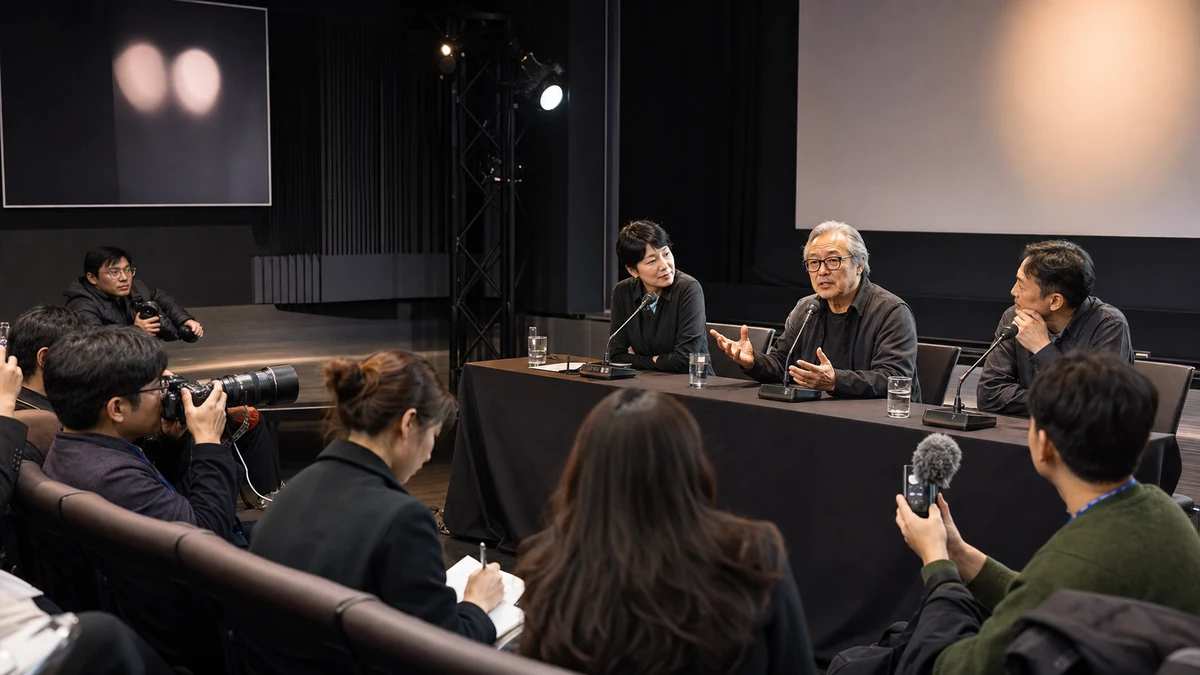
A film capital’s fading output comes into focus in Seoul
For many moviegoers in the United States, Hong Kong cinema is less a national film industry than a shorthand for a style: balletic gunfights, emotionally charged crime sagas, neon-soaked cityscapes, tragic romance and stars whose screen presence felt larger than life. Think of the influence Hong Kong action had on Hollywood, from Quentin Tarantino to the Wachowskis to the makers of the “John Wick” franchise, and it becomes easier to understand why remarks made this week in Seoul landed with unusual force for film fans across Asia.
At an event in the South Korean capital celebrating Hong Kong movies, Chan Hing-kai, the screenwriter and producer best known for the 1986 classic “A Better Tomorrow,” said the industry that once helped define modern Asian popular culture is now working under severe structural pressure. According to South Korea’s Yonhap News Agency, Chan told reporters and audiences that Hong Kong, which in the 1980s produced around 200 films a year, now turns out only about 20.
That single comparison, from roughly 200 annual releases to roughly 20, captures more than a downturn in volume. It points to a contraction in the ecosystem that once made Hong Kong one of the most dynamic movie centers in the world. Fewer films mean fewer jobs, fewer apprenticeships, fewer creative risks and fewer chances for young directors, actors, cinematographers and screenwriters to build a body of work.
Chan’s comments came around the reopening in Seoul of a public conversation about Hong Kong film, at a gathering called the “Hong Kong Film Gala Presentation” held at Emu Art Space, an arthouse venue in central Seoul. Also appearing was acclaimed director Stanley Kwan, whose “Rouge,” starring the late Leslie Cheung, remains one of the touchstones of 1980s Hong Kong cinema. The event was not merely a nostalgia tour. Instead, it became a candid discussion about how an industry famous for speed, style and star power can survive in a far leaner era.
For an American audience, the setting matters. Seoul is now one of the world’s most visible cultural capitals, propelled by the global rise of Korean film, television and pop music. That Hong Kong filmmakers chose Seoul as the place to speak publicly about crisis, continuity and the next generation suggests a larger regional truth: Asian screen industries may differ in size and influence, but many are wrestling with the same questions about financing, sustainability and talent pipelines.
Why Hong Kong movies still matter far beyond Hong Kong
To understand the weight of Chan’s remarks, it helps to remember what Hong Kong cinema represented at its peak. Long before Korean entertainment became a global brand and before streaming made international viewing commonplace, Hong Kong films circulated widely across Asia and well beyond it. They offered a pop-cultural language that crossed borders: martial arts epics, slapstick comedies, romantic melodramas and crime films that mixed glamour with fatalism.
For many Americans, Hong Kong cinema first arrived through martial arts icons like Bruce Lee and later Jackie Chan, Jet Li and directors such as John Woo and Wong Kar-wai. But within Asia, its impact ran deeper and broader. Hong Kong films were commercial, prolific and fast-moving. They were also deeply influential in places like South Korea, Taiwan and parts of Southeast Asia, where audiences absorbed not only the stars but also the rhythms, emotions and genre conventions of the films themselves.
In South Korea especially, Hong Kong movies occupied a special place for viewers who came of age in the 1980s and 1990s. They were not treated simply as imported entertainment. They helped shape regional ideas of cool, masculinity, romance and urban modernity. Films like “A Better Tomorrow” were not obscure art-house objects; they were major cultural events whose style rippled outward into fashion, music and local filmmaking.
That is why a discussion in Seoul about Hong Kong cinema’s decline resonates as something larger than industry gossip. It touches a shared cultural memory across East Asia. In American terms, imagine if veteran figures from the New Hollywood era gathered abroad to say that the system that once produced mid-budget dramas, star-making turns and a steady flow of new directing talent had nearly vanished. The numbers alone would be startling, but the deeper concern would be what happens when the infrastructure behind a golden age no longer exists.
Hong Kong cinema has long carried an outsized symbolic role, too. The city’s movies reflected its identity as a dense, fast, multilingual crossroads where commerce and creativity fed one another. When the industry thrived, it could turn a local crime story or ghost romance into a regional sensation. That adaptability was part of its magic. The danger now, as Chan and Kwan suggested, is not simply that fewer films are getting made. It is that the conditions that once let new talent emerge organically are breaking down.
What Chan Hing-kai’s numbers really mean
Chan’s stark estimate, from about 200 films a year in the 1980s to around 20 now, is the kind of statistic that can sound abstract until its consequences are unpacked. Movie industries are not sustained by marquee names alone. They depend on repetition: crews moving from project to project, writers learning through rewrites, assistant directors becoming directors, supporting actors becoming leads and producers building enough momentum to back both safe bets and creative gambles.
When output collapses, the first casualty is often opportunity. If there are only a handful of productions, established names become even safer investments, while newcomers struggle to get in the door. That creates a vicious cycle. Without enough low- and mid-level production activity, emerging filmmakers cannot gain the practical experience that once came from working steadily on real sets under real deadlines.
Chan also said large-budget productions driven by famous stars are increasingly difficult to pull off and that low-budget filmmaking has effectively become the norm. In one sense, low-budget production can be a sign of resilience; plenty of great films have been made cheaply. American independent cinema is full of examples, from early Sundance favorites to breakout first features that launched major careers.
But low-budget production can also become a trap when it is not paired with stable investment, broad distribution and institutional support. If every project is underfunded and precarious, filmmakers may survive from film to film without building durable careers. Small movies need a system around them: festival exposure, local exhibition, supportive public funding, educational institutions and perhaps most importantly, enough audience visibility to make the next project possible.
What Chan appears to be describing is not a healthy indie renaissance but a narrowing of options. A once-robust commercial industry is becoming a smaller, more risk-averse field where financing is tighter and the old formulas are no longer reliable. That distinction matters. In the American context, it is the difference between a vibrant independent scene that feeds fresh talent into the wider industry and a hollowed-out market where fewer people can afford to stay in the profession at all.
The warning carries extra authority because Chan is not speaking as a detached observer. As the screenwriter and producer of “A Better Tomorrow,” he is associated with one of the defining works of Hong Kong noir, a genre that helped transform the global grammar of action cinema. When someone who helped shape the golden era says the pipeline is shrinking, the message lands as diagnosis, not sentimentality.
The golden age, and the gap between memory and reality
“A Better Tomorrow,” directed by John Woo and starring Leslie Cheung, Chow Yun-fat and Ti Lung, is often remembered as more than just a hit movie. It helped crystallize a new model of heroic bloodshed cinema, a term American readers may know from critics describing stylized Hong Kong crime films that fused melodrama, loyalty, betrayal and operatic violence. Its heroes were often gangsters or antiheroes, but the emotional core rested on male friendship, sacrifice and codes of honor.
“Rouge,” by contrast, showcased another side of Hong Kong cinema: lush, melancholic and deeply romantic, with a ghost story framework that let it meditate on memory, desire and loss. If “A Better Tomorrow” suggested the swagger of Hong Kong’s commercial power, “Rouge” showed its artistic range. Together, the two films serve as reminders that the industry’s golden age was not built on one formula. It flourished because it could produce many kinds of films quickly and because audiences were willing to follow.
That richness is central to what is at risk now. Golden ages are often remembered through stars and classics, but they are sustained by systems. Hollywood’s studio era produced legends, yet it also depended on a constant churn of productions, departments and training grounds. The same was true in Hong Kong. The city’s cinematic vitality came from its ability to make genre films at speed, test audience response and keep the machine moving.
Stanley Kwan, speaking at the same event in Seoul, said young creators are finding it harder and harder to secure stable opportunities to make work. That observation points to a generational bottleneck. It is not simply that veteran directors face a tougher market; it is that the pathway for the next wave is getting narrower.
For younger filmmakers, talent alone is rarely enough. They need time, practice, collaborators and repeated chances to fail and improve. In every major film culture, whether in Los Angeles, Mumbai, Seoul or Hong Kong, careers are built through accumulation. A first feature leads to a second. A modestly seen film can become the calling card for a breakout. A cinematographer on one project becomes the director on another. Remove enough of those stepping stones and an industry may preserve its past prestige while losing its future.
This is the gap between memory and present reality. Hong Kong cinema still occupies a powerful place in global film history. Its classics are screened, restored, quoted and rediscovered by younger viewers on streaming platforms and repertory programs. But reverence for the past does not automatically create a workable present. That seems to be the dilemma now confronting the filmmakers who gathered in Seoul.
Why the conversation happening in South Korea is significant
There is an additional layer to this story that American readers should not miss: the symbolism of discussing Hong Kong film’s struggles in South Korea, one of the few places in the world where a national screen industry has recently translated regional strength into unmistakable global influence.
South Korea’s rise in entertainment, often grouped under the term “Korean Wave” or “Hallyu,” refers to the international popularity of Korean pop culture, including K-dramas, K-pop and film. For many Americans, “Parasite,” “Squid Game,” BTS and Blackpink are the most recognizable points of entry. But Hallyu did not happen overnight, and it did not come from a single hit. It grew through long-term infrastructure: talent training, domestic audience support, export strategy, robust production pipelines and a culture willing to invest repeatedly in new work.
That makes Seoul a revealing venue for this kind of reflection. South Korea today represents the possibility of cultural momentum, while Hong Kong’s veterans were describing a system under strain. The contrast is not neat or absolute; South Korea’s own film and television sectors face mounting pressures, from changing viewing habits to global platform competition. But the setting still sharpened the conversation. It turned a discussion about Hong Kong nostalgia into a broader question about what allows an Asian screen industry to renew itself.
The event’s format mattered, too. Audience talks and public forums are common in Korean film culture, especially at cinematheques, festivals and art-house venues where cinephile communities remain active. In this case, the audience was not just consuming classics; it was participating in a conversation about what those classics mean now and whether the conditions that produced them can be rebuilt. That public engagement is important because film industries do not live on production finance alone. They also live on memory, fandom, criticism and the willingness of viewers to keep showing up.
For Korean audiences, Hong Kong cinema has long been both nostalgic and immediate. It is nostalgic because a generation remembers it as formative. It is immediate because its styles and genres still circulate in the DNA of Asian popular culture. The result is a kind of cross-border film literacy that may be less familiar to American audiences, where foreign-language cinema is often compartmentalized. In East Asia, Hong Kong films were never just “world cinema” in the museum sense. They were mainstream cultural memory.
That is part of what made the Seoul discussion meaningful. It showed how Asian film fandom can function as a regional conversation rather than a set of isolated national markets. It also underscored how closely linked questions of heritage and future have become. The people who came to celebrate the classics were also being asked to consider what kind of industry can sustain the next generation.
The real issue may be talent development, not nostalgia
If there was a common thread in the remarks from Chan and Kwan, it was this: the future of Hong Kong cinema may depend less on recovering old box-office glory than on creating durable opportunities for new filmmakers. That may sound obvious, but in industries under pressure, the instinct is often to double down on proven brands, familiar stars or legacy properties. Hollywood does this with sequels and franchises. Other film industries have their own versions of the same impulse.
The problem is that legacy can only carry an industry so far. New voices need space to emerge, especially in a media environment crowded by global streaming giants, short-form video and rapidly shifting audience habits. If Hong Kong’s production model is now more dependent on smaller budgets, then the question becomes whether those small-scale projects can still serve as launchpads rather than dead ends.
That requires more than artistic will. It requires mechanisms: labs, public or private grants, film school-to-industry pipelines, festival support, regional co-productions and distribution channels that allow smaller films to find viewers at home and abroad. In the United States, conversations about the “missing middle” in film, the decline of the mid-budget adult drama and the narrowing of theatrical space for non-franchise fare have reflected similar anxieties. Hong Kong’s situation may be more acute, but the logic is familiar.
There is also a psychological dimension. When an industry’s output shrinks dramatically, younger artists may not simply struggle to find financing; they may begin to doubt whether a long-term career is viable. That can push talent toward television, advertising, streaming work in other markets or away from the field altogether. A creative ecosystem loses not only current projects but also future possibilities.
Kwan’s warning about the difficulty of making work “stably,” to use the general sense of his remarks, is therefore crucial. Stability does not mean comfort. It means having enough continuity that a filmmaker can imagine a second or third project, not just a one-off debut. It means knowing there is an audience infrastructure and institutional memory capable of sustaining more than occasional prestige screenings of old masterpieces.
Seen that way, the debate in Seoul was not chiefly about whether Hong Kong can recreate the exact conditions of the 1980s or 1990s. That era is gone, just as the Hollywood of the 1970s or the Miramax-driven independent boom of the 1990s cannot simply be restored. The more realistic challenge is whether a smaller industry can still build a repeatable process for nurturing talent and maintaining cultural relevance.
What this means for global audiences, including in the U.S.
For American readers, the story is worth attention not only because Hong Kong cinema helped shape films many Americans already love, but because it reveals something broader about the fragility of screen cultures. International influence can linger long after the industrial foundation behind it begins to erode. A country or city can remain iconic in cinematic memory even while its ability to produce new work at scale weakens.
That dynamic is increasingly visible around the world. Film industries face pressure from streaming consolidation, changing theatrical habits, uneven investment and audience fragmentation. The specifics differ from place to place, but the central question remains the same: how do you preserve room for discovery? How do you create systems where younger creators can experiment, fail, improve and eventually redefine the medium for their own generation?
Hong Kong’s case carries special poignancy because its earlier success was so visible and so influential. This was once one of the great engines of popular filmmaking, a place whose movies traveled widely and changed the way action, melodrama and urban cool looked on screen. If even that kind of industry can contract so sharply, it serves as a cautionary tale.
At the same time, the Seoul forum suggested another possibility. Cultural memory can be more than a museum. If audiences continue to revisit and discuss classic Hong Kong films, that attention can create space for contemporary work, especially if programmers, festivals and distributors decide that the story of Hong Kong cinema is not over. In an era when American viewers have greater access than ever to international titles through festivals, specialty streamers and repertory theaters, the future of Hong Kong film may depend partly on whether new works can be presented as more than echoes of the past.
That may be the most striking takeaway from the conversation in Seoul. The filmmakers were not simply mourning a lost era. They were identifying a practical challenge: how to keep an industry alive when its old production logic no longer holds. For fans of Asian cinema, and for anyone who cares about how creative ecosystems survive, that is not a niche concern. It is one of the defining cultural questions of the moment.
And perhaps there is a final irony here. Hong Kong cinema once taught the world how powerful movies could be when made with urgency, emotion and a strong sense of place. Now, from a stage in Seoul, some of its most respected veterans are asking whether the next generation will have enough chances to do the same. For audiences in South Korea, the question feels close to home. For audiences in the United States, it should sound familiar, too.


0 Comments