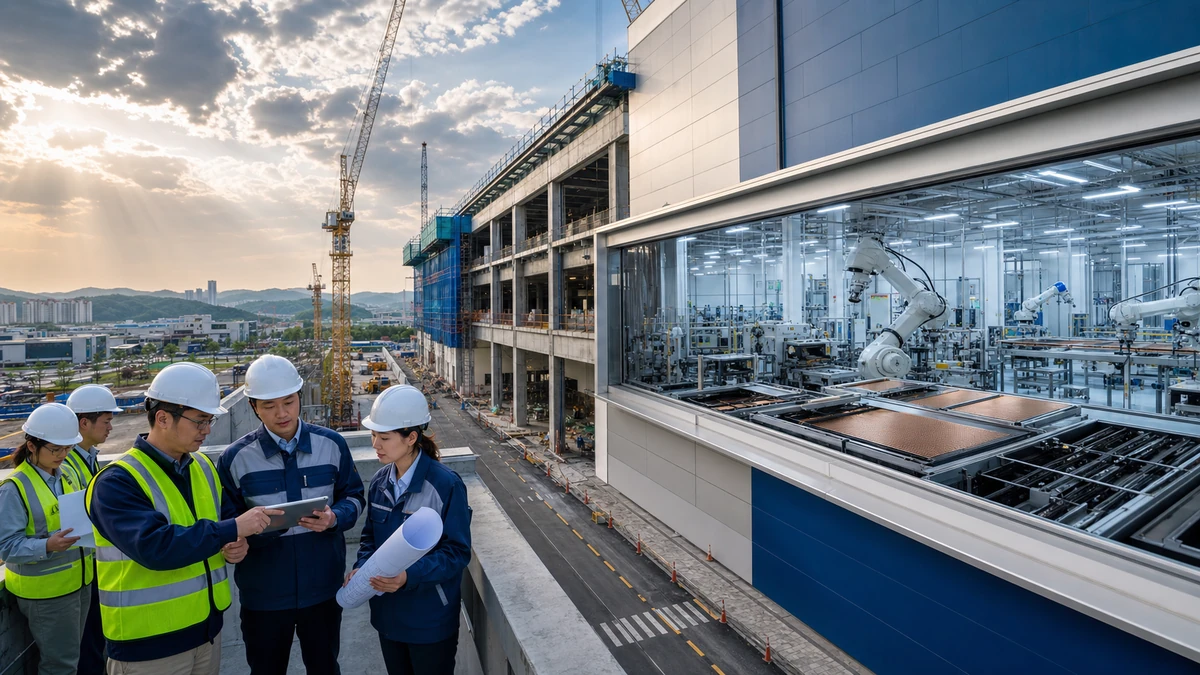
A South Korean factory expansion with global implications
South Korea’s AI push is often described in the language of software, chips and national strategy. But one of the clearest signs of where the artificial intelligence economy is headed may be found in a planned factory expansion in Sejong, a government-built city in the country’s center better known to many Koreans for ministries and public offices than for heavy industry.
Samsung Electro-Mechanics, the electronics components arm of the Samsung group, is moving ahead with an expansion of its plant at the Myeonghak Industrial Complex in Sejong and plans to build a cutting-edge production line for package substrates used in AI servers, according to details included in a broader Samsung investment announcement made public June 29.
That may sound, at first glance, like the sort of technical manufacturing update that rarely breaks through beyond industry circles. But it matters for a simple reason: AI is not only a battle over chatbots, algorithms and cloud services. It is also a competition over the physical supply chain that makes those systems possible. Every headline about generative AI, data centers or next-generation chips rests on an industrial foundation of factories, materials, packaging and precision components.
In that sense, the Sejong expansion is more than a local plant upgrade. It is a snapshot of how South Korea, one of the world’s most important technology manufacturing powers, is trying to position itself for the AI era by strengthening the less visible but indispensable layers of the hardware ecosystem. For American readers used to hearing about Nvidia GPUs, OpenAI models or the race to build more data centers in Texas, Arizona or Virginia, this is the Korean version of the same story: the AI boom is creating a scramble not just for code, but for industrial capacity.
The announcement also highlights a theme that has become increasingly important in South Korea: whether the country’s advanced industries can spread beyond the Seoul metropolitan area and create durable economic anchors in regional cities. In the United States, policymakers often talk about bringing semiconductor jobs to places outside Silicon Valley, whether through fabs in Ohio or battery plants in the South. South Korea is wrestling with a parallel question, and Sejong now finds itself at the center of that conversation.
Why package substrates matter in the AI age
To understand why this investment has drawn attention, it helps to unpack the component at the heart of it. Samsung Electro-Mechanics says the new line will produce package substrates for advanced AI servers. Package substrates are not household-name products, but they are essential in modern electronics. They serve as high-performance platforms that connect semiconductor chips to the larger system, enabling signals and power to move efficiently and reliably.
Think of them as part of the critical architecture that allows a powerful chip to actually function inside a server. As AI workloads become more demanding, the importance of those connections increases. Training and running advanced AI models requires enormous computational power, high-speed data movement and tight integration among chips, memory and other components. That makes advanced packaging and substrate technology much more than a secondary manufacturing niche. It becomes a strategic bottleneck.
In the United States, much of the public discussion around AI hardware focuses on the chips themselves, especially the companies designing the processors or building the data centers. South Korea’s latest move is a reminder that the supporting cast matters just as much. Without the right packaging technologies, even the most advanced chip designs cannot be deployed at scale. For AI servers, where performance and efficiency are paramount, those supporting components move from the margins to the center of the story.
The language disclosed so far points to three big ideas: an investment measured in the trillions of won, a plant expansion and the construction of a state-of-the-art package substrate line for AI servers. Even without detailed figures on production output or hiring, that tells investors and policymakers a lot. Samsung Electro-Mechanics is not simply adding more generic capacity. It is targeting a higher-value, more technologically demanding segment of the electronics supply chain.
That distinction matters because it signals how South Korean manufacturing sees the AI boom. This is not just about developing consumer-facing apps or boasting about digital transformation. It is about claiming a role in the hardware stack beneath global AI services. In other words, South Korea is treating AI not only as a software revolution but as a manufacturing challenge — one that runs from semiconductors to packaging, components, materials and factory equipment.
Sejong’s changing identity beyond government offices
For many international readers, Sejong may not be a familiar name. Within South Korea, it has long been associated with a distinct national project: decentralizing government functions away from Seoul. Officially known as an administrative capital of sorts, Sejong was developed to house ministries and public agencies as part of a broader effort to reduce overconcentration in the capital region.
That background makes this investment especially notable. Sejong has often been viewed as a planned administrative city, not necessarily as a marquee destination for advanced industrial production. The expansion at the Myeonghak Industrial Complex suggests that image is changing. If Samsung Electro-Mechanics follows through on its plans, Sejong will not just symbolize government decentralization. It will also represent a growing link between regional South Korea and the next generation of AI infrastructure.
For Americans, a rough comparison might be a federal city unexpectedly emerging as a hub for highly specialized manufacturing tied to a national strategic industry. The significance lies not only in the factory itself, but in what it says about regional economic identity. Advanced manufacturing projects can reshape how a city is perceived, what talent it attracts and how local suppliers position themselves.
That is part of why local officials in Sejong have reacted positively. In South Korea, a large-scale investment by a major conglomerate — a chaebol, the family-controlled business groups that dominate much of the country’s industrial landscape — can transform more than tax revenue. It can alter a city’s long-term place in the national economy. New supplier relationships, logistics activity, engineering jobs and workforce development programs often follow.
At the same time, the known facts remain limited. The available information confirms the direction of the investment and the type of production line involved, but does not spell out a construction start date, completion timetable, expected employment figures or projected output. That restraint is important. In an era when industrial policy announcements are often accompanied by eye-popping numbers, the safer conclusion for now is not to overstate the impact, but to recognize the strategic significance of where Samsung Electro-Mechanics is choosing to build.
The bigger investment map behind the announcement
The Sejong plan was not announced in isolation. It was included in a sweeping Samsung investment plan tied to fostering advanced future industries in the AI era and encouraging more balanced regional development in the Honam, Yeongnam and Chungcheong regions of South Korea. Samsung said it would invest 625 trillion won across those regions, placing Sejong’s factory expansion within a much broader industrial blueprint.
Large investment figures in South Korea can be difficult to interpret from abroad because they often combine long-term spending, affiliate-level commitments and regionally distributed projects under one umbrella. Even so, the structure of the announcement is revealing. Sejong is part of the Chungcheong region, which is being cast as one segment of a wider industrial network rather than as a standalone project site.
Separate materials cited alongside the announcement suggested regional investment totals on the order of 896 trillion won for the Honam area, 392 trillion won for Chungcheong and 270 trillion won for Yeongnam, based on a combination of government and corporate releases. The exact accounting can vary, and such figures should be approached carefully, especially when they span different project categories and time horizons. But the broader message is clear: South Korea is trying to distribute advanced-industry functions across multiple regional hubs.
That functional division may be even more important than the raw totals. In the current policy framing, different regions are associated with different roles — semiconductor production, high-bandwidth memory packaging, AI data centers and next-generation semiconductor research and development among them. Within that emerging map, Sejong’s planned package substrate line appears as a key piece of the post-fabrication and components ecosystem surrounding AI hardware.
This is a familiar pattern in modern semiconductor strategy. No single city or facility handles everything. Instead, countries build clusters of specialized capabilities: chip fabrication in one area, packaging in another, research centers somewhere else and data center demand driving the entire chain. The United States has been moving in that direction under the CHIPS and Science Act. South Korea’s industrial planners and major corporations are pursuing their own version, adapted to a much smaller geographic footprint but with similarly high stakes.
That is why the Sejong expansion should not be dismissed as a minor footnote buried in a massive corporate spending plan. It offers one of the clearest examples of how huge national investment pledges are translated into something concrete: a specific city, a specific factory and a specific product line linked to the AI server supply chain.
Balancing regional development and industrial concentration
South Korea has long struggled with an imbalance familiar to many developed countries: too much economic, political and cultural weight concentrated in and around the capital. Greater Seoul dominates talent, investment and corporate headquarters in ways that have generated persistent anxiety about regional decline. The government’s rhetoric around balanced national development reflects that tension, and the latest round of advanced-industry investment is being presented partly through that lens.
In practical terms, that means the government is not only welcoming private investment but framing it as a tool for reshaping the national economy. If advanced factories move into regional industrial complexes, the hope is that jobs, suppliers and skilled workers will follow. That is easier said than done. High-tech manufacturing does not automatically create broad local prosperity, and regional projects often succeed or fail based on infrastructure, housing, education and quality of life as much as on the factory itself.
That issue surfaced in remarks made at a high-profile public event held June 29 at the Blue House, the former presidential complex often still used as shorthand in Korean political coverage even as the presidency’s working arrangements have shifted in recent years. At a public briefing on three mega-projects, President Lee Jae Myung appeared alongside Samsung Chairman Lee Jae-yong and SK Group Chairman Chey Tae-won as major investment plans in semiconductors, AI and data centers were presented.
According to the summary provided, Lee thanked the business leaders and signaled that the government would support corporate investment in regional areas, including the country’s southwest. He also emphasized the importance of residential facilities, cultural infrastructure and health care infrastructure in those regions. That may sound like boilerplate politics, but it points to a serious policy reality: engineers and their families do not relocate on factory equipment alone.
Anyone who has watched U.S. debates over semiconductor plants in Phoenix, Columbus or upstate New York will recognize the pattern. When governments want to create new tech manufacturing hubs, they quickly find themselves talking about housing, schools, transportation and amenities. South Korea is no different. If Sejong is to become more than an administrative city with a single industrial headline, it will need the broader ecosystem that allows advanced manufacturing talent to stay.
Samsung, SK and the race to build the physical AI economy
The Sejong expansion also sits inside a larger wave of investment announcements from South Korea’s corporate giants. Materials cited in connection with the June 29 event said Samsung Electronics and SK Group together had unveiled plans amounting to roughly 4,700 trillion won in advanced-industry investment, while a government-presented semiconductor-centered figure stood at about 1,461 trillion won.
Those numbers are not directly interchangeable. The gap likely reflects differences in methodology, including existing versus new investment, nationwide versus project-specific spending and whether categories outside semiconductors — such as AI data centers, displays, batteries and energy — are included. But the contrast itself is telling. South Korea’s corporate and policy establishments want to project scale, and they want to show that AI infrastructure is being treated as a long-range national priority rather than a passing tech trend.
From a global perspective, this matters because South Korea already plays an outsized role in the electronics and semiconductor supply chain. It is one of the world’s most important producers of memory chips, displays and precision components. When companies there reallocate capital toward AI-related production, the effects ripple outward to cloud providers, server manufacturers and data center operators far beyond the Korean Peninsula.
For U.S. readers, the easiest analogy is to think of the way American conversations about AI increasingly circle back to electricity demand, specialized cooling systems, chip packaging and manufacturing bottlenecks. South Korea is having that same realization from the supplier side. The competitive advantage is not only in creating AI applications. It is in ensuring that the world’s hardware backbone can be built, packaged and delivered.
That helps explain why a package substrate line in Sejong deserves attention. It is exactly the kind of less glamorous industrial move that, taken together with chip, memory and data center investments, determines who benefits from the AI buildout. In the long run, many of the winners in AI may not be the companies with the splashiest consumer products, but the ones that secured durable positions in the machinery beneath them.
What this means for Korea — and for the world watching
The larger message from the Sejong expansion is that South Korea’s AI ambitions are being expressed through industrial geography as much as through technology branding. The country is not only betting on national champions and headline chipmakers. It is reinforcing the middle layers of the supply chain — the substrates, packaging, components and manufacturing lines that make advanced computing possible.
That is significant for South Korea because it underscores a longstanding strength. The country’s global standing in technology has never rested solely on finished consumer products. It has also depended on mastery of the hidden layers of production that most consumers never see. In the AI era, those hidden layers are becoming more strategically valuable, not less.
It is significant for the rest of the world because AI infrastructure is increasingly a geopolitical and economic issue. As governments in Washington, Brussels, Tokyo and elsewhere talk about supply-chain resilience, trusted partners and strategic dependencies, South Korea’s regional factory decisions become part of a broader international picture. A package substrate line in Sejong may be physically local, but its implications are global.
There is still much that remains unknown. Samsung Electro-Mechanics has not, based on the information provided so far, publicly laid out a detailed construction schedule, employment count or production target for the Sejong expansion. More specifics will likely be needed before analysts can assess the full commercial impact. But even at this early stage, the move offers a clear signal about direction.
The signal is that AI is reorganizing manufacturing priorities. It is reshaping where companies build, what they build and how governments think about regional development. In South Korea, that reorganization now runs through Sejong, a city once defined mainly by state administration and now increasingly tied to the hardware underpinnings of the AI economy.
In an age when AI coverage can feel detached from the physical world, stories like this restore the missing dimension. Behind every breakthrough model and every multibillion-dollar data center sits a chain of factories, workers and components. Samsung Electro-Mechanics’ planned expansion in Sejong is a reminder that the future of AI will be written not only in code, but also on manufacturing lines — and that some of the most important chapters may unfold far from Silicon Valley.
Comments
Post a Comment