At U.N. headquarters, South Korean teens in hanbok bring tradition — and a global outlook — to New York
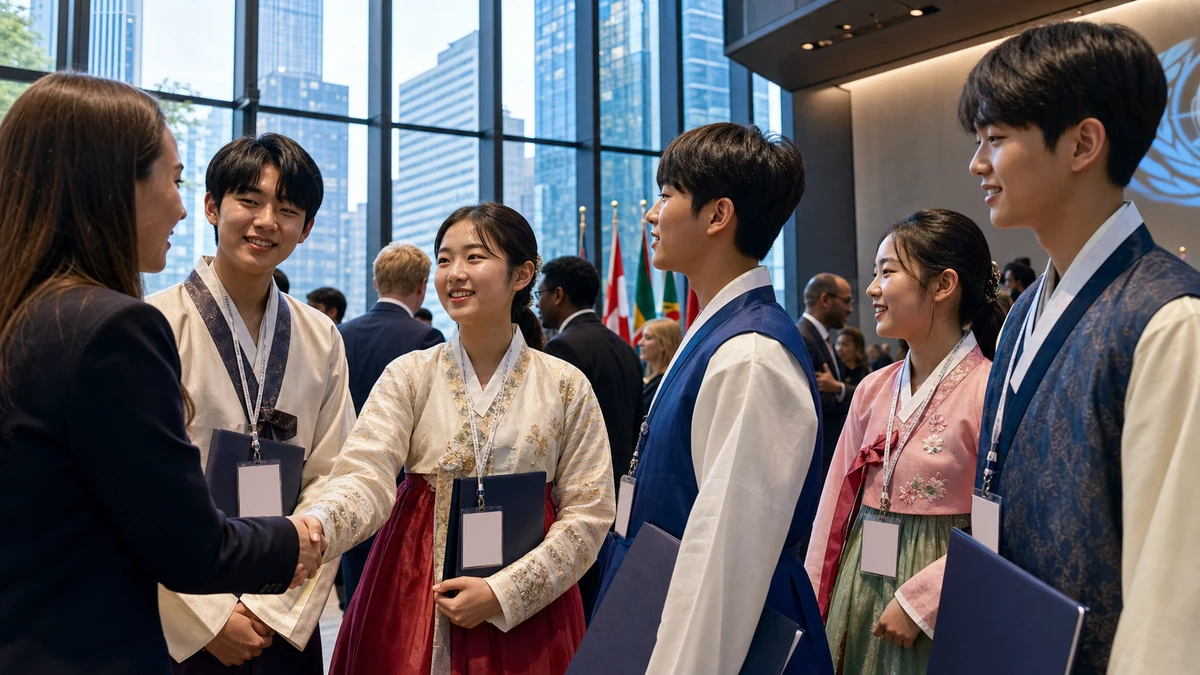
A Korean youth delegation steps onto a global stage
At United Nations headquarters in New York, a group of South Korean teenagers recently made an entrance that was as visually striking as it was symbolically layered: They arrived wearing hanbok, the traditional Korean dress known for its flowing lines, vivid colors and formal elegance. But this was not a cultural performance in the narrow sense, nor a tourist stop dressed up for cameras. According to organizers and South Korean officials who later publicized the visit, the students were there to take part in an international forum tied to World SME Day, engaging with debates about entrepreneurship, innovation, sustainability, women’s leadership and the role of young people in shaping the economy they will inherit.
For American readers, it may help to think of the moment as something more than a school field trip and different from a simple cultural exchange. Imagine high school students from across the United States walking into the U.N. in clothing that signals deep national heritage — not as costume, but as a statement of identity — and then joining discussions about artificial intelligence, small-business growth and civic leadership. That combination of tradition and future-focused ambition is what made the South Korean delegation’s appearance noteworthy.
The event, held June 26 local time in New York and later announced in South Korea on June 28, was part of an international forum hosted by the International Council for Small Business, or ICSB, in connection with the 2026 World SME Day. SMEs — small and medium-size enterprises — are the businesses that often sit below the glamour of global conglomerates but form the backbone of many economies. In the United States, they might be the family-owned manufacturer, the local logistics startup, the neighborhood food company or the founder-led software firm trying to scale. In South Korea, where the economy is often associated abroad with giant brands like Samsung, Hyundai and LG, the small-business sector carries its own economic and social weight, especially in local communities and employment.
That is part of why the image of Korean teenagers in hanbok at a U.N. forum matters. It speaks to how South Korea increasingly presents itself to the world: not only as the home of K-pop, Korean dramas and beauty products, but as a society thinking seriously about how its next generation will participate in global conversations on technology, economics and civic life.
Why World SME Day matters beyond business circles
World SME Day does not usually command the same level of public attention as major climate summits or high-level diplomatic meetings, but its subject matter touches daily life in practical ways. The United Nations established the observance to highlight the role small and medium-size businesses play in job creation, innovation and sustainable development. Those firms are often where technological change becomes real for ordinary people — where automation alters hiring, where digital tools reshape customer service and where new ideas either survive or fail.
This year’s forum theme, centered on the “future generation of SMEs,” is particularly telling. It suggests that the conversation is no longer just about balance sheets, export strategy or access to capital. It is also about who will build, lead and work inside tomorrow’s businesses. That means young people are no longer peripheral to the discussion. They are the discussion.
In the United States, politicians often talk about the future of work in terms of community colleges, coding boot camps, manufacturing reshoring or the impact of AI on white-collar jobs. South Korea is asking related questions, though in its own national context. It is a country with world-class digital infrastructure, intense educational competition and a youth population coming of age in a society balancing global cultural influence with domestic concerns over employment pressure, inequality and demographic decline. When Korean students attend a forum like this, they are not stepping into an abstract policy seminar. They are entering a conversation that will shape the conditions of their adult lives.
ICSB, the group that hosted the forum, said participants discussed the development of SMEs in an era shaped by AI and digital transformation, framed around what it described as human-centered entrepreneurship. That phrase may sound like conference jargon, but the idea behind it is straightforward: As technology changes how businesses operate, societies still need economic systems that prioritize people, communities and ethical responsibility instead of chasing efficiency alone. For teenagers preparing to enter universities and labor markets transformed by software, automation and global competition, those questions are immediate.
That is one reason the South Korean delegation’s participation resonated beyond ceremonial value. It underscored a broader shift in youth education, one in which global issues are becoming part of civic formation rather than specialized topics reserved for adults, diplomats or business leaders.
Hanbok as a statement, not a costume
To many Americans, hanbok may be most familiar from period dramas, museum exhibitions or weddings. In South Korea, however, it carries a more nuanced meaning. It is traditional attire, yes, but also a marker of occasion, respect and cultural continuity. Hanbok is often worn during major holidays such as Seollal, the Lunar New Year, or Chuseok, the Korean harvest festival, as well as family celebrations and formal ceremonies. In recent years, younger Koreans have also embraced modernized versions of hanbok in fashion and public events, using it as a way to connect heritage with contemporary identity.
That context matters here. When the youth delegation wore hanbok at the U.N., they were not simply displaying Korean culture for foreign consumption. They were signaling who they were before they said a word. In a multinational space like U.N. headquarters, where language, nationality and protocol can blend into institutional sameness, clothing can become a first form of introduction. Hanbok offered a visual reminder that these students were showing up not only as participants in a policy discussion but as representatives of a cultural tradition that remains meaningful in modern Korea.
For American audiences, a rough parallel might be Native regalia at a formal event, or young people wearing attire tied to deep communal heritage during a civic ceremony — with the crucial caveat that each cultural context is distinct and not directly interchangeable. The common thread is that traditional dress can carry memory, pride and political meaning all at once. It can say, “We are modern, but we did not arrive here without a past.”
In the Korean case, that message lands especially strongly because South Korea’s global image over the past two decades has been dominated by the forward-looking sheen of the Korean Wave. The export of music, television, film, fashion and food has made the country legible to many foreign audiences as a source of trend and innovation. Yet the U.N. appearance by these students suggested another dimension: Korea’s younger generation is not discarding tradition in order to become global. It is often taking tradition with it.
That blending of old and new is one of the reasons Korean culture continues to travel well internationally. It is not just polished entertainment. It is a society repeatedly staging conversations between heritage and hypermodernity — between palace architecture and gaming culture, between Confucian family structures and digital individualism, between folk aesthetics and AI-era ambition. The sight of teenagers in hanbok talking about innovation captured that tension in a single frame.
What the students were there to learn
According to the summary released in South Korea, the delegation took part not only in the formal international forum but also in youth-centered programming, including a “Youth Innovation Session.” The issues they encountered — innovation, sustainability, women’s leadership and youth empowerment — might sound broad, but taken together they form a pretty accurate map of the world younger generations are being asked to navigate.
Innovation is no longer a niche concern limited to engineers or startup founders. It shapes how students learn, how workers are hired and how communities stay economically viable. Sustainability is not simply an environmental slogan; it is increasingly linked to public health, food systems, energy prices and urban planning. Women’s leadership is not a decorative add-on to policy debate but a question about who gets to make decisions and whose perspectives count in institutions historically dominated by men. Youth empowerment, meanwhile, is one of those phrases that can sound soft until you consider the stakes: access to education, social mobility, political voice and the ability to imagine a future that is not entirely scripted by older generations.
In South Korea, these themes intersect with national debates that are both familiar and specific. Like many developed countries, South Korea is grappling with the economic and social fallout of rapid technological change. It is also confronting sharp pressure on young people to succeed in a highly competitive system. Educational achievement remains central to social advancement, but so do networking, language skills, digital fluency and increasingly some form of global exposure. International forums, once seen as elite extras, are becoming part of a broader educational ecosystem in which students are expected not only to excel academically but also to demonstrate what educators sometimes call “global citizenship.”
That term can be fuzzy, and sometimes it is used too loosely. But at its best, global citizenship means young people learning how decisions made in one country affect lives in another; how local identity can coexist with international responsibility; and how civic participation now often requires fluency not just in national issues but in global ones. A U.N. setting amplifies that lesson. Even if no major policy is set by a youth session, the experience itself can matter: hearing the language of international cooperation, seeing how institutions convene diverse participants and recognizing that questions about business and technology are inseparable from questions about ethics and society.
The students’ presence at discussions on women’s leadership is also worth noting. South Korea has made enormous strides in education and economic development, but gender inequality remains a live issue in politics and the workplace. Debates over career advancement, caregiving, representation and discrimination have become increasingly visible, especially among younger Koreans. For students to encounter women’s leadership as part of an international agenda is to place those domestic debates within a larger global framework.
A wider shift in how South Korea educates its youth
The deeper significance of the New York appearance may lie in what it says about South Korea’s evolving view of adolescence and education. For years, the country’s youth experience has been described abroad through a narrow lens: relentless exams, late-night study sessions, private tutoring and the pressure cooker of college admissions. Those realities are not imaginary. They remain a major part of Korean social life and a frequent subject of concern inside the country itself.
But that picture is incomplete. South Korean education is also expanding in ways that are less visible to outside audiences, incorporating more global exchange, leadership training and project-based learning tied to real-world issues. The youth delegation’s visit to the U.N. suggests a model of development in which teenagers are seen not only as students to be managed or protected, but as emerging civic actors capable of representing their country, learning across borders and engaging public questions at an early stage.
That matters in a society where the stakes of youth policy are unusually high. South Korea has one of the world’s lowest birth rates, a rapidly aging population and an economy that depends on maintaining competitiveness in advanced industries. The next generation is numerically smaller, but politically and economically more consequential. Investments in their education, leadership and international competence carry national significance.
There is also a symbolic dimension. U.N. headquarters functions as a kind of shorthand for legitimacy in global public life, even in an era when the institution is often criticized as bureaucratic or limited in power. To bring students there is to tell them that the world they are entering is not bounded by neighborhood, school district or even national curriculum. It is to let them inhabit — however briefly — a stage where global norms are argued over and where issues like development, equity and innovation are framed as shared problems.
For Americans, this may sound akin to the educational value of sending students to Washington to observe Congress, visit the Smithsonian or participate in a model diplomacy program — except with the additional layer of crossing national boundaries and carrying visible cultural identity into the room. The point is not that every participant becomes a diplomat or entrepreneur. It is that such experiences broaden the imaginative horizon of what citizenship can mean.
Beyond K-pop: A fuller picture of Korea’s next generation
There is a reason stories like this resonate internationally, especially at a time when South Korea occupies an unusually strong place in global cultural consciousness. For many English-speaking audiences, Korea still arrives first through entertainment: BTS and Blackpink, Oscar-winning films, Netflix dramas, skincare trends, fried chicken chains and the aesthetics of Seoul street fashion. Those are real and influential parts of Korean soft power. But they can also flatten the country into a stream of consumable exports.
The image of teenagers in hanbok at a U.N. forum complicates that picture in useful ways. It shows a Korea that is not just producing culture for the world to watch, but raising young people to enter international spaces as participants. It also suggests that the country’s most compelling exports may include social habits and educational aspirations, not only songs and shows.
This is not to overstate what happened. Publicly available information does not establish the full size of the delegation, the specific remarks made by each student or what concrete projects may come next. The known facts are more modest and should be treated that way: a South Korean youth delegation attended an ICSB international forum at U.N. headquarters, wore hanbok while interacting with participants from other countries and joined official and youth-focused sessions dealing with major contemporary issues.
Even so, modest facts can illuminate larger trends. One of them is that Korean identity on the world stage is becoming more layered. Another is that younger Koreans are increasingly expected to move comfortably between cultural rootedness and global engagement. That dual expectation mirrors the trajectory of South Korea itself — a nation that industrialized at remarkable speed, democratized amid struggle, built immense cultural reach and now faces the challenge of preparing a new generation for a future defined by uncertainty as much as opportunity.
Seen that way, the New York event was not just a photo opportunity. It was a small but telling snapshot of how South Korea wants to be seen, and perhaps how it sees itself: a country whose youth can honor tradition without being confined by it, and who can walk into debates about AI, sustainability and entrepreneurship without leaving their cultural identity at the door.
What one day at the U.N. says about the future
If there is a larger takeaway from the scene at U.N. headquarters, it is that lifestyle for today’s teenagers — in Korea and elsewhere — is about more than taste, trends or consumption. It is also about the social world they are being trained to enter: what they wear to represent themselves, what issues they are taught to care about, what languages of leadership they are expected to speak and what kinds of rooms they are invited into.
For the South Korean delegation, hanbok communicated continuity. The forum itself communicated future-oriented responsibility. The interaction with peers and participants from other countries communicated expanding civic horizons. Put together, those elements offered a concise portrait of a generation learning to move between local inheritance and global conversation.
In American terms, that may be the most relatable part of the story. The United States, too, is debating how to prepare young people for a world shaped by AI, fragile democracies, climate pressure and economic disruption. It is also wrestling with how cultural identity fits into public life without hardening into exclusion or performance. South Korea’s example does not provide a blueprint, but it does offer an instructive image: young people carrying something old into a conversation about something new.
At a moment when international news can feel dominated by conflict, rivalry and institutional paralysis, there is something quietly powerful about that image. No single youth forum changes the world. No ceremonial outfit solves the structural questions hanging over the global economy. But there is value in watching the next generation practice public presence — learning how to stand for where they come from while engaging the world they are about to shape.
That may be what made the South Korean delegation’s appearance in New York memorable. In one of the world’s most recognizable diplomatic spaces, these students offered a glimpse of a country whose future is being carried not just by technology or cultural export, but by young people being taught to connect heritage, ambition and citizenship. For a global audience used to seeing Korea through screens, this was a reminder that the next chapter may be written just as much in classrooms, civic programs and international forums as on concert stages.
Comments
Post a Comment