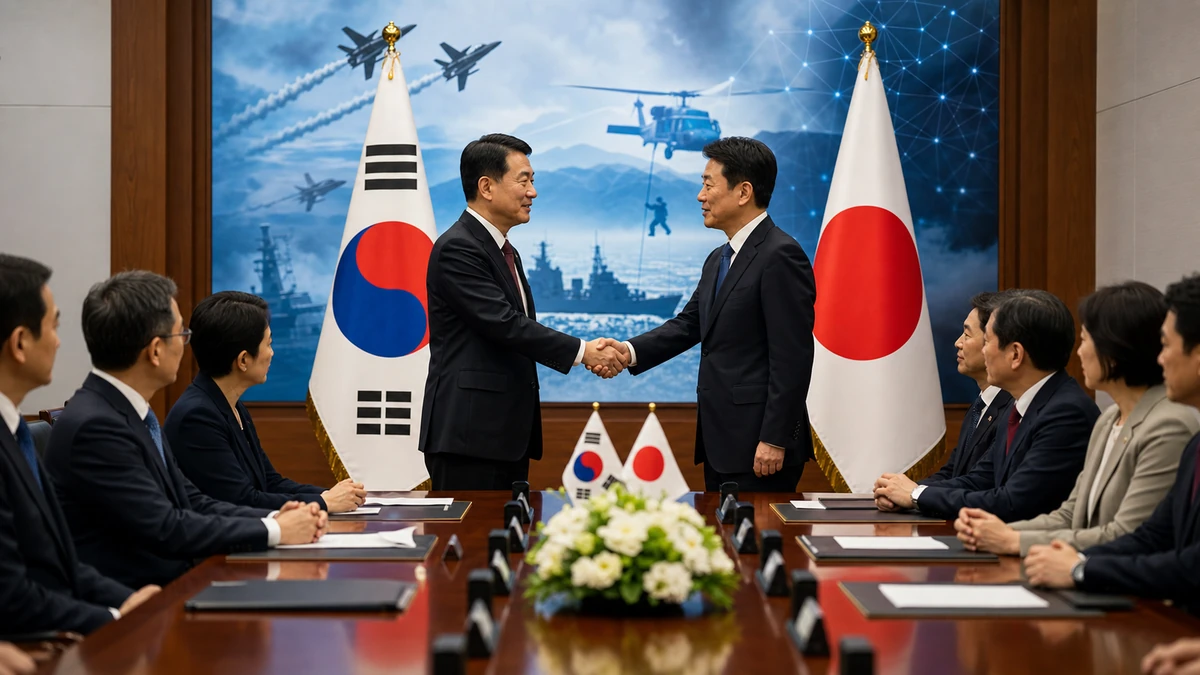
Seoul meeting points to a quieter, more practical shift in Northeast Asia security
South Korea and Japan took another step toward closer defense coordination in Seoul this week, laying out plans to broaden military exchanges in ways that are less about dramatic treaty announcements and more about the steady, often understated work of building trust. According to the South Korean Defense Ministry and a joint press statement released after the meeting, South Korean Defense Minister Ahn Gyu-back and Japanese Defense Minister Shinjiro Koizumi agreed to expand defense exchange and cooperation into three specific areas: exchanges between their air force aerobatic teams, naval search-and-rescue training, and advanced science and technology discussions, including artificial intelligence.
For American readers, the significance of the meeting is not that Seoul and Tokyo have suddenly created a new military alliance. They have not. What matters is that two countries whose modern relationship has often been burdened by history chose to identify concrete, working-level areas where their militaries can interact more regularly and more predictably. In diplomatic terms, that can be as important as a headline-grabbing declaration. It suggests their security relationship is moving beyond broad talk of improving ties and into the less glamorous but more durable terrain of actual coordination.
The talks took place at South Korea’s Defense Ministry complex in Yongsan, a district of Seoul that has become closely associated with the country’s modern national security establishment. The joint statement said the two sides would strengthen communication and efforts to develop what they described as stable and future-oriented defense exchanges, built on mutual understanding and trust. That language may sound formulaic, but in the context of South Korea-Japan relations, it carries weight. Stability and trust are precisely the qualities that have often proved difficult to sustain between the two U.S. allies.
The broader context is one familiar to Washington policymakers and increasingly relevant to ordinary Americans as concerns about regional security in Asia grow. The United States has long wanted better cooperation between South Korea and Japan, two democratic, technologically advanced partners that sit at the center of America’s strategy in the Indo-Pacific. When Seoul and Tokyo work together more smoothly, it strengthens not only their own readiness but also the wider network the U.S. relies on in dealing with North Korea, managing maritime risks and responding to fast-moving technological change in defense.
But while Washington often frames this in strategic shorthand, the politics on the ground in both countries are more complicated. Public opinion in South Korea and Japan has been shaped by decades of disputes over Japan’s colonial rule of the Korean Peninsula from 1910 to 1945, as well as recurrent fights over history, apologies and territorial claims. That is why this week’s meeting matters. It shows that even without pretending those disputes have disappeared, officials in Seoul and Tokyo are still looking for specific areas where practical cooperation can move forward.
Why the details matter more than the optics
The central phrase in the Seoul meeting was that the two sides would further strengthen defense exchange and cooperation. On its face, that sounds modest. In reality, the wording is carefully chosen. It does not announce a new alliance, a mutual defense pact or any sweeping restructuring of regional security. Instead, it signals a political decision to widen and deepen cooperation in selected sectors where the benefits are visible and the political costs may be easier to manage.
That distinction is important. In East Asia, where every diplomatic signal can be parsed for its impact on China, North Korea and the United States, governments are often careful not to overstate what they are doing. Grand declarations can provoke backlash at home or alarm abroad. Specific, manageable forms of cooperation, by contrast, can create habits of communication without forcing leaders into maximalist positions. In that sense, the Seoul meeting appears designed to show momentum while keeping expectations realistic.
The joint statement identified three pillars: air force exchanges, naval search-and-rescue cooperation and advanced technology talks. Each serves a different purpose. The air force exchanges are highly symbolic and public-facing. The naval rescue drills are practical and directly tied to public safety. The technology dialogue points to the future, especially as militaries around the world race to understand how artificial intelligence may reshape operations, logistics and decision-making.
Together, those three areas sketch out a broader vision of what defense cooperation can mean in 2026. It is not only about troop movements, missile defense or hard-power posture. It is also about interoperability in emergencies, public confidence and the ability of neighboring democracies to manage new technologies responsibly. For readers in the United States, there is a familiar analogy here: some of the most meaningful forms of security cooperation among close partners do not always happen in war games or summit photo lines. They happen in routine information-sharing, rescue coordination, professional exchanges and standards-setting that can later prove invaluable during a crisis.
Just as importantly, the two governments chose to spell out these sectors in a formal joint statement after a face-to-face meeting in Seoul. That is a level of specificity that suggests the relationship is being framed in operational terms, not just rhetorical ones. Diplomacy often advances through accumulated language, and the act of naming shared priorities can become the framework through which future military contacts are normalized.
Aerial diplomacy: What the Black Eagles and Blue Impulse represent
One of the most eye-catching parts of the agreement involves exchanges between South Korea’s Black Eagles and Japan’s Blue Impulse, the aerobatic demonstration teams of the two countries’ air forces. For readers outside Asia, that may sound ceremonial or even peripheral. But military demonstration teams carry more meaning than an air show performance might suggest.
In the United States, the Navy’s Blue Angels and the Air Force Thunderbirds are not just entertainment acts. They are symbols of national prestige, pilot skill, safety discipline and military professionalism. South Korea’s Black Eagles and Japan’s Blue Impulse play a similar role. Their flights are public displays of precision, training and technical competence, and they often function as soft-power ambassadors for their countries’ armed forces.
That is why exchanges between them matter. They are visible, symbolic and relatively public forms of military contact. They offer a way for the two countries to show that cooperation is possible in a domain that citizens can literally see in the sky. This is defense diplomacy in one of its most accessible forms: less about threatening an adversary and more about demonstrating confidence, coordination and mutual respect.
The South Korean side said the two countries would continue developing exchange and cooperation between the teams, using occasions such as Black Eagles stopovers in Japan as an opportunity. The language is notable for what it does and does not say. It points to a continued direction of travel, but it stops short of announcing a detailed schedule, a new event calendar or a specific joint performance. That restraint is consistent with the broader tone of the meeting. The point was to establish a framework, not to overpromise.
Even so, the symbolism should not be underestimated. Aerobatic teams are prestige units. They represent the public face of military aviation. When countries allow these units to interact more closely, they are often signaling a level of comfort with each other that goes beyond formal diplomacy. The exchanges can also expose personnel on both sides to each other’s organizational cultures, maintenance practices and safety procedures. Over time, those contacts can widen the web of familiarity between institutions.
In a relationship like South Korea and Japan’s, where mistrust has periodically interrupted cooperation, symbolic gestures are not trivial. They can help normalize the idea that the two militaries are not strangers operating in the same neighborhood, but neighbors capable of maintaining respectful, professional contact. For governments trying to make cooperation politically sustainable at home, that kind of symbolism can be useful.
Search-and-rescue drills offer the clearest case for everyday cooperation
If the aerobatic team exchanges are the most visible part of the Seoul announcement, the search-and-rescue component may be the most practical. The two sides agreed to further develop naval search-and-rescue training for a variety of maritime accident scenarios. In a region surrounded by busy sea lanes, commercial traffic and frequent fishing activity, that is the sort of cooperation whose value is easy to explain to the public.
Search and rescue occupies an important middle ground in security affairs. It involves military organizations, ships, aircraft and command structures, but its purpose is fundamentally humanitarian and operational rather than overtly combative. That makes it one of the more politically manageable areas for defense cooperation between countries that may still be cautious about deeper military integration.
For Americans, a good point of comparison would be the way Coast Guard, Navy and allied emergency agencies coordinate in disaster response, missing-vessel cases or aviation accidents over water. The effectiveness of those operations depends on communication systems, established procedures and repeated training. When minutes matter, governments do not want to be introducing themselves for the first time.
That logic applies strongly to South Korea and Japan. The two countries sit across a narrow stretch of sea from one another. Maritime incidents do not always respect national boundaries, and quick responses often require information-sharing and a degree of coordination. By emphasizing search-and-rescue drills, Seoul and Tokyo are choosing a form of cooperation that is both practical and publicly legible. It is easier to defend politically because it centers on saving lives and crisis response rather than military posturing.
The joint statement did not provide details about the size, timing or format of future exercises, so there is a limit to what can be said with certainty. Still, the agreement’s importance lies in the commitment to keep developing the training. Repeated, routine cooperation is where trust is often built. A rescue drill may not command the same international attention as a summit or a weapons announcement, but it can do something more durable: create habits of coordination among officers, crews and planners who may one day need to work together under pressure.
That is one reason the Seoul meeting deserves attention beyond the Korean Peninsula and Japan. In international security, resilience often comes not from one dramatic agreement but from a series of practical arrangements that make crisis response more predictable. Search-and-rescue training fits that pattern.
Artificial intelligence brings the relationship into the future
The third pillar of the announcement may ultimately prove the most consequential: the decision to pursue discussions on advanced science and technology cooperation, including artificial intelligence. Here again, the two governments were careful. They did not unveil a joint AI project, a procurement plan or a formal bilateral technology pact. What they confirmed was a commitment to push discussions forward.
Even that is significant. AI has moved from a buzzword to a central issue in defense planning around the world. Militaries are examining how it might improve data analysis, logistics, maintenance forecasting, battlefield awareness and decision support. At the same time, governments are grappling with the ethical, legal and strategic questions that come with using increasingly powerful algorithms in security settings.
South Korea and Japan are well positioned to take part in those conversations. Both are widely viewed as technologically sophisticated nations with strong manufacturing bases, advanced electronics sectors and high-capacity research ecosystems. When their defense officials place AI in a joint statement, it suggests that bilateral security ties are no longer confined to traditional military exchanges. They are expanding into the realm where future military effectiveness may increasingly be determined: software, data systems and technological standards.
For American audiences, this is a reminder that security competition in Asia is no longer only about ships, aircraft and missile ranges. It is also about who shapes the rules and operating practices around emerging technologies. If U.S. allies like South Korea and Japan find ways to align their thinking in this space, that could have implications not just for their bilateral relationship but for wider cooperation with Washington and other partners.
There is also a deeper political meaning here. Technology cooperation can sometimes provide a forward-looking agenda when historical or territorial issues complicate other forms of engagement. It allows governments to talk about shared future challenges rather than only past grievances. That does not erase history, and it should not. But it can create additional pathways for interaction that are based on common capabilities and common needs.
Still, caution is warranted. The available information does not indicate how far these discussions will go or whether they will produce a formal framework. At this stage, the most accurate reading is that both sides have publicly identified advanced technology, including AI, as a legitimate and growing area for defense dialogue. In diplomacy, that is often how larger initiatives begin: first as a topic both governments agree is worth discussing seriously.
History still shadows Seoul-Tokyo ties, which makes this moment more notable
Any report for an American audience has to explain why even limited defense cooperation between South Korea and Japan can become major news. The reason is history. Japan’s colonial occupation of Korea remains a defining issue in the relationship, and disputes over wartime memory, compensation and official statements have repeatedly spilled into contemporary politics. Trade relations, intelligence-sharing and summit diplomacy have all at times been disrupted by those tensions.
That historical backdrop means security cooperation between Seoul and Tokyo cannot be understood the same way Americans might think about cooperation between, say, the U.S. and Britain or even the U.S. and Japan. The political sensitivities are much sharper. Leaders in both countries have to think not only about strategic logic but also about domestic audiences that may view military ties through the lens of unresolved historical pain.
This is why the language in the joint statement about mutual understanding, trust, stability and a future-oriented relationship matters so much. Those are not casual diplomatic pleasantries. They are an acknowledgment that the relationship needs careful tending. Stability means avoiding the start-and-stop pattern that has often characterized ties. Future-oriented implies an effort to build cooperation around present and emerging needs rather than allowing every interaction to be consumed by old disputes.
None of this means history has stopped mattering. It means the two governments appear to be trying to prevent historical disagreements from blocking every area of practical coordination. That is a subtle but important distinction. In international relations, countries often pursue compartmentalization, trying to make progress in one area even while other disputes remain unresolved. The Seoul meeting looks very much like an example of that strategy.
For the United States, that is likely to be welcomed. American administrations of both parties have long encouraged stronger South Korea-Japan coordination as part of a stable regional balance. But the deeper story is regional, not just American. Seoul and Tokyo themselves appear to be recognizing that in a more uncertain security environment, even limited trust-building measures can be valuable.
What global readers should watch next
The most important takeaway from the Seoul talks is not that South Korea and Japan announced a sweeping new security architecture. They did not. It is that they publicly agreed on a set of manageable, concrete fields where defense cooperation can keep evolving. In diplomacy, that is often how durable change starts: not with a dramatic rewrite of the map, but with repeated small decisions about what institutions will do together next.
The choice of sectors was especially telling. Exchanges between the Black Eagles and Blue Impulse represent symbolic, public-facing diplomacy. Naval search-and-rescue training represents practical cooperation with direct human stakes. Discussions on advanced science and technology, including AI, represent the future-facing dimension of the relationship. Symbolism, utility and technological ambition are all present in the framework the two ministers outlined.
For international readers, the meeting also offers a window into how South Korea is presenting its broader strategic posture. The message is not one of overt militarization or dramatic escalation. It is one of managed cooperation, institutional contact and trust-building in selected areas. That matters in a region where security news is often dominated by missile launches, military threats and great-power rivalry. Not every significant development comes in the form of a crisis. Sometimes it comes in the form of a carefully worded joint statement that indicates officials are trying to make cooperation more normal and more routine.
Whether that effort succeeds will depend on follow-through. Future visits, actual training activity and the substance of technology talks will determine whether this week’s announcement becomes a milestone or simply another diplomatic marker. But even at this stage, the Seoul meeting sends a clear signal: South Korea and Japan are trying to anchor their defense relationship in specific forms of contact that can be repeated, explained to the public and expanded over time.
That may not be as dramatic as a new treaty, but it may be more realistic. In a relationship shaped by history and strategic necessity in equal measure, realism matters. And for American readers trying to understand the changing security landscape in Asia, this is the key point: one of Washington’s most important regional partnerships is being strengthened not through sudden transformation, but through incremental, practical steps that could make the region more coordinated and more resilient in the years ahead.
Comments
Post a Comment