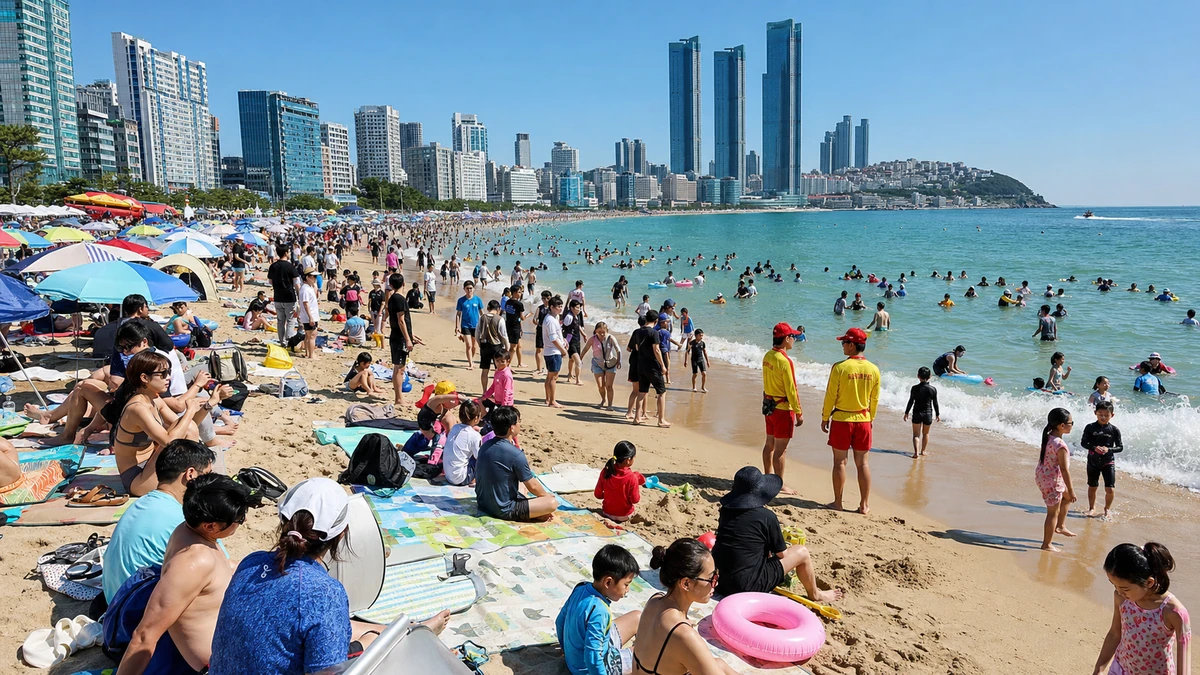
Busan’s summer starts when the beaches fill up
For many Americans, the unofficial start of summer is Memorial Day weekend, when highways clog with beach traffic and shore towns come back to life. In South Korea, a similar seasonal marker is now taking shape in the southern port city of Busan, where two of the country’s best-known urban beaches — Haeundae and Songjeong — are drawing big crowds just days after their official opening.
Local officials in Busan’s Haeundae district said a combined 194,466 people visited Haeundae Beach and nearby Songjeong Beach over the first two days after the beaches formally opened on June 26. On opening day alone, 81,541 people were counted between the two sites, including 67,697 at Haeundae and 13,844 at Songjeong. By the first weekend after opening, the beaches were already seeing a steady stream of residents and tourists, offering one of the clearest signs yet that summer tourism in South Korea’s second-largest city is fully underway.
That may sound like a routine seasonal update, but in South Korea, where dense cities, extensive transit networks and a strong domestic travel culture can move large numbers of people quickly, beach openings are more than a simple calendar event. They are a public signal that the country is entering a new phase of the year — one defined by humid heat, school breaks, weekend getaways and a renewed migration toward the coast.
The story is also a reminder that Korea’s appeal to travelers goes far beyond the global images most familiar to foreign audiences: K-pop concerts in Seoul, palace grounds crowded with rental hanbok, or television drama filming locations. Summer in South Korea also unfolds in very ordinary, highly local ways. It happens when families set up umbrellas in the sand, when friends ride the train to the coast for a day trip, and when a city like Busan, already closely identified with the sea, settles back into its most recognizable seasonal role.
In that sense, the numbers from Haeundae and Songjeong are not just attendance figures. They are evidence of how a place reasserts itself year after year. Busan’s beaches do not need a one-time megaevent to attract attention. Their draw comes from repetition, familiarity and the enduring idea that once summer arrives, this is where people go.
Why Haeundae matters in South Korea
To understand why these visitor counts matter, it helps to understand what Haeundae means in the Korean imagination. If Seoul is the political, economic and cultural center of the country, Busan is often presented as its maritime counterweight: a sprawling coastal metropolis of ports, seafood markets, apartment towers and beaches pressed right up against the city. It is the South Korean city most often associated with the ocean in the same way Miami, San Diego or parts of Southern California might function in the American imagination.
Haeundae Beach, in particular, is not just another shoreline. It is one of the most recognizable beach names in South Korea, a destination that has long occupied a central place in domestic tourism. The neighborhood around it mixes luxury hotels, high-rise residences, cafes and nightlife with the broad stretch of sand itself. For many Koreans, Haeundae is both a classic summer destination and an instantly legible symbol of Busan.
That reputation helps explain why Haeundae drew a much larger crowd than Songjeong on opening day. The gap in raw attendance does not, by itself, explain why people chose one beach over the other, and the available data does not break down visitors by nationality, spending or length of stay. But it does reflect the differing public profiles of the two locations. Haeundae is the better-known name, the place likely to appear first in guidebooks, travel videos and online searches by both domestic and international visitors.
For an American reader, the easiest comparison may be to think of Haeundae as the marquee beach district — the place with broad name recognition, heavy foot traffic and a built-in status as a must-see. Even people who know little about Busan have often heard of Haeundae, much as travelers unfamiliar with Florida still recognize South Beach. The beach’s popularity, then, is not just about sand or surf. It is tied to brand value, convenience and the social power of a destination that people feel they already know before they get there.
That symbolic power matters to Busan, especially as South Korea continues to balance domestic tourism, international branding and post-pandemic travel habits. When Haeundae fills quickly after opening, it reinforces an image that city officials and tourism businesses alike depend on: Busan as a place where urban life and coastal leisure meet without much distance between them.
Two beaches, two moods in one city
What makes this early-summer moment especially notable is that Haeundae and Songjeong opened together, giving visitors two distinct beach experiences within the same district. That may not sound unusual to Americans used to beach towns with multiple shoreline options, but in Busan it underscores one of the city’s core tourism strengths: variety packed into a relatively compact urban area.
Haeundae and Songjeong are both in Haeundae district, but they serve somewhat different functions in the public imagination. Haeundae is the flagship attraction, famous for its wide beach, big-city energy and broad appeal to tourists. Songjeong, while also well known, often carries a calmer, somewhat less crowded image by comparison. It is still very much part of Busan’s mainstream beach culture, but the atmosphere can feel more relaxed and less dominated by the spectacle that surrounds Haeundae during peak season.
That distinction is important because it shows how Busan works as a travel destination. Visitors are not limited to a single iconic site. They can choose among different rhythms of coastal life depending on what they want: a dense and energetic urban beach, a somewhat quieter stretch of sand, a seafood-heavy neighborhood, a scenic rail route or a hillside district with ocean views. Busan’s tourism strength comes not only from individual attractions but from the way those experiences sit near one another, allowing travelers to compare and combine them easily.
In practical terms, that means Busan can accommodate multiple kinds of summer visitor at once. Families with children, day-trippers from elsewhere in Korea, young travelers looking for photo-friendly cityscapes, surfers and beachgoers who simply want to mark the season can all find a place within the same coastal system. The first-weekend crowds at Haeundae and Songjeong suggest that this flexible appeal remains intact.
It also reflects a broader feature of South Korean leisure culture: people are often highly mobile on weekends and holidays, especially when public transit makes regional travel relatively straightforward. A beach trip in Korea does not necessarily require the kind of long-haul planning common in the United States. In and around Busan, a large number of people can decide to head for the shore with comparatively little friction, which helps explain how quickly attendance can swell once the season officially begins.
An urban beach culture shaped by Korean geography
The popularity of Haeundae and Songjeong also points to a specifically Korean version of beach culture. In the United States, beach travel is often associated with long coastlines, road trips, rental houses or sprawling resort communities. South Korea’s geography creates a different experience. The country is mountainous, densely populated and relatively compact, with major urban areas connected by extensive rail and road networks. As a result, beaches can function not just as vacation destinations but as highly accessible seasonal outlets for city dwellers.
That helps explain why a place like Busan occupies such an important position. It offers something that can be harder to find in landlocked or inland-heavy countries: a major metropolitan environment where mountains, dense neighborhoods and the ocean meet in the same daily landscape. In a Korean context, that combination gives urban beaches a role that goes beyond swimming or sunbathing. They become a stage for experiencing the season itself.
When local reporting says people are heading to the beach after an official opening, it implies more than a recreational choice. It suggests a social rhythm familiar to many Koreans. School is out or winding down, temperatures are rising and the shift into full summer is now visible in public space. In this sense, the beach is a civic setting as much as a tourist one — a place where the collective feeling of the season becomes visible.
That may be especially legible in Busan because the city’s identity is already so intertwined with maritime life. Unlike Seoul, where summer is often experienced through riverside parks, shopping districts, indoor escapes from humidity or historic sites, Busan’s seasonal story unfolds at the water’s edge. Its beaches are not secondary amenities. They are central to how the city presents itself to the rest of the country and, increasingly, to the world.
For international readers, including Americans who may know Korea largely through popular culture exports, this matters because it broadens the mental map of the country. South Korea is often marketed abroad through images of cutting-edge Seoul, royal palaces, beauty products and entertainment industries. All of that is real, but so is this quieter truth: for countless Koreans, summer means going to Busan, standing on the sand and watching the city’s coastal life take over once again.
What the crowd numbers do — and do not — tell us
The attendance figures released by Haeundae district are striking, but they also require some care in interpretation. The clearest confirmed facts are these: Haeundae and Songjeong officially opened June 26; a total of 194,466 people visited over the first two days, Friday and Saturday; and opening day traffic reached 81,541, with the larger share going to Haeundae. As of the first weekend, residents and tourists were continuing to arrive in large numbers.
Those numbers are meaningful because they show immediate traction. In tourism terms, they suggest that the seasonal opening translated quickly into real movement, not just symbolic interest. Busan did not need a long ramp-up period for its beach economy to begin humming. The crowds appeared almost immediately, reinforcing the idea that the city’s summer travel infrastructure remains deeply rooted in visitor habits.
At the same time, the data leaves several questions unanswered. It does not tell us how long people stayed, how much they spent, how many were from outside Busan or South Korea, or what share of traffic came from repeat visitors rather than first-timers. It does not measure whether the weekend surge will be sustained across the season, nor does it explain specific motivations for choosing Haeundae over Songjeong or vice versa.
That limitation matters because attendance alone can easily be overread. A large opening-weekend crowd is a useful indicator of momentum, but it is not the same thing as a full economic impact study. It tells us that Busan’s beaches retain strong pulling power at the start of summer. It does not, on its own, provide a complete picture of who is benefiting most, how travel behavior is evolving, or how international tourism is contributing compared with domestic demand.
Still, in the absence of broader data, the numbers do support one clear conclusion: the urban beach remains a central pillar of Busan’s summer identity. That is not a trivial finding. In an era when destinations compete for attention through festivals, social media campaigns and short-lived attractions, there is something noteworthy about a place that can draw nearly 200,000 visits in two days simply by reopening a familiar stretch of shoreline at the start of the season.
More than tourism, a lesson in how places build loyalty
One reason this story resonates beyond Busan is that it speaks to a larger truth about travel. Destinations do not become durable because they are always new. Often, they remain powerful because they are reliably themselves. Americans understand this instinctively. Families return to Cape Cod, the Jersey Shore, Gulf Coast beaches or Southern California not because each summer brings a brand-new concept, but because the ritual of return is part of the appeal.
Busan’s beaches seem to operate on much the same principle. The opening of Haeundae and Songjeong is a repeating seasonal event, but repetition here is not stagnation. It is trust. People go back because the place is already embedded in their calendar, memory and expectations. They know what summer there looks and feels like. The destination does not need to reinvent itself every year to remain relevant.
That reliability can be an underappreciated asset in tourism strategy. Cities often chase novelty because novelty generates headlines. But sustained travel demand is just as often built through predictability, ease and emotional recognition. Haeundae, especially, appears to benefit from that kind of accumulated familiarity. Its name alone signals summer to many Koreans, and the opening-weekend numbers suggest that association remains powerful.
For Busan, this kind of loyalty is especially valuable because it anchors the city’s brand in lived experience rather than abstract marketing. The beaches are not famous only because officials say they are. They are famous because people continue to show up. That gives the city a kind of credibility that splashier campaigns cannot manufacture. Each returning visitor effectively votes for Busan’s image as a summer city by choosing to spend time there again.
That may also help explain why seemingly modest lifestyle stories like this one carry weight. They show not only where people are going, but which places have managed to remain emotionally durable in a crowded travel landscape. In that regard, the early crowds at Haeundae and Songjeong are a measure of public confidence as much as recreation.
What this means for foreign travelers watching Korea
For readers outside South Korea, the scene unfolding in Busan offers a useful corrective to the narrow way Korea is sometimes consumed abroad. The country’s international image has been shaped heavily by its cultural exports, and for good reason. Korean music, film, television and food have transformed how global audiences think about the peninsula. But those headline-grabbing sectors can overshadow the texture of ordinary seasonal life.
This Busan beach story is, at heart, a piece of daily reality. It shows how Koreans themselves inhabit summer, and how tourism in the country often grows out of rhythms that are local before they are global. There is no need for a blockbuster concert or viral phenomenon to make Busan’s beaches matter. Their importance comes from the fact that people already understand them as a default destination when the weather turns hot.
That does not mean international travelers are irrelevant. Quite the opposite. Even without nationality-specific figures, it is easy to see why Busan’s beaches fit neatly into the broader appeal of South Korea as a destination. For travelers who may begin with Seoul on their itinerary, Busan offers an accessible contrast: less about palaces and political history, more about coastline, seafood, city views and seasonal atmosphere. For a foreign visitor, it can be one of the easiest ways to understand that South Korea is not a one-city experience.
The appeal is also intuitive across language barriers. A traveler may not speak Korean, but the basic logic of an urban beach city is easy to grasp. Walkable waterfronts, food nearby, easy transit, strong visual identity and a sense of place tied directly to the season — these are assets that travel well across cultures. They do not require deep prior knowledge to appreciate.
As summer progresses, today’s crowded shoreline can become tomorrow’s travel search trend. That is often how destination interest grows now: not only through official marketing, but through visible evidence that real people are choosing a place in large numbers. When a beach reopens and quickly fills, it tells prospective travelers something simple and persuasive. This is where summer is happening.
And that may be the most telling part of Busan’s first beach weekend. It was not driven by a singular spectacle, but by accumulated habit and seasonal desire. Haeundae and Songjeong opened, people came, and the city’s summer identity snapped back into focus almost immediately. For Americans familiar with their own annual migrations to the shore, the scene is instantly recognizable, even from half a world away. Different coastline, different language, same essential ritual: when the heat arrives, people head for the water — and a city built around that impulse comes alive.
Comments
Post a Comment