At the U.S. Women’s Open, Two South Korean Veterans Push Nelly Korda on Golf’s Biggest American Stage
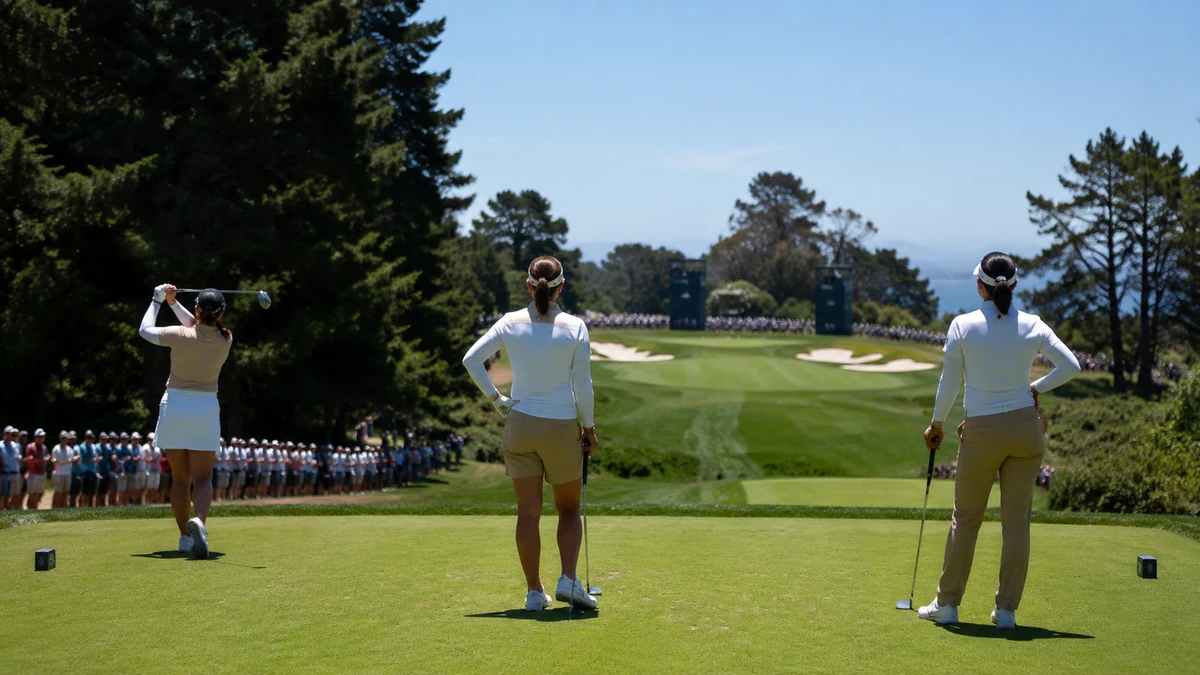
A major championship showdown takes shape in California
On one of the most demanding stages in women’s golf, the final round of the U.S. Women’s Open is shaping up as more than a simple chase between the tournament favorite and the field. At Riviera Country Club in Pacific Palisades, California, South Korea’s Kim Sei-young and Jeon In-gee have emerged as central figures in the weekend drama, putting two of the LPGA’s most accomplished Korean players squarely into the story line alongside world No. 1 Nelly Korda.
After the third round of the 81st U.S. Women’s Open, Kim stood tied for the lead with Korda at 6-under-par 207, setting up a final-round pairing that gives the tournament the kind of trans-Pacific tension golf often produces at its best: America’s top-ranked star, playing in her home country, against a proven South Korean champion with a major title already on her resume and another career-defining chance in front of her. Jeon, another major winner and one of the most respected names of her generation, has added depth to that picture, broadening the narrative from one player’s charge to a broader statement about South Korea’s staying power in women’s golf.
For American audiences, the setting is familiar: a prestigious national championship in California, a U.S. star at the top of the leaderboard, a final round at a famous course. But the deeper context may be less familiar. In women’s golf, South Korea has for years been one of the sport’s great talent engines, producing players whose precision, discipline and competitive consistency have reshaped the LPGA. That dominance is no longer novel, but moments like this serve as a reminder that it has not disappeared, either. Even in an era defined by Korda’s star power, South Korean players remain capable of seizing the center of the sport’s biggest events.
That is what makes this final-round setup so compelling. It is not just about who hits the better shots Sunday. It is also about what it means when two Korean veterans once again place themselves in contention at a major championship on American soil, under the brightest lights in women’s golf.
Kim Sei-young’s steady third round put her in the final pairing
If the scoreboard tells one story, Kim’s ball-striking tells another. Her third round was not built on chaos or a hot putting streak alone. It was built on control. Kim made five birdies and two bogeys, finishing the day 3 under and climbing into a share of the lead. Over three rounds, that kind of progression matters. Major championships rarely reward one spectacular day without punishing lapses elsewhere. More often, they reward players who manage mistakes, preserve momentum and understand when aggression makes sense.
Kim’s round appears to fit that pattern. According to the tournament account carried by Yonhap News Agency, she missed only two fairways. For casual American fans who tune in mostly for the majors, that stat may be easy to overlook, but it is one of the clearest indicators of why she was able to play comfortably. At a U.S. Women’s Open, fairways are not just nice to have. They are survival tools. Missing them can mean thick rough, awkward lies, difficult angles and bogeys that come in clusters. Hitting them gives players options, and options are everything when pressure mounts.
That is especially true at Riviera, a course that can expose even elite players if their rhythm slips. Kim’s accuracy suggests that, through three rounds, she has largely avoided the kind of unraveling that often knocks contenders out of a major before Sunday even begins. To arrive at 6 under after three days is not a flash of brilliance; it is a record of sustained decision-making. In golf terms, it means her tournament has been built shot by shot, hole by hole, with very little waste.
For Kim, the significance goes beyond a number on a leaderboard. Sharing the lead in a major entering the final round is one of the most meaningful positions a professional golfer can hold. It is not just an opportunity. It is a test of whether a player can convert form into legacy. In a regular LPGA event, a Sunday charge can be important. In the U.S. Women’s Open, it can become the defining chapter of a career.
Why the matchup with Nelly Korda carries extra weight
Korda is not just another co-leader. She is the top-ranked player in women’s golf, one of the most recognizable American names in the sport and, for many U.S. viewers, the face of the LPGA’s current era. Whenever she contends at a major in the United States, the story naturally bends toward her. That is what happens when a home-country star enters Sunday with a chance to win a national championship.
But Kim’s presence beside her in the final group changes the tone of the tournament. This is not a scenario in which an American superstar is simply holding off lesser-known challengers. Kim is a 13-time LPGA winner and a major champion in her own right. She knows how to close tournaments, how to handle TV cameras and how to navigate the peculiar emotional demands of final-round golf. If Korda represents the LPGA’s present-day American spotlight, Kim represents an enduring Korean excellence that has shaped the tour for more than a decade.
That contrast gives the Sunday pairing broader appeal. American sports audiences tend to understand competition through rivalry, contrast and stakes. Think of a title game with a home favorite facing a battle-tested challenger. This final round offers a version of that dynamic. Korda brings ranking, profile and home advantage. Kim brings experience, precision and the knowledge that major opportunities do not come around forever, even for elite players.
And there is another layer: the U.S. Women’s Open is not simply one tournament among many. It is one of the crown jewels of women’s golf, a championship whose winners are remembered differently than ordinary tour winners. For Korda, a victory would strengthen an already commanding status in the game. For Kim, it would fill one of the most meaningful gaps in a decorated career. Those are different kinds of pressure, but pressure all the same.
That is why the final pairing resonates beyond golf purists. It offers a clear, accessible narrative for any sports fan: the world No. 1 on home turf against a proven international challenger who has played her way into a head-to-head duel on the biggest stage available.
Jeon In-gee’s presence makes this more than a one-player story
If Kim’s tie for the lead provides the sharpest dramatic line, Jeon’s presence in the mix broadens the significance of the moment. Jeon is not simply another contender hanging around the edge of the leaderboard. She is one of the most accomplished players of her era, a major champion known to many golf fans for her composure in large moments and her ability to absorb pressure without visibly changing tempo.
For readers less familiar with South Korean women’s golf, Jeon’s role matters because it turns this from an individual challenge into something closer to a collective reminder. South Korea’s success in women’s golf has often been discussed in waves, as if one generation rises and then recedes. But when multiple Korean players remain part of the major-championship conversation at once, it underscores the depth of that pipeline. It suggests not a one-off exception, but a durable structure of excellence.
That structure has roots in an intensely competitive domestic golf culture in South Korea, where junior development is rigorous and the path to international success is both crowded and demanding. In some ways, it resembles the way Americans talk about youth systems in sports such as gymnastics, tennis or figure skating: high standards, deep talent pools and constant internal competition producing athletes who arrive on the world stage already accustomed to pressure. Korean women’s golf has long functioned that way.
So when Kim and Jeon are both mentioned as players battling Korda for the trophy, the image that emerges is not merely of two individuals having good weeks. It is of an entire golfing tradition reasserting itself at a major. For Korean fans, those names are familiar and carry history. For American readers, they are a useful reminder that the globalization of women’s golf is not an abstract idea. It is visible on leaderboards, in Sunday pairings and in the simple fact that the U.S. national championship often becomes an international contest by the final round.
Jeon’s inclusion also changes how the story is framed. Instead of asking whether one Korean player can hold off the world No. 1, the question becomes whether a cluster of Korean experience can once again disrupt the expected order at a major. That is a more layered story, and a more revealing one about the LPGA’s competitive landscape.
South Korea’s long influence on women’s golf remains unmistakable
American audiences are already familiar with South Korea’s cultural footprint through K-pop, Korean dramas, Korean cinema and Korean food. Over the past decade, the Korean Wave, often called “Hallyu,” has become a standard part of the American cultural conversation. But sports have been a quieter, equally powerful channel of Korean influence, especially in women’s golf.
For years, South Korean players have done more than win tournaments. They have helped define the standards of the LPGA. Their presence has shaped how the tour looks, how it recruits internationally and how young players from around the world measure themselves. In that sense, South Korea’s role in women’s golf is a little like what certain countries represent in other sports: Brazil in soccer, the Dominican Republic in baseball, or Kenya in distance running. The country’s excellence is not incidental. It is part of the architecture of the sport.
That is why this U.S. Women’s Open development matters as international sports news. It is not merely an update from a leaderboard in California. It is evidence that South Korea continues to matter at the highest level of a sport where it has long punched above its size. In an American media environment that often notices Korea most during geopolitical tension or cultural breakout moments, golf offers another lens: one of consistency, professionalism and technical mastery.
The appeal of that lens is that it is easy to understand without needing to know every detail of Korean society. You can see it in the results. You can see it in who survives the cut, who handles major pressure and who appears on the leaderboard when a national championship reaches its most difficult stage. Kim and Jeon being there together says something larger than any single round. It says that South Korea remains central to the story of women’s golf, not just historically, but right now.
And because this is happening in the United States, at one of the sport’s signature American events, the symbolism becomes sharper. The biggest sports market in the world is watching, and Korean players are not peripheral figures in the frame. They are shaping the outcome.
For Kim, Sunday is about more than another victory
Kim’s career is already accomplished enough that she does not need validation. With 13 LPGA titles and a major championship at the 2020 Women’s PGA Championship, she has long since established herself as one of the tour’s elite competitors. But careers at the highest level are often remembered not only by what players have won, but by which tournaments they conquered and which prizes remained just out of reach.
The U.S. Women’s Open belongs in the first category of trophies players dream about and the second category of titles that can define how a resume is viewed. Winning it would not merely add another line to Kim’s biography. It would alter the shape of her legacy. In golf, there are victories, and then there are victories that become shorthand for greatness. This is one of those.
That is why her position entering the final round feels so important. She is not a newcomer enjoying an unexpected week. She is a veteran standing at a door she has opened herself through years of work, experience and repeated success. She has won in America. She has won on the LPGA. She has proven she can handle a major. But the U.S. Women’s Open remains its own category of opportunity, one that asks players to marry tactical precision with emotional restraint over the hardest 18 holes of the week.
Her recent win at the BMW Ladies Championship in 2025 also matters here. It is a reminder that she is not relying on distant memories of success. She still knows how to close. She still knows what it feels like to stand near the top and finish the job. Yet golf has a way of making every Sunday different, especially at majors. Recent form can help steady a player, but it cannot remove the weight of the moment.
For Kim, then, the final round is both familiar and unique: familiar because she has been in high-pressure tournaments before, unique because this particular trophy still represents unfinished business. That combination is often what gives major Sundays their emotional pull. Fans are not only watching swings and scores. They are watching whether a career’s missing piece is about to fall into place.
What Sunday’s final round will reveal
The most revealing thing about Kim’s third round was not the number of birdies alone, but the way her game appeared organized. Five birdies showed enough aggression to gain ground. Only two bogeys suggested she kept damage under control. Missing just two fairways pointed to a driver that was reliable rather than volatile. Put together, those details describe a player who is not improvising under pressure but following a plan that has held up for three days.
That makes Sunday’s central question fairly clear. Can Kim reproduce the same controlled formula while paired directly with Korda, with the full emotional weight of the championship in view? Co-leading through 54 holes is one challenge. Doing it while watching the world No. 1 hit every shot beside you is another. Golf is full of players who can manage a leaderboard from a distance. It is less full of players who can remain in their own game when the biggest name in the field is close enough to hear every exhale.
Korda, of course, brings her own strengths and her own burden. As the top-ranked player, she is expected to contend. As an American star, she is expected to thrive at home. Expectations can be empowering, but they can also tighten the atmosphere around every missed putt and every conservative club choice. The crowd will understand the magnitude of her moment. So will Kim.
Jeon’s role, meanwhile, ensures that the final round cannot be reduced to a single duel too quickly. Championships have a way of widening before they narrow. A player a few shots back can suddenly shift the equation with an early run. In that sense, Jeon’s experience may matter not just symbolically but strategically. She knows what major Sundays require, and her presence means Korda and Kim may need to fend off more than each other.
Whatever happens, the final round already has a significance that extends past one trophy. It has shown, once again, that South Korean women’s golf remains deeply relevant in the most important corners of the sport. It has set up an American major with a truly international center of gravity. And it has given viewers a final-day contest built on exactly what the U.S. Women’s Open is supposed to test: patience, precision and nerve.
In an era when Korea’s global reach is often discussed through music, film or technology, Riviera offers another reminder. Korea’s influence also lives in competition, in technical excellence and in the ability of its athletes to meet the world’s best on one of America’s biggest sporting stages and make the outcome uncertain until the very end.
Comments
Post a Comment