BYD’s New Plug-In SUV Is Forcing South Korea to Ask the Same Question Facing Drivers Everywhere: How Cheap Can Electrified Cars Get?
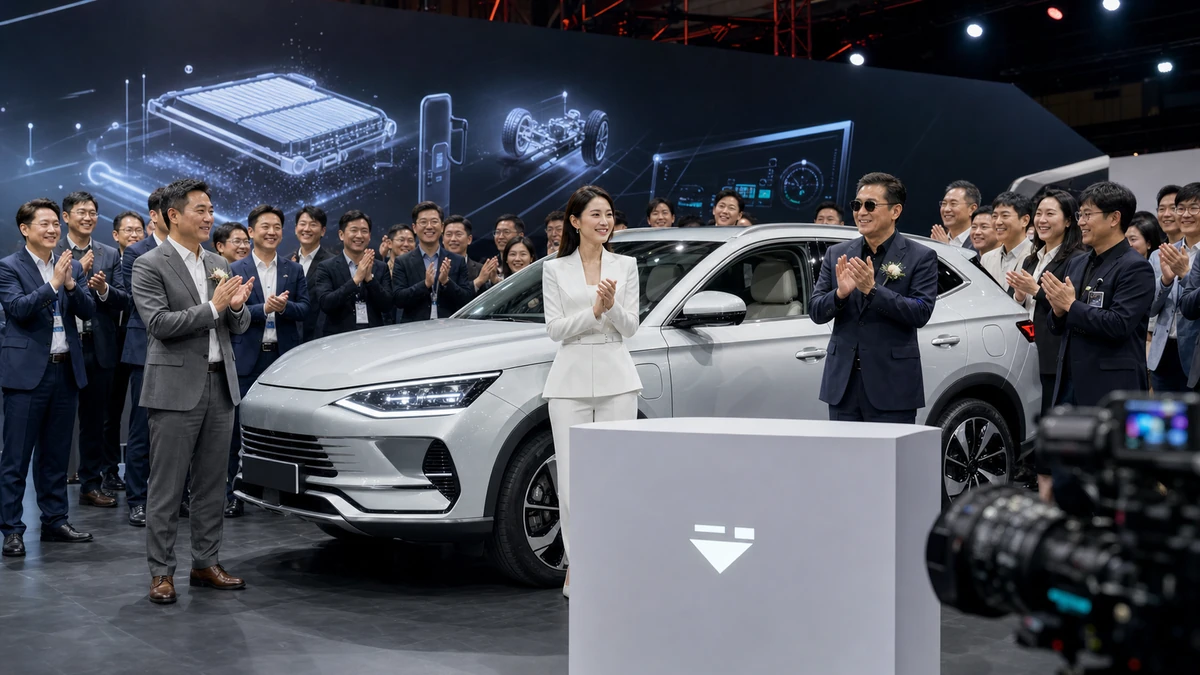
A Chinese automaker’s price tag lands like a challenge in South Korea
At this year’s Busan Mobility Show, one number did most of the talking: 37.5 million won, or roughly the equivalent of a mainstream compact-to-midsize vehicle price in South Korea. That is the price BYD, the Chinese electric-vehicle giant, unveiled for its Sealion 6 DM-i, a midsize plug-in hybrid SUV entering the Korean market. On paper, it is just another product launch. In practice, it is something much larger: a direct challenge to the way Korean consumers, Korean automakers and the broader auto industry think about the cost of electrification.
For American readers, the easiest comparison may be this: imagine a new plug-in hybrid sport utility vehicle arriving with technology features associated with pricier EVs, but priced close enough to conventional hybrid crossovers that shoppers who once ruled out a plug-in now have to take a second look. That is the disruption BYD is trying to create in South Korea, one of the world’s most technologically demanding consumer markets and home turf for Hyundai Motor and Kia.
According to Korean business outlet SBS Biz, BYD presented the Sealion 6 DM-i not simply as a fuel-saving SUV, but as a highly equipped electrified vehicle with a battery, charging system, large in-car display and advanced driver-assistance features bundled into a single package. In today’s market, that matters because electrified cars are no longer judged only by gas mileage or horsepower. They are increasingly sold as rolling technology platforms, where software, battery engineering, screens, sensors and energy management matter as much as engines once did.
That helps explain why this has been read in Korea as more than auto news. It is also a technology story, a manufacturing story and, increasingly, a geopolitical one. When BYD undercuts expectations in South Korea, it is not just competing against one model from one rival. It is testing whether consumers in a sophisticated, brand-conscious market are ready to treat Chinese electrified vehicles as legitimate alternatives to domestic favorites.
The significance goes beyond South Korea. If BYD can make a plug-in hybrid feel attainable in a market known for tough consumers and strong domestic brands, that could offer a preview of what comes next in other countries, including the United States, where price remains one of the biggest barriers to wider EV and plug-in adoption.
Why the price matters: A plug-in hybrid near hybrid territory
In Korea, the headline number is striking because the Sealion 6 DM-i is a plug-in hybrid, not a standard hybrid. That distinction is important for readers outside Asia. A conventional hybrid uses a gasoline engine and a small battery that recharges itself through braking and engine operation; drivers do not plug it in. A plug-in hybrid, or PHEV, carries a larger battery that can be charged externally and can drive meaningful distances on electricity alone before the gasoline engine takes over. In theory, it offers a middle ground between a gas-powered car and a fully electric vehicle.
In practice, plug-in hybrids usually cost noticeably more than standard hybrids because of the added battery pack, power electronics and charging hardware. That price gap has often limited their appeal, even among shoppers who like the idea of doing most weekday driving on electricity while keeping a gasoline backup for longer trips.
That is why BYD’s pricing is drawing so much attention. Korean market data cited in local coverage places the Hyundai Tucson Hybrid starting around 32.7 million won and the Kia Sportage Hybrid at about 33.46 million won. BYD’s Sealion 6 DM-i, at 37.5 million won, is not identical in price, but it is close enough that many consumers will view it as sitting in the same comparison set. For a plug-in hybrid, that is unusually aggressive positioning.
The contrast becomes even sharper against pricier plug-in offerings. Korean reports pointed to Toyota’s latest RAV4 lineup, where the hybrid version sits around the upper-40-million-won range and the plug-in hybrid climbs into the low-60-million-won range. That does not make the vehicles directly equivalent in every specification, but it does highlight the broader point: a technology that usually carries a premium is suddenly moving toward the price zone of mainstream hybrids.
For American consumers, think of how the Toyota RAV4 Hybrid, Ford Escape Plug-In Hybrid or Hyundai Tucson Hybrid are often cross-shopped less on styling than on total ownership math: upfront price, fuel savings, charging convenience and resale value. Korean shoppers are doing a similar calculation. What BYD appears to be betting is that once the price premium narrows enough, consumers stop asking whether a plug-in hybrid is worth considering and start asking why they should not consider one.
That shift matters because the purchase decision changes when electrification feels less like a luxury add-on and more like a standard feature set. If plug-in capability is priced within reach of families already shopping for a hybrid SUV, the market conversation moves from aspiration to practicality. That is exactly where large-scale disruption tends to begin.
More than a car: BYD is selling battery tech, charging and digital convenience
BYD’s argument is not just about sticker price. It is also about how much technology comes with that price. The Sealion 6 DM-i is equipped with an 18.3-kilowatt-hour battery and is marketed in Korea as capable of traveling up to 70 kilometers, or about 43 miles, in electric-only mode. For many urban and suburban drivers, that is enough to cover routine errands, school drop-offs and daily commutes without using gasoline.
That figure matters more than it may first appear. One of the biggest hurdles for plug-in hybrids has been that some deliver only modest electric range, making the charging habit feel optional rather than useful. But when the electric-only range is enough to handle a large share of daily driving, the vehicle begins to function almost like an EV during the workweek, with the gasoline engine reserved for longer drives. For consumers who are not ready to commit to full battery-electric life, that can be an attractive compromise.
BYD is also emphasizing V2L, or vehicle-to-load capability. In plain English, that means the car’s battery can supply electricity to external devices. In the United States, the concept has become increasingly familiar as automakers promote electric trucks and SUVs that can power tools at a job site, run appliances during a power outage or support camping equipment. In South Korea, local coverage ties that feature to the country’s strong outdoor and camping culture, where families often travel with portable appliances, lighting and electronics. The broader appeal is universal: the car is no longer just transportation, but also a mobile energy source.
Charging speed is another selling point. According to the Korean reports, fast charging can bring the battery from 30% to 80% in about 30 minutes. That may not matter to every plug-in hybrid owner in the same way it matters to EV drivers, but it signals something important strategically. BYD is trying to blur the line between categories. Instead of asking consumers to think of a plug-in hybrid as merely a gas vehicle with a bigger battery, the company wants them to see it as a genuine electrified product with EV-like conveniences.
That is a smart pitch in a market like South Korea, where tech-savvy consumers often judge products on everyday usability rather than abstract specs. A battery size, a charging curve and an energy export feature are not just engineering terms; they are quality-of-life indicators. Can the vehicle act like an EV when you want it to? Can it fit into your digital life? Can it do more than drive? Those are the questions electrified vehicles now have to answer.
The screen, the cameras and the software: Why this is also an IT story
One reason this launch has resonated beyond auto circles in Korea is that modern vehicles are increasingly evaluated like consumer electronics. BYD says the Sealion 6 DM-i includes a 15.6-inch display, a 360-degree camera system and advanced driver-assistance features as standard equipment. That matters in South Korea, where consumers are accustomed to polished digital experiences across phones, televisions, appliances and connected devices.
Americans have seen a version of this shift too. Tesla helped normalize the idea that a large center screen can define a vehicle’s identity. Rivals from Ford to Hyundai to Mercedes-Benz now sell cars not just on performance or styling, but on interface design, over-the-air updates and feature packaging. In that environment, a car’s dashboard increasingly functions like a software platform, and consumers notice when one vehicle offers tech features as standard while another locks them behind higher trims or option packages.
South Korea may be particularly sensitive to this kind of competition because it is one of the world’s most digitally saturated markets. Consumers there live in a country shaped by globally dominant electronics, display and battery manufacturers. That does not automatically mean they will embrace every new gadget in a car, but it does mean they are accustomed to rapid hardware improvement and aggressive value comparisons.
So when BYD bundles a large display, surround-view camera and driver-assistance systems into a relatively affordable electrified SUV, it is making a statement that goes beyond transportation. It is signaling that vehicle technology should be abundant, visible and usable from the base model upward. That pressures established automakers in two ways: not only on price, but also on expectations around what should count as basic equipment.
This is where the story becomes especially relevant to readers tracking the global technology industry. Battery costs, semiconductor supply, software integration and user-interface design all now shape the competitiveness of a car. The automaker that can deliver more battery performance, more digital features and more convenience at a lower price is not simply winning an auto sale. It is demonstrating control over a broader industrial stack.
Why South Korea matters so much in the global auto race
South Korea is not the largest car market in the world, but it carries outsized importance. It is home to Hyundai Motor Group, one of the world’s most formidable automotive players, and it sits at the center of industries critical to electrification, including batteries, semiconductors and displays. It is also a market where domestic brands traditionally enjoy strong loyalty and where consumers are known for being demanding about quality, service and technology.
That makes Korea an unusually meaningful testing ground for BYD. If a Chinese automaker can gain traction there, it suggests its products are no longer competing only on budget appeal. They may be advancing into markets where shoppers expect high build quality, strong after-sales support and up-to-date tech features.
Korean coverage notes that BYD’s sales from January through May had already surpassed 7,000 units, exceeding its total for the previous year. One should be cautious about reading too much into a short-term figure, especially in a market where launches, incentives and supply can distort the data. Still, the number matters as a signal. It suggests Korean consumers are at least willing to consider Chinese-branded electrified vehicles more seriously than in the past.
That marks a meaningful change. For years, Chinese cars in many overseas markets faced skepticism around quality, durability, brand image and service support. Some of those concerns remain. Buying a vehicle is not like buying a smartphone; consumers expect parts availability, repair networks, warranty reliability and long-term resale value. Yet pricing power can change the conversation. When a product offers a compelling enough mix of cost and capability, shoppers begin to reassess old assumptions.
For Americans, a rough analogy might be the evolution of perceptions around Korean cars themselves. Hyundai and Kia were once dismissed by many U.S. buyers as low-cost alternatives. Over time, through better design, stronger warranties and major investments in technology, they moved into the mainstream and, in some categories, became leaders. BYD is plainly hoping something similar can happen for Chinese electrified vehicles in overseas markets, though geopolitical tensions and trade barriers make that path more complicated today than it was for Korean brands decades ago.
The pressure now facing Hyundai, Kia and the rest of the market
The core question raised by BYD’s Busan debut is not whether one SUV will sell well. It is whether incumbent automakers can continue to charge substantial premiums for electrified technology as Chinese companies scale up and cut costs. For Hyundai and Kia, which have built strong reputations in hybrids and EVs, the challenge is not simply to match a price point. It is to decide how much battery capacity, digital equipment, safety technology and charging convenience they can profitably include at similar prices.
That is a supply-chain question as much as a branding question. To deliver more technology for less money, automakers need efficiency in battery sourcing, platform design, manufacturing and software integration. A cheaper sticker price cannot come at the expense of reliability or margins indefinitely. So when BYD prices a plug-in hybrid this aggressively, it effectively asks rivals whether they can streamline costs enough to respond without weakening their business.
The Korean auto industry is especially attuned to this because it has already spent years balancing the transition from internal combustion engines to electrified platforms. Carmakers must invest in factories, battery partnerships, software systems and new model development while still managing legacy businesses. They are under pressure from governments, investors and consumers all at once. A lower-cost rival intensifies every one of those pressures.
Imported brands face a similar squeeze. If BYD can bring a well-equipped plug-in hybrid into the high-30-million-won range, other global automakers may need to rethink their trim structures and pricing ladders. Consumers who once tolerated expensive option bundles may become less willing to do so if a challenger offers key tech features as standard.
None of this means the market will suddenly flip overnight. Brand loyalty remains powerful. Service networks matter. Some consumers will continue to prefer domestic nameplates or established Japanese and European brands, especially for something as expensive and long-lived as a vehicle. But the terms of comparison may already be changing. Buyers may begin to look not just at engine type and badge, but at a dense bundle of metrics: electric range, charging speed, onboard power export, screen size, driver-assistance features and total price.
What the launch says about the future of electrified cars worldwide
There is a reason this Korean launch deserves attention far beyond Busan. Around the world, the transition to cleaner vehicles has hit a difficult phase. Early adopters have already bought in. Broader adoption now depends less on enthusiasm and more on affordability, convenience and value. In many markets, especially the United States, EV growth has run into stubborn real-world concerns: charging infrastructure, higher financing costs, range anxiety and the simple fact that many buyers still find electrified vehicles too expensive.
BYD’s strategy speaks directly to that problem. Rather than waiting for every buyer to leap into a fully electric future, it is offering a transitional product that feels more technologically complete than a conventional hybrid but less intimidating than a pure EV. If the price is right, that formula can be powerful.
South Korea’s response may offer an early clue to whether consumers are ready to reward that approach on a larger scale. Because Korea combines tech-savvy buyers, strong domestic competitors and high expectations around product quality, it can serve as a useful barometer. If BYD succeeds there, it will strengthen the case that the next stage of electrification is not only about making better batteries. It is about making electrified technology feel normal, accessible and economically rational.
That may ultimately be the deeper meaning of the 37.5 million won price tag. It is not just a number attached to one Chinese SUV. It is a provocation aimed at the entire industry. How quickly can automakers compress the cost of batteries, charging hardware, software features and energy-management systems into vehicles ordinary households can afford? How much technology can be included before consumers say, at last, this feels like a fair deal?
Those questions matter in Seoul, Busan and Incheon. They also matter in Los Angeles, Dallas and Atlanta, where family crossovers dominate driveways and where many consumers remain curious about electrification but unconvinced by the economics. If BYD’s Korean play succeeds, the lesson for the rest of the world may be simple: the real breakthrough in cleaner cars may come not from a dazzling new technology, but from the moment that technology becomes boringly affordable.
Comments
Post a Comment