A South Korean province is pitching Nvidia on an AI future — and betting a vast coastal megaproject can deliver
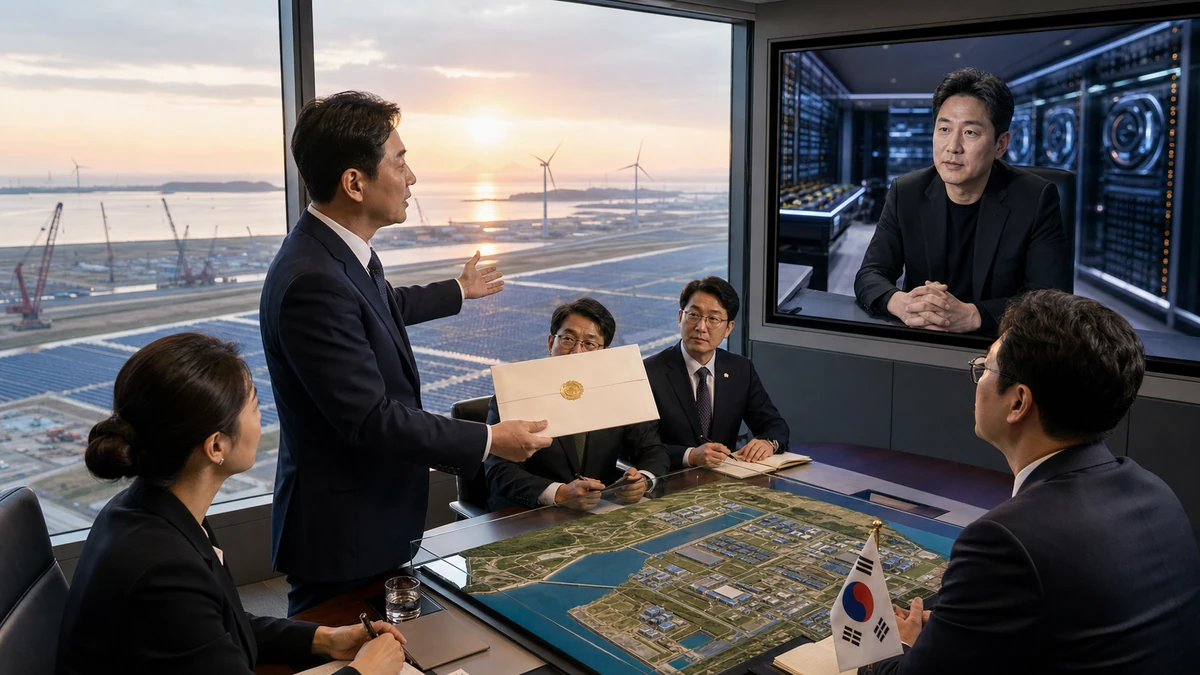
A regional Korean government makes a direct play for the world’s hottest AI company
In the global race to attract artificial intelligence investment, the latest pitch is not coming from Washington, Silicon Valley or Seoul’s corporate core. It is coming from a provincial leader in South Korea who wants Nvidia CEO Jensen Huang to take a serious look at a stretch of reclaimed land on the country’s southwest coast.
Lee Won-taek, the governor-elect of North Jeolla province — officially known as Jeonbuk State in South Korea’s new administrative language — has proposed a meeting with Huang to discuss possible investment in Saemangeum, a large-scale development zone that local officials are trying to recast as a next-generation hub for advanced industry. According to South Korean officials, Lee sent personal letters both to Nvidia’s U.S. headquarters and to the head of Nvidia Korea, framing Saemangeum as a place built for the speed and scale demanded by the AI semiconductor era.
The outreach matters less for what has been promised than for what it signals. There is no announced deal, no groundbreaking date and no confirmed Nvidia project. What exists at this stage is a formal attempt by a Korean regional government to turn passing interest from one of the world’s most important tech executives into an actual investment conversation.
That may sound routine in a world where mayors, governors and economic development agencies constantly chase factories, data centers and research campuses. In the United States, it would not seem strange for a governor in Arizona, Texas or Ohio to court Intel, TSMC or Tesla with tax breaks, shovel-ready sites and promises of streamlined permitting. South Korea is now showing a similar dynamic in the AI age: local governments are no longer waiting quietly for national ministries or family-run conglomerates to dictate the country’s industrial map. They are trying to write themselves into it.
For American readers, the significance is straightforward. As AI becomes the defining industrial contest of this decade, competition is expanding beyond countries and into regions, cities and specially designed economic zones. Jeonbuk’s message to Nvidia is that the next chapter of the AI supply chain may not be limited to obvious capitals. It could extend to places willing to offer land, energy, logistics and political urgency in one package.
Why Nvidia is the center of gravity in the AI economy
Any government seeking credibility in advanced technology would love to be associated with Nvidia right now. The California-based company has become the emblem of the generative AI boom because its graphics processing units, or GPUs, are widely viewed as the essential hardware powering large language models, cloud computing infrastructure and the data centers behind today’s AI explosion.
That makes Huang one of the most sought-after executives in global business. His public comments can move markets, influence industrial policy and reshape local expectations in places eager to host some part of the AI ecosystem. If he mentions a country, a region or a class of infrastructure, officials listen closely.
That appears to be what happened here. South Korean officials described Lee’s letter as a direct response to recent comments Huang made while visiting Korea, when he reportedly referred to Saemangeum as a potential investment opportunity. Rather than treat that as a flattering soundbite and move on, the governor-elect’s team turned it into an opening. They attempted to convert executive curiosity into formal dialogue.
This quick response is a notable part of the story. In the semiconductor and AI infrastructure business, timing can matter almost as much as subsidies. Companies looking at new facilities want confidence not only that land exists, but that power supply, permitting, transportation links, construction timelines and future expansion will not get bogged down. Delays can be costly in a sector where the window for competitive advantage is short and where capital expenditures often run into the billions.
That is why Lee’s language was tailored to investor priorities. In his letter, he presented Saemangeum as a “frictionless environment” with “unlimited scalability” and “overwhelming speed.” That is polished investment language, but it is also revealing. It translates local ambition into terms global technology companies use when evaluating where to build next.
For a company like Nvidia, the question would not simply be whether there is open land. It would be whether a site can support a broader ecosystem over time — advanced manufacturing, logistics, energy access, research partnerships and possibly the digital infrastructure associated with AI. Even if Nvidia never manufactures chips in Saemangeum, the region wants to be seen as relevant to the wider AI hardware economy.
What Saemangeum is, and why Koreans keep talking about it
For readers outside Korea, Saemangeum requires explanation. It is one of the country’s most ambitious and long-running development projects, built on reclaimed tidal flats along the Yellow Sea in the southwest. If the name is unfamiliar, think of it as part industrial zone, part logistics concept and part political promise — a place that has for years symbolized both Korea’s developmental confidence and the difficulties of turning mega-projects into fully realized economic engines.
The area is tied to an enormous seawall and land reclamation effort that created a vast amount of new land intended for agriculture, industry, ports, energy projects and urban development. Over time, Saemangeum has been marketed in different ways depending on national priorities: as a future-oriented growth center, a logistics gateway, a renewable energy zone and a manufacturing base with room to expand.
That flexibility is part of its appeal and part of its challenge. Big projects often suffer from a branding problem when they exist longer in government plans than in public imagination. Americans have seen versions of this before: former military land repurposed for tech campuses, old industrial waterfronts marketed as innovation districts, or special economic zones promoted as blank canvases for strategic industries. The basic idea is familiar. The execution is what matters.
In Korean political language, describing Saemangeum as a “blank slate” is meant to emphasize freedom from the constraints that limit denser, older industrial areas. Officials want investors to imagine fewer regulatory conflicts, more room to build and a clearer path to large-scale development. In practical terms, that means a site where expansion can happen in stages rather than being boxed in by urban congestion, local land disputes or fragmented parcels.
To foreign audiences, the phrase “regulation-free” or “frictionless” should be understood less as an absence of law than as a sales pitch about administrative convenience. Korean local governments often compete by highlighting how quickly they can process approvals, coordinate with the central government and prepare infrastructure. The underlying promise is not just tax incentives. It is bureaucratic speed.
That promise is especially potent in an era when AI infrastructure is expected to demand not just chips, but land-hungry facilities, robust transmission capacity, industrial water, transportation access and room for multiple suppliers. Saemangeum’s advocates are effectively arguing that what once looked like an unfinished development story can be reintroduced as an ideal platform for the next industrial cycle.
From Seoul-led industrial policy to regional competition
South Korea is often described abroad through the lens of centralization. Politically, economically and culturally, the Seoul metropolitan area dominates the country. Major conglomerates, national ministries, elite universities and media institutions are heavily concentrated in and around the capital. That has long created an imbalance familiar to Americans who compare New York or Washington with smaller regional cities, though Korea’s concentration is even sharper.
Against that backdrop, Jeonbuk’s outreach to Nvidia carries symbolic weight. It represents an effort by a provincial government to step into a conversation usually associated with central ministries or national corporate champions such as Samsung and SK hynix. The move suggests that Korea’s regional leaders increasingly see global capital attraction as part diplomacy, part branding and part industrial strategy.
This is not entirely new, but the target makes it more striking. Nvidia is not just another multinational. It is arguably the most recognizable corporate name in the AI hardware boom, and Huang has become one of the few business leaders whose visits can trigger real policy choreography. By proposing a meeting directly, Lee is signaling that his administration intends to compete in that arena rather than watch from the sidelines.
That matters domestically because local Korean politics has often revolved around public works, transportation links and balancing regional development. What is changing is the vocabulary. Instead of talking only about roads, land prices or local employment quotas, officials are now speaking in the language of supply chains, scalability and global tech ecosystems. In other words, the sales pitch is becoming more international and more industry-specific.
There is a strategic reason for that shift. South Korea’s future growth cannot rest indefinitely on legacy manufacturing strengths alone. The country remains a semiconductor powerhouse, but it also faces stiff competition from the United States, Taiwan, China and others in critical technology sectors. Regional governments understand that if they want a place in the next wave, they must present themselves not as peripheral beneficiaries but as active nodes in a global network.
For American readers, the comparison might be the way states such as Georgia, Nevada and Arizona reinvented their economic development identities by attaching themselves to batteries, electric vehicles or chipmaking. Those places did not stop being themselves; they learned to speak the language of the industries they wanted. Jeonbuk is now trying something similar with AI infrastructure.
The real test: land is not enough in the AI semiconductor era
The pitch to Nvidia may sound polished, but industrial strategy lives or dies on specifics. The AI semiconductor business is not a generic manufacturing sector that can be dropped anywhere with available acreage. It is a demanding ecosystem that depends on reliable electricity, high-quality logistics, technical talent, upstream and downstream suppliers, construction capacity and a regulatory environment that can keep pace with private-sector decision-making.
That is why the most important phrase in Lee’s letter may be the least glamorous: speed. In advanced technology investment, speed means several things at once. It means how fast a government can prepare land. It means how quickly environmental and construction reviews can be processed. It means whether utility connections are ready. It means whether the broader political system can sustain a project across election cycles.
It also means whether the story being sold is realistic. Plenty of governments promise “one-stop service” for investors. Fewer can actually deliver a large facility on a compressed timeline without running into cost overruns, resident opposition, infrastructure bottlenecks or interagency conflict. The more complex the project, the more those risks multiply.
Saemangeum’s defenders would argue that this is precisely where the region has an advantage. Because it is a large, strategically planned development zone, it can theoretically offer room for expansion without the land-use headaches found in crowded metropolitan areas. Because it is being promoted at a high political level, officials can frame it as a priority project rather than an ordinary investment case. And because Korea already has deep semiconductor expertise, even a region outside the main cluster can market itself as adjacent to a national strength.
Still, it is worth separating aspiration from outcome. The information available so far confirms only that a meeting was proposed and letters were sent. There is no public indication of an investment commitment, a memorandum of understanding or a specific business plan from Nvidia. The news is important because it opens a door, not because it proves where that door leads.
That distinction is especially important in the AI era, where hype frequently outruns construction. Around the world, governments are racing to brand themselves as future AI hubs. Yet many of those campaigns depend on assumptions about power, financing, export controls, labor and demand that remain in flux. The places that actually win major projects will need more than slogans. They will need execution.
Why this story resonates beyond one Korean province
At first glance, a Korean governor-elect writing to a U.S. tech CEO might seem like a niche regional story. In reality, it illuminates several global trends at once. The first is that AI has become not just a software story but a physical one. Behind chatbots and generative models lies a scramble for sites, energy, cooling systems, transportation networks and geopolitical alignment.
The second is that subnational governments are becoming more aggressive players in that competition. In the United States, governors regularly fly overseas to court foreign manufacturers. In Europe, regions market themselves for battery plants and research centers. In East Asia, the competition is increasingly similar, with local leaders trying to prove that they can move as fast as markets do.
The third is that corporate attention itself has become a strategic asset. When Huang mentions a place, even briefly, it can reshape how that place sees its own prospects. In this sense, Lee’s move is not only about Nvidia. It is about using a moment of attention from a globally admired technology company to redefine what Saemangeum stands for.
For years, Saemangeum has been a recognizable name in Korea but not necessarily a globally compelling brand. This outreach attempts to change that. Rather than selling the region through a traditional local-government checklist, Lee’s team is trying to connect it directly to the needs of a world-leading company. The underlying message is: do not think of this as an old reclamation project; think of it as a platform for the AI supply chain.
That is a sophisticated repositioning effort. Investors do not care much about whether a place carries symbolic weight in domestic politics. They care about whether it reduces friction, supports scale and improves the odds of long-term growth. By emphasizing those qualities, Jeonbuk is attempting to translate a Korean regional project into a globally legible investment proposition.
Whether that works with Nvidia is another matter. The company’s priorities are shaped by a wider landscape that includes manufacturing partnerships, data center demand, export restrictions, geopolitical risk and the evolving economics of AI computing. Any serious investment discussion would likely involve questions far beyond land availability. But from the perspective of a regional government trying to get onto the map, the first win is being taken seriously enough to have that conversation.
What comes next, and what Americans should watch for
The next phase, if there is one, will be measured not in headlines but in process. Watch for signs of a formal meeting, technical site discussions, intergovernmental coordination or broader industry outreach tied to Saemangeum. Even if Nvidia never makes a direct investment, the visibility generated by this campaign could help Jeonbuk attract suppliers, energy projects, research partnerships or adjacent technology firms looking for a foothold in Korea.
That is often how industrial ecosystems form. A marquee name may draw attention, but the deeper transformation comes from the network that grows around it. In that sense, the governor-elect’s letters can be understood as both a courtship and a branding exercise. They are aimed at Nvidia, but they are also aimed at every other company watching where AI infrastructure might spread next.
Americans should also watch this story because it reflects how U.S. companies increasingly sit at the center of other nations’ regional development strategies. Just as Korean automakers transformed parts of the American South, U.S. technology firms now have unusual power to influence local futures far beyond American borders. Nvidia’s business decisions are global industrial events.
There is also a political lesson here. In advanced economies, regional leaders are under growing pressure to prove they can secure a place in emerging industries rather than be left behind by capital-city concentration. Jeonbuk’s pitch to Nvidia is, in part, an answer to that pressure. It says a province better known for agriculture and traditional industry wants a stake in the AI age.
For now, caution is warranted. The known facts remain limited: Huang reportedly referred to Saemangeum as a possible opportunity during a visit to Korea; Lee responded by proposing talks and sending letters to Nvidia in the United States and Korea; and those letters emphasized a low-friction, expandable, fast-moving investment environment. Everything beyond that remains prospective.
Still, even at this early stage, the story is revealing. It captures a moment when local governments are learning to speak the language of global technology power, when AI investment is redrawing the geography of ambition, and when a once-familiar Korean development project is trying to reinvent itself for a new industrial era. Saemangeum may or may not become part of Nvidia’s future. But Jeonbuk has made clear that it intends to make the case — quickly, directly and in terms the AI economy understands.
Comments
Post a Comment