A mayoral photo op, but also a window into Seoul
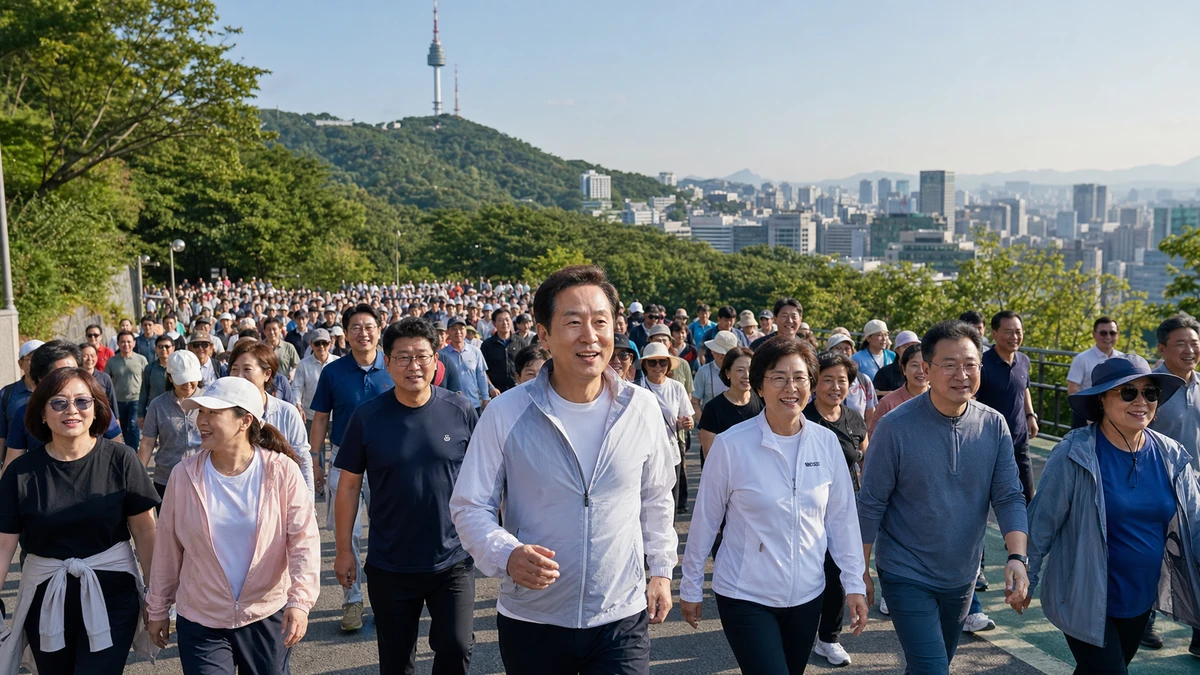
On a summer morning in central Seoul, Mayor Oh Se-hoon joined more than 1,000 residents for group stretching and a communal walk on Namsan, the forested hill that rises above one of the densest urban landscapes in the world. On its face, the event — billed as the “2026 Namsan Summer Festival” and anchored by a “Fun & Walk” route — was the kind of civic gathering large cities stage all the time: a public official, a crowd in athletic wear, a health-forward message and a scenic backdrop.
But in Seoul, and especially on Namsan, such an event says something larger about how the South Korean capital wants to present itself both to its own residents and to the outside world. Namsan is not just another park. It is one of those places that compresses a city’s identity into a single landscape. It sits close to major commercial districts, hotels, subway lines and historic neighborhoods. It is familiar to first-time visitors because of the N Seoul Tower that crowns it, yet it is also deeply ordinary in the best sense of the word — a place where locals walk, rest, date, exercise and pass through without ceremony.
According to the account provided by Yonhap News Agency, Oh took part in the event Saturday morning at Baekbeom Plaza in Seoul’s Jung District, where participants stretched together before walking the designated course. He said the city’s efforts to revitalize Namsan, a project pursued since 2009, have steadily increased the amount of space residents can enjoy. He also pointed ahead to next year’s Seoul International Garden Show on Namsan, saying the city plans to expand green and rest spaces so that residents can enjoy a higher quality of life in their daily routines.
Those are the core verified facts. Yet even within those limits, the event offers a revealing snapshot of where urban tourism is heading in Seoul. For years, the city has been sold internationally through instantly recognizable images: royal palaces, neon shopping streets, K-pop landmarks, food markets and high-rise skylines. Those attractions remain central, and for good reason. But Namsan suggests a parallel version of Seoul, one that is less about checking off a list of famous sites and more about participating in the city’s actual rhythm. That distinction matters, especially for American and other English-speaking travelers increasingly drawn to travel that feels less staged and more lived in.
In that sense, the walk with Oh was not only a local summer event. It was also a small but telling example of a broader shift: from tourism as spectacle to tourism as participation, from “seeing” a city to moving through it the way residents do.
Why Namsan means more than a hill in the middle of town
To understand why this event resonated, it helps to understand what Namsan is in the Seoul imagination. The name simply means “South Mountain,” a label so plain it almost hides the site’s symbolic weight. For Americans, the closest comparison may be a blend of Central Park, Griffith Park and a historic overlook all rolled into one — not identical in scale or design, but similar in the way a green landmark can function at once as civic icon, neighborhood amenity and tourist draw.
What makes Namsan distinctive is its relationship to Seoul’s geography. South Korea’s capital is a megacity where mountains and hills are never very far from view. Even in a metropolis defined by apartment towers, office blocks, designer storefronts and intense pedestrian traffic, the terrain keeps asserting itself. Namsan rises from the middle of this built environment, offering a kind of urban exhale. You do not need to drive hours into the countryside to get a hillside walk, tree cover and broad views. You can step off public transit, walk a short distance and find yourself in a setting that feels apart from the city while still being unmistakably inside it.
That is a key part of the cultural context that may not be obvious to readers unfamiliar with Korea. In many American cities, a significant outdoor excursion often implies a road trip, a national or state park, or at least a substantial break from downtown. In Seoul, urban life and accessible nature are more tightly braided together. Hiking itself is a major part of Korean leisure culture, especially for middle-aged and older residents, though younger people increasingly embrace city walks and park outings as well. Even a modest hill or mountain can carry real social importance because it offers a practical, repeatable form of escape within daily life.
Namsan also occupies a specific place in the tourist imagination. It is well known among foreign visitors because of the tower, the panoramic views and the countless dramas, travel guides and social media posts that have used it as shorthand for Seoul romance or Seoul scenery. Yet to stop there is to miss the deeper point. For locals, Namsan is not just a postcard. It is routine. It is part of a living city, not an isolated monument. That dual identity — famous but usable, iconic but everyday — is exactly what makes it useful for the kind of event Seoul staged this weekend.
The location of the festival, Baekbeom Plaza, reinforces that point. Positioned in central Seoul with strong access by subway and on foot, the plaza underscores how public space in a global city can serve both civic life and visitor experience without needing to become an exclusive destination. In a tourism economy often obsessed with ever-bigger attractions, there is something quietly notable about a major city showcasing a walkable, transit-linked public gathering place as a draw in itself.
From sightseeing to participation
The image that stands out from the event is simple: more than 1,000 people stretching together and then walking together. That matters because it reflects a broader travel trend visible far beyond South Korea. Increasingly, travelers are not satisfied with merely photographing landmarks. They want to feel, however briefly, that they have entered the texture of local life. They want morning markets, neighborhood bakeries, river walks, pick-up sports, seasonal fairs and public rituals that are not performed solely for outsiders.
Seoul appears to understand this. The “Fun & Walk” branding is telling. It presents walking not as a strenuous athletic challenge but as an accessible, enjoyable urban experience. For a city often associated abroad with speed — fast internet, fast trains, fast fashion cycles, fast-moving consumer culture — the emphasis on slowing down is notable. A summer walk in a city green space suggests a different Seoul: less about rushing between palace gates, beauty stores and concert venues, and more about observing how residents actually inhabit public space.
This is the kind of message that can resonate with foreign readers planning trips to Korea. The country’s tourism brand has long been powered by what Americans easily recognize: pop culture exports, food trends, cutting-edge design and highly photogenic districts. Those remain powerful entry points. But the success of places like Namsan hints at a more mature tourism proposition. Seoul is saying, in effect, that the city itself — its sidewalks, plazas, hillsides, rest areas and seasonal routines — is part of the attraction.
That shift mirrors changes in American travel, too. In cities from New York to Chicago to Los Angeles, many visitors now seek out greenways, waterfront walks, neighborhood farmers markets and public programs that reveal how locals spend a Saturday rather than just what they recommend on a top-10 list. A city becomes more memorable when it offers not only destinations, but also habits: the way people gather, pause, commute, exercise and reclaim time. Seoul’s festival on Namsan fits neatly into that global shift.
There is also a subtle economic logic at work. Participatory tourism tends to distribute attention more widely across urban life. Rather than funneling visitors solely into a handful of high-profile attractions or retail corridors, it encourages engagement with public transit, public parks, coffee shops, casual eateries and nearby neighborhoods. That can make tourism feel less extractive and more integrated, though the balance is never perfect. When officials highlight public walking routes and green spaces, they are also making an argument about what kind of city experience deserves value.
And because this happened in summer, the symbolism becomes even sharper. Summer in Seoul can be hot, humid and physically taxing, not unlike Washington, D.C., or parts of the American South. Organizing a seasonal event in a green public space acknowledges that reality while reframing it. Instead of treating summer as a period to endure between indoor stops, the city is presenting it as a time for communal outdoor experience — slower paced, more sensory and tied to the season itself.
The politics of green space in a hyper-urban capital
It would be naive to treat a mayoral appearance at a public event as apolitical. Big-city leaders everywhere understand the optics of parks, plazas and wellness programming. Whether in Seoul, New York or London, a leader photographed walking with residents projects accessibility, health, civic investment and neighborhood legitimacy all at once. Oh’s remarks about Namsan’s “revitalization” since 2009 and the expansion of green and rest spaces are part of that language.
Still, the politics of this event do not make it trivial. If anything, they underscore how important public green space has become in major global cities. “Revitalization” can sound like bureaucratic jargon, but in practical terms it often means something residents immediately feel: safer walking routes, clearer signage, improved stairways, better maintenance, more benches, more shade, smoother connections to transit and programming that makes a space feel active rather than neglected.
That is especially meaningful in a city like Seoul, where public space must work hard. The capital is one of the most densely populated urban regions in the developed world. Private indoor space can be limited, commutes can be long, and daily life can feel compressed by both competition and pace. In that context, a well-used hillside park or plaza is not just an amenity. It is part of the city’s social infrastructure.
American readers may recognize the broader theme. In the United States, debates over parks and public space often center on quality of life, downtown recovery, public safety, climate resilience and equitable access. Seoul’s conversation is not identical, but it rhymes. Green space is no longer framed only as decoration or leisure. It is increasingly tied to public health, civic identity and the competitiveness of a city trying to attract visitors, investment and resident loyalty.
Oh’s mention of the Seoul International Garden Show planned for next year on Namsan points in that direction. Garden festivals can sound niche or genteel to American ears, conjuring flower shows or botanical exhibitions. But in many cities, they function as much more: a way to brand urban environmental policy, celebrate design, promote public engagement and signal that nature has a place in the future of the city. In Seoul’s case, linking Namsan to a garden show suggests that officials want the site to embody a greener, more restful vision of urban life, not merely serve as a scenic detour.
That matters because tourism policy has changed. For decades, city tourism strategies often revolved around identifiable “must-sees”: a landmark tower, a shopping district, a historic quarter, a signature meal. Those still matter, of course. But more and more, cities compete on atmosphere and livability. Can a visitor wander comfortably? Is there shade? Are there places to sit? Can a neighborhood absorb foot traffic without feeling overwhelmed? Does the city invite you to linger rather than simply consume? Namsan’s growing profile answers yes to those questions, and Seoul appears eager to capitalize on that.
What foreign visitors can learn from a local walking event
For travelers unfamiliar with Korean culture, one of the most useful insights from this event is that Seoul often reveals itself best at ground level. This may sound obvious, but the city’s global image can flatten it into a collection of spectacular markers: Gyeongbok Palace guards in traditional dress, K-beauty shopping bags in Myeongdong, idol-related destinations in Gangnam, food alleys in traditional markets. Those are real parts of the city. But so are the quieter patterns of urban life, including walking circuits, mountain paths, riverside hangouts and neighborhood parks.
The Namsan event dramatized that idea by blurring the line between resident space and visitor space. Tourists often worry about whether they are seeing the “real” city or a curated version built for outsiders. There is no clean separation, especially in a global destination like Seoul. Yet communal programs like a public walk offer a rare middle ground. They are organized enough to be visible, but rooted enough in local habit to feel authentic. Watching residents gather for stretching, casual exercise and conversation can tell you as much about contemporary Korea as any formal exhibit.
This also helps explain why Namsan remains such a powerful stop for visitors. It connects easily to multiple kinds of itineraries. You can visit a palace, browse a market, ride the subway a few stops, and then find yourself among trees overlooking the city. In many places, tourism categories are sharply divided — history over here, nature over there, nightlife somewhere else. Seoul’s compactness allows those categories to overlap in a single day. Namsan, sitting almost literally in the middle of things, becomes a hinge between them.
For English-speaking audiences, especially Americans used to planning vacations around car travel or highly segmented districts, that can be one of Seoul’s great surprises. The city’s density is often discussed in terms of crowding or efficiency. But it also creates a kind of cultural layering. A hill walk is not a separate excursion; it is part of the city’s ordinary circulation. The fact that Saturday’s event unfolded in a centrally accessible public area reinforces that idea. Tourism here does not have to be built only on mega-projects or expensive ticketed experiences. It can emerge from a city making its everyday infrastructure welcoming enough that people want to spend time in it.
There is an additional lesson in the event’s tone. By emphasizing fun, walking and seasonal participation, Seoul is advertising a style of travel that is less extractive and more observant. Instead of racing from site to site, visitors are implicitly encouraged to spend time noticing how the city breathes — where people pause, how they use shade, how plazas operate, what a weekend morning feels like. In a travel culture increasingly saturated by checklist itineraries and social media performance, that is a meaningful alternative.
Why this matters for Seoul’s global image
South Korea’s global cultural rise — the phenomenon often called the Korean Wave, or Hallyu — has transformed the way international audiences imagine the country. For many Americans, the first points of contact are no longer the Korean War or even the technology giants that helped define South Korea’s modern economy. They are K-pop groups, Oscar-winning films, hit television series, skincare brands and a food scene that has gone from niche to mainstream. That shift has brought more attention, more curiosity and more visitors.
But cultural influence creates its own challenge. Once a place becomes globally recognizable through entertainment and consumer culture, it risks being understood only through those lenses. Seoul, in particular, can be reduced to a city of spectacles: idol agencies, LED screens, department stores, rooftop bars and dramatic palace backdrops. Those elements are part of its allure, but they are not the whole story.
Namsan offers a counterbalance. It shows a capital that is not trying to outdo itself at every turn, but one that can also market ease, accessibility and daily life. That is strategically smart. Cities with durable tourism appeal tend to offer more than marquee attractions. They offer coherence. They feel inhabitable. Visitors can imagine not only visiting, but also dwelling there for a while — even if only mentally. Public spaces like Namsan help create that feeling.
The festival also suggests confidence. Seoul no longer needs to present itself exclusively through high-intensity novelty. It can afford to spotlight the ordinary pleasures of a walk, a hill, a plaza and a crowd of residents enjoying summer together. That may seem modest, but for a city with Seoul’s global profile, modesty can be a powerful branding tool. It signals maturity. It says the city’s appeal is not confined to headline attractions; it lives in the connective tissue between them.
For the mayor, the message is equally clear. Investments in green space and public comfort are not separate from tourism strategy; they are tourism strategy. A place that residents want to use repeatedly is often more compelling than one that visitors feel obligated to see once. When local life becomes part of the destination, tourism can appear less staged and more sustainable.
That does not mean every official slogan should be taken at face value, nor that every festival transforms a city. It means this event captured a real tension and a real opportunity in contemporary urban travel. People increasingly want cities that can be experienced bodily, not just visually. They want to walk them, pause in them and feel momentarily folded into their routines. Seoul, through Namsan, is leaning into that demand.
A walk that captures the city’s pace
In the end, the significance of the Namsan Summer Festival lies less in any single announcement than in the scene itself: more than 1,000 people moving together through a central green space, in a city often defined by speed, ambition and spectacle. It is a reminder that one of Seoul’s strengths is not only what it has built, but how it allows people to inhabit what has been built around and beside nature.
Namsan is special because it compresses so many layers of Seoul into one setting. It is geographic and symbolic, local and international, practical and scenic. It is a place where visitors can recognize the skyline while also seeing how residents use the city when they are not performing it for outsiders. That is a valuable kind of urban knowledge, and one that no translation of a tourism brochure can fully deliver.
Saturday’s walk also illustrates a point American readers may increasingly recognize in their own cities: the quality of public space shapes not only civic life, but the stories a city can tell about itself. A plaza with easy transit access, a walkable route, summer programming and enough social energy to draw a crowd becomes more than infrastructure. It becomes narrative. It tells residents they are meant to gather there. It tells visitors they are welcome to join the rhythm rather than just observe it from the margins.
That is why this otherwise modest local event deserves attention beyond Seoul. It speaks to the future of travel in major cities, where the most memorable experiences may not always be the grandest or most expensive. Sometimes they are the ones that let you witness how a city spends an ordinary morning — stretching, walking and making room for leisure in the middle of urban intensity.
For Seoul, that may be one of the most persuasive messages it can send right now. The city is still a place of palaces, shopping districts, food pilgrimages and pop culture landmarks. But it is also a place where a wooded hill in the center of town can serve as common ground between locals and newcomers, between policy and pleasure, between sightseeing and actual participation. In a global tourism landscape crowded with louder pitches, that quieter promise may be one of Seoul’s greatest advantages.
Comments
Post a Comment