
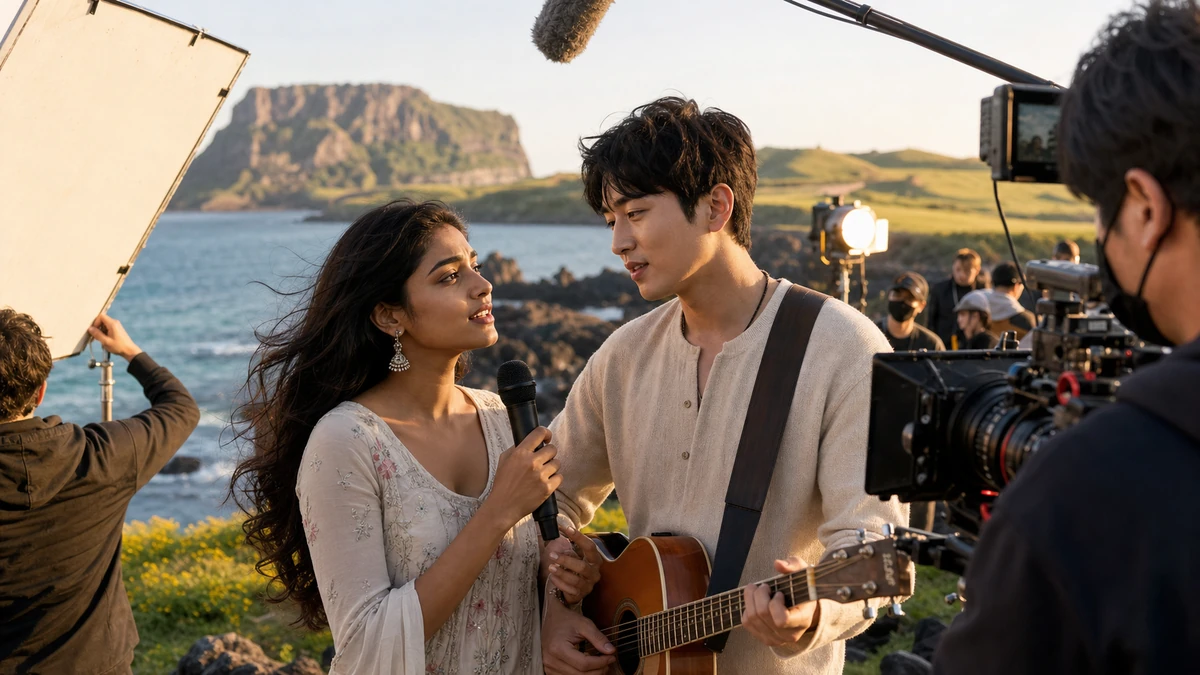
A Korean island long known for honeymoons is stepping onto a bigger global stage
A new Korean film nearing the end of production is betting that one of South Korea’s most recognizable landscapes can do more than look beautiful on screen. It can carry emotion, build international fandom and help push Korean entertainment into markets far beyond the usual K-drama and K-pop conversation.
The movie, titled Jeju Ollae, stars Indian actor Anushka Sen and South Korean actor Kang Hyung-seok in a music-centered romantic drama filmed entirely on Jeju Island, according to the production companies Lucifer Production and Story Works. The project is described as an all-location melodrama, meaning the production was shot on location in a single region rather than using Jeju for a handful of postcard scenes. In this case, the island is not just scenery. It is part of the emotional architecture of the story.
For American audiences, it may help to think of Jeju the way filmmakers think about places like Hawaii, Big Sur or coastal Maine: a destination with a strong visual identity that carries its own emotional weather. In South Korea, Jeju is one of the country’s best-known travel spots, famous for volcanic landscapes, ocean views, winding walking trails and a slower pace than Seoul. It is often associated with healing, escape and romance. Those associations matter here, because Jeju Ollae is built around grief, music and recovery.
At a moment when the Korean Wave, or Hallyu, is expanding beyond pop groups and television dramas, this film offers a useful snapshot of where the industry appears to be headed next: cross-border star casting, region-specific storytelling, tourism value and a distribution strategy aimed at audiences across India, Southeast Asia and the Middle East. In other words, this is not simply another local movie. It is a cultural export designed with international circulation in mind.
That makes Jeju Ollae notable even before a release date, trailer or platform rollout has been announced. The movie arrives as Korean entertainment companies continue to test how far Korean settings and Korean production can travel when paired with globally recognizable talent from outside East Asia. If K-pop cracked open the door and Korean dramas kept it open, projects like this are trying to decide what comes next.
Anushka Sen brings a fan base that reaches far beyond any one national market
The most immediate reason the film is getting attention is its lead actor. Anushka Sen is not simply a rising performer cast in a Korean production; she is a digital-era celebrity with reach large enough to reshape how a film gets noticed across borders.
Sen is widely known to Indian audiences for her earlier television work, including portraying Rani Lakshmibai in Jhansi Ki Rani, a historical drama centered on one of India’s best-known anti-colonial figures. More recently, she drew praise for her lead role in the 2024 Amazon Prime Video original series Dil Dosti Dilemma. For viewers in the United States who may not follow Indian entertainment closely, the simplest comparison is this: Sen represents the kind of Gen Z stardom built simultaneously through screen work and enormous social media visibility, where an actor is also a global content ecosystem.
That matters because her audience does not stop at box office geography. As of earlier this year, Sen was reported to have 38.7 million Instagram followers and more than 50 million followers across social media platforms combined. In practical terms, that gives any project she joins a built-in publicity network that many conventional film marketing campaigns would envy. A teaser image, rehearsal clip, costume reveal or location photo can travel instantly across countries and languages.
For Korean producers, that is not just celebrity casting. It is distribution logic. In the streaming era, a star’s online following can serve as both advertising and audience bridge. If Sen posts from Jeju, her followers do not only see a movie set. They see a Korean location, Korean styling, Korean production culture and the mood of the film before formal promotion even begins. The island itself becomes part of the content stream.
This is one of the clearest ways global entertainment has changed in the last decade. A location once promoted through tourism campaigns can now reach consumers through a celebrity’s feed, where landscape, fashion, music and personal branding blur together. For Jeju, that could mean exposure to millions of younger viewers who may have had little direct familiarity with the island but are open to discovering it through a favorite actor.
Sen’s casting also signals something broader about the Korean entertainment industry’s ambitions. Much of the early global conversation about Korean pop culture in the United States revolved around either K-pop groups like BTS and Blackpink or prestige survival stories such as Parasite and Squid Game. But those breakthroughs did not exhaust the export model. Korean producers are now increasingly testing partnerships that connect Korean settings and production systems with stars whose strongest fan bases sit elsewhere. India, with its massive entertainment market and digitally connected youth audience, is an especially significant arena for that strategy.
The story uses music and grief, two universal themes, to build a cross-cultural romance
According to the production companies, Jeju Ollae begins with Alicia, a singer played by Sen, traveling to Jeju after the death of the sister she loved most. The island is tied to memories of that sister, which makes the journey less a vacation than an emotional return. On Jeju, Alicia meets Sun-woo, played by Kang Hyung-seok, a once-promising singer-songwriter who no longer sings.
It is a setup that should sound familiar to audiences across many cultures: two artists, each carrying a different version of loss, meeting in a place that slows them down long enough to confront what they have been avoiding. One character shines in public but is privately unraveling. The other once expressed everything through music and has now fallen silent. Their connection is likely to unfold not just as romance but as a mutual process of recognition.
That combination of grief and music is one reason the film has a strong chance of traveling well. Melodrama, a term used more routinely in Korea than in the United States without necessarily carrying the same dismissive undertone, often centers emotional intensity, memory and healing. In Korean storytelling, especially in romance and family narratives, pain is not just an obstacle to be cleared on the way to a happy ending. It is often the emotional landscape the characters must learn to inhabit differently. A place like Jeju, associated with reflection and retreat, fits naturally into that grammar.
For American viewers, the story may evoke a familiar blend of music-driven romance and scenic introspection, something in the orbit of a prestige streaming film that mixes emotional recovery with destination cinematography. But the Korean framing is a little different. Here, the setting is not merely picturesque background. It functions almost as a quiet third character, holding memory for Alicia and offering a suspended space where Sun-woo’s silence can begin to crack.
The use of artists as leads also adds another layer. Alicia and Sun-woo are public-facing people, performers whose private wounds exist in tension with the personas the world sees. That dynamic is deeply legible in a global entertainment culture where fans are accustomed to following stars both on stage and online. It also gives the film room to explore not only romantic chemistry but creative paralysis, performance fatigue and the odd loneliness that can accompany visibility.
Most importantly, the narrative is built on emotional themes that are easy to understand across borders: losing a loved one, struggling to make meaning after that loss and finding connection through music. Those are not specifically Korean or Indian experiences. They are broadly human ones. That universality is precisely what makes the film a useful vehicle for a cross-national production. The cultural details may differ, but the emotional premise requires little translation.
Why Jeju matters, and why “all-location” is more than an industry buzzword
To understand why this project stands out, it helps to look closely at Jeju itself and at the production term being used to describe the film. In Korean entertainment reporting, an “all-location” production generally means a film or drama concentrates its shooting in a particular place, allowing that location to shape the visual identity and dramatic rhythm of the work. It is not just a matter of logistical convenience. It is a storytelling choice.
Jeju is South Korea’s largest island, located off the country’s southern coast. For domestic audiences, it has long occupied a special place in the national imagination. It is a resort destination, a honeymoon spot, a school-trip memory and, increasingly, a site associated with wellness and healing travel. The island is known for black volcanic rock, wind-bent landscapes, beaches, lava tubes, tangerine farms and the Olle trails, a famous network of walking paths circling much of the island’s coastline. The title Jeju Ollae appears to echo that sense of pathway and arrival; “Olle” in Jeju dialect refers to a narrow path linking a street to a home, and the term became widely known through the island’s trail system. For non-Korean audiences, that resonance may give the title an additional emotional layer: a route inward as much as outward.
That symbolism fits a movie about grief and recovery. A path, after all, suggests movement without promising speed. It implies wandering, reflection and the possibility of ending up somewhere different from where one began. If the filmmakers fully use the island’s terrain, Jeju can become more than scenic branding. It can mirror the characters’ internal state, much the way American films sometimes use the desert, the road or the ocean to externalize isolation and renewal.
There is also a larger industry reason Jeju matters. Filming in a distinctive place turns geography into an asset that can outlive the movie itself. Audiences who respond to a film’s atmosphere often become curious about where it was shot. That has happened repeatedly in global entertainment, from New Zealand’s lasting identity boost after The Lord of the Rings to tourism spikes linked to television phenomena in Europe and North America. South Korea knows this well. Fans have long sought out cafes, neighborhoods and seaside sites featured in Korean dramas.
In that sense, Jeju Ollae is participating in a broader fusion of entertainment and place branding. But the stronger version of that strategy is not simple tourism promotion. It is emotional place-making. People do not remember a location only because it is pretty; they remember it because something meaningful happened there in the story. If Alicia returns to Jeju because it holds memories of her sister, then the island is framed as a repository of love, pain and healing. That kind of storytelling can make a place feel intimate even to viewers who have never been there.
A Korean-Indian pairing reflects the next phase of the Korean Wave
The meeting of Kang Hyung-seok and Anushka Sen is significant not simply as a casting novelty but as a marker of how Korean media industries are trying to diversify their global partnerships. Earlier stages of the Korean Wave often moved outward through exports of finished Korean products: television dramas sold abroad, K-pop albums promoted internationally and streaming hits discovered by global audiences. Increasingly, though, the model includes collaboration at the production level itself.
That shift mirrors changes elsewhere in entertainment. Hollywood has spent years tailoring casting and release strategies for international markets. Streaming platforms normalized the idea that a series made in one country could become a hit in dozens more. Korean companies, having seen how globally portable their storytelling can be, are now experimenting with formats that start global rather than becoming global later.
That is what makes a film like Jeju Ollae especially interesting. It is rooted in a Korean locale and Korean production environment, but its lead casting widens the film’s point of entry from the start. Sen brings strong recognition in India and among online viewers elsewhere. Kang brings the Korean performance anchor within a story and setting deeply tied to Korea. Put together, they create a film that may feel neither entirely domestic nor generically international, but deliberately hybrid.
For American readers, one useful comparison might be the way some recent international co-productions are designed to speak to multiple markets without erasing local specificity. The best of those projects do not flatten cultural texture. Instead, they rely on universal emotional stakes while preserving the distinctiveness of place. If Jeju Ollae succeeds, it could demonstrate a version of that balance: Korean enough to feel grounded, global enough to travel.
Kang’s role is also crucial to the film’s emotional design. Sun-woo, the singer-songwriter who has stopped singing, is not simply a romantic lead waiting to be activated by the heroine’s arrival. He appears to be constructed as a parallel wounded artist. That makes the relationship more reciprocal and gives the movie a chance to avoid the tourist-romance formula in which one character is transformed mainly by encountering an exotic place. Instead, both leads are shaped by art, silence and damage, and Jeju becomes the environment in which their emotional stalemate begins to shift.
That kind of character symmetry tends to work well in music-centered dramas, because songs, rehearsals and shared listening can become forms of dialogue. If the filmmakers lean into that, the romance may feel less like a standard opposites-attract plot and more like a duet between two people who have lost their ability to hear themselves clearly.
Why the film’s target regions matter beyond simple market expansion
The production companies say Jeju’s natural scenery is expected to be introduced to audiences in India, Southeast Asia and the Middle East. That geographic emphasis is telling. These are not incidental spillover markets. They are among the most dynamic growth areas in global media consumption, with large youth populations, robust mobile viewing habits and increasing appetite for cross-border entertainment.
For years, discussion of Korean cultural exports in American media tended to focus on East Asia first, then the West. But that map is incomplete. Some of the most consequential growth in Korean content fandom has come from regions outside the traditional U.S.-Europe-East Asia triangle. Southeast Asian audiences have long been enthusiastic consumers of Korean dramas and music. Interest in Korean pop culture is also visible across parts of the Middle East. India, with its vast scale and highly engaged digital culture, is an especially compelling partner market, though also one with its own powerful entertainment ecosystem.
That is why Sen’s involvement matters strategically. She does not bring access to a blank space waiting to be filled by Korean content. She brings a relationship to an audience that already has its own stars, genres and expectations. A film like Jeju Ollae is therefore not just Korean content being exported. It is a negotiated cultural product, one that asks viewers to enter a Korean setting through a performer they may already know and trust.
This model may become increasingly common. As entertainment grows more global but audiences remain deeply local in taste, collaborations that bridge industries can create softer landing points for content crossing borders. Rather than asking viewers in India or the Middle East to take a chance on an unfamiliar Korean film with no recognizable face, producers attach that film to a performer with proven pull. At the same time, Korean production values, locations and storytelling styles remain intact enough to advertise the distinctiveness of the source industry.
There is also a symbolic element here. Much of the American understanding of the Korean Wave has been filtered through its success in U.S. pop culture institutions: chart rankings, Netflix hits, awards campaigns. But Korean entertainment’s global future may depend just as much on networks that do not revolve around the United States at all. A movie set on Jeju and starring an Indian actor can matter because of what it means in Seoul, Mumbai, Jakarta or Dubai, whether or not it ever becomes a mainstream conversation piece in Los Angeles or New York.
What to watch as “Jeju Ollae” moves from production to release
For now, the film remains in a relatively early public phase. Production is reportedly almost complete, but details such as release timing, distribution platform and a fuller marketing campaign have not yet been spelled out. Even so, the ingredients already visible make Jeju Ollae a project worth watching for anyone tracking the evolution of Asian entertainment.
The first question is how the film presents Jeju. Will the island feel integrated into the characters’ emotional lives, or will it function more as a prestige travel backdrop? The answer will likely determine whether the movie has staying power beyond its novelty factor. Beautiful cinematography may attract viewers, but emotional coherence is what turns a location into a memorable cinematic world.
The second question is musical identity. Because the story centers on a singer and a former singer-songwriter, music is likely to play a major role in defining tone and chemistry. If the soundtrack lands, it could become one of the movie’s strongest international assets, especially in a social media environment where songs often travel faster than plots.
The third question is whether the Korean-Indian collaboration feels organic. International co-productions can sometimes seem assembled by market logic more than dramatic necessity. But when the emotional core is solid, cross-cultural casting can enrich a story rather than distract from it. The premise here gives the film a good chance at that balance, because it is driven by experiences that require sensitivity rather than spectacle.
More broadly, Jeju Ollae matters because it shows how Korean entertainment companies are thinking in 2026. The goal is not just to make a film and hope the world notices. It is to design a project in which star power, location branding, emotional universality and regional market strategy all reinforce one another. That is a sophisticated model, and one likely to become more visible as Korean media companies look for the next chapter after the first global wave of K-pop and streaming drama success.
For viewers in the English-speaking world, the film offers another reminder that the Korean Wave is not static. It is evolving in form, geography and ambition. Jeju, long sold as a destination for rest and romance, now stands to become something else as well: a screen for transnational storytelling, where Korean landscapes and global fandom meet. Whether Jeju Ollae becomes a breakout hit remains to be seen. But even before its release, it captures an important shift in contemporary entertainment: the future of global pop culture may be built less around one center exporting outward and more around carefully crafted intersections like this one, where an island in South Korea, an Indian digital star and a Korean music melodrama converge in the same frame.


0 Comments