South Korea’s World Cup Return Draws Pre-Dawn Cheers, Not Jeers, as Fans Welcome Son Heung-min and Teammates Home
A subdued homecoming, and a revealing one
South Korea’s men’s national soccer team came home from the 2026 World Cup with a result that fell well short of expectations. The team did not advance beyond the group stage, finishing third in Group A with one win and two losses, then missing out on a place in the knockout round under the expanded 48-team tournament format. By the numbers, it was a disappointing campaign for one of Asia’s most established soccer powers.
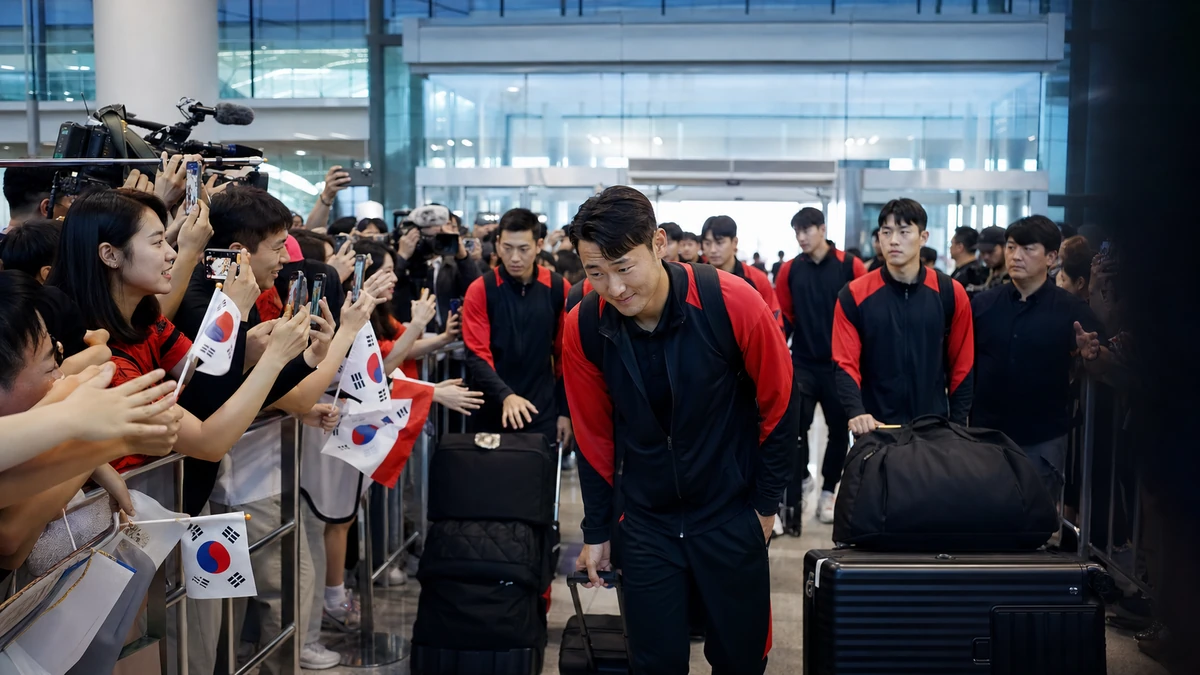
And yet when some of the players landed at Incheon International Airport early July 1, the scene that greeted them was not dominated by anger. It was defined instead by patience, loyalty and a kind of weary encouragement. Fans in South Korea jerseys began gathering around 2 a.m. at Terminal 2, even though the flight carrying several national team players was not expected to arrive until about 4 a.m. They waited through the night to welcome back captain Son Heung-min, now with Los Angeles FC, along with a group of teammates returning from the World Cup.
For American sports fans, the closest comparison might be the way supporters of a beloved franchise still show up after a crushing playoff exit — less to celebrate a result than to acknowledge the emotional investment of a long season. But the airport scene in South Korea also carried a specifically Korean meaning. The national team is not simply followed as a collection of athletes who win or lose. It is often treated as a national symbol, especially during major tournaments, with players carrying expectations that extend beyond the scoreboard.
That was visible in the arrival hall. This was not the triumphant parade that follows a title run, nor the hostile reception that sometimes meets underperforming teams elsewhere. It was something more complicated: disappointment without abandonment. Fans came anyway. They applauded anyway. And in doing so, they offered a snapshot of how South Korean soccer culture processes defeat — critically, yes, but also communally.
The players returning that morning included Son, midfielder Lee Jae-sung of Mainz, goalkeeper Kim Seung-gyu of Tokyo, goalkeeper Song Bum-keun of Jeonbuk, winger Eom Ji-sung of Swansea, midfielder Lee Dong-gyeong of Ulsan, midfielder Kim Jin-gyu of Jeonbuk, defender Lee Han-beom of Midtjylland, defender Lee Tae-seok of Vienna, Lee Ki-hyuk of Gangwon, Bae Jun-ho of Stoke, and Jeonbuk players Jo Wi-je and Kang Sang-yoon. The list itself tells a broader story about modern South Korean soccer: a national team spread across European leagues, other Asian clubs and the domestic K League, brought together briefly for the sport’s biggest stage before dispersing once more.
The numbers that made this exit sting
South Korea’s tournament ended with a hard set of facts that are likely to shape debate for months. The team went 1-2 in the group stage and finished with three points, placing third in Group A. In previous World Cups, that record might have been enough to keep faint hopes alive depending on goal difference and the tournament structure. But the 2026 World Cup introduced a new reality.
For the first time, the men’s World Cup was contested by 48 nations, an expansion from the 32-team field that had defined the modern tournament for decades. On paper, expansion can seem like an invitation — more slots, more opportunities, more nations at the party. In practice, it also creates a more tangled route forward. Teams no longer compete only against the two obvious benchmarks in their group. They are measured against third-place finishers from other groups as well, forcing coaches, players and fans into scoreline math that can feel almost cruel in its precision.
South Korea finished 10th among the 12 third-place teams and therefore failed to reach the round of 32. Its final overall ranking was listed as 34th, the lowest placement in the country’s World Cup history. That statistic matters because South Korea is not viewed, at home or abroad, as a peripheral soccer nation. It has long been one of Asia’s flagship programs, a team with a reputation for discipline, fitness, tactical organization and a capacity to rise on the international stage.
In the United States, where soccer still competes with football, basketball and baseball for cultural space, World Cup expectations tend to be calibrated differently. For South Korea, however, reaching the knockout stage is not treated as a fantasy. It is seen as a reasonable target, especially after the team advanced to the round of 16 at the 2022 World Cup in Qatar. This tournament, then, was not just another appearance. It was supposed to be the next step, or at minimum a reaffirmation that South Korea remained one of the most reliable teams outside the traditional European and South American elite.
That context explains why the elimination felt heavier than the raw record might suggest. It was not simply that South Korea went out. It was that it went out in an expanded tournament that seemed, at first glance, to offer a wider door. Instead, the new format underscored how unforgiving global soccer has become. More teams did not mean easier progress. They meant more variables, more styles of play and less room for error.
Why Son Heung-min remains the center of the story
No figure embodied that emotional weight more than Son Heung-min. Even outside South Korea, Son is the face most American readers will recognize immediately: a global star whose years in the Premier League made him one of the most visible Asian athletes in the world, and whose move to LAFC has only strengthened his profile in North America. In South Korea, though, Son’s significance goes beyond fame. He is commonly referred to as the team’s “captain,” but the word functions almost like a civic title.
When Son returns from a major tournament, the moment is rarely treated as just another travel arrival. It becomes a kind of opening scene for the nation’s postmortem. His expression, his body language, any brief comment he makes to reporters — all of it is studied as shorthand for the state of the team. Was he devastated? Defiant? Reflective? Burdened? In South Korean sports culture, especially around the national soccer team, the captain is expected to absorb public disappointment in a way that can feel intensely personal.
That helps explain why Son’s presence at the airport mattered so much. He was not the only player arriving, but he was the symbolic center of the morning. As captain, he represented both the tournament’s failure and the continuity of the team’s identity. The players around him will return to clubs in Germany, Japan, Wales, Denmark, Austria, England and South Korea. Son, too, will move on to club obligations. But for a few hours at Incheon, he stood in for the whole enterprise of South Korean soccer.
For American readers, it may help to think of the role as something between a national team captain and a franchise icon who also carries the emotional expectations of a country. There are very few direct parallels in U.S. sports because national teams do not sit at the center of American sports life in the same way. The U.S. men’s basketball team comes closest at the Olympics, or perhaps the U.S. women’s national soccer team during a major tournament. In South Korea, the men’s soccer team commands that kind of cultural scrutiny on a more regular basis.
That burden was visible in this return. Yet so was the support. Fans waiting before dawn were not there merely for autographs or photos. Their presence suggested a recognition that players, especially a captain, do not leave a World Cup loss behind the moment the final whistle blows. They carry it onto the plane and back into public life.
An airport as a national stage
Incheon International Airport has long functioned as more than a transportation hub. In South Korea, it often becomes a stage for public emotion at the end of major sporting events, cultural tours and diplomatic moments. For the national soccer team, the airport arrival after a World Cup is a ritual of transition: from global competition back to everyday scrutiny, from collective mission back to individual careers.
This year’s return unfolded in waves. A day earlier, coach Hong Myung-bo and eight players, including Lee Kang-in of Paris Saint-Germain, Kim Min-jae of Bayern Munich and Hwang In-beom of Feyenoord, had already arrived in South Korea. The July 1 arrivals continued that process, bringing home another group that included Son and several players from a mix of overseas clubs and the K League.
That staggered return may sound logistical, but it also has symbolic force. Once the World Cup ends, the national team effectively dissolves in real time. Players peel off toward their next obligations. A goalkeeper returns to his club. A midfielder heads back to Europe. A domestic league player rejoins his K League side. The jersey with the national crest is folded away until the next call-up.
At the airport, that dispersal becomes visible. Fans see the team one last time as a unit, even if only a partial one. Reporters get a final chance to document the faces, the fatigue and the mood. In that sense, the airport is not just an ending point. It is the place where evaluation begins.
That evaluation in South Korea tends to be intense. The country’s soccer media environment is sophisticated and highly engaged, and public commentary can be unforgiving. But it would be a mistake to reduce the culture to criticism alone. The airport gathering showed another side: a fan base capable of holding two thoughts at once. The results were not good enough. The players still deserved acknowledgment for enduring the pressure of the tournament.
That balance matters because national-team fandom can easily turn absolutist. In many countries, support is exuberant in victory and harsh in defeat. South Korea is not immune to that pattern. Yet the pre-dawn welcome suggested a more mature emotional register, one that separates accountability from contempt.
The expanded World Cup and a harsher kind of math
The 2026 tournament was billed globally as an era of inclusion. More nations. More matches. More chances for teams outside the traditional power centers to leave a mark. But expansion also changed the pressure points. Every group-stage match now fed into a wider comparison among third-place teams, making the path forward less intuitive and, in some ways, less merciful.
South Korea’s finish offered a case study in that dynamic. Third place in a group used to mean near-certain elimination in a 32-team format. In the new system, it can still mean hope — but only if the broader numbers fall into place. That creates a tournament within the tournament, one in which teams are not just trying to win but trying to survive on margins. Goal difference, disciplinary records and narrow scorelines take on outsized importance.
For a team like South Korea, which entered the competition with a history of proving itself on this stage, the new format was supposed to present an opportunity. Instead, it became a reminder that experience alone guarantees nothing. The field is larger, but so is the volatility. A single poor stretch can ripple across the entire bracket picture.
This is not just a South Korean story. Traditional powers have found the modern World Cup less predictable than ever. Germany, another nation with deep soccer history, also suffered an early and painful exit, losing to Paraguay on penalties in the round of 32 and failing to reach the last 16. Subsequent political commentary in Germany drew backlash, underlining how emotionally charged national-team failure remains in soccer countries.
That comparison does not erase South Korea’s disappointment, but it does put it in perspective. The World Cup is increasingly democratic in one sense and increasingly ruthless in another. Reputations matter less once the tournament begins. Every nation arrives carrying history; many leave with fresh humiliation.
For South Korea, the challenge now is not merely to lament the numbers — one win, two losses, three points, 34th overall — but to interpret them properly. Was the problem tactical? Structural? A matter of roster depth? Preparation? Chance? Those questions will define the next phase of discussion. What the airport scene made clear is that the conversation will happen in the presence of a public that still cares deeply.
What the fans’ response says about Korean soccer culture
The most striking image from this homecoming may ultimately have nothing to do with tactics, standings or rankings. It may be the sight of supporters turning up in the middle of the night after a failed campaign, not to vent, but to stand witness. In a sports culture often stereotyped from the outside as hypercompetitive and results-obsessed, that kind of reception complicates the picture.
South Korean fandom has long had a powerful collective dimension. During World Cups, public plazas, street cheering sections and organized fan groups can transform matches into shared national events. The most famous example remains the 2002 World Cup, co-hosted by South Korea and Japan, when the “Red Devils” supporters’ group became internationally known for filling city centers in red shirts as the national team made its historic run to the semifinals. That tournament permanently changed the emotional scale of soccer in South Korea.
Since then, every World Cup has existed in conversation with those memories. Not every team can reproduce 2002, of course, and fans know that. But the expectation that the national team should be met as a collective experience — not merely consumed as entertainment — has endured. That helps explain why supporters were at the airport before sunrise.
Their presence also reflected a familiar Korean social value: the importance of enduring hardship together. While it would be simplistic to romanticize that impulse, it is relevant here. The fans’ message was not that the result did not matter. It was that disappointment did not dissolve solidarity. In practical terms, that meant applause instead of outrage, encouragement instead of public scolding.
For athletes, that distinction can matter. World Cup players already face enormous pressure from coaches, federations, media and social media. A homecoming defined entirely by blame can deepen the sense of collapse. A homecoming that acknowledges failure while still recognizing effort can create space for honest reckoning rather than panic.
That does not mean South Korea’s team will be spared criticism. It should not be. A program with this history and talent base will be judged on results, and rightly so. But the airport crowd offered a reminder that a healthy sports culture can criticize without dehumanizing, and can demand more without discarding the people asked to deliver it.
The questions waiting after the applause
By the time the players left Incheon and the fans headed home, the larger issues remained unresolved. Why did a team with South Korea’s pedigree finish only third in its group? Why did it fail to rank high enough among third-place teams to advance? Why did an expanded field, which seemed to offer more room, expose so little margin for error?
Those are the questions South Korean soccer now carries into its next cycle. Some answers may involve squad construction and tactical identity. Some may concern how the domestic game develops players relative to the demands of elite international competition. Others may be more immediate, tied to tournament management, execution in key moments or the difficulty of integrating players from widely different club environments into a cohesive short-term team.
For now, what is clear is that the return from the World Cup marked not a conclusion but the beginning of review. The players who arrived July 1 are already heading back into the rhythms of club soccer. Another season, another set of matches and another round of professional obligations await them. National team time, by contrast, pauses and then reassembles.
That is why the airport mattered. It was the place where one version of the team ended and the next debate began. The standings and final ranking will live in the record books. The pre-dawn welcome may live longer in memory. It suggested that even in failure, South Korea’s national team remains connected to a public that sees more than a table of results.
In the United States, where sports disappointment is often processed through hot takes and morning-after outrage, there is something notable in that image. A star captain walks off a long flight after a World Cup exit. The fans have every reason to stay home. Instead, they come out in the dark to say the story is not over.
South Korea did not get the tournament it wanted. The hard facts are not in dispute. But at Incheon, amid rolling suitcases, camera flashes and the first hours of morning, the country’s soccer culture showed another fact worth noticing: losing can clarify what kind of support is real. In that sense, the loudest message of the team’s return was not about what went wrong in North America. It was about what still holds together at home.
Comments
Post a Comment