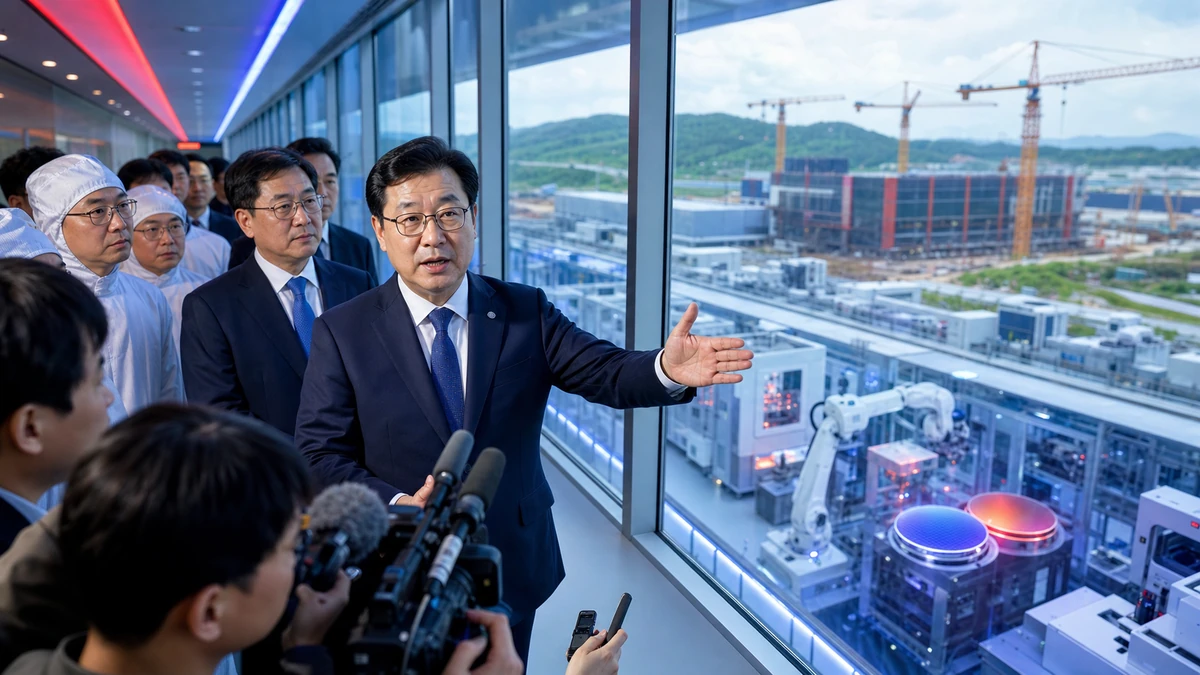
A strategic signal from Seoul before the investment details arrive
South Korea’s government is sending a clear message ahead of expected semiconductor investment announcements from Samsung Electronics and SK hynix: The country does not want its next phase of high-tech growth to be confined to the Seoul metropolitan area.
Deputy Prime Minister Koo Yun-cheol, who also serves as finance minister, said June 28 that the government would fully back the companies’ planned semiconductor facility investments in the Honam region, according to Yonhap News Agency. In a social media post, Koo said the government would respect companies’ decisions to invest outside the capital region and would support those decisions with its full capacity. He framed the issue in blunt terms, saying the decisive battleground for achieving a “super gap” in competitiveness is now in the provinces.
That phrase matters in South Korea. The idea of a “super gap” is often used in Korean policy and corporate circles to describe a lead so wide that rivals struggle to catch up. In the semiconductor industry — where chipmakers compete over manufacturing scale, engineering talent, supply chains, energy access and research capacity — that kind of lead is increasingly seen as something that must be built not only inside factories, but across regions.
The announcements from Samsung and SK hynix had not yet been detailed in the source material available here, so the precise investment amounts, the types of facilities involved and the construction timelines remain unclear. But even without those specifics, Koo’s remarks amount to more than a routine welcome statement. They suggest the government is trying to reframe regional development as a core part of national industrial policy, especially in the industry that has become most closely associated with South Korea’s place in the global economy.
For American readers, this may sound a bit like the logic behind the U.S. push to spread semiconductor investment beyond Silicon Valley or coastal tech hubs. Just as Washington has promoted new chip manufacturing in places such as Arizona, Ohio and upstate New York, Seoul appears to be signaling that the future of its chip industry cannot rely indefinitely on the same highly concentrated geography around the capital.
Why semiconductors matter so much in South Korea
To understand why this statement carries weight, it helps to understand the role semiconductors play in South Korea’s economy. Chips are not just another export category there. They are one of the country’s signature industries, a pillar of its trade balance and a source of national identity tied to technological achievement.
Samsung Electronics and SK hynix are central to that story. Both are globally important chipmakers, particularly in memory semiconductors, which power everything from smartphones and laptops to data centers and artificial intelligence infrastructure. Their decisions affect not only domestic suppliers and local labor markets, but also customers and manufacturing networks across Asia, the United States and Europe.
That means even a seemingly domestic political message — one about supporting investment in a region outside Seoul — has international implications. When these companies move, the global supply chain pays attention. That is especially true at a moment when semiconductors are no longer treated as merely commercial goods. They are now discussed, in Washington as in Seoul, as strategic assets tied to economic security, national resilience and geopolitical influence.
Koo underscored that point by describing the current era as one of life-or-death competition for global dominance in advanced industries. The rhetoric is dramatic, but it reflects the way governments increasingly view the sector. Chips have become the infrastructure behind artificial intelligence, cloud computing, defense systems, electric vehicles and consumer electronics. Countries that lead in semiconductors gain leverage far beyond manufacturing itself.
In the United States, this shift in thinking was embodied by the CHIPS and Science Act, which treats semiconductor capacity as a matter of national strategy. South Korea has approached the issue differently, but with similar urgency. Its leaders know the country’s economic strength is deeply tied to staying near the front of the global chip race. Any sign of weakness — whether in technology, supply chain resilience or industrial coordination — can carry outsized consequences.
What “the provinces” means in the Korean context
Koo’s phrase about the “battleground” being in the provinces needs some explanation for readers outside Korea. South Korea is geographically compact, but economically lopsided. Seoul and the surrounding capital region dominate the country’s political power, corporate headquarters, elite universities, venture funding and population growth. For decades, many of the country’s best jobs and opportunities have been drawn into that orbit.
The Honam region, by contrast, refers broadly to the southwestern part of the country, including the Jeolla provinces. In Korean political and economic discourse, regional identities remain powerful, and Honam has often been discussed as an area with unrealized industrial potential compared with the capital region or parts of the southeast long associated with manufacturing heavyweights.
So when a senior official says advanced-industry competition will be decided in the regions, he is not making a geographic observation. He is making a policy argument. He is saying that land, labor, infrastructure, education and industrial ecosystems outside Seoul should be understood as strategic national resources, not secondary considerations.
That distinction matters because South Korea’s growth model has long leaned heavily on concentration. The capital region offers dense networks of talent, logistics, research institutions and political access. It is efficient in one sense. But it also creates vulnerabilities: rising real estate costs, infrastructure strain, demographic imbalance and a development pattern in which other regions can feel left behind.
American audiences will recognize the pattern. The U.S. has spent years debating how much national innovation can be concentrated in a handful of superstar regions before the social and economic costs become too high. South Korea is wrestling with a version of the same question, only in a more compressed geography and with even sharper regional disparities.
In that light, the Honam investment message is about more than one part of the country getting a new factory. It is about whether South Korea can build a broader map for advanced manufacturing — one that links national competitiveness to regional revitalization rather than treating those as separate goals.
A new phase in Korea’s industrial playbook
The most important takeaway from Koo’s remarks may be what they suggest about the evolution of South Korea’s industrial strategy. In the past, Korean economic success was often described through the lens of corporate champions: giant firms with export power, deep engineering capabilities and the backing of a state determined to move fast. That model helped transform South Korea from a war-scarred country into one of the world’s most advanced economies.
But the country’s current challenges are different. It is no longer trying to catch up from the outside. It is trying to stay ahead in sectors where the technological frontier keeps moving. That requires not just big companies and strong balance sheets, but also resilient regional ecosystems, long-term workforce pipelines and the physical space needed for next-generation facilities.
Koo’s statement hints that policymakers increasingly understand this. Because he serves not only as a top economic official but also oversees finance, his comments imply that industrial support may be tied to broader questions of budgeting, regional development and investment conditions. The source material does not specify what form support might take, and it would be premature to assume details that have not been announced. Still, the significance lies in the framing: chip competitiveness is being discussed as an all-of-government challenge, not merely an issue for one ministry or one corporate boardroom.
That is an important shift. In advanced manufacturing, the competitive edge does not come only from who has the best engineers or the most capital. It also comes from who can coordinate power supply, water access, transportation links, permitting, housing, training programs and supplier networks. A semiconductor fab is never just a building. It is the center of an entire ecosystem.
If South Korea is now trying to extend that ecosystem more deliberately beyond its traditional centers, it is effectively redrawing the industrial map of the country. That is why this story deserves attention even before the companies release the fine print of their investments. The strategic signal may end up being as consequential as the investment numbers themselves.
The role of Samsung and SK hynix in the global supply chain
Any story involving Samsung Electronics and SK hynix carries significance well beyond South Korea. These are not regional manufacturers making a symbolic local move. They are among the most important companies in the world’s semiconductor supply chain.
Samsung is one of the most recognizable Korean brands in the United States, known to many Americans for its smartphones and televisions. But behind those consumer products is a vast chip business that touches memory, foundry services and advanced manufacturing technologies. SK hynix, while less familiar to the average U.S. shopper, is enormously influential in memory chips and has become increasingly important in the AI era, where high-bandwidth memory and other advanced components are essential.
Because of that, decisions about where these companies expand can shape much more than local employment. They can influence supply chain redundancy, vendor clustering, transportation flows and the strategic calculations of other countries watching how East Asia’s semiconductor heartland evolves.
There is also a symbolic dimension. When the South Korean government publicly says it supports these companies’ decisions to invest in a region outside the capital, it is telling international observers that regionalization is not a fallback plan. It is being presented as a competitive strategy.
That message lands at a time when companies and governments alike are trying to reduce overconcentration in critical supply chains. The pandemic, trade tensions and U.S.-China technology competition have all reinforced the risks of relying too heavily on a narrow set of production nodes. From that perspective, expanding advanced industrial capacity into new regional clusters inside South Korea may be seen as a way to build internal resilience as well as external strength.
Still, caution is warranted. The source summary does not confirm the scale or structure of the upcoming investments, and not every regional project becomes a transformational hub. Semiconductor ecosystems take years to build and depend on more than one headline announcement. Suppliers, researchers, utilities, local governments and universities all need to align. The gap between political ambition and industrial execution can be wide in any country.
What this could mean for Honam
If the investment plans materialize in a meaningful way, Honam could gain more than new facilities. Semiconductor investment tends to attract networks: component suppliers, materials companies, specialized equipment services, training institutions and transportation improvements. Even when the first project is narrow, the long-term value often lies in the ecosystem it can anchor.
That is part of why regional leaders in many countries compete so aggressively for advanced manufacturing. A major plant can alter the trajectory of a local economy for years, not simply by hiring workers directly but by changing what kinds of businesses, schools and infrastructure become viable. In the American context, state officials pitch chip plants with promises of multiplier effects, apprenticeship programs and spillover growth in housing and services. South Korean regions are making their own version of that case.
For Honam, the stakes are especially notable because the region’s economic future has often been discussed in terms of catching up rather than leading. A semiconductor foothold would help challenge that narrative. It would suggest that the geography of Korean innovation is not fixed and that areas outside the capital region can claim a meaningful role in the industries most tied to the country’s future.
That said, big industrial projects also bring familiar tensions. Local communities may welcome jobs and investment while worrying about environmental burdens, land use or whether benefits will flow to residents rather than mainly to contractors and outside professionals. Semiconductor production requires substantial infrastructure and resource planning, including power and water. Governments that promise full support will eventually have to show what that support actually means in practice.
Those questions are not yet answered by the information currently available. But they are the practical tests that will determine whether this is remembered as a turning point or simply another aspirational policy message.
Why American readers should watch this story
For readers in the United States, the immediate temptation may be to view this as a niche domestic Korean development. That would be a mistake. South Korea’s chip strategy matters because its semiconductor firms sit at the center of technologies Americans use every day, from phones and laptops to cloud services and AI tools. When Seoul changes how it thinks about chip investment, the ripple effects can travel far beyond the Korean Peninsula.
There is also a broader lesson here about how advanced economies are redefining industrial policy. In the United States, debates over semiconductors often focus on subsidies, national security and competition with China. In South Korea, those same themes are present, but this story highlights another dimension: the geography of competitiveness inside a country. Where factories go, where talent settles and which regions are linked to national strategy all matter.
Koo’s remarks suggest South Korea wants to treat regional capacity as part of the chip race itself, not as a side benefit. That idea should sound familiar to Americans who have watched efforts to revive domestic manufacturing in places that once felt overlooked by the innovation economy. The challenge in both countries is similar: Can governments turn strategic rhetoric into durable ecosystems rather than isolated projects?
For now, the hard facts remain limited. What is confirmed is that, ahead of expected announcements by Samsung Electronics and SK hynix regarding semiconductor facilities in Honam, a top South Korean economic official publicly pledged robust support and argued that the next edge in chip competition will be won outside the capital region. That alone is newsworthy.
It signals that one of the world’s most important semiconductor powers is thinking about competitiveness in broader terms — not just as a contest of technology and capital, but as a question of how a nation organizes its space, people and resources. In a global economy increasingly shaped by strategic industries, that is the kind of shift the rest of the world, including the United States, cannot afford to ignore.
Comments
Post a Comment