A low-key meeting with bigger implications
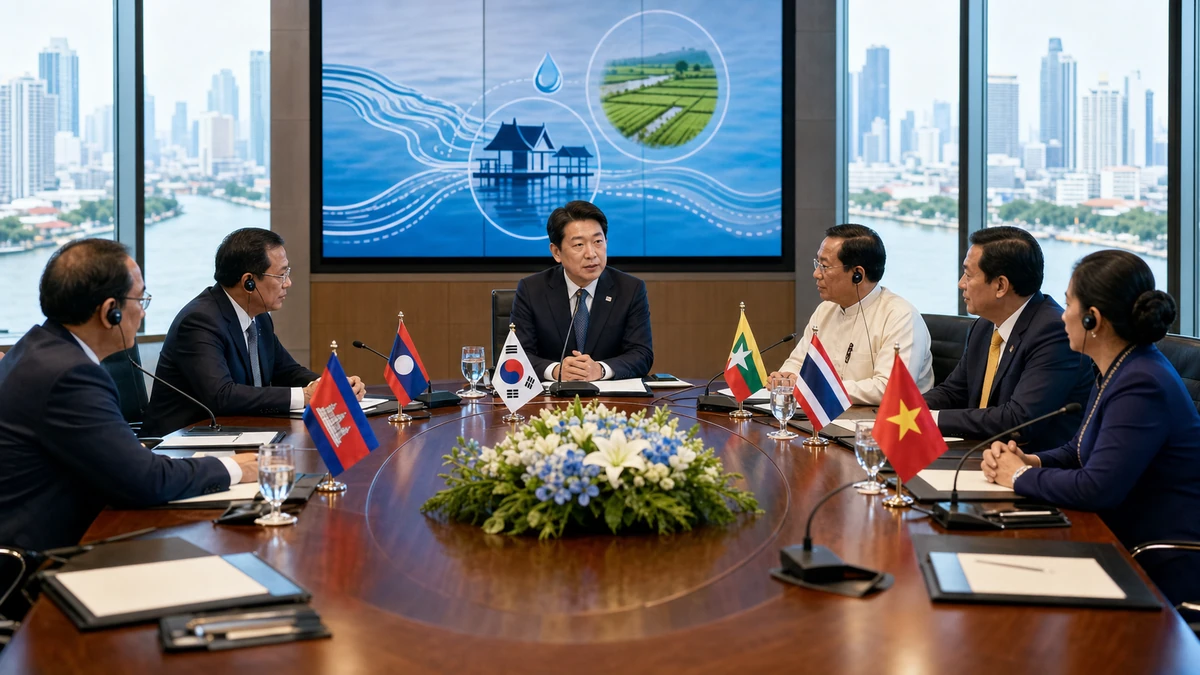
BANGKOK — In the daily churn of Asian diplomacy, some of the most consequential meetings are not summits with red carpets or photo lines packed with heads of state. They are working-level sessions where senior officials sit down, compare notes, review old promises and test where cooperation might go next. That was the case this week in Bangkok, where Lee Dong-gi, director-general for ASEAN affairs at South Korea’s Foreign Ministry, met with senior officials from five countries in the Mekong subregion — Cambodia, Laos, Myanmar, Thailand and Vietnam — to assess existing projects and sketch out new areas for cooperation.
On paper, the meeting sounded technical: a South Korea-Mekong senior officials’ meeting focused on development cooperation. In practice, it offered a revealing look at how Seoul is trying to broaden its diplomatic footprint in mainland Southeast Asia at a time when economics, security and technology are increasingly intertwined.
The Mekong region, named for the river that runs through much of mainland Southeast Asia, has long been a focus of development policy because water, agriculture, rural livelihoods and climate vulnerability are so tightly linked there. But the agenda discussed in Bangkok suggests South Korea wants the relationship to be about more than traditional aid. According to South Korea’s Foreign Ministry, Lee said he hoped the partnership could expand into advanced technology, innovation, digital cooperation, economic security and responses to transnational crime.
That matters because it signals a shift in emphasis, not necessarily a new treaty or a major program launch. No specific projects, budgets or implementation timelines were announced. Instead, the meeting served as a formal reaffirmation that Seoul and the five Mekong countries see room to deepen ties in areas that reflect today’s geopolitical pressures: supply chains, digital infrastructure, cross-border security threats and resilience against natural disasters.
For American readers, one way to think about this is as a version of the quiet, mid-level diplomacy that often gives shape to broader foreign policy before presidents and prime ministers ever step in front of cameras. In Washington, these kinds of meetings often happen far from public attention, yet they lay the groundwork for how partnerships actually function. In Bangkok, South Korea appeared to be doing something similar — taking a practical relationship built on development assistance and trying to adapt it to a harsher and more interconnected regional environment.
Why the Mekong matters beyond geography
The Mekong subregion does not always command the same attention in American news coverage as the South China Sea, Taiwan or the Korean Peninsula. But it occupies a strategic middle ground in Asia. The countries that participated in the Bangkok meeting sit at the intersection of continental Southeast Asia, regional trade routes and some of the world’s most contested questions about development, governance and outside influence.
That alone gives the region diplomatic weight. The five countries involved — Cambodia, Laos, Myanmar, Thailand and Vietnam — are linked by geography but not by identical political systems or economic conditions. Thailand is a major U.S. treaty ally. Vietnam has emerged as a key manufacturing hub and strategic player in the U.S.-China competition. Cambodia and Laos have faced scrutiny over their economic dependence on larger powers. Myanmar remains mired in turmoil following its 2021 military coup. Treating the Mekong as a single diplomatic space does not erase those differences, but it does reflect the reality that many of the region’s challenges cross borders.
Water management is the obvious example. What happens upstream can affect farming, fishing and electricity generation downstream. Rural development has similar spillover effects, especially where labor migration, food production and uneven infrastructure shape both livelihoods and political stability. Disaster risk reduction — another area highlighted by the South Korean side — is not an abstract policy category in this part of the world. Seasonal flooding, drought, storms and climate stress can quickly become national economic issues and regional humanitarian ones.
South Korea sees an opening in that landscape. It is not a superpower competing for military dominance in the Mekong. What it can offer instead is the model it often presents in international development circles: a country that moved, within a few generations, from war and poverty to industrialization, technological sophistication and capable public administration. Whether one fully accepts that narrative or not, it remains central to how Seoul explains its external partnerships.
That gives South Korea a particular pitch in mainland Southeast Asia. Rather than framing itself primarily as a donor with cash or as a strategic patron demanding alignment, Seoul often emphasizes practical know-how — digital systems, infrastructure planning, agricultural modernization, public-sector training and lessons drawn from its own development experience. The Bangkok meeting underscored that South Korea still sees that formula as relevant, but also in need of updating.
From development assistance to digital and economic security
The most notable shift in the meeting was the language around new cooperation areas. Lee’s call to expand into advanced technology, innovation, digital fields and economic security reflects a larger pattern in Asian diplomacy: governments that once treated development and security as separate tracks increasingly see them as part of the same conversation.
In Washington, the phrase “economic security” has become almost routine in discussions about semiconductors, critical minerals, batteries and supply-chain resilience. In Asia, it is acquiring similar significance, though often with a broader developmental dimension. For countries in the Mekong subregion, economic security can mean access to reliable markets, energy stability, digital capacity, resilient logistics and less vulnerability to external shocks. For South Korea, it also means cultivating relationships in regions that matter to manufacturing networks and future growth.
It is important not to overstate what happened in Bangkok. The South Korean readout did not identify specific products, sectors or investment plans. There was no announcement of a chip partnership, no named companies and no new mechanism targeting a particular supply chain. Still, the choice to place economic security on the table is telling. It suggests Seoul wants its ties with the Mekong countries to fit into a broader diplomatic strategy shaped by geopolitical uncertainty, rather than remain confined to classic development categories.
The same is true of digital cooperation. That phrase can sound vague, but in practice it can encompass a wide range of issues familiar to Americans: digitizing public services, improving disaster alert systems, supporting online education, strengthening administrative efficiency and helping local industries integrate into a more technology-driven economy. In lower-income or unevenly developed parts of Southeast Asia, digital infrastructure is not only about convenience. It can influence state capacity, competitiveness and access to opportunity.
For South Korea, digital cooperation is also an area where it has clear brand value. Seoul has spent years building an international reputation around high-speed connectivity, e-government systems and a consumer-tech ecosystem that Americans may know through companies like Samsung and LG. The challenge, as always, is whether that reputation can be translated into programs tailored to local conditions rather than exported as a one-size-fits-all model.
The Bangkok meeting did not answer that question. What it did show is that both sides are at least discussing a future in which South Korea-Mekong ties are not just about villages, irrigation and disaster preparedness, but about the technological and economic architecture that will shape regional stability in the next decade.
Why transnational crime has entered the conversation
Another notable element of the meeting was the inclusion of transnational crime as a potential field of deeper cooperation. That may sound like standard diplomatic boilerplate, but it reflects a real shift in how governments define regional stability. Cross-border crime is no longer treated solely as a law-enforcement matter. It is increasingly viewed as a threat to investment, tourism, governance and public trust.
In mainland Southeast Asia, those concerns can touch everything from trafficking and online scams to illicit financial flows and porous border activity. The Foreign Ministry’s summary did not specify which crimes were discussed, and there was no mention of joint operations, intelligence-sharing agreements or new enforcement structures. That restraint matters. It means observers should not read the Bangkok meeting as the launch of a new security pact.
Even so, the inclusion of the issue is significant. It suggests that South Korea and the Mekong countries see safety and governance as inseparable from development. Investors are less confident in unstable environments. Tourism suffers when security concerns rise. Supply chains can be disrupted by corruption, criminal networks or political volatility. In that sense, talking about transnational crime at a development-focused diplomatic meeting reflects a broader reality in Asia: economic cooperation increasingly depends on a baseline of institutional reliability.
For South Korea, this is also a recognition that its interests in Southeast Asia have grown beyond trade statistics. South Korean tourists, businesses, students and cultural exports are deeply woven into the region. K-pop, Korean dramas, beauty brands and electronics have helped make South Korea a visible soft-power presence across Southeast Asia. But cultural popularity alone does not protect commercial or diplomatic interests. As Seoul expands its role, it also has to think more seriously about the governance environment in partner countries.
That makes the Bangkok meeting a useful indicator of how South Korea’s regional diplomacy is maturing. The old formula of development assistance plus goodwill still matters, but it is no longer enough on its own. The agenda now includes questions that would have once been considered more squarely strategic.
The value of South Korea’s practical diplomacy
According to South Korea’s Foreign Ministry, officials from the Mekong countries praised Korean support in water resource management, rural development and disaster risk reduction, and expressed hope that such projects would continue to expand. Those may sound like modest accomplishments compared with headline-grabbing defense deals or billion-dollar infrastructure announcements, but in diplomacy, consistency in useful areas can build more trust than grand promises.
That may be one of the clearest lessons from the meeting. South Korea’s comparative advantage in the Mekong is not that it can outspend every rival or dominate the geopolitical field. It is that it can offer targeted cooperation in areas that local governments and communities recognize as tangible needs. Water management matters because the Mekong River system underpins agriculture, fisheries and daily life. Rural development matters because large parts of the region still depend on agricultural economies and face uneven access to state services. Disaster risk reduction matters because climate volatility is no longer a distant threat; it is a regular governing challenge.
In American terms, this is the difference between promising a sweeping regional transformation and helping local governments improve the equivalent of flood control, farm productivity, emergency response and public administration. It is less dramatic, but often more durable.
There is also a political lesson in how South Korea describes this cooperation. The emphasis on responding to the needs of Mekong countries — rather than simply announcing what Seoul wants to provide — fits a demand-driven model of diplomacy. That language is important, especially in parts of the world where smaller states are accustomed to being treated as arenas for major-power competition rather than as partners with their own priorities.
South Korea has long tried to distinguish itself in that space. As a middle power — a term often used for countries with significant influence but not superpower scale — it tends to frame its foreign policy as practical, collaborative and rooted in experience rather than coercion. The Bangkok meeting was a textbook example of that approach. There were no dramatic declarations. Instead, the focus was on reviewing ongoing work and exploring where cooperation could make sense next.
That might not generate immediate headlines in the United States. But it helps explain why South Korea has become an increasingly serious diplomatic actor beyond Northeast Asia. It is no longer defined only by its standoff with North Korea or its balancing act among Washington, Beijing and Tokyo. It is also building a wider network of relationships across Southeast Asia based on development expertise, technology and administrative capacity.
A broader stage than domestic Korean politics
For audiences outside South Korea, Korean politics often comes into view through the most visible and familiar lenses: the North Korean threat, summit diplomacy with the United States, or domestic controversies involving presidents, prosecutors and party infighting. Those stories are important, but they can obscure another reality: much of modern South Korean statecraft plays out in quieter regional diplomacy like the meeting in Bangkok.
That is especially true in relations with the Association of Southeast Asian Nations, or ASEAN, the 10-country bloc that has become central to Asian economic and diplomatic life. Within South Korea’s Foreign Ministry, the ASEAN bureau handles that relationship, and the presence of its director-general at the meeting underscores how seriously Seoul treats Southeast Asia as a long-term strategic arena, not a side project.
The setting also matters. This was not a bilateral meeting with one partner, but a multilateral format involving five Mekong countries at once. That kind of structure allows Seoul to think regionally rather than only country by country. It suggests South Korea wants to preserve a framework for engaging the Mekong as a shared policy space, even though the countries involved differ sharply in governance, development level and foreign alignments.
For an American audience, that can be understood as part of a familiar diplomatic logic: if you want stable economic and political relationships in a region, you do not only cultivate the biggest capitals. You also invest in the connective tissue — the subregional groupings, the sector-based dialogues and the technocratic channels where real implementation happens.
South Korea appears to be doing exactly that. And while the U.S. has its own strategic interests in Southeast Asia, Seoul’s approach offers a reminder that regional influence is often built through persistence and relevance rather than spectacle. If partner countries believe your assistance improves flood management, supports rural livelihoods or helps modernize governance, you may earn more lasting credibility than you would from one dramatic summit statement.
What comes next, and what to watch
The biggest unanswered question after the Bangkok meeting is whether the themes discussed will eventually turn into concrete projects. For now, the record is modest but clear: South Korea and the five Mekong countries reviewed existing cooperation, affirmed positive assessments of work in water management, rural development and disaster mitigation, and discussed expanding collaboration into technology, digital issues, economic security and transnational crime.
That is best understood as agenda-setting rather than deal-making. In diplomatic terms, the meeting established direction and signaled mutual interest. It did not, at least based on the public summary, lock in new funding packages, implementation schedules or institutional changes. The real test will come in follow-up announcements — whether Seoul identifies specific initiatives, whether partner governments endorse them and whether the projects reflect local demand rather than donor fashion.
Several issues will be worth watching. One is whether economic security remains a broad umbrella term or becomes tied to specific sectors such as logistics, digital systems or manufacturing inputs. Another is whether digital cooperation stays at the level of rhetoric or evolves into concrete support for e-government, training, educational access or disaster-response technology. A third is how far security-related cooperation can go, especially given the political sensitivities in a region that includes Myanmar and countries with very different governance systems.
There is also a larger question about South Korea’s place in Asia. The Bangkok meeting suggests Seoul wants to be seen not only as an advanced economy or a cultural powerhouse, but as a practical diplomatic partner able to connect development, governance and strategic resilience. In a period when many countries are trying to reduce vulnerability without choosing stark geopolitical sides, that can be an appealing role.
None of this should be mistaken for a dramatic realignment. The meeting in Bangkok was, by design, a working-level affair. But that is precisely why it deserves attention. International partnerships are often sustained less by soaring language than by the patient accumulation of useful cooperation. In the Mekong, South Korea appears to be betting that practical help — updated for a more digital, insecure and economically fragmented era — can translate into lasting regional influence.
For now, the significance of the meeting lies not in what was announced, but in what was clarified. Seoul wants its Mekong ties to move beyond a narrow development framework without abandoning the bread-and-butter projects that have earned goodwill. The Mekong countries, in turn, appear open to deeper engagement so long as it remains grounded in needs they recognize. That combination — practical, demand-based and strategically aware — may not make for flashy diplomacy. But in a region where stability increasingly depends on exactly those qualities, it may prove to be one of South Korea’s most effective foreign-policy tools.
Comments
Post a Comment