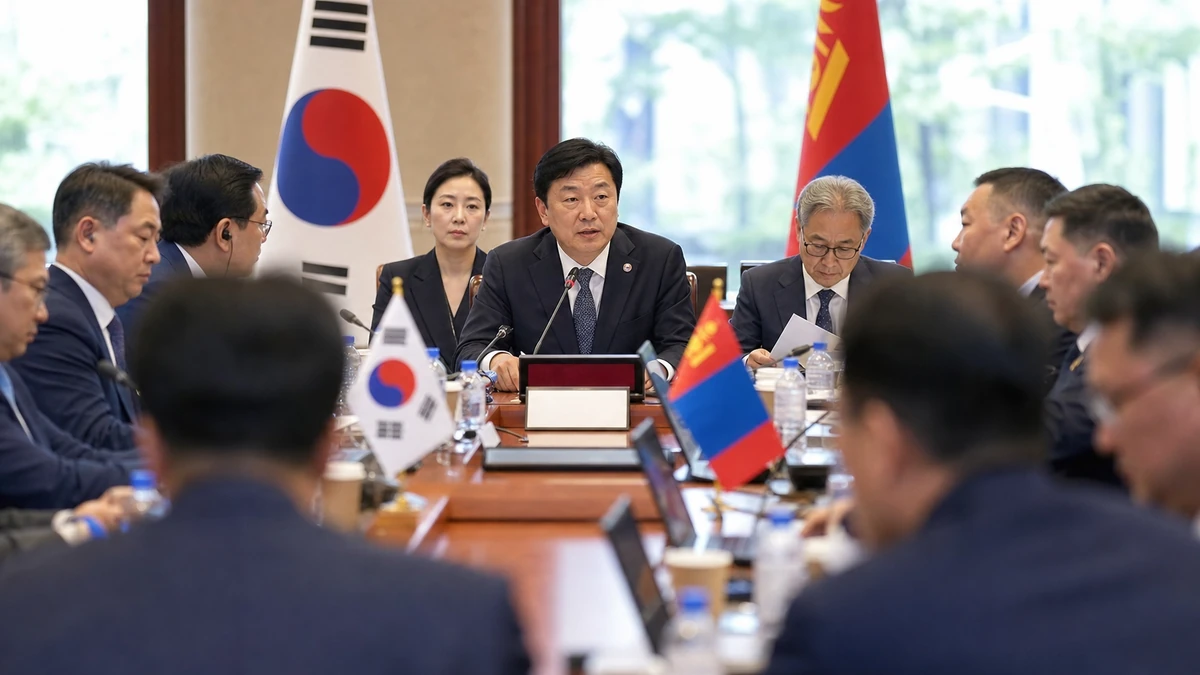
Supply chains move from factory floors to summit tables
In a sign of how dramatically economic security has risen on the global agenda, South Korean Prime Minister Kim Min-seok used a high-level meeting in the Chinese port city of Dalian to press a message that would have sounded highly technical just a few years ago: supply chains now belong at the center of diplomacy.
Meeting Mongolian Prime Minister Nyam-Osor Uchral on the sidelines of the World Economic Forum’s summer meeting, often called “Summer Davos,” Kim said he hoped South Korea and Mongolia could deepen cooperation on supply chains, especially given Mongolia’s status as a major resource-rich country. The comments, reported by South Korea’s Yonhap News Agency, were brief and did not include announcements of a new agreement, investment package or mining project. But the symbolism was clear. In Seoul’s view, the security of industrial inputs is no longer just a matter for corporate procurement managers or trade ministries. It is now a matter for national leaders.
That shift will be familiar to American readers who have watched Washington spend the past several years worrying about semiconductor shortages, dependence on Chinese processing capacity for critical minerals, and bottlenecks exposed during the COVID-19 pandemic. South Korea, one of the world’s most export-dependent manufacturing powers, is confronting a similar reality. For a country whose economy is heavily tied to industries such as batteries, electronics, autos, shipbuilding and advanced manufacturing, reliable access to raw materials is not an abstract concern. It is a strategic necessity.
Kim’s meeting with Uchral underscored how governments increasingly see supply chains as part of what policy experts call “economic security” — the idea that access to materials, technology and transport routes can shape a nation’s resilience as much as traditional military power. In practical terms, that means conversations once relegated to industry conferences are now taking place in diplomatic settings, alongside talks about security, trade and regional stability.
The South Korean prime minister’s language also reflected a broader trend among middle powers such as South Korea: diversifying partnerships without necessarily framing every move as a confrontation. Rather than announcing a dramatic break with existing suppliers, Seoul appears to be steadily broadening its network of resource relationships. Mongolia, with its mineral wealth and geographic location between China and Russia, fits into that strategy.
Why Mongolia matters to South Korea
Mongolia is often overlooked in American coverage of Asia, where attention tends to focus on China, Japan, North Korea and the Indo-Pacific rivalry. But for governments thinking about energy transition, advanced manufacturing and strategic materials, Mongolia has become harder to ignore. The country has large reserves of coal, copper, fluorspar, gold and other mineral resources, and it has long been seen as holding potential in rare metals and other inputs important to high-tech industries.
That matters for South Korea because the country is a manufacturing heavyweight with few domestic natural resources of its own. South Korea built its modern economy by importing raw materials, refining them, and turning them into high-value exports — from cars and petrochemicals to memory chips and consumer electronics. In some ways, its economic model resembles that of Japan and, in a different form, Germany: resource-poor at home, but highly competitive in processing, design and manufacturing.
Mongolia offers a possible complement to that model. South Korea brings industrial expertise, research capacity, financing potential and access to downstream manufacturing networks. Mongolia brings resource potential. That does not automatically translate into mines, contracts or profitable investment. Mineral development is slow, capital-intensive and politically complex. But the logic of complementarity is straightforward.
Kim’s public remarks captured that logic when he said he hoped cooperation with Mongolia could be strengthened amid growing uncertainty in global supply chains. That phrase — uncertainty in global supply chains — does a lot of work. It points to disruptions caused by geopolitical competition, trade restrictions, sanctions, environmental rules, war-related transport shocks and the race among industrialized nations to secure supplies of critical inputs before shortages worsen.
For American readers, a helpful comparison might be the U.S. scramble to secure domestic and allied sources of lithium, cobalt, nickel and rare earth processing after policymakers concluded that clean-energy goals and defense needs could not depend too heavily on vulnerable overseas chokepoints. South Korea faces a version of the same challenge. It may not be trying to replicate the U.S. scale of industrial policy, but it is clearly trying to reduce risk by building more dependable relationships with resource producers.
The rare metals center is modest, but politically significant
One of the most concrete elements mentioned in the meeting was the Korea-Mongolia Rare Metals Cooperation Center, which Kim noted opened late last year. He said he hoped the center would support additional research and cooperation between the two countries. Uchral, according to Yonhap, welcomed the center’s successful launch.
On paper, a research and cooperation center may sound modest compared with the headline-grabbing announcements that usually dominate international business news. There was no reported multibillion-dollar deal, no groundbreaking ceremony, and no new memorandum publicly unveiled during this meeting. Yet that may be precisely the point. Supply-chain diplomacy often advances through institutions that look small at first: research hubs, technical exchanges, feasibility studies, regulatory consultations and information-sharing mechanisms.
Those are the nuts and bolts that make larger agreements possible later. Before governments and companies can commit to major mineral or industrial projects, they usually need detailed geological information, environmental assessments, transport planning, legal clarity and confidence that both sides understand the market and regulatory landscape. A cooperation center can help build that foundation.
In Washington policy circles, this kind of groundwork is often discussed in the language of “friend-shoring,” “de-risking” or “trusted supply chains.” South Korea does not always use exactly the same rhetoric, and it has reasons to be more cautious in how it balances ties with larger neighbors. But the underlying concept is familiar: countries want not only access to materials, but also relationships that are predictable enough to withstand political or market turbulence.
The emphasis on rare metals is especially notable. The term can cover a range of materials used in advanced manufacturing, clean energy technology, digital devices and defense applications. These are the building blocks behind products Americans use every day, even if most consumers never think about where the ingredients come from. Batteries for electric vehicles, magnets used in wind turbines and electronics, specialized alloys, and components used in semiconductors all rely on supply chains that begin far from the showroom or store shelf.
In that sense, the Korea-Mongolia center serves as both a practical tool and a political signal. Practically, it creates a platform for sustained working-level collaboration. Politically, it tells businesses, investors and other governments that Seoul and Ulaanbaatar want their relationship to include a strategic resource dimension — not just ceremonial diplomacy or generalized goodwill.
A meeting in China reveals Seoul’s layered diplomacy
The setting of the meeting matters almost as much as the substance. Kim met the Mongolian prime minister in Dalian during a China trip tied to the Summer Davos gathering, after also traveling to Beijing. That detail highlights how South Korea increasingly conducts diplomacy in overlapping layers: bilateral, regional and multilateral, often all at once.
In the same broader trip, Kim also met Chinese Premier Li Qiang and discussed the Korean Peninsula, including hopes that China could play a constructive role in creating conditions for inter-Korean and U.S.-North Korea dialogue. According to South Korean officials cited in domestic reporting, Li expressed sympathy with Kim’s broader comments, including the need for a Chinese role.
For Seoul, that kind of scheduling is not accidental. South Korea’s foreign policy has to manage several strategic tracks simultaneously. There is the security track centered on North Korea and the U.S. alliance. There is the economic track involving trade, investment, energy and industrial competitiveness. And there is the regional diplomacy track, where China remains indispensable because of its weight in commerce and in any conversation about North Korea, even as Seoul also seeks to reduce vulnerabilities linked to overdependence on China.
Seen from that angle, the Mongolia meeting becomes part of a larger pattern. South Korea is not treating supply chains as a stand-alone business issue. It is weaving them into a diplomatic calendar that also includes great-power relations and security concerns. That reflects a world in which economics and geopolitics are increasingly fused. A government can discuss North Korea in one meeting, industrial cooperation in another, and yet both conversations are connected by the broader question of national resilience.
American audiences may recognize a similar pattern in U.S. diplomacy, where officials now routinely pair security discussions with conversations about semiconductors, clean energy manufacturing, export controls or critical minerals. The old division between “hard security” and “economic policy” has eroded. South Korea, facing one of the world’s toughest neighborhood dynamics, has little choice but to adapt.
The choice of Dalian also carries symbolism. As a major Chinese port city with deep links to Northeast Asian trade, Dalian is a fitting backdrop for talks about supply chains. The geography of the meeting served as a reminder that even as countries seek diversification, Asia’s industrial map remains deeply interconnected. Raw materials, intermediate goods, processing capacity and shipping routes still flow through networks in which China plays an enormous role.
What this meeting did — and did not — produce
It is important not to overstate what emerged from the Kim-Uchral talks. Based on the public summary, the two sides expressed support for stronger cooperation and pointed to the rare metals center as a vehicle for continued work. But no new deal was announced, no investment number was attached, and no specific commodity list, project timeline or jointly branded initiative was detailed.
That distinction matters because resource diplomacy is often judged by splashy announcements that may take years to materialize, if they ever do. Mining and processing projects are notoriously difficult. They can be slowed by commodity price swings, local politics, infrastructure gaps, environmental concerns, permitting disputes and changes in government. A polished diplomatic statement is easier to produce than a functioning mine-to-manufacturing supply chain.
Still, the lack of a headline-grabbing deal does not mean the meeting was empty. In diplomacy, elevating an issue can be a substantive act in itself. When prime ministers publicly discuss supply chains, they give direction to ministries, researchers, state-backed institutions and private firms. They signal priorities. They create political cover for bureaucratic follow-through. And they tell counterpart governments that the issue deserves sustained attention.
That appears to be the real significance of the meeting. South Korea and Mongolia used a high-level encounter to affirm that their cooperation should extend into strategic materials and related research. The outcome was more about direction than immediate deliverables.
There is also a domestic political audience in both countries. In South Korea, leaders want to show they are alert to economic risk and proactive about protecting industrial competitiveness. In Mongolia, officials often seek to demonstrate that the country is not merely a passive source of raw materials, but a partner capable of engaging in research, planning and broader value-chain cooperation. The rare metals center fits that message well because it suggests an effort to move beyond simple extraction toward a more institutionalized partnership.
Why middle powers are rewriting the rules of economic security
The broader lesson from this episode is that middle powers are becoming more active and more inventive in how they pursue economic security. Countries like South Korea do not have the global leverage of the United States or China, but they are not bystanders either. They can build specialized partnerships, create research platforms, coordinate with multiple capitals and use multilateral venues to advance practical agendas.
That approach may become increasingly common as governments try to avoid being trapped in binary choices. South Korea, like many U.S. allies, has strong security ties with Washington and deep economic exposure to China. It cannot simply decouple from the region’s biggest economy, nor can it ignore the strategic risks of concentrated dependence. Partnerships with countries such as Mongolia offer a way to widen options without making every move look like bloc politics.
For Mongolia, too, the calculus is larger than one bilateral meeting. Ulaanbaatar has long pursued what is sometimes called a “third neighbor” strategy — an effort to deepen ties with countries beyond its two giant neighbors, China and Russia. South Korea fits naturally into that approach. A stronger partnership with Seoul can help Mongolia diversify its diplomatic and economic relationships, attract technical cooperation and connect more closely to advanced manufacturing ecosystems.
That is one reason the meeting could matter beyond the immediate optics. It reflects two countries whose interests overlap in practical ways, even if they differ sharply in size, economic structure and geopolitical exposure. One has industrial demand and technological capacity. The other has resource potential and a strategic desire for diversified partnerships. Neither side can transform that overlap into results overnight, but both appear to see value in trying.
For American readers used to headlines dominated by U.S.-China competition, the story is a reminder that some of the most consequential shifts in global economics may come not from direct superpower confrontation, but from quieter relationship-building among secondary players. These deals are often incremental. They begin with meetings, centers, studies and pilot cooperation. Over time, if successful, they can reshape where materials flow and who holds leverage.
Why this matters beyond Korea and Mongolia
At first glance, a meeting between the South Korean and Mongolian prime ministers in a Chinese hotel during an economic forum might seem like a niche diplomatic footnote. But it touches on several of the biggest international themes of the moment: the race for critical minerals, the fusion of economics and national security, the struggle to make supply chains more resilient, and the growing importance of middle-power diplomacy.
Those themes have direct relevance for the United States and other English-speaking countries. The clean-energy transition, the AI boom, advanced weapons systems and next-generation electronics all depend on supply chains that stretch across continents. A disruption in one link — mining, refining, shipping, processing or component manufacturing — can reverberate globally. That is why countries are no longer content to treat supply chains as invisible plumbing behind the modern economy. They are treating them as strategic infrastructure.
South Korea’s outreach to Mongolia should be understood in that context. It is not simply about buying more raw materials. It is about building a relationship that could, over time, reduce uncertainty for South Korean industry and create new avenues of cooperation in research and resource development. The emphasis on a rare metals cooperation center suggests that Seoul sees institutional depth as important, not just one-off transactions.
Whether the effort produces measurable results will depend on what happens after the cameras move on: technical studies, business participation, political consistency and the hard realities of project execution. But the diplomatic message is already clear. South Korea wants to ensure that resource access and industrial resilience are discussed not only in corporate boardrooms, but at the highest levels of government.
That is a significant marker of how the global economy is changing. In the old model, leaders might have focused on tariffs, market access or broad investment ties while leaving supply questions to private companies. In the new model, governments are much more directly involved in shaping who supplies what, under what terms, and with what degree of strategic trust.
Kim’s meeting with Uchral did not produce a dramatic breakthrough. What it did produce was something subtler, but increasingly important: a public acknowledgment that in an era of fractured globalization, securing the materials behind modern industry has become an issue of statecraft. For South Korea, Mongolia may become one part of that effort. For the rest of the world, the meeting offered a small but telling glimpse of how diplomacy is being remade by the politics of supply.
Comments
Post a Comment