A 37-Year-Old Defender, a Red Card and a Road Win: What Pohang’s Wild 3-2 Victory Says About South Korea’s K League
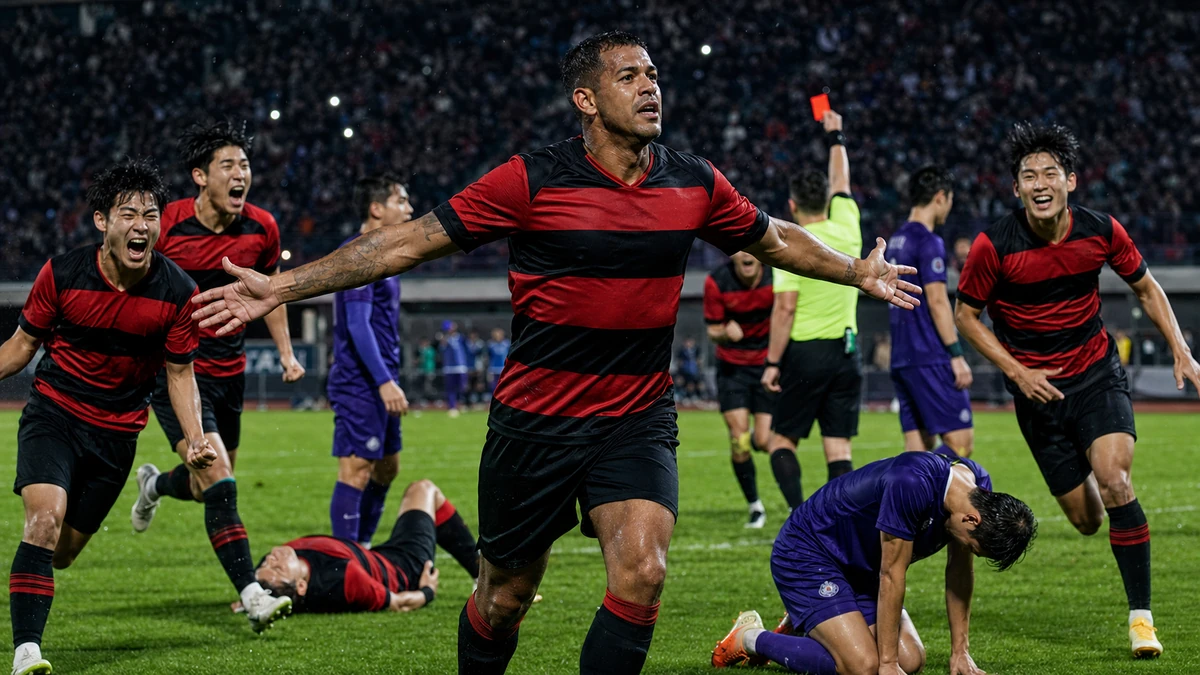
A veteran steals the show in South Korea’s top soccer league
In a sport that often worships youth, speed and the next big thing, one of the most memorable performances in South Korean soccer this week came from a 37-year-old defender who refused to play his age.
Pohang Steelers, one of the most established clubs in South Korea’s top professional soccer division, beat FC Anyang 3-2 on the road on Friday in a K League 1 match that turned into something bigger than a routine regular-season result. Pohang spent a significant stretch of the second half down to 10 men after a red card, yet still found a way to keep scoring and leave Anyang with all three points.
At the center of nearly everything was Wanderson, the Brazilian veteran who delivered two goals and one assist in a performance that would stand out for any player, at any age, in any position. It was especially striking because Wanderson is not a center forward or an attacking midfielder built around highlight-reel production. He is listed as a defender, a role that typically brings praise for positioning, recovery runs and discipline more than goals and assists.
For American readers more familiar with the English Premier League, Major League Soccer or the UEFA Champions League, the K League can sometimes feel distant despite its increasingly global reach. But matches like this one explain why South Korea’s domestic league continues to command respect across Asia and beyond. It is a competition where tactics matter, where veteran foreign players can become club institutions, and where a single game can reveal something larger about endurance, team identity and the unforgiving demands of the professional game.
Pohang’s victory over Anyang was not just dramatic because of the score line. It was dramatic because of the conditions under which it was won: on the road, with a man disadvantage, and with one of the decisive players being a veteran defender who has built his late-career reputation on preparation as much as talent. In American sports terms, this was the kind of performance that becomes part of a player’s mythology — not unlike an aging NBA star turning back the clock in a playoff game, or a longtime NFL veteran making the defining play when a younger roster is starting to wobble.
Why this match mattered beyond the scoreboard
A 3-2 road win in the middle of a league season does not always travel beyond a club’s local fan base. This one likely will. According to South Korean media reports, the turning point came in the 60th minute, when Pohang right back Shin Kwang-hoon was sent off after receiving his second yellow card. In soccer, going down a player is one of the clearest competitive disadvantages the sport offers. A one-man deficit changes spacing, pressing, recovery shape and the emotional rhythm of the match all at once.
That is particularly true for a fullback, a position already asked to cover enormous ground. Lose a right back, and the problem is not only numerical. The entire balance of the back line shifts. Wingers have to track deeper. Midfielders must slide wider. Center backs are pulled into uncomfortable areas. The opponent, sensing weakness, usually begins targeting the vacated channel almost immediately.
Most teams in that situation do what logic suggests: retreat, compress the field and try to survive. They defend deeper, slow the game when possible and hope to steal a point or perhaps nick a counterattack. Pohang did not entirely abandon caution, but neither did it collapse into pure survival mode. Instead, it kept producing decisive attacking moments.
That is what made the result stand out. The win was not simply a matter of hanging on after taking a lead. It was an active, aggressive response to adversity. Even after the sending-off, Pohang continued to find a way to threaten Anyang and convert chances. In a sport where momentum can turn instantly and a crowd can swell behind the team with the extra man, maintaining that kind of composure is as much a psychological achievement as a tactical one.
For U.S. audiences, there is a temptation to view Asian domestic leagues mainly through the lens of transfer markets or World Cup development. But results like this show the weekly intensity of the competition on its own terms. K League 1, South Korea’s highest professional soccer league, is not just a proving ground for younger talent. It is also a stage where experienced players can shape games through decision-making, conditioning and the kind of calm that only comes from years in the profession.
Wanderson’s night was extraordinary for more than one reason
The basic stat line — two goals and one assist — is eye-catching enough. The deeper context makes it much more impressive.
Wanderson is 37, an age at which many outfield players in top-flight soccer have already retired, moved into lower divisions or transitioned into reduced roles. Soccer is brutally demanding on the body. Recovery slows. Muscle strains linger. Sprint speed fades. The margin for error gets thinner. The modern game, with its constant pressing and transition demands, has only intensified those realities.
And yet Wanderson turned in the sort of performance usually associated with a player in his prime. He was involved in nearly every decisive attacking moment for Pohang, and he did it while carrying responsibilities that defenders do not ordinarily shed simply because they happen to be having a good offensive night. For a defender to record multiple goals and an assist in such a high-pressure road environment is rare. For a 37-year-old defender to do it while his team is navigating a red card is the kind of story that naturally cuts through league tables and reaches a broader audience.
There is also the positional element. In American sports, scoring bursts are generally expected from specialists. A quarterback throws touchdowns, a point guard creates offense, a slugger drives in runs. In soccer, defenders can influence the attack, especially in the modern game, but they are still not expected to dominate the score sheet. When they do, it often signals not only individual sharpness but also tactical freedom, trust from the coaching staff and a deep understanding of where danger can be created.
That seems to be part of Wanderson’s value to Pohang. His night was not just a matter of fortunate bounces or isolated moments. It reflected a broader role in how the team plays. He appears to be the kind of veteran who reads the game fast enough to arrive in the right spaces and experienced enough to recognize when a match is tilting emotionally. Some players manage moments; others seem to feel them before they arrive. On Friday, Wanderson looked like the latter.
After the match, he attributed his longevity to disciplined physical maintenance over the past decade, saying he had committed himself seriously to taking care of his body 10 years ago. That comment landed with force because it offered a simple, unsentimental explanation for a performance that might otherwise be reduced to inspiration or heart. Athletes at the highest level often talk about sacrifice and preparation, but those phrases can become cliches. Wanderson backed them up with evidence that was visible on the field.
The K League’s foreign veterans often become more than imports
One of the most interesting parts of this story for international readers is the place Wanderson occupies within Korean club soccer culture. In many leagues, foreign players are judged quickly and often harshly. They are brought in to produce immediately, and if they do not, they are replaced just as quickly. That pattern exists in South Korea, too. Roster spots are valuable, expectations are high, and foreign signings are often viewed as players who must change games.
What makes Wanderson notable is that he has done more than have a hot streak or a memorable month. He has built a durable body of work at Pohang. Since joining the club in 2019, he has appeared in 154 matches and compiled 26 goals and 20 assists for the Steelers, according to the figures cited in Korean media. With Friday’s performance, he reached the symbolic 20-goal, 20-assist mark for Pohang.
That kind of production is significant for any long-serving player. For a defender, it is especially unusual. It suggests not just longevity, but sustained relevance. He has not merely stuck around; he has continued to matter. In a league where tactical organization is prized and where clubs are constantly balancing local development with immediate competitive demands, maintaining that level of influence over multiple seasons is difficult.
There is a larger pattern here that American audiences may find familiar. Every sports market has its beloved career imports — players born elsewhere who become inseparable from the local team’s identity. Think of the foreign soccer stars who became MLS cornerstones, or international NBA players who became face-of-the-franchise figures in cities far from where they grew up. In South Korea, foreign players who stay long enough, produce consistently enough and embrace the grind of the league can earn a similar kind of standing.
Pohang, a club with deep roots and one of the stronger historic identities in Korean soccer, is the kind of place where those bonds can matter. Fans do not only remember the flashiest names. They remember the players who show up year after year, who deliver in difficult away matches and who seem to understand what the badge means in the context of the league. By that standard, Wanderson’s performance against Anyang was not just another big night. It was a chapter that likely deepens his place in club memory.
What his message to younger players reveals about Korean sports culture
Wanderson’s postmatch comments were almost as revealing as his stat line. Speaking afterward, he offered a blunt message to younger players: If you want to play for a long time, do not live carelessly. In Korean coverage, that remark carried the tone of a veteran warning against complacency rather than delivering a celebratory sound bite.
That matters in the Korean sports context. South Korean athletics, like many parts of Korean society, places strong emphasis on discipline, hierarchy, endurance and respect for experience. Younger players are expected to listen. Veterans are expected to lead not only with performance but with seriousness. When a 37-year-old who has just produced two goals and an assist says that long careers are built through daily habits, the message resonates beyond one locker room.
To Americans, the phrase may sound similar to what coaches preach in any sport: take care of your body, respect the work, do not waste your talent. But in the Korean context, those words carry an additional layer. They speak to a culture in which professional identity is often tied closely to sacrifice and self-management. The point is not simply that a player should train hard. It is that the unseen hours — sleep, diet, recovery, routine, focus — eventually reveal themselves in public moments.
Wanderson also thanked his teammates for fighting until the end and helping secure the result, framing the night as a collective effort rather than a personal showcase. That, too, fits the tone often prized in Korean team sports, where overt self-promotion can be viewed differently than it is in many American leagues. Leadership is frequently measured by how a veteran absorbs pressure, deflects praise and reinforces group identity.
That does not mean Korean sports culture is monolithic or uniquely austere. Modern athletes everywhere are brands as well as competitors. But the language of responsibility still matters deeply, and veteran statements like Wanderson’s are often read as lessons, not just reactions. For younger players in the K League, his performance was a highlight. His warning may be the more lasting part.
A tactical and emotional blueprint for why fans love this sport
There is a reason wins like this tend to linger with supporters. They satisfy both the analytical side of soccer and the emotional side at the same time.
From a tactical perspective, Pohang’s response after the sending-off was impressive because it suggested structure under stress. A team reduced to 10 men must redistribute labor immediately. Cover shadows change. Passing lanes become riskier. The burden of every sprint increases. Concentration errors become more costly. To keep scoring in that setting means a team has not completely lost its shape or its nerve.
Wanderson’s direct involvement in three goals also suggests that Pohang’s attack was not confined to one predictable source. When defenders contribute decisively in advanced areas, it often reflects a system that allows experienced players to interpret space rather than simply occupy positions. That flexibility can be especially valuable in chaotic matches, when rehearsed patterns start to break and instinct becomes more important.
At the same time, soccer fans do not fall in love with the sport because of rest-defense diagrams or transition structures alone. They love nights like this because they dramatize something elemental: a team under pressure finding one more response than expected. A player written off by age producing the game’s loudest statement. A road crowd silenced, then stirred, then left stunned. Those are the rhythms that make soccer compelling in Seoul, in Buenos Aires, in London and in Kansas City alike.
For Pohang supporters, the 3-2 victory will likely be remembered as evidence of grit and cohesion. For neutral fans, it is the kind of result that turns casual attention into curiosity. And for those outside South Korea who may only occasionally check in on the K League, it serves as a reminder that the sport’s most vivid stories are not confined to Europe’s richest competitions.
What this says about the K League’s global appeal
South Korean soccer is often discussed internationally through a narrow set of familiar names and events: the national team’s World Cup pedigree, the emergence of stars who move to Europe, or the high-profile moments that make global highlight packages. Those deserve the attention they get. But the domestic league has its own storytelling power, and Friday’s match offered a near-perfect example.
It had drama, tactical complication, veteran excellence, cultural subtext and a result that defied the conventional script. It also showcased an aspect of the K League that deserves more notice: the way long-serving foreign players can become central characters in Korean soccer rather than temporary hired hands.
For American readers, it may help to think of the K League less as an outpost and more as a mature, competitive soccer environment with its own rhythms, traditions and fan expectations. The quality of play may not carry the financial muscle or international marketing apparatus of Europe’s elite leagues, but the competition offers something that many fans say they want from sports in the first place: stakes, identity and stories that feel earned instead of manufactured.
Pohang’s win over Anyang checked all of those boxes. The Steelers won away from home. They won after a sending-off that should have tilted the game against them. And they won because a 37-year-old Brazilian defender — a player whose career arc already says something about longevity and adaptation — authored one of the most memorable individual performances of the K League season.
That does not make this the biggest match in world soccer, and it does not need to be. Its value lies in its specificity. This was Korean club soccer at its most revealing: intense, disciplined, emotional and unexpectedly cinematic. In one evening, it produced a story about aging, preparation, teamwork and the stubborn refusal to accept the logic of disadvantage.
Those themes travel well across cultures. They are easy to understand whether you follow the K League every week or had never heard of FC Anyang before now. That is ultimately why this result matters beyond the standings. It reminded anyone paying attention that sports still have room for performances that feel almost old-fashioned in the best sense — a veteran rising to the moment, a team outlasting adversity and a game turning into a story bigger than itself.
Comments
Post a Comment