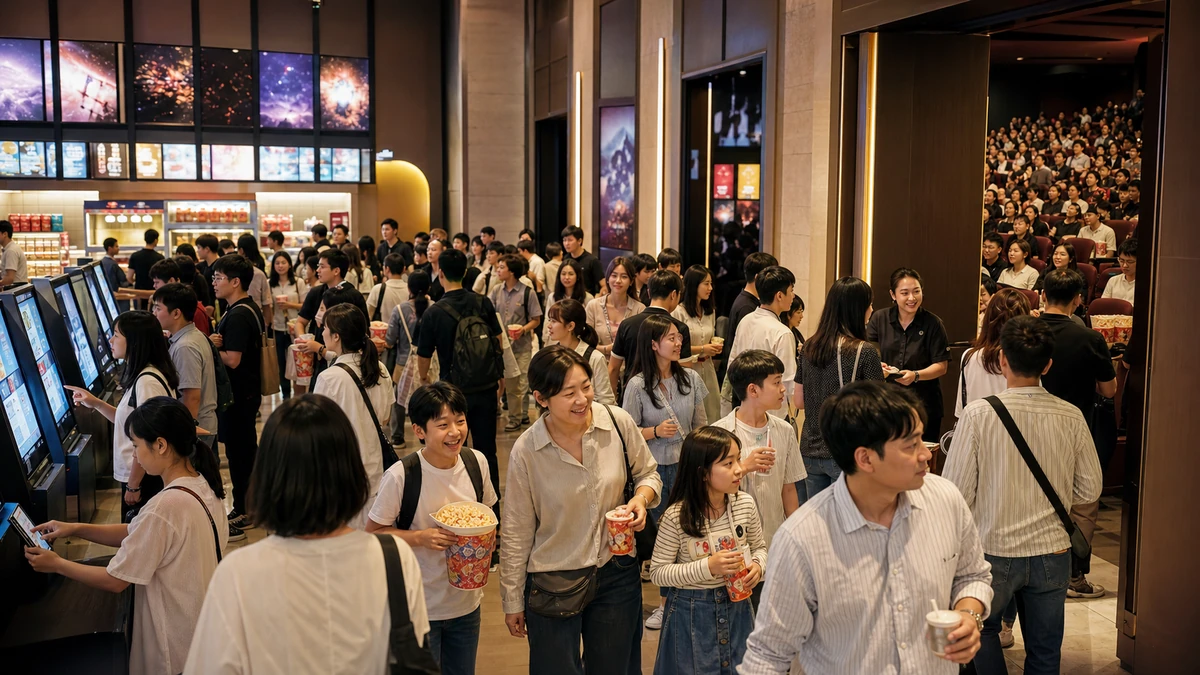
A strong first half signals a comeback for South Korean cinemas
South Korea’s movie theaters are showing real signs of life again after several difficult years, with new figures suggesting that audiences are returning to cinemas in meaningful numbers rather than just for a one-off hit.
From January through June, Korean films sold about 37.37 million tickets in South Korea, up 74.9 percent from the same period a year earlier, according to data compiled by the Korean Film Council’s box office tracking system, known as KOBIS. Revenue for Korean films rose even faster, climbing 81.7 percent to 370.2 billion won, or roughly the equivalent of hundreds of millions of dollars depending on exchange rates.
For American readers, it may help to think of KOBIS as South Korea’s version of a centralized box office scoreboard, something akin to a national blend of Comscore data and industry reporting. Because the Korean theatrical market is relatively compact and closely tracked, shifts in attendance can offer a clear view into broader consumer behavior.
What makes these numbers stand out is not simply that they are higher. It is that ticket sales and revenue rose sharply even though fewer Korean movies were released in theaters during the first half of the year. That suggests moviegoing in South Korea is no longer being buoyed by volume alone. Instead, audiences appear to be responding to movies that feel culturally urgent, socially shareable or big enough to justify leaving the couch and buying a ticket.
That is a familiar question in the United States too. Ever since the pandemic accelerated the shift to streaming, Hollywood has wrestled with the same issue: What kind of movie still gets people into theaters? In South Korea, where cinema has long played an outsized role in popular culture, the first half of the year offered one possible answer. Give audiences a movie that feels like an event, and they will still show up in large numbers.
Fewer releases, bigger crowds
One of the most revealing details in the first-half data is that the number of Korean films released actually declined. There were 217 domestic theatrical releases from January through June, down from 240 over the same period last year.
In many entertainment markets, more releases are assumed to mean more chances to attract viewers. More titles can create more variety, more niche appeal and more reasons for repeat visits. But South Korea’s latest numbers point in a different direction. Even with a slimmer release slate, more people bought tickets and total box office revenue climbed sharply.
That implies the Korean theatrical business is being driven less by abundance than by concentration. The market is rewarding movies that break through the noise and create a sense of necessity. In practical terms, audiences seem less interested in merely having a larger menu of options than in finding a handful of titles that feel like they deserve the big-screen treatment.
That trend should sound familiar to anyone following U.S. box office patterns. American theaters have increasingly leaned on franchise films, prestige spectacles, horror breakouts and a small number of must-see cultural moments. South Korea’s movie market, while structurally different and more domestically oriented in some key ways, appears to be experiencing a parallel dynamic. Strong titles matter more than crowded release calendars.
It also says something about changing consumer habits. South Korean viewers, like American ones, now live in a media environment where entertainment is always available at home. Streaming services, short-form video, gaming and social media all compete for attention. In that environment, a theatrical release does not automatically earn a trip to the multiplex. It has to offer scale, buzz or communal excitement that home viewing cannot easily match.
That does not mean smaller films are irrelevant. But it does mean the overall health of the theatrical sector is becoming more dependent on films that can cut through a fragmented attention economy. When those films arrive, audiences respond. When they do not, even a full release schedule may not be enough to keep theaters busy.
The power of a “10 million movie”
At the center of the first-half rebound is director Jang Hang-jun’s “The Man Living With the King,” which drew 16.9 million admissions and became the second-biggest Korean film release of all time by ticket sales. In a country of about 52 million people, that is a staggering figure.
For readers outside Korea, one cultural concept needs some explanation. In the South Korean film business, a “10 million movie” is more than just a hit. The phrase refers to a film that surpasses 10 million admissions, a benchmark that carries symbolic weight similar to a movie crossing a major box office threshold in the United States, though arguably with even more cultural prestige because of the size of Korea’s population. It suggests not only commercial success but broad social penetration. A “10 million movie” becomes something people talk about at work, with family and across social media. It can turn moviegoing itself into a national conversation.
That symbolic power helps explain why one giant hit can ripple across the entire marketplace. A blockbuster of this size does more than sell tickets for itself. It reminds audiences that going to the theater can still feel like participating in a shared public moment. In an age of personalized streaming queues and algorithm-driven viewing, that kind of collective experience has become more valuable, not less.
American audiences have seen versions of this phenomenon. Think of the way films such as “Barbie,” “Oppenheimer,” “Top Gun: Maverick” or “Avengers: Endgame” became more than movies. They became occasions. People planned outings around them, debated them online and used them as cultural reference points. In South Korea, the success of “The Man Living With the King” appears to have played a similar role, helping turn a box office uptick into a broader argument that theaters still matter.
The scale of the film’s admissions also matters because the Korean market has been under pressure in recent years. A runaway domestic smash offers hard evidence, not just hope, that local audiences can still rally behind Korean-language films in huge numbers. That is important in a country where homegrown cinema has long been one of the most vibrant parts of national culture and one of the strongest engines of soft power abroad.
South Korean films have spent decades building a reputation for genre innovation, emotional intensity and social critique. International audiences know the modern Korean film industry through directors and hits such as Bong Joon Ho’s “Parasite,” Park Chan-wook’s “Oldboy” and more recent streaming-driven global interest in Korean storytelling. But the domestic box office remains the foundation of that ecosystem. A healthy home market is what allows filmmakers, investors and distributors to take risks and sustain a pipeline of new work.
Why Korean theaters still matter in the streaming era
Movie theaters have long occupied a central place in South Korea’s cultural life. In big cities such as Seoul, Busan and Incheon, theaters are integrated into shopping districts, subway-connected commercial hubs and everyday urban routines. For years, seeing a new movie was not just weekend entertainment but a standard part of social life for couples, families, friends and office workers.
That social role helps explain why the latest figures are being read as more than a financial bounce. They point to the possibility that cinema outings in Korea are becoming “events” again, especially when the right film comes along. Audiences are not simply consuming content. They are participating in a group experience, one that is amplified by word of mouth, digital chatter and the appeal of seeing a movie on a large screen with a crowd.
This is especially important in Korean popular culture, where communal response often shapes a work’s momentum. K-pop fandoms coordinate streaming and buying campaigns. Korean television dramas generate intense online discussion after new episodes. Films, too, can benefit when people feel they are joining a wider cultural moment rather than watching in isolation.
The first-half rebound suggests audiences still respond to three core ingredients: strong buzz, a collective viewing experience and storytelling that feels enhanced by theatrical presentation. That could mean spectacle, emotional impact, star power or simply the sense that a movie will be more satisfying if experienced with others. In that respect, South Korea is not so different from the United States. Both markets are discovering that theatrical exhibition survives not by competing with streaming on convenience, but by offering something streaming cannot fully replicate.
There is another layer here as well. South Korea is one of the world’s most digitally connected societies, with consumers highly accustomed to instant access and rapid trend cycles. If theaters can still pull large crowds under those conditions, that is a notable sign of resilience. It suggests that even in a hyper-online culture, physical spaces for shared entertainment retain their appeal when the content is compelling enough.
That matters beyond Korea. Around the world, policymakers, investors and film professionals are asking whether theaters are in structural decline or simply waiting for a new equilibrium. South Korea’s first-half performance does not settle that debate. But it does offer a case study in how quickly audience behavior can improve when a market produces films that feel culturally unavoidable.
The second half will test whether the momentum is real
Still, industry watchers in South Korea are likely to be cautious about declaring full recovery. A strong first half is encouraging, but it does not guarantee that the rest of the year will follow the same trajectory.
Last year, major hits were concentrated more heavily in the second half. This year, strong titles arrived earlier and helped warm up the market sooner. That is a positive development, but it also creates a challenge. Can the industry sustain that energy through the rest of the calendar, or will the first-half surge prove overly dependent on one exceptional film?
That question matters because a durable theatrical recovery usually requires repetition, not just spikes. The goal is not merely to produce one giant blockbuster every so often. It is to rebuild the habit of moviegoing so that audiences return for multiple films over the course of a year. In industry terms, that means creating continuity: a steady pipeline of releases that appeal to different demographics and keep theaters relevant between tentpoles.
Hollywood has struggled with the same issue. One giant weekend can generate headlines, but sustainable box office health requires more than a handful of mega-hits. The calendar has to feel alive. Theaters need enough variety and enough confidence-building successes that consumers begin treating moviegoing as a normal leisure option again, not an occasional splurge.
For South Korea, the first-half numbers may represent the start of that process rather than its completion. If audiences continue to turn out for a range of Korean films in the months ahead, the industry will have a stronger case that the rebound reflects a restored habit. If attendance falls back sharply without another major sensation, it could suggest that the market remains fragile and highly dependent on singular breakout titles.
That distinction matters for everyone in the business, from theater operators and distributors to producers deciding what projects to finance next. A one-film surge can boost confidence, but a consistent recovery changes planning assumptions. It can influence marketing budgets, release strategies and even the kinds of stories that get greenlit.
Why global audiences should pay attention
For international readers, especially those who follow the Korean Wave, or Hallyu, this story is about more than domestic box office math. It is another indicator that South Korean cultural production continues to have powerful local roots even as it reaches global audiences.
In the United States, Korea is often discussed through the lens of exported hits: BTS, Blackpink, “Squid Game,” Oscar-winning cinema and streaming-ready thrillers. Those success stories can create the impression that Korean entertainment now lives mainly on global digital platforms. But the latest theater data is a reminder that Korean popular culture still depends heavily on its home audience, home institutions and home habits of collective consumption.
That has real implications for what international audiences ultimately see. A strong domestic film market gives Korean creators a base from which to experiment, refine talent and build the scale necessary for global crossover. It also helps preserve the distinctive features that make Korean cinema so attractive abroad: its tonal boldness, its willingness to mix genres and its sharp engagement with class, family, history and power.
There is also a symbolic dimension. Korean content has become one of the country’s most visible forms of soft power, shaping perceptions of South Korea far beyond East Asia. When local theaters rebound, it reinforces the idea that Korean storytelling is not just globally marketable but locally vital. The energy flows both ways. International acclaim can raise the profile of Korean creators, while domestic enthusiasm sustains the ecosystem that produces the next wave of films.
For American readers, there is a lesson here about the future of moviegoing in general. The theatrical experience may be under pressure, but it is not obsolete. In South Korea, as in the United States, people still go to the movies when a film feels big enough, urgent enough or communal enough to justify the outing. The challenge for the industry is not persuading people that theaters exist. It is giving them a reason to care.
South Korea’s first-half numbers suggest that reason can still be found. A market that looked weighed down by changing habits and post-pandemic uncertainty has shown that audiences remain willing to gather in the dark for the right story. Whether that marks a lasting revival or a temporary lift will depend on what comes next. But for now, one of the world’s most influential film cultures has delivered a clear signal: the big screen still has drawing power.
A comeback worth watching
It would be premature to call this a complete restoration of South Korea’s theatrical business. The industry still faces the same structural pressures confronting cinemas almost everywhere: streaming competition, uneven release pipelines, changing consumer budgets and the risk that younger viewers may reserve theaters for only the biggest titles.
Yet the first half of the year has undeniably changed the mood. Attendance is up. Revenue is up. And perhaps most importantly, the rise appears connected to renewed audience motivation rather than to a simple increase in supply. Koreans did not return because there were more movies to choose from. They returned because at least some movies felt worth the trip.
That may be the most important takeaway for executives in Seoul and Los Angeles alike. The future of theaters will not be secured by flooding the market. It will be secured by producing films that people believe should be seen together, in public, on a large screen.
South Korea has now offered an encouraging example of what that can look like. A blockbuster with broad appeal helped reignite interest. A tightly watched box office system captured the scale of the rebound. And a film culture long known for its passionate audiences demonstrated that the communal ritual of moviegoing is not gone yet.
For fans of Korean cinema around the world, that is good news. The vitality of the domestic audience is one of the reasons South Korea has remained such a creative force in global entertainment. If theaters there are finding their footing again, the effects could extend far beyond local ticket counters.
In other words, this is not just a story about admissions totals. It is a story about whether one of the most dynamic film industries in the world can restore the conditions that made it so influential in the first place. Based on the first six months of the year, the answer looks more hopeful than it has in some time.
Comments
Post a Comment