A City Water Park in South Korea Is Reopening With Timed Reservations, Family Discounts and a Bigger Safety Push
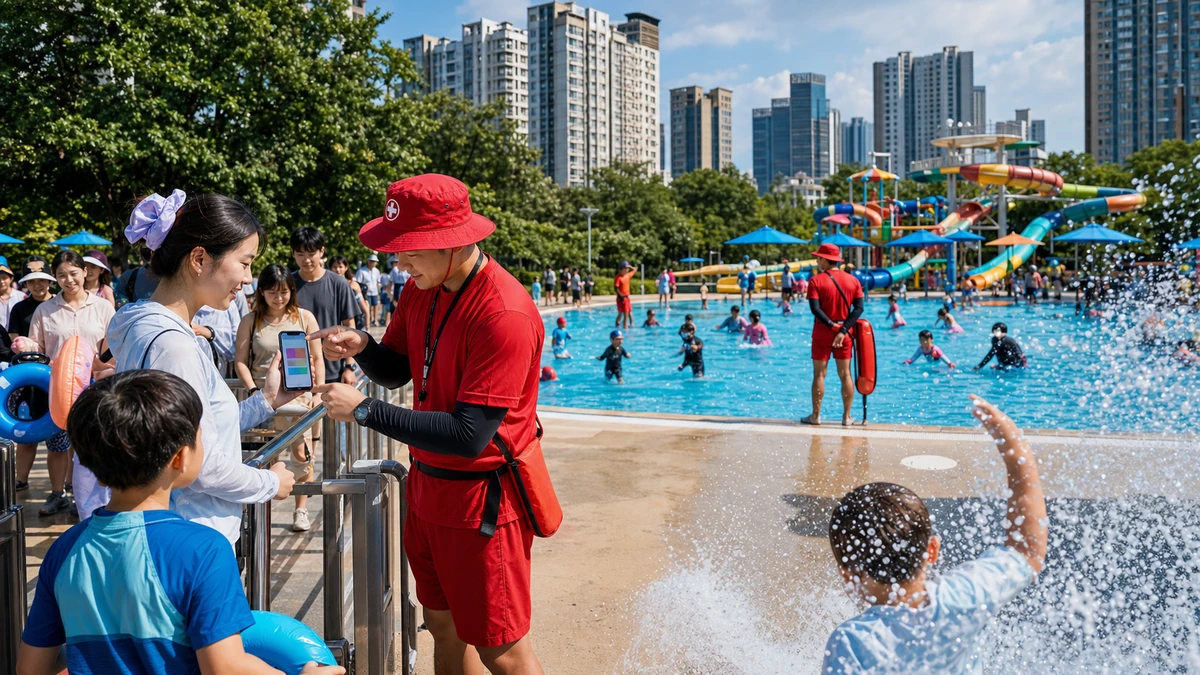
A summer ritual returns in one of South Korea’s hottest cities
In Daegu, a large city in southeastern South Korea known for sweltering summers, a seasonal water park is reopening with a plan that says as much about modern urban life as it does about beating the heat. Duryu Water Park, a city-run facility inside Daegu’s urban core, is scheduled to open July 18, according to the Daegu Public Facilities Corporation, the municipal body that oversees a range of public amenities.
On the surface, this is a straightforward summer story: a water park opens, families show up, children splash through school vacation and office workers look for relief during the muggy peak of the season. But the details of this year’s operation tell a broader story about how South Korean cities are redesigning public leisure around convenience, cost and safety.
The main changes are practical rather than flashy. Visitors will use an online timed-reservation system intended to cut down on long entrance lines. The city is also offering weekday discounts aimed at families, including a 30% reduction in weekday admission for visitors accompanied by children, as well as a weekday pass designed for repeated use over the season. And in a move the operator emphasized heavily, the facility will deploy more than twice the number of water safety personnel required under legal standards, along with hourly safety patrols.
For American readers, the easiest comparison may be a city pool complex or municipal sprayground that has evolved to function more like an airport boarding system crossed with a family recreation center. The attraction here is not a giant resort destination on the scale of Disney’s Blizzard Beach or a sprawling suburban amusement park. It is something more woven into everyday life: a public summer facility meant to serve nearby residents and visitors who want a day of recreation without leaving town.
That distinction matters in Korea, where dense urban living and efficient public transportation shape how leisure is organized. In many U.S. metropolitan areas, families may drive an hour or more to reach a lake, beach or major water park. In South Korea, where large numbers of people live in apartment-heavy cities and weekend congestion can be intense, the appeal of a local, accessible, city-managed water venue is obvious. Duryu Water Park’s reopening highlights how urban leisure in Korea is becoming less about simply opening the gates and more about managing the entire visitor experience from the moment a family decides to go.
Why this reopening matters beyond a day at the pool
The Daegu announcement is notable not because the facility itself is brand-new, but because the operating model reflects a larger shift in public services. Across South Korea, digital systems are increasingly built into daily routines, whether people are reserving museum entries, ordering food, booking train tickets or using public services through smartphone platforms. Public recreation is following the same path.
The timed online booking system at Duryu Water Park is designed to reduce one of the most common frustrations at popular summer attractions: waiting in a long line without knowing how quickly it will move or whether capacity limits will affect entry. Under the new system, visitors must select a time slot online and complete their reservation by midnight the day before. In practical terms, that gives the operator a better sense of how many people will arrive at each interval, and it gives families a more predictable start to the day.
For people in the United States, that may sound familiar. Americans have grown accustomed to timed entry at museums, national parks, special exhibitions and even some city-run recreation programs. What is striking in the Korean case is how quickly those kinds of systems have become normalized in ordinary public life, including at seasonal facilities aimed largely at residents rather than tourists.
That is part of the story here. South Korea’s public-sector institutions, sometimes criticized for bureaucracy in other contexts, have also developed a reputation for adopting high-functioning digital tools in everyday administration. The park’s timed reservation model fits that pattern. Instead of treating crowding as an unavoidable downside of summer fun, the operator is trying to engineer around it.
The same applies to pricing. Summer recreation can become expensive for families almost anywhere, whether the cost is admission, parking, food or repeat visits over school break. By introducing a weekday pass and a weekday discount for visitors with children, the Daegu operator appears to be doing two things at once: lowering the barrier for families and encouraging people to spread out their visits beyond the most crowded weekend windows.
That kind of pricing strategy is common in private-sector entertainment. Airlines, movie theaters and theme parks routinely use off-peak discounts to influence behavior. What makes Duryu Water Park worth watching is that a public leisure facility is using similar tools not just to bring in visitors, but to shape a more manageable and family-friendly environment.
Understanding Daegu and the role of urban leisure in Korea
For readers less familiar with South Korea outside Seoul, Daegu deserves a little introduction. It is one of the country’s major cities, often associated with textile manufacturing, technology and a regional identity distinct from the capital. It is also famous inside Korea for hot summers. Koreans sometimes speak of Daegu’s heat with the same kind of shorthand Americans might use for Phoenix or Houston in July. That climate reality helps explain why a city water park can hold real significance beyond simple entertainment.
South Korea’s summer culture revolves around what Koreans call “piseo,” a term that broadly means escaping the heat. In the U.S., that impulse might send people to the Jersey Shore, a municipal pool, an air-conditioned mall or a backyard sprinkler. In Korea, where living spaces are often smaller and population density is high, public cooling and leisure spaces take on extra importance. Urban streams, river parks, splash zones and seasonal water play facilities can become central pieces of summer life.
Duryu Water Park is described as an urban-style water recreation facility, meaning it is built for accessibility within the city rather than as a destination requiring long-distance travel. That is important for parents navigating school vacation, grandparents caring for children during weekdays and workers trying to plan low-friction leisure outings close to home. It also matters for visitors to Daegu, who can experience a slice of local summer culture without needing to travel to the coast or to a mountain resort area.
In Korea, city governments often play an active role in staging seasonal life. That can include everything from flower festivals and night markets to outdoor skating rinks in winter and water play zones in summer. To American audiences, a city-run water park might sound modest or purely local. In the Korean context, it is part of a broader civic model in which municipal governments are expected to help create livable seasonal experiences for residents.
That may also help explain why the announcement put such heavy emphasis on operational details. The message was not simply “we are open.” It was, in effect, “we are open, and we have thought carefully about how you actually use this place.” That is a subtle but important distinction. It reflects a rising standard among users who increasingly judge public amenities not only by whether they exist, but by whether they are easy to access, affordable and trustworthy.
The reservation system is about more than convenience
The timed reservation requirement may end up being the most consequential change. In popular summer venues, waiting can shape the entire mood of a visit. Parents with young children know this well: a day that begins with uncertainty, heat and a long line can become exhausting before anyone even gets into the water.
By requiring reservations by midnight the previous day, Duryu Water Park is essentially asking people to plan ahead rather than show up and hope for the best. That approach has trade-offs. Spontaneous visitors may find it less flexible, and last-minute weather changes could complicate plans. But the benefit is a more controlled flow of guests and, presumably, less crowding at the entrance.
In South Korea, where smartphone use is nearly universal and online transactions are deeply integrated into daily life, that kind of pre-booking requirement is less culturally disruptive than it might be in places where walk-up culture remains the norm. Korean consumers are used to reserving services digitally, and public agencies are increasingly expected to provide that option.
There is also a broader governance angle. Timed entry systems generate data: what hours are most popular, how weekday use compares with weekends, whether certain discount programs shift behavior and how staffing should be aligned with demand. In that sense, this is not just customer service. It is a management tool that can help city operators make decisions with more precision.
For foreign readers trying to understand why a local water park opening warrants attention, this is one answer: it offers a window into how everyday public administration works in South Korea. The country is often discussed internationally through the lenses of K-pop, advanced technology, geopolitical tension with North Korea and export industries such as semiconductors and automobiles. Less often noted is the way many cities have adopted data-driven, digitally mediated systems for routine civic life.
Duryu Water Park is a small-scale example, but a revealing one. It shows how even a leisure site for summer play is being reshaped by the logic of scheduling, user experience design and demand management.
Family discounts and the economics of a summer day out
The financial side of the reopening matters too. Family recreation can be one of the most visible places where inflation and household budgeting collide. That is true in South Korea as it is in the United States. A day out with children is rarely just the entry fee; it often includes transportation, food, drinks, sunscreen, gear and, if the outing is repeated, the cumulative cost of an entire season.
Daegu’s operator says it is introducing a weekday free-use pass, effectively a weekday season ticket, along with a 30% weekday discount for customers visiting with children. Those policies are clearly aimed at reducing the burden on family groups while steering demand toward weekdays.
The strategy reflects a familiar reality: school breaks do not necessarily mean parents are free on weekends only. In Korea, as in America, summer schedules are often a puzzle involving working parents, grandparents, child care arrangements and efforts to find affordable activities for kids during hot weather. A weekday discount gives price-sensitive families a reason to choose a less crowded day, and a weekday pass may particularly appeal to those who expect to come multiple times.
There is also a social dimension. In many countries, high-quality summer recreation can become stratified by income. Families with more resources can travel farther, book private facilities or take vacations centered around resorts and attractions. Families with tighter budgets often rely more heavily on public amenities close to home. That makes pricing policy at a city-run water facility more than an operational footnote. It affects who gets to participate comfortably in seasonal recreation.
It is too early to know how successful Daegu’s approach will be. The city has announced the programs, but no public data are yet available on attendance patterns, repeat visits or whether weekend crowding will actually ease. Still, the design is clear: make the water park easier to use, cheaper for target groups and less chaotic during peak periods.
In that respect, Duryu Water Park resembles a larger trend in public leisure management. The value is no longer measured only by the physical facility — the pools, slides or splash areas — but by the total system around it. How easy is it to book? How long is the wait? How understandable are the prices? Can a family decide in advance what the day is likely to cost? Those are the questions increasingly shaping public satisfaction.
A stronger safety posture reflects rising expectations
If convenience and pricing form two pillars of this year’s reopening, safety is the third. The Daegu Public Facilities Corporation says it will place more than twice the number of water safety personnel required under legal standards and conduct safety patrols every hour.
That is a significant statement in a country where public safety, emergency response and institutional responsibility have become highly scrutinized topics over the past decade. Without overstating the connection, it is fair to say that South Korean agencies now operate in an environment where citizens expect visible, proactive safety planning in public spaces, especially where children are involved.
At water facilities, safety staffing is not just ceremonial. Lifeguards and water safety personnel are central to both accident prevention and rapid response. In family-heavy environments, the challenge is greater because the pace of movement is fast, children can separate from adults in seconds and risk is unevenly distributed across crowded zones. Hourly patrols suggest that the facility wants to move beyond static staffing and toward repeated site-wide checks.
American readers may think of the difference between a pool that merely meets code and one where management has clearly gone further to reassure parents. That distinction can influence attendance. In public recreation, confidence matters almost as much as the attraction itself. Families are more likely to return if they feel the environment is orderly, supervised and responsive.
In Korea, where public facilities often serve a wide age range in limited space, that trust can be especially important. A stronger safety posture supports not only accident prevention but also the reputation of the city-run system behind it. If visitors come away feeling the operation is disciplined and attentive, that can strengthen confidence in municipal services more broadly.
There is another layer here as well. Safety spending does not produce the visual excitement of a new slide or eye-catching expansion. It is less glamorous than a ribbon-cutting over a major capital project. But for many families, especially those with young children, it may be the single most important factor in deciding whether a summer venue feels worth the trip. By foregrounding staffing and patrols, Daegu is signaling that operational quality can matter as much as physical features.
A small story that reveals a larger Korean trend
To international audiences, a local water park reopening may sound like a minor civic item. It is not a diplomatic summit, a blockbuster entertainment launch or a major economic development. Yet stories like this can be revealing precisely because they show how ordinary life is organized.
Duryu Water Park’s July 18 opening offers a snapshot of contemporary South Korea at the municipal level: digitally managed, family-conscious, highly attentive to crowd control and increasingly explicit about safety standards. It also highlights how local governments are trying to make seasonal life more livable in dense cities where weather, transportation and household budgets all shape how people spend their free time.
For Americans whose image of South Korea is dominated by Seoul skyscrapers, K-pop stages and hit Korean dramas on Netflix, there is another country to notice as well: regional cities building their own rhythms of public life through pragmatic services. Daegu’s water park is part of that picture. It is a reminder that the Korean Wave, while often associated abroad with celebrity culture and glossy exports, exists alongside a domestic culture built on highly organized everyday systems.
That may be the most interesting takeaway. The real story is not just that urban water play is returning to the summer calendar. It is that city-run leisure in Korea is becoming more finely tuned as a public service. Reservations are intended to cut friction. Discounts are intended to widen access and redirect traffic. Extra staffing is intended to reinforce trust. Each change is modest on its own. Together, they suggest a model of public recreation that is less about spectacle than about design.
Whether Duryu Water Park becomes a standout success this season remains to be seen. The available information is limited to the opening date, reservation method, discount structure and safety plan. There is not yet public data on visitor turnout, local economic spillover or how smoothly the system will work in practice. But even at this early stage, the reopening points to a broader shift: in South Korea, even a summer day at a city water park is increasingly shaped by the logic of smart management.
In a country where hot-weather recreation is part necessity, part family ritual and part urban policy, that makes this more than a seasonal footnote. It is a small but telling example of how Korean cities are trying to make ordinary life run better, one timed entry slot at a time.
Comments
Post a Comment