South Korea’s vocational aid reaches a classroom in Uzbekistan, showing a quieter side of Korean influence
A small volunteer trip with a bigger diplomatic story
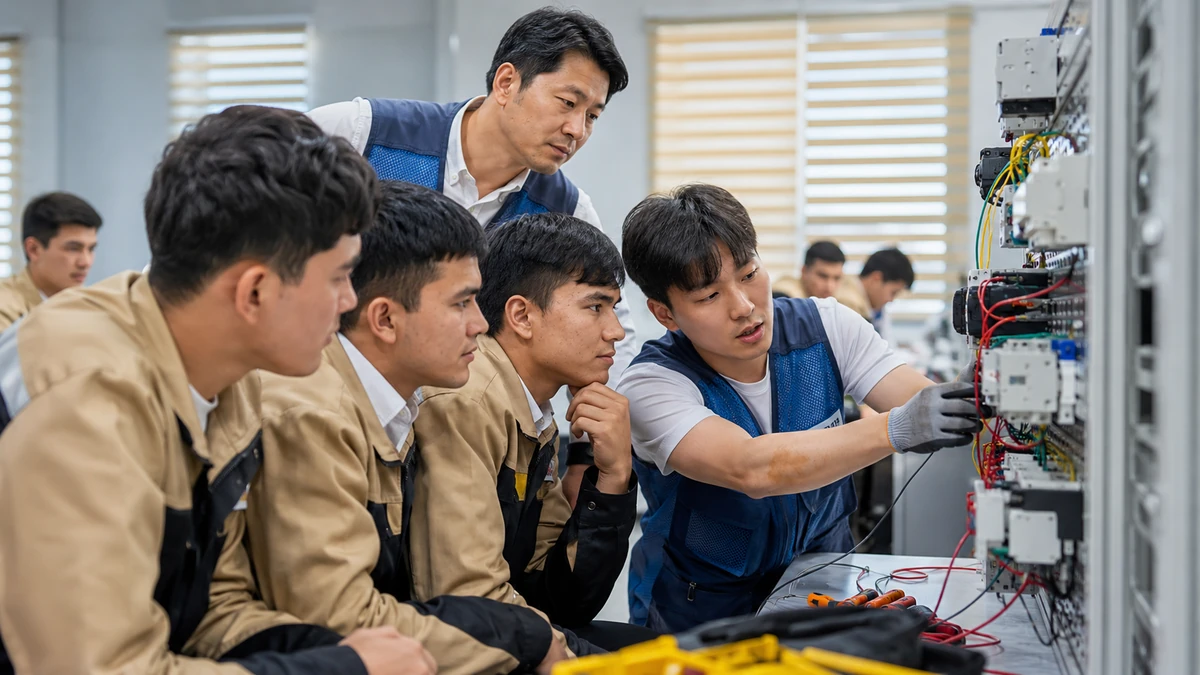
South Korea’s global image is often framed through the exports Americans know best: K-pop, Korean dramas, smartphones, cars and beauty brands. But in the ancient Uzbek city of Samarkand this week, another version of South Korea’s international presence is taking shape far from concert arenas and streaming charts. A 10-member volunteer team from Korea Polytechnics — made up of students and faculty — is spending six days at Samarkand 4th Technical School, offering technical instruction and repairing aging electrical equipment at the campus, according to Yonhap News Agency.
On paper, the trip looks modest. The program runs from June 29 to July 4, 2026, on a four-night, six-day schedule. The group is small. The work is practical rather than ceremonial. There is no summit, no celebrity ambassador, no billion-dollar investment announcement. Yet the visit captures something important about how South Korea increasingly operates abroad: not only as a cultural powerhouse, but as a country trying to export know-how in education, job training and industrial development.
For American readers, one useful comparison might be the difference between sending donated computers to a school and sending skilled instructors who can teach welding, electrical systems, industrial maintenance or other trade skills while also helping make the classroom safer and more functional. One is a shipment. The other is a transfer of experience. The latter tends to be slower, less glamorous and harder to measure in a headline, but often more durable.
That is what gives this assignment its significance. Korea Polytechnics is one of South Korea’s best-known public vocational education systems, focused on the kind of hands-on technical training that helped support the country’s industrial rise. By placing its own students and staff inside a vocational campus in Uzbekistan, South Korea is not just donating equipment or appearing for a photo opportunity. It is connecting its education model directly to a local training environment overseas.
The symbolism matters because the school itself is part of an earlier South Korean development effort. Samarkand 4th Technical School was established through South Korea’s official development assistance, or ODA, a term used for government-backed aid meant to support the economic and social development of partner countries. That means this is not simply a case of Korean volunteers arriving at a random overseas site. They are working inside an institution that South Korea helped create in the first place, turning infrastructure investment into continuing educational engagement.
In an era when international influence is often measured in military alliances, tariff disputes or viral entertainment, the scene in Samarkand offers a quieter example of how countries build long-term relationships: one classroom, one workshop and one repaired electrical panel at a time.
Why vocational education matters in this story
Vocational education does not usually dominate international news coverage, especially in the United States, where public attention tends to focus more on elite universities, major tech companies or headline-grabbing diplomacy. But workforce training can be one of the most consequential areas of international cooperation, particularly in countries trying to expand manufacturing, modernize infrastructure or create stable paths into employment for young people.
That is part of the backdrop here. The Korean volunteers are providing what the Korean report described as major-related or field-specific instruction to local students. The summary did not identify the exact disciplines being taught, so it would be premature to specify programs not publicly named. Still, the broader point is clear: this is specialized technical education, not a general cultural exchange or language program.
For American readers, think of the role played by community colleges, technical institutes and apprenticeship programs in fields like advanced manufacturing, electrical work, automotive repair or industrial automation. Those institutions often sit outside the glamour of four-year college rankings, but they are central to how local economies actually function. South Korea has long treated vocational and technical education as a strategic national asset, tied closely to industrial policy, workforce development and social mobility.
That perspective has deep roots in South Korea’s modern history. The country transformed itself within a few generations from a war-scarred, aid-receiving nation into a major industrial economy. Education was central to that shift, and not only the academic track that leads to top universities. Technical training helped prepare workers for factories, construction, electrical systems, machinery and the layers of skilled labor that sustain modern industry. Institutions like Korea Polytechnics emerged as part of that ecosystem.
When South Korean students and faculty enter a vocational school in Uzbekistan to teach and assist with facilities, they are carrying more than lesson plans. They are carrying a model of development that South Korea itself once used to accelerate growth. That does not mean the Korean experience can be copied wholesale in another country. Every labor market, government system and educational structure is different. But the exchange reflects a larger idea that technical knowledge can be shared in ways that support local capacity rather than simply showcase foreign generosity.
There is also a practical educational logic behind this kind of volunteer work. Technical education is cumulative. A tool can be handed over in a day, but skills are built over time, through instruction, repetition and functioning equipment. If students at the school gain exposure to new methods, clearer demonstrations or a better learning environment, the impact may outlast the visit itself, even if the trip is short.
That is why this story is more than a feel-good dispatch about overseas volunteering. It sits at the intersection of labor, development, education and foreign policy — areas that rarely attract the same public attention as pop culture, but often matter just as much in shaping how countries are perceived abroad.
From aid to partnership in Central Asia
Uzbekistan may not be the first place Americans think of when they consider South Korea’s overseas engagement, but the relationship makes sense in a broader Eurasian context. Central Asia has increasingly drawn interest from countries seeking new economic links, development partners and strategic relationships beyond the orbit of the world’s largest powers. For South Korea, the region presents an opportunity to deepen ties through education, technology transfer and development cooperation rather than through military leverage.
Samarkand, one of the oldest continuously inhabited cities in Central Asia, carries enormous historical resonance. For many Americans, the name may evoke Silk Road imagery — caravans, trade routes and cultural exchange across continents. That history can easily overshadow the present-day reality that Samarkand is also a living modern city with schools, infrastructure needs and a young population preparing for work in a changing economy. In this story, the significance of Samarkand is not primarily romantic or historical. It is functional. It is the site of a technical school where training, equipment and educational conditions matter in immediate, everyday ways.
The fact that Samarkand 4th Technical School was established through South Korean ODA is important because it shows how development assistance can evolve. Too often, aid is understood as a one-off transaction: a building gets funded, equipment is shipped, officials attend an opening ceremony and attention moves elsewhere. What this case suggests is a more layered form of engagement. South Korea helped build the educational base, and now members of a South Korean public vocational institution are returning to work inside that base.
That continuity is meaningful. It turns aid from a donor-recipient snapshot into an ongoing relationship. Instead of stopping at construction or procurement, the effort extends into what might be called operational partnership: teaching students, supporting facilities and maintaining the real-world conditions under which education happens. In development circles, that difference can be critical. Institutions do not function because buildings exist on paper; they function because people keep them running.
For Americans more familiar with the language of foreign assistance through agencies like USAID, the Korean approach here may feel recognizable in some ways and distinct in others. Like U.S. development programs, it aims to support local capacity. But South Korea’s version often carries an additional layer of historical memory. Korea was itself once a major recipient of international aid. Its current role as a donor country allows it to present development cooperation not only as foreign policy, but also as a reflection of its own national journey.
That historical reversal gives South Korea particular credibility in some parts of the world. It can argue, implicitly and sometimes explicitly, that it is not offering abstract advice from a distance. It is sharing methods from a country that moved from poverty to industrial sophistication within living memory. Whether that message resonates everywhere is another question, and development models always require adaptation. Still, it helps explain why technical education projects like this one carry diplomatic weight beyond their size.
What the electrical repairs reveal about conditions on the ground
One of the most telling details in the Korean report is also one of the least flashy: the volunteer team is repairing aging electrical facilities at the school. In many international stories, infrastructure maintenance gets reduced to a footnote. But in a vocational training environment, electrical systems are not background details. They are part of the learning conditions themselves.
A trade school depends on more than teachers and textbooks. It needs functioning workshops, stable power, safe wiring and equipment that can actually be used for practice. If those basics are unreliable, the quality of instruction suffers no matter how strong the curriculum may be. A student cannot fully learn technical work in a setting where the training environment is itself compromised.
That is why the repair work matters. It suggests the Korean team is addressing both the human and physical sides of technical education: instruction for students and maintenance for the space where that instruction takes place. In development terms, this is a more integrated approach than simply delivering lectures or materials. It recognizes that education is embodied in buildings, circuits, machines and safety conditions as much as in lesson content.
There is also a humility to that kind of work. Repairing electrical facilities is not the sort of task that typically drives international branding campaigns. It is practical, local and easy to overlook. But anyone who has spent time in a school, factory or workshop knows that aging infrastructure can quietly limit what institutions are able to do. Fixing those constraints may not produce dramatic headlines, but it can make daily learning more reliable.
At the same time, it is worth resisting the temptation to overstate the measurable outcome. The Korean summary did not provide detailed numbers about the scale of the repairs, the condition of the equipment before the team arrived or the precise changes expected afterward. Responsible reporting requires keeping those boundaries clear. What is known is that the volunteers are working on outdated electrical facilities. What can reasonably be inferred is that such work may strengthen the educational environment. What cannot yet be claimed is a quantified transformation.
Even with those limits, the detail is revealing because it grounds the story in the material realities of international cooperation. Development is often discussed in sweeping language — partnerships, strategy, regional ties, capacity building. Here, it also means touching wires, checking systems and improving a physical space so students can learn more safely and effectively. That combination of policy ambition and workshop-level labor may be exactly what gives the project its credibility.
The role of students, not just governments
Another notable feature of the volunteer mission is who is participating. The team includes not only staff but also current Korea Polytechnics students. That makes the project more than an institutional outreach effort. It also becomes a story about how young South Koreans are being folded into the country’s international engagement.
In many cross-border programs, students are positioned mainly as recipients of global opportunity — they study abroad, intern abroad or observe international systems from the outside. Here, they appear as contributors. They are taking skills learned in South Korea and applying them in a teaching and service context overseas. That shift in role matters, because it shows how the internationalization of technical education can move beyond administrative agreements and into lived experience.
For the Korean students themselves, the educational value is likely two-way, even if the mission is framed as volunteer service. Teaching a skill often sharpens one’s own understanding of it. Explaining a technical concept to learners from another language and cultural background can force greater clarity, adaptability and patience. Working in a different institutional setting can also expose students to how technical training is shaped by local constraints, resources and needs.
That does not erase the asymmetry that can exist in overseas volunteer work, where visitors from a wealthier or more industrialized country arrive to assist students elsewhere. Those dynamics are real and worth acknowledging. But the structure described in the Korean report — students and faculty working together inside a school that South Korea helped establish — suggests an effort to place the activity within an educational framework rather than treating it as a brief act of charity detached from local institutions.
The presence of faculty is especially important on that point. Staff members can provide curricular oversight, maintain safety standards and ensure that whatever instruction or repair work is being done aligns with the mission of a vocational school. In practical terms, they can help transform student enthusiasm into accountable educational service. In symbolic terms, they signal that South Korea is presenting itself not just through youthful volunteerism, but through the professional standards of a public educational institution.
For American audiences, this may sound familiar to programs in which university engineering departments, trade schools or service-learning initiatives send students abroad with faculty supervision. But the Korean case also reflects a national emphasis on technical skill as a source of international value. South Korea is not only sending language instructors, cultural performers or business delegations. It is sending people trained to work with the nuts and bolts of vocational education.
That expands the picture of what Korean soft power can look like. Soft power is often discussed through entertainment and consumer appeal. Here, it takes a different form: credibility built through expertise, public institutions and practical problem-solving.
A quieter side of the Korean Wave
For years, Americans have encountered South Korea primarily through what is often called the Korean Wave, or hallyu — the global spread of Korean pop culture, from BTS and Blackpink to Oscar-winning films, hit television series and a booming beauty industry. That cultural rise has reshaped how many English-speaking audiences think about Korea. It has made the country more visible, more familiar and, in many cases, more admired.
But stories like the one unfolding in Samarkand point to a different layer of Korean influence, one that does not rely on fandom or consumer trends. In this version, South Korea appears as a training partner, a development actor and a country trying to turn its educational and industrial experience into a form of international cooperation. That is a less glamorous narrative than the entertainment boom, but in some ways it may be more consequential over the long term.
The distinction matters because it broadens the meaning of Korean global presence. A country’s influence is not only what people watch, stream, wear or buy. It is also what other countries seek from it in terms of policy ideas, institutional models and practical skills. If South Korea can be seen not only as a producer of globally popular culture but also as a source of technical education and development partnership, that marks a deeper kind of international standing.
This is especially relevant at a time when many middle powers are trying to define distinctive roles in a crowded geopolitical landscape. South Korea cannot outspend the world’s largest economies on every development front, nor can it dominate every diplomatic arena. What it can do is offer targeted cooperation in areas where it has accumulated genuine experience, including vocational education, industrial training and the management of rapid development. The Samarkand project fits that niche.
It also reflects a broader truth about international relationships: they are not built only in presidential palaces or foreign ministries. They are built in classrooms, workshops and technical schools where people learn skills that shape their futures. A repaired electrical system or a well-taught training session will never draw the same attention as a major summit. But for the students who use that room every day, those are the things that make cooperation real.
That may be the clearest reason this relatively small story deserves notice beyond Korea and Uzbekistan. It shows how international influence can move through ordinary institutions and practical labor. It shows how development assistance becomes more meaningful when it is followed by continued engagement. And it shows how South Korea’s global reach now extends beyond culture and commerce into the less visible, but deeply important, world of workforce education.
In the end, the significance of the trip is not that 10 Koreans traveled to Uzbekistan for less than a week. It is that they represent an approach to international partnership rooted in teaching, maintenance and continuity. In an age of oversized rhetoric, that may be one of the most credible forms of diplomacy a country can offer.
Comments
Post a Comment