In a Seoul Market, South Korea Confronts a Small-Business Problem Americans Would Recognize: What Happens When the Owner Gets Sick?
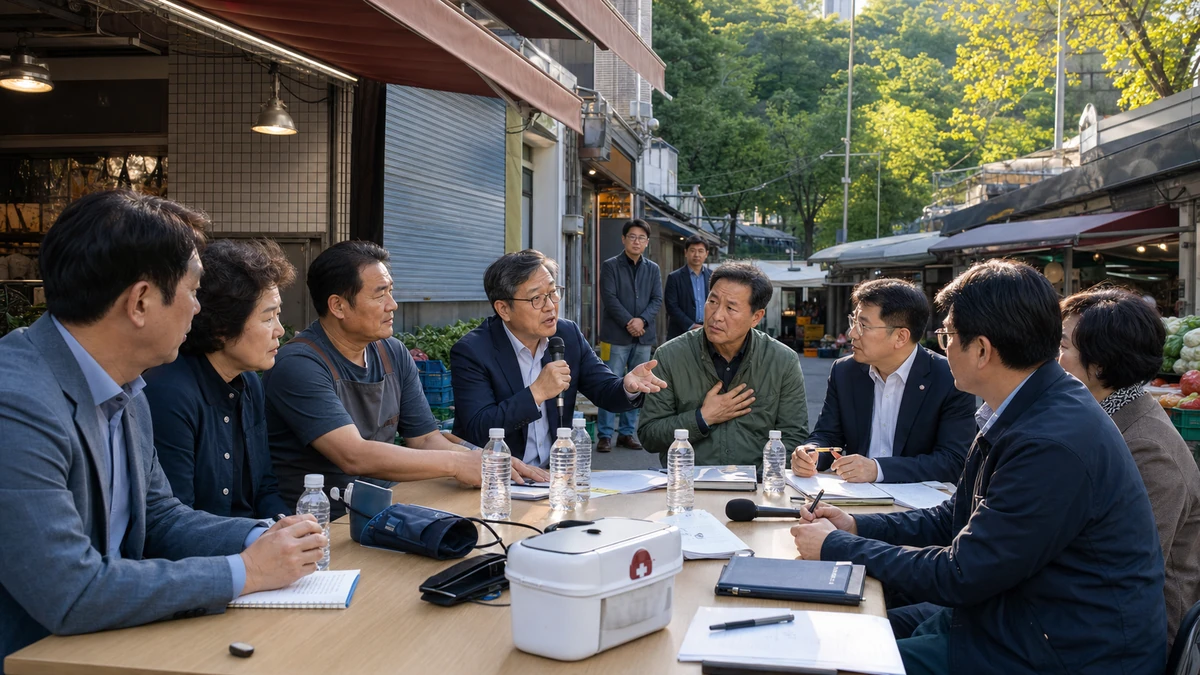
A policy debate in one of Seoul’s everyday marketplaces
In a traditional market tucked into Seoul’s Yongsan district, South Korean officials gathered this week to discuss a problem that would sound familiar in many American cities: What happens to a small business when the person who runs it gets sick and simply cannot afford to stop working?
The meeting, held at HaeBang Park inside Seoul’s Shinheung Market, focused on middle-aged and older small-business owners and the fragile line between personal health and economic survival. According to South Korea’s Ministry of SMEs and Startups, the event was designed to hear directly from merchants dealing with health problems, as well as public health experts, about how illness, treatment and temporary closure can destabilize a livelihood.
That may sound like a niche policy discussion. It is not. In South Korea, as in the United States, many small businesses depend heavily on the daily labor of the owner. When the owner of a restaurant, corner shop, repair business or neighborhood service store cannot work, revenue often stops immediately. Rent does not. Loan payments do not. Utility bills do not. Customers may drift elsewhere. In the worst cases, a health crisis becomes a business crisis, and then a debt crisis.
The symbolism of the venue mattered. Shinheung Market is not a polished conference center or a government building. It is part of the dense, lived-in commercial fabric that supports daily life in Seoul. Traditional markets in Korea are often described as tourist attractions because they offer street food, local produce and a sense of neighborhood character. But for the people who work there, they are first and foremost workplaces. They are where families make rent, pay school bills and plan for retirement — or fail to.
By staging the discussion in a market rather than an office tower, the government signaled that this was about more than abstract economic planning. It was about the physical strain of standing all day, the anxiety of missing a shift for a doctor’s appointment, the risk of closing for treatment, and the reality that for many small merchants, there is no backup manager waiting in the wings.
In the United States, policymakers often frame debates about small businesses around taxes, regulation, inflation or labor costs. Those issues matter in South Korea, too. But this week’s conversation in Seoul pointed to a different question: whether a modern economy can truly support entrepreneurship if it has no reliable answer for the moment when the entrepreneur’s body gives out.
Why health is becoming an economic issue for Korean shopkeepers
The South Korean government has been widening the way it talks about small-business policy. Officials said this meeting was the final event in a broader series on the social safety net for small merchants, following discussions on childbirth and child care support, and on easing the burden of temporary closure and permanent closure. Taken together, those topics suggest a shift in emphasis from short-term business aid toward the longer arc of a person’s working life.
That matters in a country where self-employment and microbusinesses play an outsized role in the economy. South Korea’s urban landscape is filled with family-run restaurants, small cafes, beauty salons, independent service shops and neighborhood retailers. Many of them operate on thin margins in a highly competitive environment. Unlike a large company, they often cannot redistribute workloads when a key worker is absent. And in many cases, the key worker is the owner.
For middle-aged and older business owners, the pressure can be especially intense. This is often the period of life when health needs become more urgent even as family and financial obligations remain high. Some are supporting children in school or adult children struggling with housing costs. Others are also helping aging parents. In Korea, where social expectations around family responsibility remain strong, these pressures can overlap. The Korean phrase “saeng-eop,” used in the government discussion, roughly refers not just to one’s job but to one’s means of making a living — the practical foundation of household survival.
That concept helps explain why officials paired “health” and “livelihood” in a single policy conversation. In this context, illness is not treated merely as a medical issue. It is also an operational risk. If a small restaurant owner has to undergo treatment, the result may be shortened business hours, a temporary shutdown or reduced service quality. Each of those can cut into already narrow profit margins. In a competitive neighborhood, even a brief closure can mean losing regular customers.
American readers may recognize the pattern from the smallest of U.S. businesses: the independent diner where the owner also cooks, the dry cleaner where the proprietor greets every customer, the neighborhood barbershop where the business is inseparable from the individual behind the chair. When that person gets sick, there is often no cushion. South Korea’s difference is not that it faces a unique problem, but that it is beginning to address it explicitly as part of its small-business safety net.
The policy challenge is broader than access to hospitals or insurance coverage. It is about whether small-business owners can realistically seek care without triggering immediate financial damage. A system that tells people to rest, recover or receive treatment is of limited value if doing so means shuttering the store and putting the household deeper into debt.
A troubling backdrop: high closure rates and heavy debt
The timing of the meeting gave it additional weight. Just two days earlier, the ministry released findings from a statistical analysis and field survey on business closures. The numbers painted a sobering picture of the pressures facing South Korean small merchants.
According to the ministry, more than 970,000 businesses in sectors including food service and services closed last year, with the closure rate reaching 9%. For a country that relies heavily on neighborhood commerce, that is not just a business statistic. It is a warning sign for local economies, employment and household stability.
Even more striking was the debt burden carried by those who shut down. The survey found that 68.5% of small-business owners who closed their businesses had debt at the time of closure, with average debt totaling 85.31 million won — roughly tens of thousands of dollars at current exchange rates, and enough to represent a life-changing burden for many households. Closing a business, in other words, does not mean the problem ends. It may simply mark the beginning of a new period defined by loan repayment, job searching and financial insecurity.
The most common reason cited for closure was worsening profitability and sluggish sales due to declining customer traffic. Health problems were not identified as the primary driver in those statistics. But the government’s discussion this week made clear that the two issues are connected. A small business that depends heavily on the owner’s labor is vulnerable both to weak consumer demand and to interruptions in that labor. Poor sales make it harder to build savings. A lack of savings makes it harder to pause work for treatment. And delayed treatment can ultimately deepen the business risk.
That dynamic is familiar in many economies with large numbers of self-employed workers. It is especially acute in South Korea because of the density and competitiveness of the small-business sector. Korean neighborhoods can support block after block of near-identical cafes, chicken shops, convenience stores and beauty services. Competition is intense, consumer expectations are high, and rent in urban areas can be punishing. If a customer switches habits while a store is temporarily closed, that lost business may not return.
So while the meeting in Shinheung Market centered on health, its implications reach into questions of labor structure, consumer behavior and debt management. The underlying message was that resilience for small businesses cannot be measured only by whether loans are available or whether a store can open its doors tomorrow. It must also be measured by whether the owner can survive a health shock without seeing the entire enterprise collapse.
What makes traditional markets important in South Korea
For readers outside Korea, the setting deserves some explanation. Traditional markets, known in Korea as “sijang,” are longstanding neighborhood commercial zones that predate the rise of big-box retail and e-commerce. They are places where shoppers buy produce, meat, prepared foods, household items and everyday services. Some have become trendy stops for younger consumers and foreign visitors seeking a more “authentic” urban experience. But they remain, at their core, practical spaces of local commerce.
That is why the government’s choice of Shinheung Market was significant. It grounded the discussion in the real geography of Korean small-business life. A debate about social insurance or business continuity can feel abstract when held inside a ministry building. In a market, surrounded by stalls and storefronts, the stakes are easier to see. This is where owners stand through long summers and cold winters. This is where a missed day of work becomes a missed day of income.
The location also highlights something foreign audiences can miss when they encounter Korean markets through travel videos or food television. The visual appeal of a market — colorful side dishes, sizzling griddles, handwritten signs, close-packed alleys — can obscure the economics behind it. Many vendors are older. Many operate with family labor. Many are working in sectors with low barriers to entry but intense competition. The charm that consumers enjoy often rests on labor arrangements that are physically demanding and financially fragile.
In that sense, the meeting reflected a broader reality of Korean society. South Korea is globally known for high-tech exports, K-pop, award-winning films and sleek consumer brands. But beneath that image lies a dense street-level economy of independent merchants and service workers whose struggles are less visible internationally. If Korean popular culture represents one face of the country’s global rise, the small storefront economy represents another: less glamorous, more vulnerable and central to everyday life.
For policymakers, strengthening the social safety net for these merchants could have ripple effects beyond individual households. Fewer abrupt closures may mean more stable neighborhoods, less disruption for consumers and lower social costs after bankruptcy or debt distress. A stronger safety net might also help preserve the kinds of local commercial districts that residents rely on and visitors often romanticize.
From cash aid to sustainability: a shift in policy language
One of the most revealing aspects of this week’s discussion was not a specific new program — none was announced in detail — but the language surrounding it. The ministry framed the conversation as part of a move beyond narrow management support and toward a wider social safety net. In plain terms, that means thinking about small-business owners not just as economic actors but as people who age, get sick, care for children and sometimes need to suspend work.
That is a meaningful shift. In many countries, aid for small businesses tends to be reactive: emergency loans, temporary subsidies, tax relief or rent support after a crisis. South Korea used many such tools during the pandemic, as did the United States. But those measures are often designed around market shocks, not life-cycle shocks. A person’s illness, a childbirth event, caregiving responsibilities or the need to close a business in an orderly way do not fit neatly into traditional business policy categories.
The Seoul meeting suggested that Korean officials are trying to connect those dots. The prior discussions on childbirth and child care support, along with reducing the burden of temporary or permanent closure, point toward a framework in which entrepreneurship is not treated as a separate sphere from family life and health. It is an acknowledgment that for millions of small operators, the business and the household are deeply intertwined.
That approach may resonate with American debates over paid leave, gig work, health insurance and the precarity of self-employment. The institutional details differ. South Korea has a national health insurance system, for example, while the United States relies on a far more fragmented model. But the core tension is recognizable in both places: economies celebrate flexibility and entrepreneurship, yet often leave individuals to absorb the risks when family life or health interrupts work.
Vice Minister Lee Byung-kwon said the government would strengthen the social safety net so that middle-aged small-business owners can prepare for the future with greater peace of mind, protecting both their lives and livelihoods. The phrasing was notable. It suggested a policy goal larger than preserving business registration numbers or keeping storefront vacancy rates down. It suggested that the subject of policy is the person, not just the enterprise.
Still, there are limits to what can be concluded at this stage. Public materials from the event did not include final decisions on funding size or specific programs. That leaves open the most important questions: whether the government will provide income support during medically necessary closures, how eligibility would be determined, whether temporary replacement labor could be subsidized, and how any new measures would fit with existing health and welfare systems.
Those details matter because good intentions do not always translate into practical relief. A safety-net policy that is too narrow, too bureaucratic or too small in scale may not help a merchant decide to take time off for treatment. For many operators, the calculation is brutally simple: Can I close for a week and still pay the bills next month?
What this says about Korea’s broader economy — and why Americans should care
The story unfolding in Shinheung Market is local, but it speaks to global questions about work, risk and the future of neighborhood commerce. South Korea’s economy is often discussed in terms of exports, semiconductors and industrial policy. Yet this week’s meeting was a reminder that an advanced economy is also held together by far smaller units: the noodle shop, the market stall, the repair counter, the hair salon, the family-run eatery on a side street.
Those businesses are not peripheral to Korean culture. They are one of the ways people experience it. Visitors encounter Korea through alley restaurants, market snacks and corner cafes just as much as through museums or concert venues. Residents rely on those same businesses for routine, daily life. When policymakers talk about protecting small merchants, they are also talking about preserving the human infrastructure of urban neighborhoods.
There is also a lesson here for foreign readers who may think of social safety nets as something separate from business policy. In practice, they are deeply connected. If business owners cannot safely step away when they are ill, they may delay treatment, worsen outcomes and ultimately exit the labor force in more damaging ways. If closures lead to high debt and long recovery periods, that becomes a broader economic drag. Seen this way, supporting health and supporting commerce are not competing goals. They are part of the same sustainability question.
For Americans, the parallels are hard to miss. Across the United States, independent businesses often become symbols of community resilience. Politicians celebrate “Main Street” the way Koreans often celebrate local markets and alleyway commercial districts. Yet the people running those businesses frequently face the same vulnerability: no paid time off, limited backup staffing, mounting debt and the fear that one medical setback could undo years of work.
South Korea’s discussion does not offer an instant solution. But it does show a government explicitly naming a problem that many societies leave in the shadows. The issue is not merely whether small-business owners are hardworking enough or savvy enough to survive. It is whether the social architecture around them recognizes that illness is inevitable, aging is unavoidable and self-reliance has limits.
That is why the meeting in a Seoul market mattered. It reframed the health of small-business owners as a public issue, not a private failure. It suggested that the viability of local commerce depends not only on customers and credit, but on whether merchants can seek care without jeopardizing everything they have built.
For now, the practical outcome remains to be seen. The government has said it is listening to field voices and considering policy improvements. Future announcements will determine whether that leads to substantive income protection, closure support or other mechanisms that help merchants weather a health crisis. But the larger shift is already visible. South Korea is beginning to treat the owner’s body — tired, aging, occasionally sick, still working — as part of the economic equation.
In a country famous for speed, competition and relentless work, that is a notable change in tone. And in an era when small businesses everywhere are being asked to withstand rising costs, demographic strain and consumer volatility, it is a question that reaches well beyond one Seoul market: If local commerce is worth saving, who takes care of the people holding it up?
Comments
Post a Comment