A local public health effort with a universal lesson
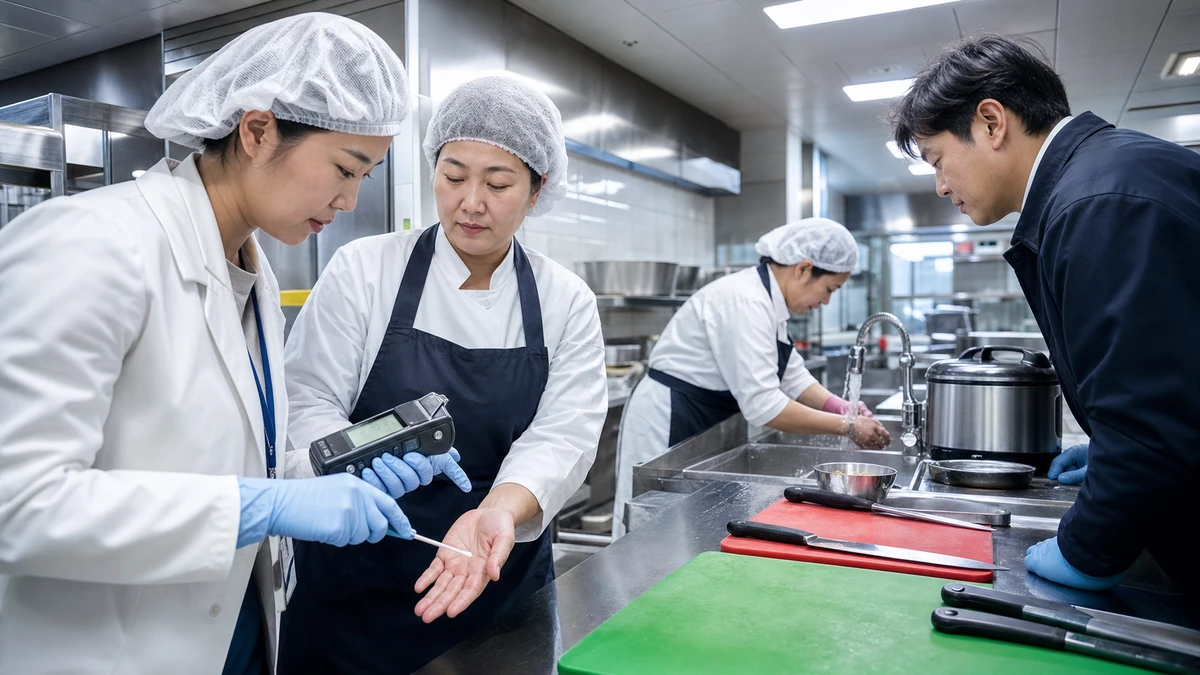
Public health officials in South Korea’s Gangwon Province say they found something both basic and striking while revisiting restaurants and group meal facilities linked to suspected food poisoning reports: When food workers washed their hands properly, measured organic contamination on their hands dropped by an average of 7.3 times.
That number, released this week by the Gangwon provincial government, gives unusual precision to a message health authorities around the world have repeated for decades. Good food safety does not begin with a flashy machine or a high-tech inspection tool. It starts with hand-washing, clean knives and cutting boards, and safe water.
The province, formally known as Gangwon State in South Korea’s northeastern region, said it conducted on-site sanitation consulting at 17 locations, including restaurants and institutional cafeterias, after those sites had received suspected food poisoning complaints last year. According to the provincial government, the point was not simply to punish or inspect, but to identify what, in practical terms, workers needed to change in real kitchens.
For American readers, the broad idea will sound familiar. In the United States, health departments routinely inspect restaurants, schools and food service operations, and foodborne illness remains a recurring concern from coast to coast. The Centers for Disease Control and Prevention estimates that millions of Americans get sick from contaminated food each year. What makes the Gangwon case notable is the way officials framed their response: less as a citation-focused crackdown and more as a field-based prevention exercise built around measurable hygiene improvements.
That distinction matters. Restaurant inspections often become public only when something goes wrong, and the story can quickly turn into one of blame. Gangwon officials appear to be trying a different approach, one that treats food safety as a system that can be improved in place, with workers, tools and water supplies all examined together. In an era when many families rely on prepared meals, school lunches, workplace cafeterias and takeout, the message travels well beyond one Korean province.
Why Gangwon’s response stands out
Gangwon is best known internationally for mountain landscapes, beach towns along the East Sea and, for many Americans, the 2018 Winter Olympics in Pyeongchang. But like any region with schools, businesses, tourist destinations and a busy service economy, it also has to manage the routine public health risks that come with feeding large numbers of people every day.
The province said the 17 sites it targeted included food service businesses and group meal facilities, a category that in South Korea commonly refers to places such as school cafeterias, workplace dining halls, hospitals and other settings where many people are fed from a shared kitchen. Those environments carry a particular kind of risk: If something goes wrong in food preparation, many people can be exposed at once.
That concern is not unique to Korea. Americans have seen similar cases tied to school lunches, catered events, cruise ships, church suppers and chain restaurants. Public health officials in both countries know that food poisoning often cannot be explained by one careless person or one bad ingredient alone. Contamination can move through an entire chain: from hands to cutting boards, from raw food to ready-to-eat dishes, or through water used in cooking and cleaning.
Gangwon’s sanitation consulting focused on those links. Working with the province’s public health and food safety office, researchers from the provincial Institute of Health and Environment examined not just workers’ hands, but also cooking tools such as knives and cutting boards, as well as water used in meal service. They checked both organic contamination levels and microbial conditions, according to the province’s account.
That kind of whole-process approach is especially important because food safety failures are often invisible. A dining room can look clean and still have cross-contamination problems in the kitchen. A worker can appear careful and still transfer residue from raw ingredients to cooked food. A sink can be available, but if hand-washing is rushed or inconsistent, it may not prevent transmission. By measuring conditions before and after intervention, officials tried to turn hygiene from an abstract rule into something observable.
The power of a simple number: 7.3 times cleaner after hand-washing
The figure at the center of the announcement — a 7.3-fold average reduction in organic contamination after hand-washing — is the kind of public health statistic that resonates because it translates a familiar instruction into visible impact. Everyone has heard “wash your hands.” Fewer people see data attached to the result.
In this case, the province said food microbiology specialists tested food workers’ hands and compared contamination levels before and after washing. While the announcement did not detail every technical parameter in public-facing language, the takeaway was clear: basic hand hygiene produced a substantial and immediate drop in contamination.
For American audiences, it is a useful reminder of how many major outbreaks have been linked, directly or indirectly, to failures in the most routine precautions. Public health campaigns in the United States often emphasize temperature control, refrigeration and cooking times, and for good reason. But hand hygiene remains among the most accessible and most effective barriers against transmission, whether in a restaurant kitchen in Denver, a school cafeteria in Atlanta or a soup kitchen in Los Angeles.
The Korean example also underscores something behavioral scientists and health educators have long understood: People are more likely to change habits when they can see evidence that the habit matters. Telling workers to wash their hands is one thing. Showing them a measurable drop in contamination after washing is another. The second approach can make training more concrete, less symbolic and more likely to stick.
That lesson extends well beyond commercial kitchens. At home, the same logic applies before handling ingredients, after touching raw meat or seafood, after switching tasks and before plating food. In busy households, especially those juggling children, groceries, takeout containers and half-finished meal prep, cross-contamination can happen quickly. The Gangwon findings offer a timely reminder that food safety at home is not separate from food safety in institutions. The basic principles are the same.
Why officials checked knives, cutting boards and water — not just workers
One of the most important details in the Gangwon effort is what officials chose to inspect. They did not limit their attention to individual workers. They also examined the tools and water that move through the kitchen every day.
That approach reflects a core reality of foodborne illness: contamination is often about traffic patterns as much as ingredients. In other words, it is about where food, hands, surfaces and water intersect. A well-washed pair of hands can still pick up contamination from a poorly cleaned cutting board. A sanitized knife can be re-contaminated if it is used interchangeably for raw and cooked foods. Water that is unsafe or mishandled can compromise cleaning and preparation.
American health inspectors use slightly different terminology and regulatory frameworks, but the underlying concept is the same. One of the classic food safety failures is cross-contamination between raw and ready-to-eat items. Another is inadequate sanitation of food-contact surfaces. Anyone who has watched a restaurant kitchen inspection on local TV news or followed a county health department report has likely heard warnings about these exact issues.
In South Korea, group dining settings add their own urgency. School lunches and workplace cafeterias are deeply embedded in daily life, much as they are in the United States, though often with different menus and service styles. Korean institutional meals can involve multiple shared side dishes, rice, soup and freshly prepared components that require substantial handling. That does not make them inherently less safe than American cafeteria food, but it does mean kitchens must manage numerous points of contact.
By looking at hands, utensils and meal-service water together, Gangwon’s public health team appears to be treating food safety not as a single rule to memorize, but as a sequence to manage. That may sound obvious, yet it is often where prevention efforts succeed or fail. A kitchen does not become safer because one box is checked on a form. It becomes safer when the full path from storage to prep to service is consistently controlled.
For consumers, the practical implication is simple. Some of the most useful signs of a well-run food operation are not technical. Is there a clear hand-washing setup for workers? Are raw ingredients visibly separated from cooked or ready-to-eat food? Do utensils appear organized rather than mixed together haphazardly? Is the food service area orderly? Diners cannot see microbes, but they can often see whether a business treats sanitation as an everyday discipline.
Prevention over punishment in a culture of inspections
Another striking aspect of the Gangwon announcement is its tone. The province did not present the 17 sites as examples to shame publicly. Instead, officials emphasized on-site consulting, diagnosis of weak points and guidance on how to improve sanitation practices.
That matters in any country, but perhaps especially in South Korea, where public institutions often operate with a strong emphasis on coordinated administrative action. When a local government says it is sending teams to work with facilities directly, it signals a style of governance that combines oversight with hands-on intervention. Americans may think of it as somewhere between a health inspection and a compliance coaching visit.
To be clear, enforcement remains part of food safety in Korea, as it does in the United States. But prevention-focused work can be more useful in the long run, particularly at sites where the goal is to stop repeat problems before they become outbreaks. A kitchen staff can change. Menu items can change. Supply chains can change. What remains constant is the need for a durable sanitation routine.
That is why public health experts often argue that a food safety system should not rely solely on fear of penalties. It should build repeatable habits. The Gangwon consulting effort appears designed around exactly that idea. Since May, according to the province, officials had visited participating businesses and facilities, diagnosed hygiene vulnerabilities and explained corrective steps they could take on site.
In the United States, many health departments have also moved toward educational models in at least part of their work, especially for smaller establishments that may lack deep compliance resources. The principle is not leniency for its own sake. It is recognition that preventing foodborne illness requires behavior change, not just paperwork. If operators understand why a procedure matters and can verify that it works, they may be more likely to keep it in place.
There is also a political dimension to this kind of response. Governments everywhere are under pressure to protect public health without appearing heavy-handed or punitive for its own sake. A consultation-based approach can offer a middle path: targeted because it focuses on places with prior warning signs, but constructive because it centers on improvement instead of spectacle.
What this says about South Korea’s food culture and public health system
For readers less familiar with South Korea, it is worth pausing on the setting. Dining out is a central part of urban and social life across the country, and group meals play a major role in schools, workplaces and institutions. Korean food culture often emphasizes shared eating, multiple dishes on the table and freshly prepared items served in high volume. That social style can be warm, communal and efficient, but it also means hygiene systems must be disciplined behind the scenes.
South Korea’s public health and administrative systems are generally capable and highly structured, though they face the same challenges as any country: balancing inspection workloads, responding to complaints, educating businesses and maintaining public trust. When a province like Gangwon publicizes detailed sanitation consulting and measurable results, it is doing more than sharing a local update. It is signaling attentiveness to a basic everyday risk that can quickly become politically and socially sensitive.
Food poisoning carries a particular kind of public anxiety because it cuts across age and class. A suspicious meal at a restaurant can affect tourists and locals alike. A problem in a group meal facility can raise fears among parents, workers or hospital families. In both Korea and the United States, stories about foodborne illness often gain traction not because they are exotic, but because they are ordinary. Nearly everyone depends on someone else to prepare food at some point during the week.
That helps explain why the Gangwon announcement placed so much emphasis on the practical chain of safety. Officials were not discussing food trends or restaurant marketing. They were talking about a kitchen as a public health environment — a place where invisible contamination can either be controlled through disciplined routines or allowed to spread through ordinary shortcuts.
The fact that the province revisited places tied to suspected food poisoning reports from the previous year is also significant. It suggests a system trying to learn from warning signs rather than treating each complaint as an isolated episode. In public health, that kind of follow-up can be more valuable than dramatic one-day enforcement drives. It keeps the focus on whether conditions have actually improved.
What American readers can take away
For U.S. readers, the headline from Gangwon may feel both distant and immediately relatable. The place names are Korean, the administrative offices are Korean, and the institutional context is Korean. But the risk factors are universal. So are the remedies.
Hand-washing matters. Clean tools matter. Safe water matters. Separation of raw and cooked foods matters. Training matters. Follow-up matters. None of this is glamorous, but nearly all of it is preventable. That is the core message embedded in Gangwon’s announcement.
There is also a broader lesson about how public institutions communicate health information. The most effective messages are often the ones that connect daily habits to concrete outcomes. By attaching a measurable figure to hand-washing, Gangwon officials offered exactly that kind of communication. They made the invisible more visible. In an information environment crowded with abstract warnings, that kind of specificity can cut through.
Consumers, too, have a role. In restaurants and cafeterias, people cannot run microbial tests, but they can pay attention to basic signs of kitchen discipline and sanitation culture. At home, they can apply the same principles the province highlighted: wash hands before and after handling ingredients, clean knives and cutting boards immediately after contact with raw foods, avoid using the same surfaces for different tasks without cleaning them, and pay attention to the water and tools involved in cooking and storage.
Ultimately, what happened in Gangwon is a local story with a global vocabulary. A provincial government in South Korea examined 17 facilities associated with suspected food poisoning complaints, sent teams into the field, measured contamination and concluded that the oldest advice in the book still works. Wash hands well. Keep tools clean. Treat the whole kitchen process as connected.
That may not sound revolutionary. But in food safety, the most important breakthroughs are often not new inventions. They are old rules taken seriously enough to be measured, taught and repeated. In that sense, the lesson from Gangwon is one any American reader can recognize: A safe meal usually depends less on what is extraordinary than on whether the ordinary things were done right.
Comments
Post a Comment