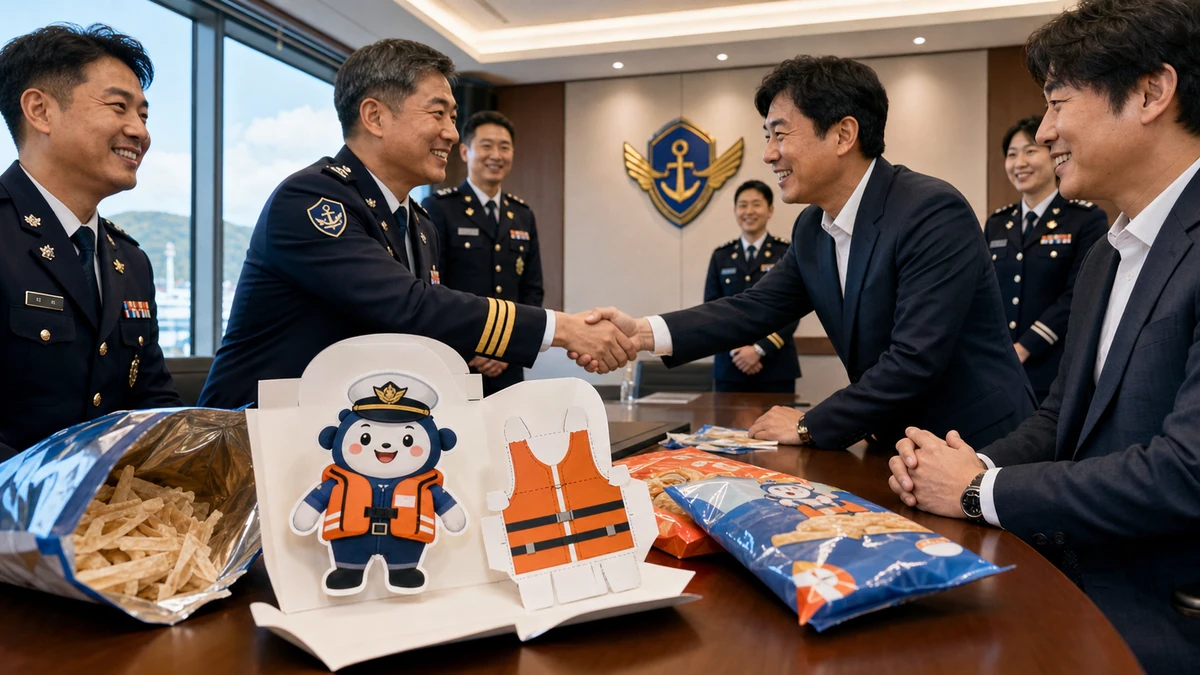
A summer safety message tucked inside a snack wrapper
In the South Korean port city of Mokpo, a summer water-safety campaign is taking shape in an unexpected place: inside the packaging of a local snack. The Mokpo Coast Guard said July 10 it has signed a partnership with a hometown food company, Hwang Doctor Mokpo Jjondigi, to promote marine safety during the busy vacation season by embedding life-jacket messaging into the experience of opening and playing with a snack package.
For American readers, the idea may sound a little like finding a public-service campaign inside a box of Cracker Jack, except more hands-on and more deliberately local. Rather than printing a generic warning label on the outside, the new package uses the inside surface to create an interactive paper-doll activity built around the Korean Coast Guard’s mascot, a character named Archi. Consumers can detach the mascot and a paper life jacket, then “dress” the character themselves. The point is simple: wearing a life jacket is not optional decoration. It is the essential step that completes the picture.
The campaign comes as South Korea enters the peak season for beach trips, boating, fishing and other marine leisure activities. In a country ringed by water and dotted with coastal cities that draw millions of domestic travelers each summer, safety officials face the same problem public agencies do nearly everywhere: people often tune out formal warnings. Signs blend into the background. Pamphlets get tossed. Social media notices are easy to scroll past.
Mokpo’s answer is to move the message into a part of daily life that residents and visitors already embrace. Instead of asking people to stop and study safety rules, the city’s coast guard is trying to place the lesson inside an ordinary, even nostalgic, moment: buying a regional treat, opening it with family or friends, and discovering something playful inside. In that sense, the campaign reflects a broader shift in public communication, one seen in many countries, toward meeting audiences where they are rather than waiting for them to seek out official information.
It also says something about how local South Korean institutions increasingly think about public messaging. In the United States, safety education is often tied to school programs, government ad campaigns, sports partnerships or highway billboards. In South Korea, where packaging design, mascots and branded collaborations are deeply woven into everyday consumer culture, it is not unusual for civic institutions to experiment with friendlier, more tactile ways of delivering serious information. What makes this case notable is not just that the message appears on a snack, but that it is designed to be remembered through touch, play and repetition.
Why Mokpo matters in a story about the sea
Mokpo is not just any city for this kind of experiment. Located in South Jeolla Province at the southwestern tip of the Korean Peninsula, it is a historic port with strong ties to fishing, shipping and island travel. Ferries link the region to nearby islands, and the city serves as a gateway for coastal tourism. In summer, that means a rise in the number of people heading out onto boats, waterfronts and beaches — precisely the circumstances in which basic safety habits, especially life-jacket use, can make the difference between a close call and a tragedy.
Americans may know Busan, South Korea’s biggest port city, or Jeju, the resort island often compared to Hawaii. Mokpo is less internationally famous, but regionally it is a meaningful travel hub and a place with a strong local identity. Its food, maritime setting and island geography are central to how people experience it. That makes a local food brand a particularly effective partner for a public campaign tied to the sea.
The Coast Guard’s decision to work with a regional company instead of a national conglomerate is also significant. South Korea has no shortage of major food manufacturers that could place a safety message in front of more consumers. But choosing a beloved local snack gives the campaign something national brands cannot easily replicate: a sense of place. The message does not arrive as an abstract government directive. It arrives as part of Mokpo itself.
That matters for tourists as well as residents. Vacationers often remember a destination through sensory details — a signature dish, a local dessert, a market stall, a package they carried home. By attaching the idea of life-jacket use to a food item strongly associated with the region, the campaign tries to make marine safety part of the memory of the trip rather than an annoying interruption to it. In other words, the strategy is not to compete with leisure but to travel alongside it.
The Mokpo Coast Guard chief, Chae Su-jun, said the partnership is meaningful because it uses a food product loved by many visitors to spread awareness of what he described as the most basic and essential marine-safety practice: wearing a life jacket. That emphasis is important. The campaign is not trying to teach every possible rule of boating or swimming. It is zeroing in on one behavior that officials believe is foundational and widely applicable.
The snack at the center of it all
The product involved is jjondigi, a chewy, often grilled or toasted Korean snack that many Koreans associate with childhood, street food and old-school treats. The name can be unfamiliar to English-speaking audiences, and there is no perfect one-word American equivalent. The closest comparison might be a nostalgic snack that sits somewhere between a puffed grain treat and a chewy cracker, with the emotional resonance of something like saltwater taffy, Fruit Roll-Ups or a concession-stand favorite people remember from childhood. The exact texture and flavor profile differ, but the cultural role is similar: it is casual, fun and tied to memory.
That nostalgic dimension is one reason the campaign may resonate. Public agencies around the world often struggle to make safety language feel personal rather than bureaucratic. A beloved snack already carries warmth, familiarity and routine. It comes with less resistance than a lecture. If a coast guard wants parents and children to spend even 30 extra seconds talking about life jackets, a snack wrapper can sometimes accomplish what a formal brochure cannot.
In this case, the packaging itself becomes the campaign medium. Instead of using the exterior simply as ad space, the designers took advantage of the inside, which consumers only see after opening the product. That changes the order of attention. A buyer is not confronted upfront with a block of official messaging that could be ignored. The consumer first has the ordinary experience of purchasing a treat, then discovers the character and life-jacket cutout as part of using it.
That design choice may sound small, but communication specialists would recognize the logic immediately. It lowers what marketers sometimes call “message resistance.” People do not feel as though they are being preached to. They are invited into a miniature activity. The safety lesson reveals itself through participation. In a crowded information environment, where warnings compete with entertainment and advertising, this kind of soft-entry strategy can be remarkably effective.
The use of the package interior also reinforces the campaign’s broader philosophy: safety should not exist in a separate, solemn category detached from everyday life. It should be woven into routines people already have. Buying food, taking a trip, opening a wrapper, sharing a joke with a child — these are ordinary acts. The campaign’s bet is that ordinary acts can carry memorable lessons when designed thoughtfully.
From warning label to paper-doll play
The centerpiece of the campaign is Archi, the Korean Coast Guard’s official mascot. Mascots play a larger role in East Asian public culture than many Americans may expect. In South Korea and Japan especially, government agencies, police departments, transit systems and municipalities often use cartoon characters to make institutions feel more accessible. To an American audience, it might help to think of the way Smokey Bear became more than a forest-fire warning or how state fairs, minor league baseball teams and school districts often rely on mascots to create recognition and emotional connection.
What Mokpo’s campaign does with Archi is particularly clever. Rather than simply printing the mascot alongside a slogan that says, in essence, “Wear a life jacket,” it makes the user complete the safety message. Consumers remove the character and the life-jacket piece from the package interior and physically place the jacket onto the mascot, like dressing a paper doll. The final image only makes sense when the life jacket is in place.
That matters because it transforms a sentence into an action. Safety information is often delivered as text: wear this, do not do that, keep away, beware. But human memory does not always retain text as well as it retains a simple physical task paired with a visual result. Here, the consumer sees the difference between an unequipped character and a protected one. The act of fitting the life jacket onto Archi becomes a miniature rehearsal of the desired real-world behavior.
The campaign draws on the idea of “paper doll play,” which many Koreans across generations recognize as a low-tech childhood pastime. That generational aspect is another strength. Younger children may enjoy it simply as a craft. Adults may respond to its retro feel, much the way Americans might feel a flicker of recognition at Colorforms, paper chain crafts or classic cereal-box activities. A single package can therefore spark intergenerational interaction: a parent explaining the toy, a child asking what the jacket is for, a traveler showing it to a friend.
In that sense, the campaign does not merely communicate safety. It creates a conversation starter. And that may be its most important feature. Much of public education succeeds not because people absorb a message instantly, but because a message prompts a short exchange — “Why do you need that?” “Because boats can be dangerous.” “Do we have ours?” That kind of ordinary talk can do more to build habit than a dozen official posters.
Crucially, the campaign does not trivialize the message by making it playful. Instead, it uses play to reduce psychological distance. The seriousness remains. The life jacket remains the central symbol. What changes is the mode of entry. Rather than presenting safety as scolding, it presents it as something familiar enough to handle, discuss and remember.
A Korean model of everyday public communication
What happened in Mokpo also offers a window into how South Korean local governments increasingly approach civic campaigns. South Korea is known globally for high-tech infrastructure, pop culture exports and rapid trend cycles. But one underappreciated feature of daily life there is the dense network of local institutions, small businesses and regional identities that shape how messages move through a community. A campaign does not always have to arrive through television ads or national ministries. It can spread through neighborhood stores, tourism products and regional pride.
That is why this partnership between a coast guard office and a local snack company is worth attention beyond its novelty. It shows a public agency borrowing the strengths of an existing consumer relationship instead of trying to build one from scratch. The Coast Guard brings authority and a clear public-interest goal. The company brings packaging, customer familiarity and a product people already associate with positive emotions. Together, they create a communication channel that feels less formal and more embedded in ordinary life.
In American terms, it is somewhat akin to a coastal sheriff’s office or National Park Service unit teaming up with a famous local food producer to print a hands-on rip-current or wildfire safety activity inside a regional favorite sold during vacation season. The product would still be a snack. But it would also become a storytelling vehicle for the place itself — one that says something about what the community values and what risks it wants visitors to take seriously.
That “storytelling vehicle” function is increasingly important in tourism economies. Destinations compete not only through scenery and cuisine but through narrative. What do visitors remember? What do they bring home? What image sticks? In Mokpo’s case, officials appear to be betting that a package featuring a local mascot, a life jacket and an interactive design can turn a passive purchase into a memory with civic meaning.
At the same time, the campaign avoids the common pitfall of overloading the message. It does not try to cram every marine hazard into one package. It does not flood the user with rules. It chooses one essential practice and reinforces it visually. In public communication, that kind of restraint can be more effective than a longer list people will never fully absorb.
Tourism, safety and the business of memory
The campaign arrives at a moment when many communities worldwide are rethinking how to manage the tensions of tourism. Visitors bring revenue and energy, but they also increase pressure on infrastructure and emergency services. Coastal destinations from Florida to California know the challenge well: people on vacation are often relaxed, distracted and unfamiliar with local conditions. The same sun-and-water atmosphere that makes a place appealing can also encourage risk-taking.
Mokpo’s approach reflects an understanding that safety messaging works best when it does not position itself as the enemy of fun. Instead of framing marine precautions as joy-killing restrictions, the snack campaign places them within the pleasure of travel and consumption. The result is subtle but important. It suggests that a successful summer outing is not one in which warnings disappear; it is one in which basic precautions are normal enough to blend seamlessly into the experience.
There is also an economic layer here, even if officials stress that the campaign’s direct purpose is not boosting sales. Products with stories tend to stand out. A regional snack that doubles as a civic campaign can become more memorable than one that does not. That can help a local brand differentiate itself in a crowded market while simultaneously amplifying a public-interest message. The brand gains narrative depth; the public agency gains reach.
Still, the distinction matters: this is not primarily a marketing gimmick for a snack. By the Coast Guard’s own framing, the heart of the campaign is life-jacket awareness. The food product is the delivery system, not the message itself. That is why the design centers on the act of putting the life jacket on Archi. Everything else — the brand familiarity, the nostalgia, the tourism tie-in — supports that core lesson.
There is reason to think the approach could have staying power. People remember unusual campaigns, especially when they encounter them in tactile form. A sign on a pier may blur into the landscape. A wrapper that turns into a small toy may end up on a kitchen table, in a backpack or in a family photo. For public officials trying to cut through message fatigue, that is no small advantage.
What a small package says about a bigger shift
At first glance, a snack wrapper may seem too modest a platform to tell us anything meaningful about public policy. But modest platforms are often where social habits actually form. Seat belt use, sunscreen awareness, anti-smoking efforts and recycling culture all grew not only through laws and major campaigns, but through repeated reminders embedded in everyday settings. In that sense, the Mokpo project points to a broader truth: safety culture does not spread only through grand events or stern directives. It spreads through repetition, familiarity and design.
The Korean campaign is notable because it recognizes that public information has to compete with entertainment, routine and distraction. Rather than lamenting that reality, it works within it. It borrows the appeal of a local snack, the emotional accessibility of a mascot and the simplicity of a paper-doll activity to make one clear point memorable: if you are heading onto the water, wear the life jacket.
For American observers, the story may also resonate as an example of how local governments can collaborate creatively with small businesses without losing sight of the public interest. The partnership is rooted in place, modest in scale and highly specific in its goal. Those are often the ingredients of successful community-level communication. Big national campaigns matter, but local trust and local symbolism still carry exceptional power.
Whether the Mokpo model spreads to other Korean coastal communities remains to be seen. But it is easy to imagine why it might. The idea is adaptable, inexpensive compared with major media buys, and capable of reaching both residents and tourists at a moment when they are already primed to think about recreation. It is also inherently shareable in a culture where distinctive packaging and character design travel quickly through word of mouth and social media.
In the end, the most striking part of the story is not the novelty of putting a safety message inside a snack. It is the discipline of the message itself. In a season associated with leisure, local flavor and time by the water, officials in Mokpo are trying to make one life-saving habit feel as natural as opening a treat. That may be a small intervention. But like many effective public messages, it works precisely because it understands how ordinary life really works.
Comments
Post a Comment