South Korea Elevates a Small Immigration Outpost in Mokpo, Highlighting How Rural Labor and Border Policy Now Collide
A bureaucratic upgrade with outsized meaning
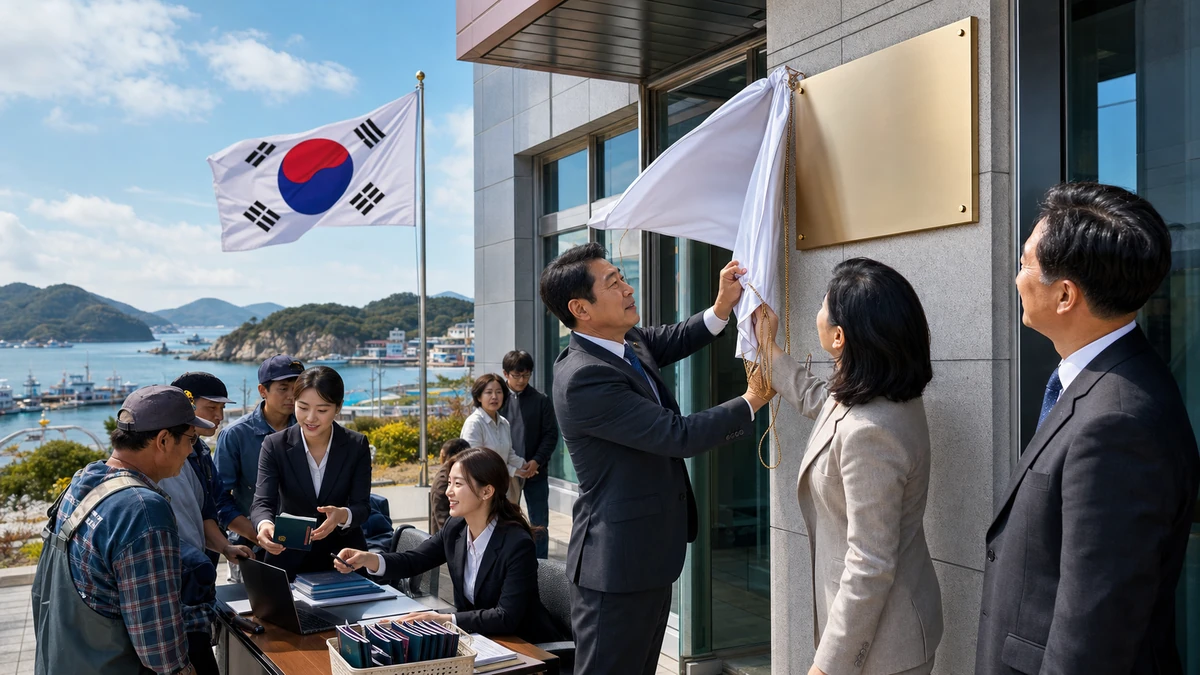
South Korea has quietly upgraded its immigration branch office in the southwestern port city of Mokpo, a bureaucratic change that might sound minor on paper but carries broader implications for how the country manages foreign labor in its rural communities and island regions.
The office, which had operated as a branch of the national immigration service, was formally elevated to full office status on July 10, according to details released through South Korean officials and reported by Yonhap News Agency. The Mokpo office has handled visa issuance for seasonal foreign workers and enforcement matters involving foreign nationals, making it a key point of contact in a part of the country where farms, fishing communities and outlying islands depend increasingly on migrant labor.
For American readers, the shift may be easiest to understand as the difference between a satellite federal field post and a more fully recognized district office. It does not necessarily mean a new building, faster service overnight or a dramatic expansion in authority. But it does signal that the central government now sees the region’s immigration workload as significant enough to warrant a higher administrative standing.
That matters because immigration policy in South Korea is no longer concentrated only in Seoul, Incheon or other large urban gateways. In places like South Jeolla province, where Mokpo serves as an important hub, immigration administration is tied directly to local labor shortages, crop cycles, fisheries and the practical difficulty of governing far-flung island communities. In that sense, this is not just a local office reshuffle. It is a window into how a country long defined by ethnic homogeneity is adapting, unevenly and pragmatically, to the realities of an aging society and a tightening labor market.
At the center of the story is a simple institutional fact: a regional office that already handled sensitive immigration work has now been given a higher status. Around that fact sits a much larger debate over how South Korea should welcome, regulate and police the foreign workers who increasingly keep rural parts of the economy running.
Why Mokpo matters in South Korea’s labor economy
Mokpo is not Seoul, and that is precisely the point. Located in the country’s southwest, the city serves as a gateway to South Jeolla province, an area known for agriculture, fisheries and a coastline dotted with islands. The region’s economy depends heavily on seasonal labor, especially during planting and harvest periods and in industries where physically demanding work has become less attractive to many younger South Koreans.
That pattern will sound familiar to American readers who have followed labor issues in California’s Central Valley, Florida agriculture or seafood processing along the Gulf Coast. When local populations age and younger workers move to cities, rural employers often turn to temporary migrant labor to fill the gap. South Korea has increasingly faced the same reality.
In recent years, foreign seasonal workers have become an important part of that solution. These workers typically come for fixed periods to perform time-sensitive jobs in farming and related industries. Their legal entry and stay depend on visa procedures that can seem technical from a distance but are deeply consequential on the ground. A delayed or confusing visa process can leave crops unpicked, employers scrambling and workers vulnerable to misunderstandings or irregular status.
That is one reason the Mokpo office matters. Its work connects central-government rules with the day-to-day reality of labor demand in rural communities. The office’s jurisdiction includes both agricultural areas and islands, where distance itself becomes an administrative challenge. Getting to an immigration office can be harder in these regions than in metropolitan South Korea, and coordinating inspections or responding to problems can be slower and more complicated.
In the American context, imagine trying to manage seasonal labor rules not only for farms spread across a rural county but also for communities accessible only by ferry. That is the kind of logistical complexity South Korean officials are dealing with in the Mokpo area. The upgrade suggests the government recognizes that immigration administration in such places cannot be treated as an afterthought.
It also underscores an often overlooked truth about migration policy: it is not only about national borders. It is also about local capacity. Whether a legal system works in practice depends on the offices, staff and procedures that connect workers and employers to the state. In that sense, a status change for a local immigration office can reveal as much about policy priorities as a headline-grabbing national reform.
The politics behind the move
The timing of the upgrade also points to the role of domestic politics. Lawmaker Park Jie-won of the liberal Democratic Party said he was informed of the change by Interior and Safety Minister Yoon Ho-jung on July 10. Two days earlier, Park had raised the issue during a full meeting of the National Assembly’s Legislation and Judiciary Committee, urging Justice Minister Chung Sung-ho to consider more flexible immigration enforcement that reflects the realities of rural and island communities.
For readers unfamiliar with South Korea’s political structure, the National Assembly is the country’s unicameral legislature, and its committees often serve as major arenas for public pressure on ministries. The Legislation and Judiciary Committee, in particular, carries weight in legal and administrative matters. When immigration staffing and office status come up there, it suggests the issue has moved beyond a routine local complaint and into the realm of national governance.
Park also argued that the Mokpo branch needed more personnel and should be elevated in rank. The fact that the administrative upgrade followed so quickly after his intervention will likely be read in South Korea as an example of how lawmakers advocate for regional needs within a highly centralized state. It is a familiar political dynamic in many countries, including the United States: a representative pushes a federal agency to give more resources or recognition to a district office serving a strategically important constituency.
Still, the politics here should not be mistaken for proof of transformed services. The publicly available facts do not yet show exactly how staffing, budget, facilities or jurisdiction will change. That is an important distinction. In government, a change in title can matter symbolically and institutionally without immediately altering the experience of the public.
Even so, symbolism matters in bureaucracies. Elevating the office sends a message that the concerns of South Jeolla’s rural and island communities have reached the central government. It also reflects the increasingly cross-ministerial nature of immigration governance in South Korea. Park raised practical immigration-enforcement concerns with the justice minister, while the upgrade notice came from the interior and safety minister. That overlap illustrates how migration policy touches law enforcement, public administration, regional development and labor management all at once.
In Washington terms, it would be as if issues involving visas, local field operations and rural labor enforcement were bouncing across the Departments of Homeland Security, Justice and Agriculture. South Korea’s system is different, but the complexity is similar. Immigration is never just one ministry’s problem.
What “flexible enforcement” means — and what it does not
One of the most politically sensitive parts of this story is Park’s call for “flexible enforcement” that takes rural realities into account. In almost any country, that phrase can trigger competing interpretations. Does it mean going easy on violations? Does it mean looking the other way when labor shortages are severe? Or does it simply mean that rigid rules designed for cities do not always fit remote farming communities?
Based on the available information, the last interpretation is the more grounded one. The request does not appear to be a call for abandoning enforcement. Rather, it reflects a policy argument that administration should account for distance, seasonal labor demands and the practical conditions of farms and islands when applying immigration rules.
That distinction is crucial. South Korea’s immigration system, like the U.S. system, has to balance at least two goals that are often in tension: enabling lawful labor migration and maintaining confidence that the rules are actually being enforced. If authorities focus only on crackdowns, workers and employers may find legal channels too unpredictable or intimidating to use. If authorities focus only on convenience, they risk undermining the legitimacy of the system and increasing opportunities for abuse or irregular stay.
The Mokpo office has long handled both visa issuance and enforcement involving foreign nationals. That combination matters because it places support and control functions under the same local administrative umbrella. On one side, the office helps process the legal path for seasonal workers to enter and remain in the country. On the other, it participates in enforcement efforts intended to preserve what South Korean officials often call “sojourn order” — the orderly management of foreigners’ residence and status.
For American readers, that dual role may recall the recurring debate over whether immigration systems are designed primarily as service agencies, law enforcement agencies or both. South Korea’s rural labor reality makes that tension especially visible. Seasonal workers are needed, but they are also regulated. Employers need efficiency, but the government wants compliance. Workers need stability, but they may be one paperwork problem away from serious consequences.
That is why the language of flexibility is so delicate. In the best case, it can mean better judgment, clearer communication and more realistic administration. In the worst case, if poorly defined, it can invite inconsistency or the perception that rules depend too much on local discretion. The real test will come after the office upgrade, when observers can see whether the change leads to better coordination without sacrificing fairness or predictability.
The bigger story: South Korea’s dependence on foreign seasonal workers
Beneath this administrative story is a larger demographic and economic one. South Korea is among the world’s fastest-aging societies, with low birth rates and growing labor shortages in sectors that rely on hard, seasonal or lower-paid manual work. Rural communities have felt those pressures especially sharply. As younger South Koreans leave for cities and white-collar careers, farms and fisheries have struggled to find enough domestic workers willing to do physically demanding labor on a temporary basis.
That has made foreign seasonal workers increasingly essential. These workers are part of a broader pattern seen across East Asia, where countries that once viewed themselves mainly as sources of emigrants have become destinations for labor migration. South Korea’s approach differs from the immigration systems familiar to many Americans because it is often framed less around long-term settlement and more around tightly managed categories of temporary or conditional labor.
In practical terms, that means the visa process carries unusual weight. A seasonal worker’s relationship to the state is defined not only by employment but by a narrow legal pathway that governs entry, stay and work conditions. If the local office responsible for that process is under-resourced or geographically hard to reach, the consequences are not abstract. They affect whether workers can regularize their status, whether employers can comply and whether disputes can be resolved before they become crises.
The Korean term often translated as “seasonal worker” refers to migrants brought in to meet cyclical labor needs in agriculture and related fields. For Americans, the closest comparison might be guest worker arrangements such as the H-2A visa program for temporary agricultural labor, though the systems are not identical. Both reflect the same underlying contradiction: wealthy countries often rely heavily on migrant workers for food production while maintaining immigration regimes that are strict, technical and politically sensitive.
The upgrade in Mokpo should be understood against that backdrop. It is not evidence that South Korea has solved its rural labor dilemma. Nor does it mean migrant workers will automatically experience better protection or faster service. But it does show that the state recognizes immigration administration in rural areas as a core part of economic management, not just a peripheral legal function.
That recognition is significant in a country where public discussions of migration can still carry social and political tension. South Korea remains more ethnically and linguistically homogeneous than the United States, and public institutions are still adjusting to the demands of a more visibly international workforce. Offices like the one in Mokpo sit at the frontline of that adjustment.
Why office status alone is not the full story
As notable as the promotion from branch office to full office may be, it comes with a major caveat: no public record cited in the initial reporting spells out the concrete changes that will follow. There is no confirmed breakdown, at least from the facts provided so far, of how many new staff members will be assigned, whether additional budget support is coming, whether the office’s jurisdiction will expand or whether services will be reorganized in a way the public can feel immediately.
That caution matters because administrative upgrades are often judged by outcomes, not titles. If visa processing times remain long, if island residents still face major travel burdens, if enforcement remains inconsistent or if employers and workers continue to struggle with compliance, the symbolic value of the promotion will have limits.
In journalism, especially when covering bureaucratic changes, it is important not to overstate what has been proved. The confirmed development is that the office’s status has been elevated. The unconfirmed questions involve how much practical authority, manpower and service capacity will accompany that change. Those are not trivial details; they are the very metrics by which the public will ultimately judge whether the move mattered.
This is a familiar story in many democracies. Governments announce reorganizations, renamings or office elevations as evidence of responsiveness. Sometimes those changes do lead to stronger local capacity. Sometimes they function more as political signals than operational breakthroughs. The outcome often depends on follow-through: staffing, funding, training, technology and coordination with other agencies.
That is especially true in immigration administration, where human systems are only as effective as the people and procedures behind them. A better-labeled office without enough personnel can still become a bottleneck. A higher-status local post without clear guidance can still produce confusion. And a rural labor program without worker education and employer compliance can still leave migrants exposed to exploitation or inadvertent violations.
So while the Mokpo move deserves attention, it also deserves scrutiny. The next phase of the story will not be the announcement itself but what happens after it.
What foreign workers and local communities may be watching next
For foreign seasonal workers, the significance of the upgrade is likely to be judged in concrete, everyday terms. Can they access officials more easily? Are applications handled more predictably? Is there clearer guidance when problems arise with employers, contracts or visa conditions? Are enforcement actions carried out in a way that is understandable and consistent rather than abrupt or opaque?
For local employers, the questions may be just as practical. Will a higher-status office make it easier to secure lawful labor in time for peak seasons? Will it improve communication between farms, local governments and immigration authorities? Will regional conditions — including travel constraints in island areas — be reflected more realistically in administration?
And for policymakers, the larger issue is whether this upgrade can become a model for other rural regions facing similar pressures. If the answer is yes, Mokpo may come to represent a broader shift in how South Korea organizes immigration administration outside major metropolitan centers. If the answer is no, the move could remain largely symbolic, important in politics but limited in day-to-day impact.
There is also a more subtle signal in this development, one that extends beyond South Jeolla province. To foreign workers considering temporary employment in South Korea, the structure and accessibility of local immigration institutions are part of the country’s message about whether it can manage labor migration responsibly. Trust in the system is not built only through laws on paper. It is built through the offices people can actually reach, the officials they encounter and the consistency with which rules are explained and applied.
That is why this bureaucratic promotion, however small it may appear from afar, has real stakes. It touches labor supply, local economies, state capacity and the lived experience of migration. In an era when countries across the developed world are struggling to reconcile border control with economic need, Mokpo offers a local example of a global challenge.
The office’s new status will not by itself resolve South Korea’s dependence on temporary foreign labor, nor will it erase the tensions built into enforcement-heavy migration systems. But it does suggest that the government is paying closer attention to where immigration policy is actually carried out: not only at airports and capitals, but in farm towns, fishing districts and ferry-linked islands where demographic change is no longer theoretical.
For now, the clearest conclusion is a modest one. South Korea has upgraded the standing of a local immigration office in a region where foreign seasonal workers play an increasingly important role. Whether that bureaucratic change becomes a meaningful policy improvement will depend on what follows — more staff, better service, smarter enforcement or simply a new name on the door.
Comments
Post a Comment