In South Korea’s Industrial Heartland, Schools Bring Career Talks Into the Classroom as Teens Face an Uncertain Future
A school visit program with a simple idea
In Ulsan, a heavily industrial city on South Korea’s southeast coast best known to many outsiders as the home of Hyundai’s vast shipbuilding and auto operations, local education officials are trying to answer a question that feels increasingly global: How do you help teenagers imagine a working life that may look nothing like the one their parents knew?
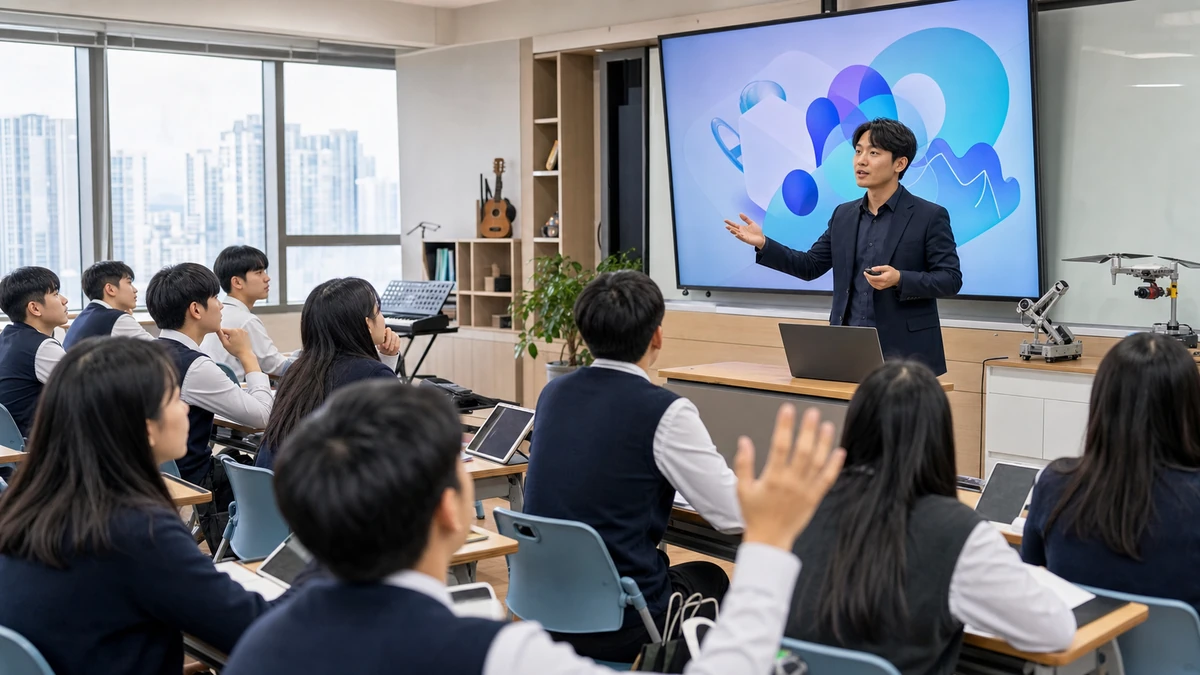
The answer this year is not a giant college fair, a one-day expo or a bus trip to an outside venue. Instead, the Ulsan Metropolitan Office of Education says it will continue running a school-based lecture series through December, sending invited speakers directly into high school classrooms to talk with students about careers, technology, music, entrepreneurship and the future of work.
That may sound modest, even routine. But in the context of South Korea’s education system — where students often move through rigid schedules, high-pressure testing and tightly managed academic calendars — the structure itself matters. Rather than asking students to leave school for a special event, the program brings the event to them. Schools choose preferred dates, and speakers come on campus.
For American readers, the closest comparison may be a district-organized speaker series that blends career day with mentorship and college-and-workforce advising, but with a stronger emphasis on weaving the experience into the school day. In South Korea, where logistics, schedules and the intense weight of college entrance preparation can make off-campus enrichment harder to arrange, accessibility is not a side issue. It is often the deciding factor in whether students get exposure to new possibilities at all.
According to South Korean media reports, the Ulsan education office launched the initiative in 2021 and is now in its sixth year. That longevity stands out. Education programs are often announced with fanfare and then quietly fade. This one appears to have settled into the school system as a recurring tool for career exploration, suggesting that local educators see practical value in a format that reduces travel burdens on schools while meeting students where they already are: inside familiar classrooms, among classmates, during the ordinary rhythm of school life.
Just as important, the program is not built around the idea that there is one “right” job for students to discover. Its speaker lineup spans future-focused education research, music, information and communication technology, entrepreneurship and artificial intelligence. The message is less about steering teenagers toward a single profession than about helping them ask better questions about their interests, skills and the changing economy.
Why career guidance looks different in South Korea
To understand why a classroom lecture series can draw attention in South Korea, it helps to understand the country’s educational culture. South Korea is widely admired for high academic performance and intense family investment in schooling. It is also known for a system that can place extraordinary pressure on teenagers, especially in high school, when preparation for the national college entrance exam — the College Scholastic Ability Test, or CSAT, known in Korea as the suneung — looms over daily life.
The exam has long functioned as more than a test. It is a social milestone, an organizing principle and, for many families, a proxy for future opportunity. On the day it is administered, offices open late, flights may be rescheduled to reduce noise and police sometimes escort late students to testing sites. For Americans, it can be difficult to grasp the cultural force of a single exam carrying that much symbolic weight.
That pressure has shaped how students think about their futures. In such an environment, career education can easily narrow into a ranking exercise: Which majors are stable? Which jobs are prestigious? Which pathway will keep options open? The risk is that students learn to treat career choice like filling out a bracket rather than building a life.
Programs like Ulsan’s appear designed, at least in part, to push against that narrowing. They do not reject academic achievement or college preparation; those remain central to South Korean schooling. But they widen the frame. By bringing in speakers from different sectors and asking students to think about imagination, self-understanding, technology and adaptability, the district is making a case that career planning is not simply about matching grades to a department name at a university.
That broader approach reflects changes in the labor market that are not unique to Korea. Young people in the United States hear similar warnings and promises: artificial intelligence could automate some tasks, create new fields and scramble old assumptions; technical literacy matters even for nonengineers; entrepreneurship is a mindset as much as a startup; and personal fulfillment is difficult to separate from professional sustainability. The difference is that in South Korea, these conversations are unfolding inside one of the world’s most exam-centered school cultures, which makes any effort to create room for reflection especially notable.
There is also a regional dimension. Ulsan is not Seoul. It is one of South Korea’s economic engines, but it does not occupy the same place in the national imagination as the capital, where elite universities, major corporations and government ministries are concentrated. For students outside Seoul, local access to mentors and institutions can carry added significance. A district-run program that introduces nearby university professors and working professionals may help bridge a psychological gap as well as a logistical one.
From music to microchips, a wider picture of work
The speaker roster itself offers a revealing snapshot of how educators in Ulsan are defining “career exploration.” One lecturer, Oh Gi-young, head of a future education research institute, is scheduled to speak on a theme that translates roughly to “A world where imagination becomes a job: What future talent needs.” Another, music company executive Ahn Ji-yeon, will talk under the title “Listening to music, listening to myself.” Two professors from local universities will cover technology, entrepreneurship and AI-era survival strategies.
That combination matters because it resists a false choice that schools around the world often present, especially in technology-centered economies: practical fields on one side, personal passion on the other. Ulsan’s program seems to argue that students need both. They need to understand technological change, but they also need ways of understanding themselves.
In the American conversation, policymakers often talk about STEM, workforce pipelines and future-ready skills. Those phrases can be useful, but they can also flatten teenagers into future labor units. The inclusion of a music-centered lecture in Ulsan’s series suggests a somewhat richer view. Students are not only future employees or founders. They are young people trying to make sense of identity, emotion, talent and meaning.
Ahn’s lecture title is especially striking in that regard. Rather than focusing on the music business alone, it frames music as a tool for self-reflection. In a culture where students are frequently evaluated, ranked and compared, that emphasis on listening inward may be as important as any vocational advice. Career development, after all, is not only about discovering which industries are growing. It is also about recognizing what kind of work a person can stay committed to over time.
The technology-focused talks pull in the other direction, but not in a contradictory way. Kim Dae-hwan, a professor in information and communication technology convergence at the University of Ulsan, is slated to speak on technology as opportunity and on designing the future through entrepreneurship. In South Korea, as in the United States, “entrepreneurship” can sometimes be reduced to startup branding. But in education settings, it often signals something broader: identifying problems, seeing gaps, taking initiative and learning to act under uncertainty.
That framing is especially relevant in a city like Ulsan, whose identity has long been tied to large-scale manufacturing and heavy industry. If an older model of success pointed students toward stable roles within major corporations, a newer model asks them to imagine more fluid pathways — some inside big firms, some in emerging sectors, some possibly created by students themselves.
Then there is the AI question. Kim Sung-hoon, a professor in semiconductor applications at Ulsan College, plans to address a topic that many teenagers everywhere are already asking in one form or another: “Will artificial intelligence take my job?” It is a blunt question, and perhaps that is why it works. Teenagers do not need euphemisms about “disruption.” They know the world is changing quickly, and they want adults to speak plainly about what that means.
Notably, the lecture title does not stop at anxiety. It pairs the fear with “survival strategies in the age of technology.” That does not mean promising certainty where none exists. It means treating uncertainty itself as part of career education. In a school system often associated with correct answers, that may be one of the more forward-looking choices the district is making.
The value of taking the program to students
On paper, a visiting lecture can sound like a small administrative choice. In practice, the delivery model says a great deal about educational priorities. The Ulsan program is built around the idea of a “visiting special lecture,” meaning speakers travel to schools rather than requiring schools to transport students elsewhere.
That design brings immediate advantages. It cuts transportation and coordination costs. It makes scheduling easier for schools with different timetables. It lowers barriers for students who might not join optional outside events. And it signals that career education is not an extra reserved for students with time, money or unusually proactive schools.
For U.S. audiences, this may recall debates over whether enrichment should depend on field trips, after-school programs or family resources. When schools bring opportunities directly onto campus, participation tends to broaden. The same principle seems to be at work in Ulsan.
There is also something psychologically important about hearing these messages in a regular classroom rather than in a one-off conference hall. A large external venue can make a career event feel exceptional, detached from daily school life. A classroom can make the same conversation feel immediate and personal. Students are not stepping into a special world for a day; they are being told that questions about work, identity and the future belong inside ordinary education.
That is a subtle but meaningful shift. In many systems, career exploration is treated as peripheral until late in high school, or as a remedial exercise for students not headed toward elite academic pathways. Ulsan’s approach suggests something closer to mainstreaming: career thinking as part of the educational experience for a broad range of students.
The flexibility given to schools matters, too. South Korean schools do not all move in lockstep, and local calendars, academic pressures and school cultures vary. A program that adapts to each school’s preferred dates gives administrators some ownership. It also increases the odds that the talks fit the school’s actual needs rather than becoming a centrally mandated box-checking exercise.
None of that guarantees impact. Career lectures can be inspiring, forgettable or somewhere in between. Much depends on the quality of the interaction, the students’ age, the preparation teachers do beforehand and whether follow-up opportunities exist. But accessibility is a precondition for everything else. If students cannot realistically participate, even the best-designed content will not matter. Ulsan’s model appears to start by solving that first problem.
What this says about Korea’s changing economy
The themes of the lectures reflect a South Korea that is both highly advanced and deeply uneasy about the future. The country is a global powerhouse in semiconductors, electronics, shipbuilding, batteries and cultural exports. K-pop, Korean film, TV dramas and beauty brands have helped make the “Korean Wave,” or Hallyu, a familiar concept to audiences far beyond Asia. But beneath that success lies a society wrestling with youth competition, demographic decline, rapid technological change and persistent questions about mobility.
The Korean word “jinro,” often translated as “career path” or “course,” carries more than the idea of picking a job. It refers to a broader direction in life, especially in educational settings. That helps explain the logic of a program that includes both AI and music, both practical labor-market concerns and inward reflection. The point is not just employment placement. It is helping students connect who they are, what they can do and what the future may demand.
Ulsan is a fitting place for that conversation. The city’s economic success was built on the kind of industrial development that once offered relatively legible life paths: study hard, join a major company, build stability. But as advanced manufacturing becomes more automated and the digital economy reshapes work, those paths are less predictable. Even in a city closely associated with industrial strength, students are being told they may need imagination, adaptability and entrepreneurial habits alongside technical knowledge.
The inclusion of local university professors also underscores another point: regional ecosystems matter. In the United States, much discussion of innovation revolves around places such as Silicon Valley, Boston or Austin. In South Korea, the Seoul metropolitan area often dominates attention in a similar way. When a city like Ulsan uses local higher education institutions as part of career guidance, it highlights the role regional universities can play in keeping talent connected to place.
That may be increasingly important in a country dealing with regional imbalance, where opportunities and prestige often cluster in and around the capital. If students can meet professors and professionals linked to institutions in their own city, the future may feel less like something that only happens elsewhere.
At the same time, the district’s message is not narrowly local. AI anxiety, future-of-work uncertainty and the push to fuse creativity with technical skill are recognizably global issues. An American parent or educator reading about the program may see familiar concerns: how to keep teenagers informed without overwhelming them, how to talk about jobs that may not yet exist and how to encourage resilience without turning every student into a brand manager for their own life.
A modest program with bigger implications
It would be easy to overstate what a lecture series can accomplish. A handful of talks will not solve the structural pressures of South Korean education, erase inequality in opportunity or settle debates over how AI will reshape labor markets. The details of each lecture also matter, and public summaries can only go so far in showing what students actually hear and how they respond.
Still, the Ulsan program deserves attention precisely because it does not promise to do everything. It addresses a concrete problem with a practical design: students need exposure to different ways of thinking about the future, and schools need a format that is easy to host. That kind of realism is often missing from grand education rhetoric.
There is also value in the program’s refusal to present career choice as a tidy match between a teenager and a fixed occupational label. The talks ask bigger questions. What counts as talent in a changing world? How do culture and self-knowledge fit into career planning? How should students respond to technological uncertainty without being paralyzed by it? What does initiative look like in an economy where industries rise and fall faster than school systems can update textbooks?
Those are not uniquely Korean questions. They are questions playing out in American schools, too, from suburban districts experimenting with career academies to urban systems trying to connect students with internships and mentors. What is distinctive in Ulsan is the cultural setting: a high-achieving, high-pressure education environment trying to make room for imagination without abandoning rigor.
That balance may be the real story here. South Korea is often portrayed abroad through extremes — dazzling technological modernity, punishing academic competition, global pop-culture dominance. This program points to something quieter and perhaps more durable: the day-to-day work of educators trying to help teenagers navigate complexity without pretending it can be reduced to a test score or a single career ladder.
By the time the lecture series wraps up in December, many students may remember only fragments — a line about AI, a thought about music, a challenge to think more boldly about the future. But fragments matter at that age. A single idea, delivered at the right moment, can alter how a student sees college, work or even their own abilities.
And in an era when so much discussion about youth and technology swings between hype and dread, there is something refreshingly grounded about bringing an adult expert into a classroom and saying, in effect: Let’s talk honestly about the future together.
Comments
Post a Comment