A Korean high school baseball chant sparked outrage. The deeper issue is how a democracy teaches painful history to teenagers.
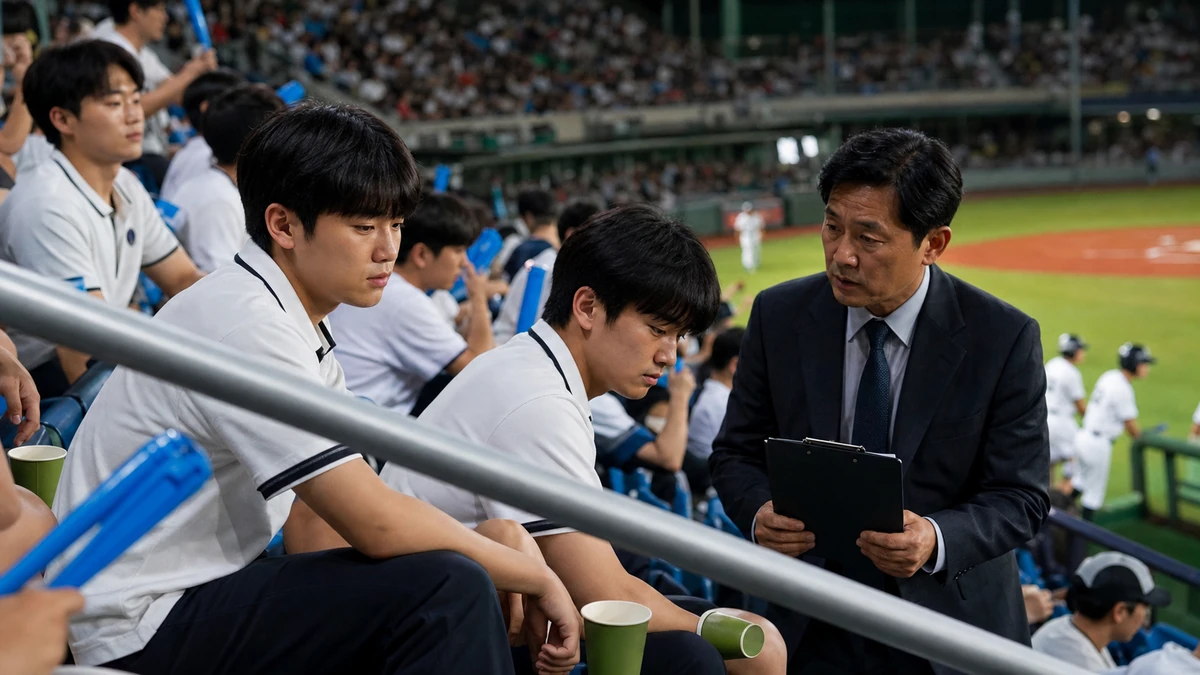
A stadium chant becomes a national controversy
What began as a few shouted words in the cheering section at a high school baseball game in Seoul has turned into a broader public debate in South Korea about history, accountability and what schools owe students when youthful mockery collides with national trauma.
Baehwae High School — better known in Korean as Paejae High School, a well-known private boys’ school in Seoul — has decided to refer two students to its school disciplinary guidance body after they allegedly led a chant during a major high school baseball tournament that drew immediate backlash. According to a school inspection report submitted to the Seoul Metropolitan Office of Education and later obtained by a member of the National Assembly, one student allegedly shouted, “We should go to Starbucks,” during the top of the eighth inning of a game at Mokdong Baseball Stadium on June 29. Other students reportedly echoed the phrase. A second student was documented as shouting “Tank Day.”
On its face, the language might sound random, even silly, to readers outside South Korea. In an American setting, it might be tempting to view it as the kind of oddball, disposable chant teenagers improvise in bleachers at a Friday night football game or a spring baseball tournament. But in South Korea, those words carried a loaded political and historical echo. That is why the school’s response is being watched not just as a matter of student discipline, but as a test of how a society passes on historical memory to a generation raised on internet humor, viral phrases and rapid-fire online culture.
The case has not yet reached a final disciplinary outcome. What is known at this stage is that the school has moved to put the two leading students before its student guidance committee — a formal school process that can weigh discipline, counseling and educational measures — and is also considering whether additional students who joined in the chant should also be referred. That detail matters. The school is not treating the incident solely as a one-off outburst by one teenager. It is also examining how a group dynamic amplified the remarks.
That broader inquiry has turned this into something larger than a sports story. It is now a national conversation about what happens when public memory, youth culture and school spirit collide in one of South Korea’s most tradition-bound student spaces: high school baseball.
Why “Starbucks” and “Tank Day” hit such a nerve
The outrage was not simply about students saying the name of a global coffee chain in the stands. The phrase became controversial because it appeared to invoke a separate recent dispute involving Starbucks Korea and one of the most painful events in modern South Korean history: the May 18 Gwangju Democratization Movement.
For Americans unfamiliar with that history, May 18 occupies a place in South Korea’s civic memory that is difficult to map neatly onto a single U.S. comparison, but it may be best understood as part Kent State, part Selma and part the long reckoning over state violence in a democracy. In May 1980, in the southwestern city of Gwangju, citizens rose up against military rule. The military crackdown that followed left many civilians dead or injured. In South Korea today, the Gwangju uprising is not treated as a footnote. It is one of the defining episodes in the country’s democratic story and a deeply emotional symbol of sacrifice, repression and the cost of freedom.
That context explains why references linking the date “5/18” with militarized imagery — including tanks — can provoke immediate public anger. According to the Korean report summarized here, the stadium chant called to mind a recent controversy in which Starbucks Korea promoted a tumbler discount event with wording that included “5·18 Tank Day,” a phrase that many South Koreans viewed as insensitive because it appeared to commercialize or trivialize a date tied to bloodshed and state violence.
Once that phrase entered the public sphere, it did not remain confined to a corporate marketing controversy. Like many internet-age expressions, it was apparently detached from its original setting, repurposed and repeated. By the time it appeared in a high school baseball cheering section, it had become something else: a meme-like phrase with enough cultural recognition to be repeated as a joke, but with all the historical pain still attached.
That is often how public language works in the social media era. Words travel faster than understanding. A phrase can move from advertisement to outrage to parody to schoolyard repetition in a matter of days. But when the phrase touches a national wound, the chain reaction can be severe. In South Korea, many people saw the chant not as a harmless joke but as an example of historical memory being flattened into a punchline.
For an American audience, it may help to think about how a joking chant referencing a massacre, a civil rights tragedy or a terrorist attack would be received if repeated by teenagers at a school sporting event. Even if the students did not fully understand the reference, the public would still ask how such language became normalized enough to be shouted in a crowd.
Why high school baseball in South Korea is bigger than a game
To understand why this incident drew such scrutiny, it also helps to understand the place of high school baseball in South Korea. While American audiences may associate school sports most strongly with football on Friday nights, March Madness or the Little League World Series, high school baseball in South Korea carries its own distinctive prestige. Tournaments such as the Blue Dragon Flag National High School Baseball Championship, where this incident occurred, are not minor campus events. They are part of a long tradition in which school identity, alumni pride, regional loyalties and future athletic careers converge.
The cheering section at one of these games is not simply a place to clap for hits and boo bad calls. It is a stage where teenage group culture is performed in public. Students chant in unison, sing fight songs and project school identity outward. In that sense, the bleachers function as both a sports arena and a social theater. What is said there can quickly escape the confines of the game and become part of a national discussion, especially when video, witness accounts and official reports give the public a clear narrative.
That is one reason the school inspection report appears to describe the sequence of the chant with unusual specificity, noting who allegedly initiated which words and how other students responded. Such detail suggests school officials are trying to distinguish between leadership and participation, between spontaneous speech and collective repetition. In disciplinary terms, that distinction can affect outcomes. In educational terms, it says something else: adults are trying to understand not only what happened, but how an idea spread through a crowd.
That question is especially urgent in teenage settings. Adolescents often test boundaries in groups, and the emotional atmosphere of a sporting event can lower inhibitions even further. Anyone who has covered youth sports in the United States knows that group chants can swing quickly from spirited to ugly. The same dynamics apply in South Korea. The difference here is that the language in question reached into the country’s democratic memory, making the chant more than a moment of poor judgment.
The public setting matters too. This did not happen in a private group chat, a closed classroom or an off-campus conversation. It happened in a visible school contingent at a nationally recognized competition. In other words, the remarks were heard not only as individual student behavior but as speech attached to a school community and performed in a civic space.
The school’s response: discipline, education or both?
In South Korea, the body to which the students were referred is often translated loosely as a student guidance or student life education committee. The exact name reflects a feature of Korean school culture that does not map perfectly onto an American equivalent. It is not just a punitive board. It is part of a broader system of student life management that can include behavioral review, counseling, corrective instruction and disciplinary judgment.
That nuance is important. In the United States, readers might hear “disciplinary committee” and picture suspension hearings or zero-tolerance punishment. In South Korea, while sanctions are certainly possible, there is also a strong expectation that schools should use such incidents to teach communal norms and social responsibility. That is one reason the language around this case has quickly expanded beyond whether particular students should be punished.
At the center of the debate is a difficult question familiar in many democracies: When teenagers repeat offensive or historically insensitive language, what is the right balance between holding them accountable and recognizing that schools exist to teach, not only to penalize? If students were performing a joke without understanding its historical meaning, that ignorance is itself part of the problem. But ignorance does not erase harm, especially when the words touch collective grief.
The reported consideration of whether to refer additional students who joined in the chant sharpens that dilemma. A crowd chant is not the same thing as a private insult uttered by one person. Group repetition can normalize a phrase, drown out hesitation and turn a single provocation into a public performance. At the same time, schools must decide whether every participant bears the same responsibility as the student who starts the chant or whether the educational response should reflect degrees of agency and awareness.
That is where this story has become more than a disciplinary file. It has become a case study in civic education. The core issue is not only whether students broke school rules, but whether they understood why certain language is socially unacceptable in a democracy shaped by painful historical memory. A punishment-only approach may satisfy demands for accountability in the short term. But many observers in South Korea appear to be asking for something deeper: a response that explains the history, the injury and the social meaning of the words.
That kind of educational response is especially important because the chant appears to have emerged from recycled public language rather than from original ideology. The students, based on the reported facts so far, are not accused of authoring a political slogan. They are accused of reproducing one. That raises uncomfortable but necessary questions about the adults, institutions and media ecosystems that allow historically charged language to become familiar enough for teenagers to treat it as crowd banter.
The shadow of Gwangju in contemporary South Korea
To outsiders, South Korea is often seen through the lens of its remarkable modern success: K-pop, Oscar-winning films, Samsung smartphones, beauty brands, export power and vibrant democracy. All of that is real. But the country also lives with an acute awareness that its democracy was hard-won. The Gwangju uprising remains central to that national self-understanding, especially because disputes over its meaning once reflected broader battles over truth, censorship and state legitimacy.
That helps explain the emotional intensity surrounding this case. In South Korea, May 18 is not simply a date on a commemorative calendar. It is an active moral reference point. Political leaders, educators and ordinary citizens continue to revisit what happened in Gwangju because the event is tied to basic questions of who belongs in the democratic community, whose suffering is recognized and how state power should be constrained.
When language associated with that history is stripped of context and recycled as a joke, many South Koreans see more than bad taste. They see a warning sign that democratic memory is thinning. Every generation inherits history unevenly. Teenagers do not experience historical trauma directly; they receive it secondhand through school lessons, family stories, media and public rituals. Sometimes that transmission works. Sometimes it frays.
This case appears to have struck a nerve precisely because it exposed that vulnerability in real time. A phrase with roots in a public controversy over historical sensitivity was allegedly transformed into a stadium cheer. In one sense, that is a local scandal involving one school and a baseball game. In another, it is a snapshot of a much larger issue facing democracies everywhere: how to preserve the meaning of painful history in an age that rewards speed, irony and detachment.
The American parallel is not exact, but it is recognizable. The United States has its own recurring battles over how schools teach slavery, civil rights, the Vietnam War, Sept. 11 and other national traumas. At heart, those debates ask the same question South Korea is wrestling with here: What happens when civic memory stops feeling immediate to the young, and who is responsible for restoring the missing context?
Public anger moves beyond the school gates
The Korean report also noted a striking visual sign of public anger: funeral wreaths placed outside the school. In South Korea, those displays can serve as a highly visible form of protest, signaling condemnation and public mourning for what critics see as a moral failure. For readers in the United States, the closest equivalent might be a demonstration outside a school with symbolic objects intended to shame administrators or call attention to a community’s grief and outrage.
Those wreaths matter because they show that the controversy has already moved beyond internal school procedure. The incident is no longer just about what happened between students in a cheering section. It has become part of a wider civic response in which members of the public are asserting that a line was crossed.
Still, there are reasons for caution. The reported facts available so far are limited. The school decided to refer two students to the committee and is considering possible additional referrals for students who echoed the chant. The final disciplinary outcome has not been reported in the summary provided. That means the most responsible interpretation, at least for now, is not to overstate what is known or assign motives that have not been established.
That restraint matters in journalism, especially in stories involving minors and emotionally charged public reaction. Teenagers can cause real harm, and communities can demand accountability, but reporting still has to distinguish between verified facts, public anger and broader interpretation. In this case, the verified facts already tell a consequential story. They show a school acknowledging the seriousness of the matter, education authorities documenting it and a society responding with unusual sensitivity because of the history involved.
The involvement of a lawmaker on the National Assembly’s Education Committee also underscores that this has moved into the realm of public oversight. Once school records are reviewed through an education office and surfaced through a legislative channel, the issue is no longer merely local. It becomes part of a national conversation about how institutions respond when student behavior reflects a wider failure of historical understanding.
What this episode says about memory, youth and democracy
There is a temptation in stories like this to settle on a simple moral: students behaved badly, adults intervened, case closed. But the reason this incident has drawn such close attention is that it resists that easy ending. It sits at the intersection of several difficult truths.
One is that teenagers often repeat language before they understand its weight. Another is that public harm can occur even when intent is shallow or immature. A third is that democracies depend not only on laws and elections, but also on memory — on a shared understanding that some events remain too painful, too sacred or too consequential to be reduced to jokes.
South Korea’s response to this incident suggests that many people there believe the problem is not just that two students crossed a line. It is that a historically charged phrase became available for casual use in the first place. That shift — from remembrance to reference, from history to meme — is what alarms so many observers.
For schools, that creates a challenge with no perfect formula. Punishment without explanation can harden resentment or leave ignorance intact. Education without accountability can minimize harm and signal that public cruelty carries no consequences. The most credible response is likely one that does both: establishes responsibility while also teaching why the words mattered, how historical trauma continues to shape public life and why communal spaces such as sports stadiums are not exempt from civic norms.
That may be the most universal lesson in this story. Whether in Seoul, Chicago, Los Angeles or Atlanta, young people absorb the world around them in fragments: headlines, jokes, chants, hashtags, brand slogans. Adults often assume that the moral meaning travels with the words. It does not always. When it doesn’t, schools become one of the last institutions capable of rebuilding the missing context.
In that sense, the controversy at a Seoul high school baseball game is about more than one school or one chant. It is about how a democratic society reacts when the language of historical pain is echoed back by the next generation without the history attached. South Korea is now confronting that question in public. Other countries, including the United States, would recognize the dilemma immediately.
The disciplinary process at Baehwae High School may eventually produce a formal outcome for the students involved. But whatever decision emerges, the broader significance of the case is already clear. A moment of adolescent chanting has forced a national reminder that memory is not self-sustaining. It has to be taught, defended and renewed — especially in the noisy, fast-moving places where young people test the boundaries of what their society is willing to forget.
Comments
Post a Comment