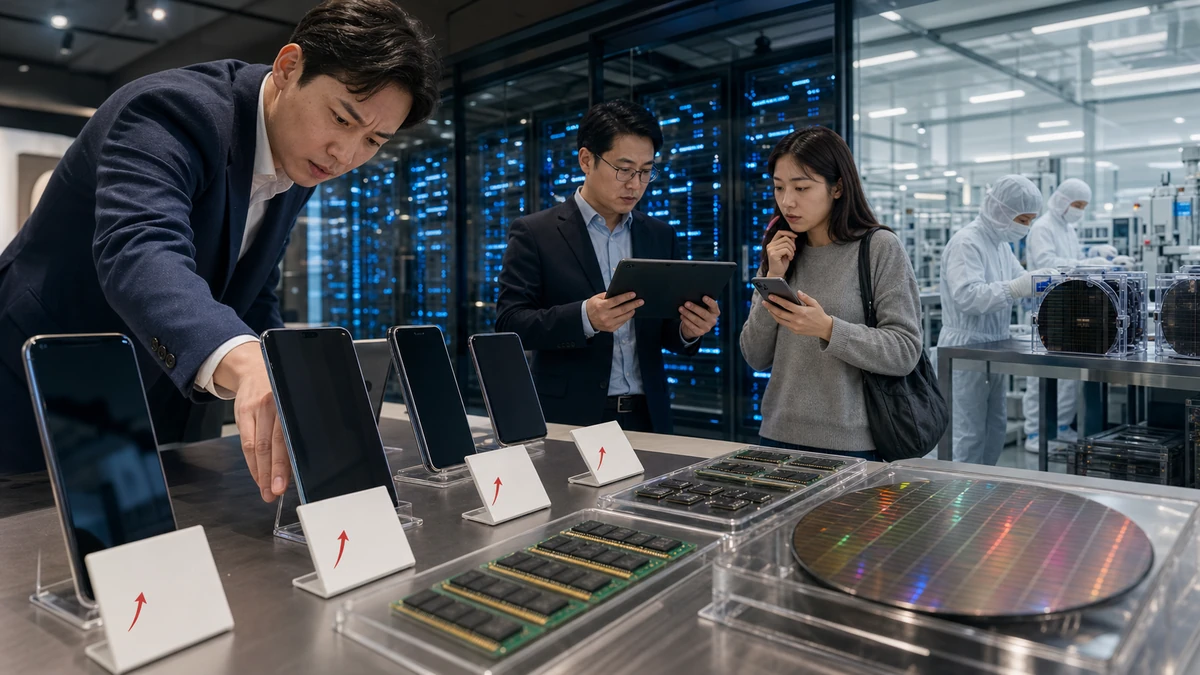
The next smartphone price hike may start in the server room
For years, shoppers in the United States and elsewhere have grown used to a familiar rhythm in consumer tech: each fall or spring brings a new phone with a better camera, a faster chip and maybe one headline feature meant to justify the upgrade. Prices moved up over time, especially at the premium end, but major brands also tried to preserve a sense of stability. A new flagship might cost more than one from five years ago, yet consumers could still believe there was a rough ceiling on how far prices would go.
That assumption is now under fresh strain, and one reason sits far from the smartphone aisle. The global boom in artificial intelligence is putting sustained pressure on the market for memory chips, a core component inside nearly every modern device. Industry analysts in South Korea and beyond say that tighter memory supply and rising component costs are increasingly filtering through to the retail prices of smartphones, tablets and laptops. In other words, the race to build ever more powerful AI systems in data centers may soon be reflected in the price tag on the next phone a consumer buys at a mall, carrier store or online checkout page.
This matters well beyond the technology sector. Smartphones are no longer niche electronics; they are everyday essentials used for banking, school, work, transportation, entertainment and communication. When the cost of a smartphone rises, the effect is felt broadly, much like increases in laptop prices during the pandemic-era supply crunch. What makes this moment different is that the pressure is tied not only to shipping bottlenecks or inflation, but to a deeper structural shift in computing itself. AI is demanding more hardware everywhere, and memory is one of the clearest places where that demand is colliding with consumer budgets.
South Korea sits near the center of this story. Its companies are deeply embedded in both sides of the global electronics business: they make some of the world’s most important memory chips, and they also sell finished consumer devices. That means the same trend can be good news for one part of the industry and a headache for another. Higher memory prices may improve profits for semiconductor makers, but they also raise costs for companies trying to keep phones affordable in a fiercely competitive market.
Why memory matters more in the AI phone era
To understand why memory prices are suddenly so important, it helps to look at what smartphones have become. A decade ago, manufacturers could still market phones mainly around screen size, battery life and camera quality. Those factors remain important, but today’s premium devices are also sold as pocket computers designed to run increasingly complex software on the device itself. That includes photo editing, voice transcription, language tools, search features, image generation and other so-called on-device AI functions.
Those capabilities depend heavily on memory. In simple terms, DRAM helps a phone run apps and process tasks in real time, while NAND flash stores the photos, videos, apps, operating system and growing amounts of AI-related data consumers keep on their devices. The more advanced the phone becomes, the more memory and storage it typically needs. That makes manufacturers more sensitive to swings in memory pricing than they were when handsets were less powerful and less dependent on large local data processing.
Market researcher TrendForce has projected that in the third quarter, prices for standard DRAM could rise another 13 percent to 18 percent from the previous quarter, while NAND flash could climb 10 percent to 15 percent. Those are substantial moves in a business where component costs can have an outsize impact on final pricing strategy. A company can sometimes absorb modest increases, or try to offset them through marketing, subsidies or changes elsewhere in the bill of materials. But when both processing expectations and memory costs rise together, it becomes harder to hold the line.
That challenge is especially acute because phone makers cannot easily respond by cutting memory capacity without undermining the very features they are promoting. An AI-heavy device with less RAM or smaller storage may feel slower, limit functionality or compare poorly against rivals. That leaves companies facing a familiar but uncomfortable choice: accept lower margins, raise prices or try to push consumers toward more expensive versions where profit is easier to preserve.
Analysts at IDC have suggested the effects of memory tightness could spill over into next year, affecting both manufacturers and consumers. Forecasts are not guarantees, and retail prices will still depend on competition, regional strategy and product mix. But the underlying logic is hard to ignore. If memory remains expensive and AI features remain a selling point, the economic pressure on devices is unlikely to disappear quickly.
Samsung, Apple and the end of the price-freeze mindset
One reason this issue is drawing close attention in South Korea is that it is no longer theoretical. The pressure appears to be showing up in real pricing decisions from major brands. Samsung Electronics, the country’s best-known consumer tech company and one of the few businesses with major stakes in both memory semiconductors and smartphones, has reportedly moved away from a pricing posture it maintained through much of the recent period. According to the Korean report, Samsung raised prices on its Galaxy S26 lineup earlier this year after keeping pricing broadly stable since 2023. In April, it also increased the prices of the 512GB versions of the Galaxy Z Fold7 and Galaxy Z Flip7 in South Korea.
That is significant not simply because Samsung raised a price, but because it suggests component inflation is becoming difficult to hide even for one of the world’s largest electronics companies. Samsung has enormous scale, supply-chain reach and pricing power. If a company of that size is adjusting prices upward, it signals the cost pressure is not limited to smaller brands with weaker bargaining leverage.
Apple, too, appears to be moving within the same broader current. The Korean summary cites data showing Apple raised prices on MacBooks and iPads by $100 to $300 late last month. Those are not smartphones, but they are part of the same mobile-computing ecosystem and rely on the same broad memory market. For American consumers, that may be the clearest sign that this is not just a Korea story or even just a phone story. It is a hardware story.
There is also growing speculation around what comes next. Ahead of Samsung’s next foldable launch, some market watchers expect at least higher-capacity models to face upward price pressure even if entry pricing on the base version remains unchanged. That would fit a pattern American consumers already know well from car dealerships, airline tickets and streaming services: companies try to preserve the headline starting price while making premium configurations more expensive. In the smartphone business, that could mean a 256GB model looks stable on paper while 512GB or 1TB options absorb more of the memory-cost increase.
For consumers, the distinction may not matter much in practice. Many buyers no longer view the base storage option as sufficient, especially if they keep a phone for three, four or even five years. High-resolution video, large app libraries and AI features that cache or generate content locally all push users toward bigger configurations. A stable entry price can therefore mask a real increase in what many people actually pay.
Chinese phone makers are raising prices, too
Another important detail in the Korean reporting is that Chinese smartphone makers, long known for aggressive pricing in both domestic and global markets, are also facing similar upward pressure. The summary says Vivo raised prices on its X300 series by 100 to 300 yuan, Oppo increased prices on the Find X9 by 200 to 300 yuan, Realme lifted GT8 prices by 300 to 500 yuan, and Xiaomi’s budget Redmi K90 series also came in higher than the previous generation.
That matters because Chinese manufacturers often compete by offering strong hardware at lower prices than premium rivals from Apple and Samsung. In the U.S. market, consumers are less exposed to some of those brands than shoppers in Asia, Latin America or parts of Europe, but their pricing still matters globally. These companies shape expectations across the smartphone industry, especially in the midrange and lower-premium segments. When even cost-focused manufacturers begin raising prices, it suggests the squeeze is not confined to elite devices with high marketing budgets and luxury positioning.
Normally, makers of cheaper phones are especially reluctant to pass higher costs directly to consumers because price sensitivity is greater in that segment. A $50 increase on a $250 or $300 handset can change a buying decision more dramatically than a similar bump on a $1,200 flagship. If brands still choose to move prices upward, analysts tend to read that as evidence that component costs are becoming too large to absorb quietly.
For global consumers, this has another implication: the idea that shoppers can simply trade down to a more affordable alternative may become less reliable. If memory costs rise across the board, then the entire ladder moves up. Premium models may get pricier, but so may the midrange devices many households depend on. That is particularly relevant in an era when phones are increasingly purchased not as indulgences but as practical, long-cycle necessities.
It also challenges a common assumption in tech that competition will always compress prices. Competition still matters, but it cannot fully neutralize a broad-based rise in input costs. If every manufacturer needs more memory and memory stays expensive, rivalry alone may not be enough to keep devices cheap.
Fewer phones sold, but at higher average prices
Perhaps the most striking part of the outlook is not just that prices may rise, but that the market could simultaneously sell fewer phones overall. IDC projects that global smartphone shipments could decline 12.9 percent this year while the average selling price climbs 14 percent to $523, a record high. On its face, that sounds contradictory. In practice, it reflects a market that is becoming more concentrated around premium or feature-heavy devices even as more price-conscious consumers delay upgrades.
American shoppers have already been moving in that direction for some time. Many people now keep their phones longer than they once did, thanks to incremental hardware improvements, better durability and longer software-support windows. That trend may accelerate if buyers perceive that the jump from one generation to the next is not dramatic enough to justify another price increase. Instead of replacing a phone every two or three years, they may stretch it further, repair cracked screens, swap batteries or choose refurbished devices.
Manufacturers, in turn, may respond by leaning harder on higher-end models and larger storage options, where margins are stronger. That creates a market that looks more like the auto industry than the old mobile phone business: lower unit growth, higher average transaction prices and greater reliance on premium trims. In that environment, a company does not necessarily need to sell more phones to protect revenue, so long as it can sell enough expensive ones.
There is, however, a limit to how far that logic can go. Smartphones occupy a complicated place in household budgets. They are indispensable, but they are still discretionary in the sense that consumers can postpone replacement or look for used alternatives. If prices rise too fast, demand may soften more sharply, carriers may need to sweeten financing offers, and brands may have to balance short-term profitability against longer-term market share.
That makes the coming product cycle worth watching closely. If memory prices remain elevated and AI remains the central selling point, companies may continue to price for performance. But if consumers resist, manufacturers could be forced into subtler tactics: bundling, trade-in promotions, installment plans or storage-tier reshuffling rather than across-the-board sticker shock.
How AI servers are shaping the devices in your pocket
At the heart of this story is a supply-chain connection that many consumers never see. The same broad memory ecosystem serves data centers building powerful AI systems and companies making mass-market electronics. When demand for AI servers surges, it can tighten supply conditions across the industry. That does not mean every chip is interchangeable, but it does mean the memory market becomes more constrained, more expensive and more strategically important.
This is one of those moments when the abstract excitement around AI collides with an everyday purchase. Much of the public conversation about artificial intelligence has focused on chatbots, image generators and productivity tools. But beneath the software sits a vast physical infrastructure of servers, chips, cooling systems and power-hungry data centers. Those systems require huge amounts of memory to process and store data efficiently. As cloud companies and enterprise buyers continue spending heavily on AI buildouts, the ripple effects can reach all the way down to consumer hardware.
That helps explain why a person who has little interest in generative AI may still end up paying more for a phone. The global technology industry is now more interconnected than ever. A surge in demand from one corner of the market can reshape pricing across several others. It is similar, in some ways, to how the boom in home exercise equipment or gaming consoles during the pandemic strained chip supply chains for cars and appliances. The difference now is that AI infrastructure may prove more durable than a one-off pandemic shock.
An industry official quoted in the Korean report said price pressure is unlikely to ease easily as long as AI server demand remains strong, adding that upward pressure could continue across IT devices for the time being. That assessment fits a broader industry consensus: AI is not a short-lived fad from a hardware perspective. Even if software hype cycles fluctuate, the underlying investment in compute and memory has become central to tech strategy.
Why South Korea’s role makes this more than a local business story
For readers outside Asia, it is worth pausing on why a Korean industry report about memory and smartphones deserves attention. South Korea is not just another electronics exporter. It is one of the key nodes in the global semiconductor and consumer-device supply chain. Companies there play oversized roles in memory production, smartphone manufacturing, displays and advanced components. When Korean industry watchers flag a pricing shift in those areas, the consequences often extend far beyond the country’s domestic market.
Samsung is the clearest example. It straddles two worlds that are often discussed separately in the U.S.: the chip business and the branded consumer-device business. That dual role creates unusual tension. Higher memory prices can help one side of the house while hurting the other. If the company’s semiconductor arm benefits from a stronger pricing environment, its smartphone division still has to decide how much of the resulting cost burden can be passed on to shoppers without damaging demand.
This is one reason Korean reporting often provides an early window into changes that later become visible globally. The country’s tech sector is deeply plugged into both manufacturing economics and end-user markets. It sees the supply-chain pressure and the consumer consequences at the same time. For American readers used to thinking about Silicon Valley software or Apple product launches, the Korean vantage point offers a useful reminder that hardware economics still matter enormously in the AI age.
It also shows how technological progress can create uneven winners and losers within the same industry. Memory suppliers may welcome tighter markets and improved profitability. Phone makers may not. Consumers almost certainly will not. Yet all three are tied together in the same cycle, and none can fully opt out.
What consumers should watch next
The immediate takeaway is not that every phone is about to become dramatically more expensive overnight. Companies still have tools to manage price perception, and competition remains intense. Some brands may hold entry prices steady, adjust storage tiers, increase trade-in deals or rely more heavily on carrier promotions. In the U.S., where installment plans often soften the blow of higher sticker prices, consumers may not feel the change all at once.
But the broader direction is becoming harder to miss. The era when phone makers could add more AI features, more storage and more processing power without eventually revisiting the price tag may be ending. If memory inflation persists, especially alongside strong AI server demand, consumers should expect pressure first on higher-capacity models and premium devices, and then potentially across wider parts of the market.
That means shoppers may want to think more strategically about upgrades. The best value may increasingly come from buying a device one tier below the flagship, timing purchases around major promotional windows, or choosing a refurbished model from a recent generation. Consumers who do not need on-device AI features immediately may also decide that holding on to a current phone for another year makes more financial sense.
For the industry, the bigger question is whether AI can deliver enough real-world value on phones to justify the added hardware cost. Consumers will pay more for features they use and understand. They are less willing to pay for marketing language. If manufacturers want higher prices to stick, they may need to prove that AI is not just an expensive add-on but a meaningful improvement to daily life.
For now, one thing is clear: the smartphone market is being reshaped by forces much larger than the annual product cycle. The next jump in your phone bill may have less to do with the camera bump or screen refresh rate than with a global battle for memory chips driven by the AI boom. That is the kind of supply-chain story that starts in semiconductor fabs and hyperscale server farms, but ends where it matters most to consumers: at the checkout screen.
Comments
Post a Comment