
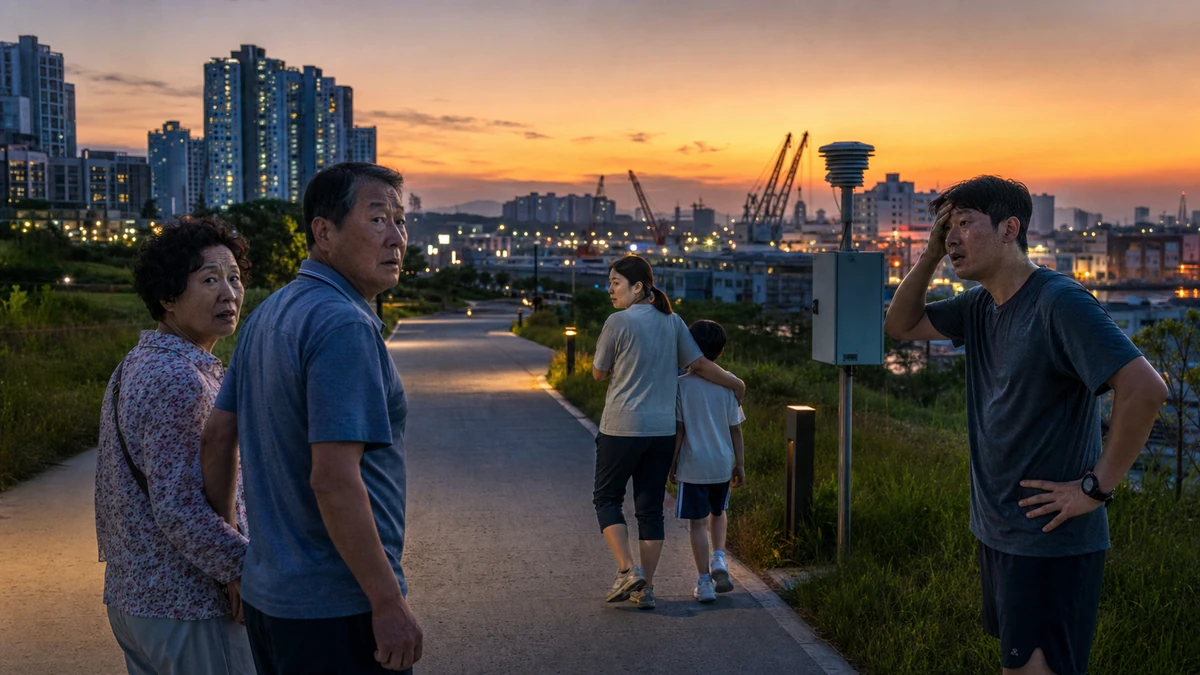
A summer evening warning in Gunsan
For many people, 8 p.m. on a July evening is when the worst of the heat finally begins to ease. It is the hour when families step outside after dinner, older residents take a walk, runners head for the waterfront and travelers set out to see a city in softer light. In Gunsan, a port city on South Korea’s west coast, that familiar summer routine was interrupted Friday night by a less visible threat: ozone pollution.
Authorities in North Jeolla Province, officially known as Jeonbuk State, issued an ozone advisory for Gunsan at 8 p.m. on July 11 after the city’s one-hour average ozone concentration reached 0.1271 parts per million, according to Yonhap News Agency. That exceeded South Korea’s advisory threshold of 0.12 parts per million, triggering a public alert aimed at changing how residents and visitors spent the evening.
The warning did not close parks, shut down roads or force people indoors by law. Instead, it carried the kind of public-health guidance that has become increasingly important in hot-weather urban life: Children, older adults and people with respiratory or heart conditions were urged to limit outdoor activity, while the general public was advised to avoid strenuous exercise outside.
To Americans, the concept is familiar even if the numbers are different. In the United States, people in cities from Los Angeles to Atlanta have grown used to checking air quality alerts during heat waves, wildfire events or periods of stagnant summer air. South Korea has developed a similar warning culture around weather and pollution, with public advisories serving as a routine part of daily decision-making. In that sense, the Gunsan ozone alert was not only a local environmental notice. It was a snapshot of how modern city life in Korea increasingly depends on reading the air as carefully as reading the temperature.
That matters in a country where summer nights are not just about relief from the heat but also about social life. South Korean cities come alive after sunset in July and August. Families gather outdoors, couples stroll riverside parks, children play in neighborhood spaces and office workers often meet for late meals after long workdays. An ozone advisory issued at 8 p.m. lands at exactly the hour when many people would otherwise be heading out.
In practical terms, the alert meant that what looked like a perfectly ordinary evening could no longer be treated as one. The sky might appear calm. The streets might remain open. But public health officials were signaling that the air itself had become a factor in whether to jog, sightsee or even linger outside.
What the numbers mean — and why they matter
The figure at the center of the Gunsan advisory, 0.1271 parts per million, may look small to the untrained eye. Parts per million, or ppm, is exactly what it sounds like: a measurement of how many parts of a substance exist in 1 million parts of air. But in air quality regulation, what matters is not whether a number appears visually small. What matters is whether it crosses a health-based threshold.
In South Korea’s ozone alert system, an advisory is issued when the one-hour average ozone concentration reaches 0.12 parts per million or higher. A stronger warning is issued at 0.30 parts per million, and the highest level comes at 0.50 parts per million. Gunsan’s reading placed it in the first category: serious enough to require caution, but not at the level of the more severe warning or emergency stages.
That distinction is important. Public officials want people to respond without panic. An advisory is not the same as a full-scale emergency, but it is also not background noise to be ignored. It is an instruction to adjust behavior based on current conditions.
There is another detail that often gets lost in discussions of pollution data: This was based on a one-hour average, not an all-day average. In other words, the advisory was tied to the air conditions measured during a specific window of time. That makes ozone alerts especially relevant to everyday planning, because they are not abstract summaries issued after the fact. They are near-real-time signals telling people that the air at that hour has crossed into a range that calls for caution.
For a resident who spent the afternoon outdoors without any obvious discomfort, the 8 p.m. alert could still change the evening. A parent planning to take a child to a playground, a retiree heading out for a walk or a traveler thinking about a waterfront stroll might need to reconsider. That is the nature of ozone: It does not always announce itself dramatically, but its health effects can still be meaningful, especially for vulnerable groups.
Ozone at ground level is different from the ozone layer high in the atmosphere, which helps shield the Earth from harmful ultraviolet radiation. Ground-level ozone is a pollutant formed when sunlight and heat drive chemical reactions involving emissions from vehicles, industry and other sources. It tends to become more problematic in warm, sunny weather, which is one reason summer brings recurring alerts in cities around the world.
For American readers, the comparison may be easiest to understand through the language of “bad air days.” South Korea’s advisory system serves a similar function. The numbers are technical, but the message is straightforward: The air has become unhealthy enough that people should change what they do outside.
Why vulnerable people are told to act first
The advisory in Gunsan placed special emphasis on groups that public-health agencies generally identify as more susceptible to air pollution: older adults, children and people with respiratory or cardiovascular disease. That guidance mirrors long-standing advice from health authorities in the United States and elsewhere.
Children are at particular risk because they tend to be more physically active outdoors and because their lungs are still developing. Older adults can be more vulnerable because of age-related health conditions or reduced resilience in extreme weather. People with asthma, chronic lung disease or heart conditions may experience symptoms more quickly or more severely when ozone levels rise.
In practical Korean terms, that means everyday routines become subject to revision. A grandparent’s evening walk, a child’s outdoor playtime and a family outing after dinner all become activities to weigh against the air-quality alert. In multi-generational households, which are still more common in South Korea than in the United States, those decisions can affect several age groups at once.
The advisory also speaks to an important feature of Korean public life: the high value placed on timely, centralized alerts. South Korea is a deeply connected society where weather, transit and disaster information is widely disseminated through smartphones, apps, news alerts and local government systems. When an ozone advisory is issued, it is not merely a technical bulletin for specialists. It is intended to become actionable information for ordinary families that same evening.
That action may be as simple as postponing a walk, moving exercise indoors or shortening a trip outside. For people with existing health conditions, it can mean something more significant: avoiding outdoor exposure altogether unless necessary. Even when advice does not come with legal force, it can have a real effect on household behavior.
The broader point is that the first people asked to change plans are not necessarily the only ones at risk. They are the groups for whom the consequences are most immediate. Public-health messaging often works this way, identifying the most vulnerable first while also encouraging everyone else to take reasonable precautions.
In Gunsan, that meant the burden of response fell not only on individuals but also on caregivers, relatives and companions. A child may not be checking local ozone readings. An elderly person may not see a push alert in time. Advisories depend on social networks as much as official systems, especially when they are issued in the middle of the evening.
Even healthy adults are being told to rethink summer routines
One of the more notable features of the Gunsan advisory is that it did not stop with the medically vulnerable. Authorities also recommended that the general public avoid strenuous outdoor activity. That includes the kinds of things many people choose specifically because the sun has gone down: running, brisk walking, outdoor sports and extended sightseeing.
That guidance underscores a reality that is becoming more common in hot-weather cities: Escaping the heat by waiting until evening does not necessarily mean escaping environmental risk. In fact, modern summer planning increasingly requires people to consider multiple factors at once, including temperature, humidity and air quality.
For South Koreans, evening outdoor activity is a deeply familiar part of summer life. In dense urban areas, nights are often when neighborhoods feel most livable. Office workers who spend long days indoors may only have time to exercise after sunset. Parents who avoid the hottest afternoon hours may bring children out later in the day. Tourists, too, often prefer evening walks in historic districts or along the water.
Gunsan is especially notable in that regard. The city is known not only as an industrial and maritime hub but also as a destination with a distinct historical identity, including neighborhoods associated with Korea’s early modern era and Japanese colonial rule. Visitors often explore on foot, and locals make regular use of outdoor public spaces. An ozone advisory can therefore affect both ordinary residents and people who are only in the city for the day or weekend.
The guidance to avoid strenuous activity should not be read as an order to freeze all movement. It is more nuanced than that. A short, necessary trip outdoors is different from an hour-long run. A slow walk to a nearby destination is not the same as high-intensity exercise. Public-health officials are asking people to reduce exposure and effort, not to treat the city as if it has shut down.
Still, even that modest change can alter the rhythm of an evening. The person who normally runs along a riverside path may stay inside. The family that planned a long stroll may cut it short. The tourist who wanted to wander after dinner may choose an indoor stop instead. These are small decisions individually, but together they reveal how environmental data increasingly shapes urban behavior.
For Americans accustomed to heat advisories, flood watches or wildfire smoke warnings, the pattern is recognizable. The difference in Gunsan is not the existence of the risk but the particular way it intersects with Korean city life, where evening activity carries social and cultural weight and where local advisories have become part of everyday civic awareness.
Summer in Korea now means tracking heat and air together
The ozone advisory came as South Korea was also facing broader summer heat concerns. Forecasts cited in local coverage projected low temperatures of 73 to 79 degrees Fahrenheit and daytime highs of roughly 88 to 99 degrees Fahrenheit across the country, with many areas expected to remain above 91 degrees in the days ahead. In other words, the Gunsan alert did not occur in isolation. It arrived within a larger pattern of sustained midsummer heat.
That matters because heat and ozone are linked in both practical and behavioral ways. Hot weather can contribute to ozone formation, and it also pushes people to reorganize their daily schedules. When afternoons become oppressive, evenings naturally become the preferred time for errands, exercise and leisure. But if the evening air carries elevated ozone levels, the strategy of simply waiting for the sun to go down may no longer be enough.
This is one of the central lessons of the Gunsan case. Summer safety is no longer just about asking, “How hot is it?” It also means asking, “What is the air like right now?” That is true in Seoul and other major metropolitan areas, but it is increasingly relevant in regional cities as well.
South Korea is unusually well positioned to turn that information into public behavior because of its strong digital infrastructure and centralized alert systems. Air-quality information can spread quickly, and local residents are accustomed to checking multiple forms of civic data, from transit updates to weather forecasts to emergency notifications. In that sense, the air alert in Gunsan reflects not only a pollution problem but also a public-information system designed to make environmental data useful in real time.
For Americans, there is a useful parallel in the way many households now check both the weather app and the Air Quality Index before planning outdoor activity, especially during summer or wildfire season. The Korean version is shaped by local thresholds and local agencies, but the broader shift is global: daily life is becoming more data-driven because environmental conditions are becoming less predictable and, at times, more hazardous.
That trend is especially visible in East Asia, where dense urban populations, industrial activity, traffic emissions and increasingly intense summer weather can combine to create complicated public-health conditions. A warm evening may still look inviting. But as Gunsan showed, what feels comfortable on the skin may not be safe for the lungs.
What an alert like this says about modern Korean city life
At one level, the Gunsan ozone advisory was a straightforward environmental bulletin: A measured one-hour average exceeded the official threshold, and authorities responded with guidance. But at another level, the episode illustrates something bigger about life in South Korea today. Public data is not just being collected. It is being translated, almost immediately, into decisions about how people move through their neighborhoods, care for family members and spend leisure time.
That connection between measurement and behavior is one of the defining features of contemporary urban governance. The number — 0.1271 parts per million — was not released simply for recordkeeping. It was presented so that residents could decide whether to take a walk, let a child play outside or keep a vulnerable relative indoors. In that sense, the advisory sits at the intersection of science, public policy and everyday life.
It also says something about how South Korea manages risk communication. The point of an advisory is not to dramatize but to calibrate. Officials distinguish between an advisory, a warning and the highest emergency level so that the public understands the severity of the situation without confusion. That tiered approach helps prevent two opposing problems: unnecessary panic on one hand, and complacency on the other.
For visitors to Korea, this kind of alert can come as a surprise. Travelers may focus on popular sights, food districts and cultural attractions without realizing how much local life is shaped by environmental notices. Yet in many Korean cities, checking the day’s conditions — heat, fine dust, rain, typhoon paths or ozone — has become as ordinary as checking a train schedule. Tourism, too, depends on that infrastructure of daily information.
Gunsan offers a particularly vivid example because it is a city where atmosphere matters in both senses of the word. It has a strong local identity, a recognizable waterfront and a rhythm that invites walking and outdoor exploration. An ozone advisory does not erase those qualities, but it reminds residents and visitors alike that a city’s appeal depends partly on how safely people can experience it.
There is also a broader lesson here for readers far from Korea. As climate pressures intensify and urban environmental systems grow more fragile, the distinction between weather news and public-health news continues to blur. A summer story is no longer only about temperatures, beach traffic or vacation plans. It may also be about air chemistry, vulnerable lungs and whether a jog after sunset is still a good idea.
In Gunsan on Friday night, the shift was subtle but consequential. The streets did not necessarily empty. The city did not stop. But the official message was clear: Pay attention to the air, not just the heat. For some residents, especially children, older adults and those with heart or lung conditions, that message could mean changing plans immediately. For everyone else, it was a reminder that the modern summer evening — in South Korea, in the United States and increasingly around the world — is shaped by invisible forces that demand visible choices.
That is why a single local ozone advisory in a Korean port city deserves attention beyond its geography. It shows how environmental risk is entering the smallest units of daily life: the after-dinner walk, the evening run, the family outing, the tourist stroll. And it shows how public institutions are trying to meet that reality with faster, more precise warnings that ordinary people can use in the moment.
The number in Gunsan was only slightly above the advisory threshold. But the social meaning was larger than the decimal point suggests. It marked the moment when summer air, not just summer heat, became the deciding factor in how a city moved through the night.


0 Comments