
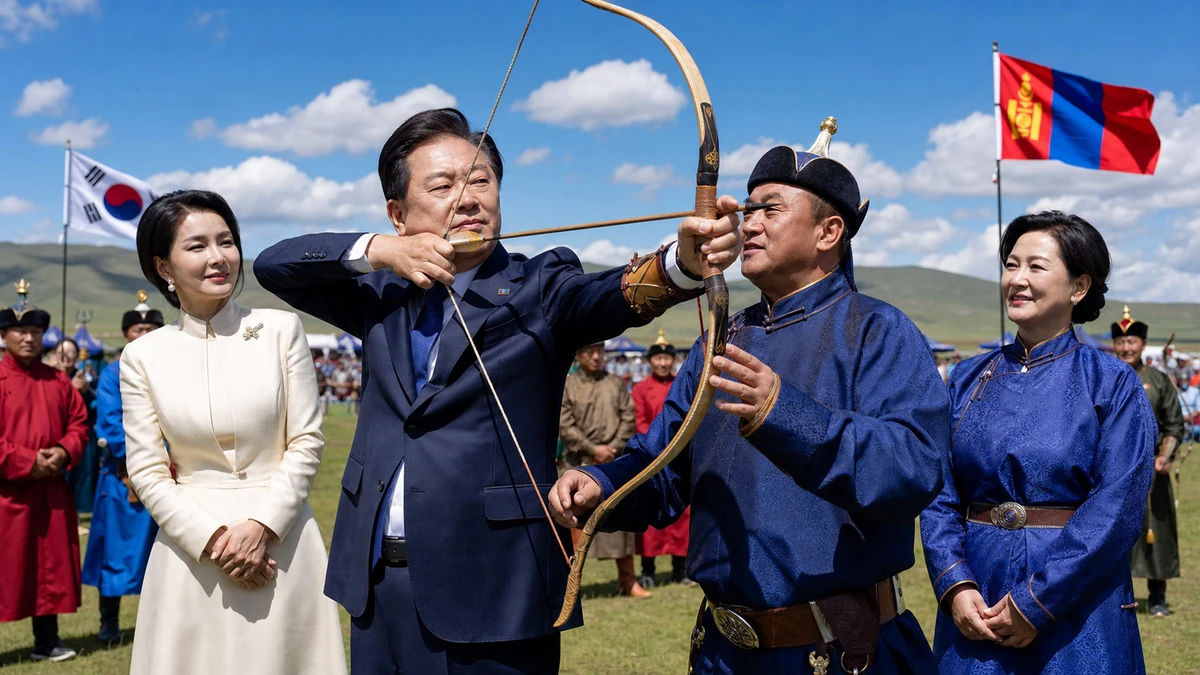
A diplomatic photo op with deeper meaning
When South Korean President Lee Jae-myung stood beside Mongolian President Ukhnaa Khurelsukh at the opening of the Naadam festival and tried his hand at traditional archery, the image was easy to read even without subtitles. One leader was not simply visiting another capital for a closed-door summit or a carefully staged signing ceremony. He was stepping onto one of Mongolia’s most symbolically charged public stages, taking part in a national celebration that carries the weight of history, identity and independence.
That matters because Naadam is not just another summer festival. For Mongolians, it is a cornerstone of national memory, a celebration tied to the country’s sovereignty and cultural inheritance. The event, often described as Mongolia’s biggest holiday, centers on what are known as the “three manly games” — wrestling, horse racing and archery — though today the festival is embraced as a broad national celebration that draws families, officials and visitors from across the country and abroad. To be invited as an official guest at Naadam is to be welcomed into a space that is part patriotic ceremony, part living museum and part popular spectacle.
According to the South Korean account of the visit, Lee became the first South Korean president to attend Naadam as an official guest of honor. That first is significant on its own. But it also comes at a moment when Seoul is trying to broaden its diplomatic reach beyond its traditional major-power relationships and deepen ties with countries that matter for energy security, supply chains and regional strategy. In that sense, Lee’s appearance at Naadam was not a detour from “real” diplomacy. It was diplomacy, carried out in a language ordinary people can see.
For American readers, the closest comparison may be a foreign leader attending a Fourth of July celebration on the National Mall, appearing at a presidential inauguration parade, or joining in a highly symbolic event that speaks to a country’s founding story. These moments are public, emotional and accessible in a way that official communiques rarely are. They do not replace policy agreements, but they can shape how those agreements are received.
That helps explain why the images from Ulaanbaatar drew attention beyond the usual diplomatic press coverage. In an era when politics is increasingly consumed through video clips and social media posts, a leader drawing a bow alongside his host can send a message as clearly as a paragraph in a joint statement: We respect your history. We want our publics to see that respect. And we want the relationship to feel bigger than transactions.
What Naadam means in Mongolia
To understand the importance of Lee’s appearance, it helps to understand Naadam itself. The festival is one of the most important events on the Mongolian calendar, with roots stretching back centuries. It is often associated with statehood, martial tradition and the endurance of Mongolian culture across periods of foreign domination and political change. Modern Naadam is festive and family-oriented, but it also carries a strong civic message about freedom, resilience and national pride.
That combination of pageantry and historical meaning makes Naadam different from a routine cultural stop added to a state visit for color. Foreign leaders regularly tour museums, attend banquets or watch performances meant to showcase local heritage. Naadam occupies a more central place than that. It is not cultural wallpaper. It is one of the country’s most recognizable expressions of who Mongolians believe themselves to be.
For U.S. audiences unfamiliar with Mongolia, it may help to picture an event that blends the symbolic energy of Independence Day, the athletic rituals of a state fair and the historic importance of a civic holiday tied to nationhood. The festival’s competitions are not random entertainment. Archery, in particular, draws on a tradition deeply associated with the Mongol past and the steppe culture that shaped it.
So when Lee attended the festival with first lady Kim Hye-kyung and sat with Khurelsukh and his wife at the opening ceremony before heading to the archery grounds, the visit conveyed something beyond courtesy. It suggested that South Korea was prepared to acknowledge Mongolia not just as a source of strategic minerals or as a partner in official talks, but as a country whose identity and historical memory deserve visible respect.
That kind of gesture can matter in countries that sit between larger powers and often have to guard against being treated as strategically useful but culturally invisible. Mongolia’s foreign policy has long included balancing relationships with powerful neighbors and cultivating what it sometimes calls “third neighbors,” countries beyond Russia and China that can help broaden its international space. South Korea, a middle power with its own experience navigating larger geopolitical pressures, has reason to present itself as a partner that understands symbolism as well as statecraft.
Archery as public diplomacy
After the opening ceremony, Lee joined the Mongolian president at an archery venue, where he handled a traditional Mongolian bow and took part in the experience rather than merely observing from the stands. On one level, it was a classic diplomatic image: two leaders smiling, engaging with local tradition and creating footage that can circulate widely at home and abroad. On another level, it showed how public diplomacy now works in a media environment that rewards scenes over speeches.
Public diplomacy is the part of foreign policy aimed not just at governments, but at people. It includes cultural exchanges, education programs, sports, media outreach and symbolic appearances meant to build familiarity and goodwill. The idea is simple: a relationship is stronger when it makes sense to the public, not only to bureaucrats and experts.
There is a reason governments invest in these moments. A joint declaration about supply chains may be strategically important, but it can be abstract even for attentive citizens. A clip of a foreign president trying a traditional sport is easier to understand instantly. It lowers the language barrier. It humanizes diplomacy. And it allows the host country’s public to see whether the guest appears genuinely engaged or merely checking a ceremonial box.
That does not mean such gestures should be overstated. Lee’s archery appearance was not a new treaty, and it did not create policy on its own. Symbolism is not substance. But effective diplomacy often involves linking the two. A state visit works best when formal meetings produce concrete agendas and public-facing events help anchor those agendas in a broader story about mutual respect.
American politics offers familiar versions of this dynamic. Presidents throw the ceremonial first pitch, visit culturally important sites, host state dinners with symbolic menus and music, or bring foreign leaders to places that help tell a national story. These acts are not trivial because they appear ceremonial. They are part of how governments signal values, warmth and political intent without having to say everything out loud.
In Lee’s case, the symbolism was sharpened by the fact that he was the first South Korean leader to attend Naadam as an official guest of honor. Firsts in diplomacy often function as markers of changing priorities. They tell both domestic and foreign audiences that a relationship is moving into a new phase — or at least that leaders want it to appear that way.
The harder policy issue behind the festival: minerals and supply chains
The cultural stop in Ulaanbaatar came after more conventional statecraft. During Lee’s visit, South Korea and Mongolia discussed expanding cooperation on supply chains for critical minerals, including rare earths and other strategic resources. That is the kind of subject that rarely produces memorable visuals but increasingly drives international relationships.
Rare earths and other critical minerals have become central to economic security debates from Washington to Seoul to Brussels. They are used in products ranging from electric vehicle batteries and semiconductors to defense technologies and renewable energy systems. Governments around the world are trying to reduce overdependence on any single supplier, particularly as competition with China sharpens and supply-chain shocks have exposed vulnerabilities.
Mongolia has drawn growing attention because of its resource potential. Landlocked between China and Russia, the country holds significant mineral wealth and has long tried to convert that endowment into broader strategic leverage. For South Korea, a manufacturing-heavy economy with deep exposure to global trade, finding stable and diversified sources of critical inputs is not a side issue. It is core economic strategy.
That is why the Naadam appearance should be read alongside, not apart from, the summit agenda. The two governments adopted a joint declaration calling for stronger strategic partnership and invoking the idea of a “golden era” in bilateral relations. Diplomatic language like that is often aspirational, and it should be treated carefully. It does not guarantee follow-through. Still, it signals that both capitals want to frame the relationship as expanding beyond isolated projects.
In practical terms, the pairing of minerals talks and festival diplomacy created a layered message. The official meetings handled the serious business of economics and security. The festival appearance translated the relationship into a public story ordinary citizens could grasp. One side addressed interests; the other addressed atmosphere. Together, they suggested a partnership that Seoul wants to present as both useful and respectful.
That approach is especially important when resources are involved. Countries rich in minerals often worry about being viewed merely as extraction sites. By visibly honoring Mongolia’s most important national festival, South Korea could signal that it is not approaching the relationship only through a transactional lens. Whether Mongolians accept that message over the long term will depend less on a ceremonial visit than on the terms of any actual cooperation, but the symbolism is part of the opening bid.
South Korea’s broader diplomatic balancing act
Lee’s stop in Mongolia was the final leg of a 3-night, 5-day overseas trip that also included diplomacy tied to NATO-related meetings in Turkey, according to the Korean summary. That itinerary reflects how South Korea increasingly operates as a country with global interests that extend well beyond the Korean Peninsula.
For decades, South Korean diplomacy was understandably dominated by North Korea, the U.S. alliance, relations with China and Japan, and trade. Those priorities remain. But Seoul in recent years has also worked to position itself as a broader middle-power player with stakes in defense exports, supply-chain resilience, technology standards and regional partnerships across Asia, Europe and the Middle East.
That expansion of scope has been driven partly by necessity. South Korea is one of the world’s most trade-dependent advanced economies. It cannot afford to treat geopolitics and economics as separate files. Semiconductor access, shipping routes, military procurement, energy supplies and critical minerals all intersect. So do public images and strategic goals.
Seen from Washington, this may look familiar. U.S. allies increasingly are expected to do more than manage bilateral ties with the United States. They are asked to contribute to networked partnerships that strengthen resilience across multiple regions and industries. South Korea has embraced much of that logic, while also seeking room to advance its own diplomatic brand.
That brand often emphasizes technological sophistication, cultural reach and a mix of hard and soft power. South Korea sells weapons and warships, but it also exports K-pop, film, TV dramas, beauty brands and cuisine. Its diplomacy increasingly mirrors that dual identity. A summit can involve defense industry talks one day and a highly visual cultural event the next.
Lee’s Naadam appearance fit squarely into that model. It followed talks on practical cooperation and capped the visit with an image-rich moment that suggested South Korea knows how to engage not just ministries, but audiences. In a world where soft power can open doors for hard-interest negotiations, that is a calculated choice.
Why this matters beyond Seoul and Ulaanbaatar
There is a tendency in international news to treat smaller bilateral stories as niche developments unless they involve war, sanctions or a major superpower. But the South Korea-Mongolia encounter is worth watching because it reflects a broader pattern in 21st-century diplomacy: middle powers are building denser relationships with one another, and they are doing it through a mix of strategic necessity and symbolic politics.
Mongolia is not a headline country in most American newsrooms. Yet it occupies an important geographic and political position, wedged between two authoritarian giants and trying to preserve autonomy through diversified diplomacy. South Korea, meanwhile, is often covered in U.S. media through the lens of North Korea, K-pop or trade disputes. This episode is a reminder that Seoul’s foreign policy is wider than those themes.
It also shows how culture and strategy are increasingly fused. Governments do not stage these appearances merely for charm. They understand that public sentiment can influence the durability of foreign partnerships. If citizens see a visiting leader taking their traditions seriously, it can create goodwill that formal documents alone cannot produce. If they see only resource deals and technical language, the relationship may look colder and more extractive.
There is also a domestic political angle. Leaders returning home want to show that they can pursue national interests abroad while projecting dignity and ease on the world stage. Images from Naadam allowed Lee to do that: he appeared engaged, welcomed and active in a moment larger than standard protocol. That matters in South Korean politics, where presidential diplomacy is closely watched and often judged as theater as much as policy.
None of this means the visit should be romanticized. Declarations about a “golden era” are easy to issue and harder to implement. Critical-mineral cooperation requires follow-through, investment, regulatory alignment and trust. Public diplomacy can warm a relationship, but it cannot substitute for sustained work. Still, state visits are partly about setting tone, and tone matters when governments are trying to build something bigger.
In that sense, Lee’s appearance at Naadam was a case study in how modern diplomacy functions. The summit room produced the language of partnership. The festival produced the image of partnership. One appealed to officials, investors and strategic planners; the other to broader publics in both countries and beyond.
For American readers, the takeaway is straightforward. South Korea’s president did not simply stop by a colorful local festival while traveling overseas. He showed up at the most symbolically important celebration in Mongolia, the first South Korean leader to do so as an official guest of honor, shortly after talks on critical minerals and strategic ties. The message was that Seoul wants this relationship to be seen as durable, respectful and multidimensional.
And in a geopolitical moment shaped by competition over resources, shifting alliances and the global race for influence, even a bow drawn at a festival can say quite a lot.


0 Comments