A Heat Wave Rewrites the Weekend
South Korea is in the grip of the kind of summer heat that does more than make people uncomfortable. It changes how cities move, how families spend their day off and which public spaces suddenly become essential. On Sunday, July 12, temperatures across much of the country climbed toward or past the mid-90s Fahrenheit, with some areas topping 96 degrees. In the southeastern cities of Gyeongsan and Pohang, officials issued what local authorities described as the season’s first severe heat warnings, underscoring how quickly dangerous weather has become a part of daily life.
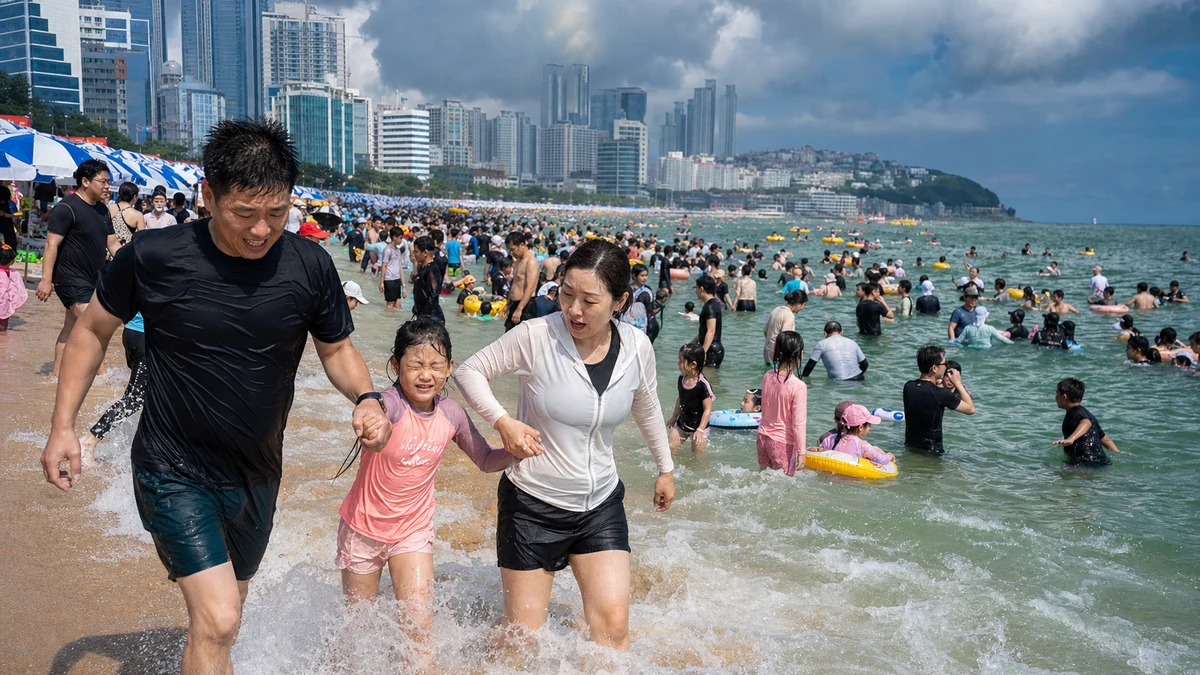
The result was visible not just on weather maps but on streets, beaches and shopping centers. Crowds poured into places where relief was possible: the surf at Busan’s famous beaches, the cool water of mountain valleys and air-conditioned indoor malls. At the same time, parks and tourist spots that would normally draw weekend foot traffic looked strikingly subdued. The contrast offered a revealing snapshot of modern urban life in South Korea, where people did not simply stay home because it was too hot. Instead, they recalculated.
That distinction matters. In much of the United States, extreme heat often gets covered as a story of cancellation: games called off, outdoor events delayed, residents urged to remain indoors. In South Korea, the same basic pattern exists, but the response often looks more spatial than absolute. Leisure does not disappear. It relocates. A punishing summer day becomes less about whether to go out than about where the body can endure being outside.
Sunday’s scenes showed that heat is no longer just a meteorological event. It is a condition that reorganizes public life. A beach with water access becomes more attractive than a famous scenic overlook. A shopping mall becomes more than a retail destination; it becomes an urban refuge. A stream or valley, long part of Korea’s summer culture, turns from a picturesque getaway into something closer to a heat-management strategy. In other words, extreme heat is not only raising temperatures. It is reshuffling the social map.
That shift has become increasingly important in a country where dense cities, intense seasonal humidity and a fast-moving public culture intersect. When the weather becomes oppressive, South Koreans often adapt with remarkable speed, altering weekend routines around cooling possibilities. What happened Sunday across the country was a vivid example of that flexibility — and a sign of how climate pressures are quietly redefining ordinary leisure.
Why the Beaches Filled Up
In Busan, South Korea’s second-largest city and a major coastal destination, Haeundae and Gwangalli beaches became magnets for residents and visitors seeking immediate relief. By afternoon, beach umbrellas dotted the sand in bright colors and swimmers crowded the shoreline. To American readers, Haeundae might be understood as a cross between Miami Beach and Santa Monica in terms of name recognition, though more compact and woven into the rhythms of everyday urban life. Gwangalli, known for its broad waterfront views and the illuminated Gwangan Bridge, is another iconic destination where city nightlife and beach culture meet.
On a day like this, however, the beaches functioned less as postcard attractions and more as practical cooling infrastructure. Water changes the value of outdoor space. Under direct sun, a plaza or park may become nearly unusable in the hottest hours. A shoreline where people can wade, swim or at least feel sea breeze offers an entirely different experience. That was the basic calculus driving the crowds. The same heat that emptied other sightseeing spots intensified the appeal of the coast.
South Korea’s beach culture also carries its own distinct rhythms. Public beaches are highly organized spaces, often with designated swimming zones, rental umbrellas and heavy summer visitation concentrated into a relatively short season. Families, couples and friend groups tend to use them as all-day destinations. On especially hot weekends, they become a collective outlet, a place where relief is public and visible. What Americans might think of as a “beach day” took on a sharper edge Sunday: it was recreation, certainly, but also adaptation.
The influx was shaped by timing as much as by temperature. Sundays in South Korea remain an important day for family outings and short domestic trips, particularly for workers and students coming off demanding weekly schedules. When a severe heat wave collides with one of the few widely shared leisure windows in a high-pressure society, behavior can change quickly. People do not necessarily give up the outing. They choose the version of the outing that offers the best chance of tolerating the weather.
That helps explain why the beaches were crowded even as other tourist areas went quiet. Popularity alone was not the deciding factor. Comfort was. In extreme summer weather, a destination’s status matters less than whether it offers shade, water or cooling systems. The day’s beach crowds illustrated that the real competition was not between one attraction and another. It was between places that could blunt the heat and places that could not.
The Korean Summer Escape: Valleys, Streams and Water as Refuge
Just as the beaches filled, so did streams and valleys in other parts of the country. That pattern may be less familiar to American readers, but it is deeply recognizable in Korea. In the summer, mountain valleys and shallow creekside recreation areas become a classic form of escape, especially for people who want relief without committing to a long vacation. In a mountainous country crisscrossed by short drives and day-trip destinations, a valley with cold running water can serve much the way a lake house, riverbank or state-park swimming hole might in the United States.
These areas are often valued not simply for scenic beauty but for their cooling effect. Sitting with feet in the water, eating outdoors near a stream or spending a few hours in a shaded valley is a longstanding seasonal practice. On extremely hot days, that tradition becomes more than nostalgic. It becomes functional. A place that might seem modest on a mild day suddenly has a major advantage over more famous landmarks with little tree cover and no water access.
That dynamic was especially visible because South Korea is also in the midst of the jangma season, the summer monsoon period that typically brings heavy rain, humidity and thick cloud cover. For Americans, the closest comparison may be a Gulf Coast summer stretch when air feels heavy enough to wear, except compressed into a more mountainous, densely populated landscape. When a break in monsoon rain coincides with temperatures climbing into the mid-90s, the effect can be brutal. Heat feels amplified, and water-centered destinations become even more desirable.
There is a broader cultural point here. Korean summer leisure has long balanced movement and practicality. It is not only about checking famous sites off a list. It is also about finding spaces where families and groups can actually stay comfortable for hours. In that sense, valleys and streams represent a form of seasonal commons. They are places where nature, accessibility and heat relief overlap. As the country grows hotter, their value appears to be rising.
Sunday’s rush to those places suggested that people were making highly rational choices in real time. They were not merely “beating the heat” in the abstract. They were sorting destinations by physical usability. Could you step into water? Could you sit in the shade? Could children play without baking in the sun? Those practical questions are becoming central to how summer weekends are organized, not just in Korea but increasingly around the world.
When Famous Places Go Quiet
One of the most telling details from Sunday was not where the crowds went, but where they did not. Tourist spots that would normally be busy were noticeably sparse if they lacked a reliable way to escape the sun. In Jeonju, for example, Se-byeong Park in Deokjin District was reported to be far quieter than usual despite its normal popularity with families and local residents. That image — a known public gathering place subdued by heat — captured the day’s split-screen reality.
It is easy to assume that tourism rises and falls mainly on reputation, season or calendar. But extreme weather increasingly scrambles those assumptions. A photogenic place may lose out to a less famous one if it offers no shade, no cooling breeze and no nearby water. In that way, heat wave weekends create a kind of unofficial ranking system based less on prestige than on survivability. The tourist economy does not vanish. It sorts itself according to thermal comfort.
That kind of sorting may sound obvious, but it reveals a subtle shift in public behavior. Under normal circumstances, people might choose a destination because it is trendy, scenic or culturally significant. Under extreme heat, the deciding factor can become tactile and immediate: how the place feels on the skin. Can you remain there without exhaustion? Can older adults and children endure it? Does the site let you cool down rather than just look around?
Those questions also reflect South Korea’s dense urban geography. Public space in Korean cities is intensely used, and many well-known attractions are embedded in built-up environments with heat-retaining pavement, limited wind flow and crowded pedestrian areas. On a relatively mild day, those same features can produce energy and convenience. On a brutally hot day, they can make an outing feel punishing. The places that held onto visitors Sunday were the ones that provided an escape valve.
What emerged across the country was not a collapse of leisure but a redistribution of it. Heat thinned crowds in conventional sightseeing areas while packing them into a narrower set of destinations with obvious cooling value. That creates winners and losers in real time: waterfront districts, valleys and indoor complexes gain traffic, while exposed parks, plazas and open-air attractions lose it. In practical terms, the country’s leisure map was redrawn by temperature.
The Mall as Modern Shelter
For many South Koreans, the answer was not the beach or the mountains at all. It was the mall. Air-conditioned shopping centers drew people looking for a place to spend time without enduring direct heat, highlighting how the line between consumer space and refuge has blurred in modern city life. In the United States, malls have long served as informal climate-controlled gathering places, especially for teenagers, older adults and families during cold winters or hot summers. South Korea’s large indoor retail complexes now play a similar role, often on an even more integrated scale.
These spaces can include restaurants, entertainment facilities, supermarkets, cafes and long indoor walking routes, making them practical all-in-one destinations. On an oppressive weekend, they allow people to preserve the idea of going out without exposing themselves to the harshest conditions. A trip may begin as shopping, but it also functions as cooling, socializing and passing time. The point is not always to buy something specific. Often it is simply to spend several hours somewhere comfortable.
This reflects a wider change in urban leisure patterns. As climate extremes intensify, cities increasingly rely on privately operated indoor spaces to absorb public demand for comfort. That raises familiar questions for Americans as well: What happens when essential forms of climate refuge are tied to commercial spaces? Who has access? How do public parks and civic destinations compete when thermal comfort is unequally distributed?
In South Korea, where summer humidity and heat can become severe and urban convenience is highly prized, the appeal of these indoor environments is especially strong. They offer predictability. Unlike outdoor attractions, they do not require visitors to gamble on whether the day will become unbearable. On Sunday, that predictability made them part of the same broader movement that filled beaches and valleys. People were not rejecting leisure. They were redefining it around temperature control.
The mall, in that sense, has become a kind of contemporary summer shelter. It is not as romantic as the beach or as traditional as a valley stream, but it meets the same need. On an extreme weather day, cold air can be just as decisive as ocean water. The popularity of indoor shopping centers Sunday showed how thoroughly modern leisure habits now overlap with adaptation to climate stress.
The Numbers Behind the Heat
The weather data help explain the scale of the shift. In Gyeongju, a historic city known for ancient royal tombs and major heritage sites, the temperature reportedly reached 36.5 degrees Celsius, or about 97.7 Fahrenheit, by 2 p.m. Pohang and Yeongdeok hit 36 Celsius, roughly 96.8 Fahrenheit. Daegu, one of South Korea’s hottest major cities and often compared to an inland heat bowl during summer, reached 35.8 Celsius, or 96.4 Fahrenheit. Automatic weather observations in several neighborhoods and towns registered similar highs, including 36.8 Celsius in one part of Gyeongju.
Elsewhere, the heat was hardly isolated. In North Jeolla Province, readings around 35 Celsius, or 95 Fahrenheit, were reported in multiple areas. Heat advisories were broadly in effect. The point was not that one city had an especially bad afternoon. It was that much of the country was experiencing the same basic condition at once. That broad geographic spread reduced people’s alternatives and intensified the sorting effect. When extreme heat is widespread, cooler-seeming destinations become even more crowded because there are fewer meaningful escapes.
For readers in the United States, the temperatures may not sound unprecedented compared with parts of Arizona, Texas or Nevada. But humidity, urban density and local infrastructure make those figures more consequential than they might appear on paper. A mid-90s day in a humid East Asian summer can feel punishing, especially when combined with concrete-heavy cityscapes and limited shade. What matters is not only the thermometer reading but the body’s experience of it.
South Korea has also been confronting a broader pattern that many countries now know well: hotter summers, more frequent heat advisories and growing awareness that high temperatures are a public-safety issue, not just a seasonal inconvenience. The formal warning issued in Gyeongsan and Pohang signaled that authorities view this as a dangerous event, especially for older adults, outdoor workers, children and those with health conditions.
Yet Sunday’s public behavior showed another side of the heat story. Even under dangerous conditions, daily life continues. Families still want to be together. Young people still want to meet friends. Workers still use weekends to decompress. The issue is not whether those desires disappear. The issue is how they get rerouted when the weather turns oppressive. The answer, on this weekend, was visible in every crowded beach, every busy indoor retail floor and every quiet park baking under the sun.
What This Says About Climate and Urban Life
The most important lesson from Sunday may be that extreme heat does not affect all places equally, even within the same city and on the same afternoon. Two neighborhoods can experience the same official temperature and feel like entirely different worlds depending on access to shade, water, breeze or air conditioning. That reality is changing how leisure works, but it also points to a larger challenge for urban planners, tourism officials and public-health authorities.
If summers continue to intensify, destinations that once relied on scenery or reputation alone may have to rethink what they offer. Shade structures, misting stations, cooling centers, splash features and more heat-conscious design could become as important as marketing campaigns. The concept of a successful summer destination may be shifting from “most beautiful” or “most famous” to “most livable under stress.” That is as true for a Korean beachfront as it is for a downtown park in Chicago or a public square in Phoenix.
There is also a social dimension. When people cluster into a smaller number of heat-tolerable spaces, crowding itself can become part of the problem. Beaches overflow. Indoor venues grow packed. Traffic patterns shift. Some areas become uncomfortably congested while other parts of the city sit nearly empty. Extreme heat, in that sense, is not just an environmental issue. It is a force that redistributes bodies, commerce and attention in uneven ways.
South Korea offers a particularly vivid case because its cities are dense, its domestic travel culture is fast-moving and its summer leisure habits are highly adaptive. Sunday’s scenes showed a public making fast judgments about where comfort was possible and where it was not. They also showed how resilient those habits can be. People did not simply surrender the weekend. They remapped it.
That image may resonate far beyond Korea. As climate change drives hotter summers across continents, more cities are likely to experience the same pattern: a visible divide between places built for heat resilience and places left exposed. On one side are beaches, streams, cooled interiors and shaded refuges. On the other are open plazas, exposed parks and attractions designed for a gentler climate than the one now arriving. Sunday in South Korea was not just a weather story. It was a preview of how ordinary life gets reorganized when heat becomes one of the main forces shaping where people can comfortably exist.
For now, the takeaway is straightforward. In South Korea’s intensifying summer, leisure has not disappeared. It has become tactical. Families, couples and groups of friends are still going out, still claiming their day off, still searching for pleasure. But they are doing so under a new rule set written by temperature. Where there is water, they gather. Where there is air conditioning, they linger. Where there is only direct sun, they move on.
Comments
Post a Comment