As Seoul’s Heat Wave Intensifies, the City Checks on Seniors Living Alone and Expands Street Outreach for the Homeless
Heat in Seoul Is Becoming a Public Safety Test
As a punishing summer heat wave settles over South Korea, officials in Seoul are treating the weather not simply as a forecast problem but as a human one. The city government has stepped up efforts to protect residents considered most at risk in extreme heat, especially older adults who live alone and people experiencing homelessness. On Sunday, with high temperatures pressing down on the capital and much of the country, Seoul said it had strengthened its response by expanding welfare checks, field visits and street-level outreach.
According to South Korean officials, Seoul and its district governments are operating emergency heat response situation rooms staffed by about 430 workers. Their job is not limited to tracking temperatures. They are monitoring weather conditions, watching for signs of heat-related harm and checking whether protective measures are actually reaching the people most vulnerable to illness or death in extreme heat.
That distinction matters in a city of nearly 10 million people, where the danger of a heat wave can vary sharply depending on who you are and where you live. A healthy office worker with air conditioning and a support network faces a different risk than an older person living alone in a cramped room or someone sleeping outside. Seoul’s latest response reflects a growing recognition seen in cities around the world: extreme heat is not just an inconvenience of summer. It is a public health emergency that exposes existing inequalities.
For American readers, the logic may sound familiar. Cities in the United States from Phoenix to Chicago to New York have spent years grappling with how to protect older residents, unhoused people and others during dangerous heat. But Seoul’s approach stands out for how much it depends on something remarkably simple: calling someone to ask whether they are OK, and if they do not answer, going to find them.
That basic act of checking in can become a lifeline. In a dense, fast-moving global city often known abroad for K-pop, technology and luxury retail districts, the latest heat response highlights a less visible side of urban governance in South Korea — one built on relentless monitoring, neighborhood administration and direct contact with people who may otherwise be overlooked.
A Phone Call Can Trigger an In-Person Rescue
At the center of Seoul’s response is a welfare-check system aimed at older residents in especially precarious living situations, including some who live in what Koreans call “jjokbang,” or tiny subdivided rooms. The term refers to extremely small single-room dwellings, often found in older neighborhoods and typically associated with poverty, social isolation and difficult living conditions. While not identical to the shelter system or low-income housing Americans may know, jjokbang communities can function as a last-stop form of housing for people with few resources and limited family support.
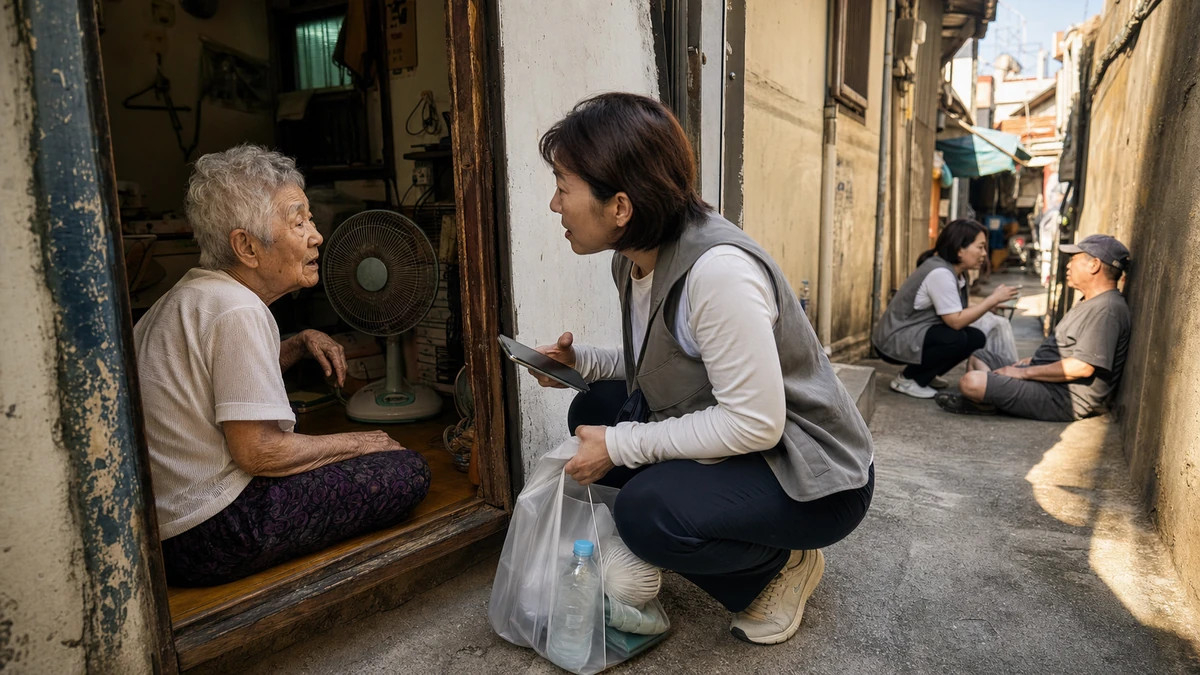
City workers or affiliated care personnel place phone calls to older residents considered vulnerable in the heat. The goal is straightforward: confirm that the person is safe, responsive and physically managing. If the resident answers, officials can ask about symptoms, immediate needs and whether further help is required. If there is no answer, that silence is treated not as a bureaucratic inconvenience but as a warning sign.
From there, the response escalates. When a call does not go through, officials or care workers make an in-person visit to check on the resident’s condition. In policy terms, the system links remote monitoring with field intervention. In human terms, it means the city is trying not to let a person disappear behind a closed door during a stretch of dangerous weather.
That may sound almost old-fashioned in an era of smart-city branding and AI-assisted urban management. But Seoul’s strategy underscores a reality emergency planners know well: not every crisis is solved by a sensor, an app or a push alert. The people most vulnerable to heat are often those least able to benefit from digital tools. Some may have health problems, mobility challenges, low incomes or weak social ties. Some may not seek help even when they need it. For them, the most effective intervention may begin with a real person on the other end of the line.
The model also addresses a particular danger of living alone. In many heat emergencies, the people at greatest risk are not necessarily those in the hottest places but those with the fewest opportunities to be noticed. If a family member, roommate or neighbor is nearby, signs of heat distress may be caught early. When someone lives alone, a medical crisis can remain invisible until it is too late. Seoul’s approach is designed to shrink that gap.
In the United States, the deadly 1995 Chicago heat wave became a defining example of how isolation can turn extreme weather fatal, particularly for older adults cut off from social support. Public health researchers have long emphasized that heat deaths often reflect not only temperature but also loneliness, poverty and weak community networks. Seoul’s call-and-visit system reflects that same lesson, translated into Korean local governance.
Why Seoul Focuses on Seniors and the Homeless
The city’s intensified response focuses on two groups for good reason. Older adults, especially those living alone, are physiologically more vulnerable to heat-related illness. They may be less able to regulate body temperature, more likely to have chronic medical conditions and more likely to take medications that complicate heat exposure. They may also be reluctant to use air conditioning because of cost concerns, a familiar issue in many countries including the United States.
People experiencing homelessness face a different but equally acute set of risks. Without stable housing, they are directly exposed to high temperatures, hot pavement, poor air circulation and limited access to water, shade and rest. They also may have underlying medical or mental health conditions that make sustained heat especially dangerous. For someone living outdoors, a heat advisory is not just information; it is a threat that cannot easily be avoided.
Seoul said it has increased management personnel in areas where homeless residents are concentrated and expanded counseling and patrol activities. The city’s outreach workers are not simply passing through. They are checking conditions on the ground, speaking directly with people in need and maintaining a presence in the areas where heat danger is most immediate.
The use of patrols and counseling together is significant. Patrols help authorities identify where people are staying and whether anyone appears to be in distress. Counseling can connect individuals with available services, cooling support or other assistance. This is an active model of care, one that does not wait for vulnerable people to enter a government office or request aid through formal channels.
That point is especially important in the South Korean context. Like many wealthy countries, South Korea is rapidly aging, and it also faces persistent problems of elder poverty and social isolation despite its advanced economy. The country has long wrestled with gaps between headline prosperity and the realities facing some older residents, particularly those with little family support. Meanwhile, homelessness in Seoul can be less visible to outsiders than in some large American cities, but it remains a real and complicated issue shaped by housing costs, labor insecurity and mental health needs.
By pairing outreach to older residents in vulnerable housing with expanded street-level engagement for the homeless, Seoul is acknowledging that heat does not strike evenly. The city is effectively sorting risk not just by age or income, but by living conditions. That is a critical distinction. Two people can experience the same official temperature yet face entirely different odds of harm depending on whether they are alone, indoors, outside, reachable or invisible.
Inside the 430-Person Heat Response Network
Seoul’s heat response situation rooms, operated by both the city government and local district offices, are staffed by roughly 430 people. In a megacity, that kind of coordination matters. Seoul is not a place where weather can be treated as a single, uniform experience. High-rise business districts, older low-rise neighborhoods, transit hubs, riverside areas and clusters of vulnerable housing all create different patterns of exposure.
Officials say the emergency monitoring teams are tracking multiple streams of information at once: weather updates, reported damage, signs of health impacts and the status of protective measures for vulnerable groups. In other words, the system is meant to connect information with action. Knowing that temperatures are climbing is only the first step. The harder question is whether the city’s response is reaching the right people fast enough.
That operational focus may sound technocratic, but it reflects a central challenge of heat policy everywhere. Heat can kill quietly. Unlike a typhoon, wildfire or flood, it often leaves behind no single dramatic scene that captures public attention. The danger accumulates through dehydration, exhaustion, missed medication, poor ventilation and delayed treatment. Governments therefore have to manage not just a weather event but a chain of small, often private vulnerabilities.
That is where a staffed situation room becomes more than an administrative box to check. It serves as a hub connecting district-level updates, welfare checks, field visits and homeless outreach into one system. If a person cannot be reached by phone, that information needs to move quickly. If a patrol finds someone in distress, services need to respond. If conditions worsen in one part of the city, staffing and attention may need to shift there. Speed matters because the difference between discomfort and medical emergency can narrow quickly in extreme heat.
For Americans accustomed to hearing about emergency operations centers during hurricanes or winter storms, Seoul’s response may be understood as a heat-focused version of the same idea. The difference is that the frontline action here is often intimate rather than dramatic: a list of names, unanswered calls, a knock on a door, a counselor on a street corner, another patrol through a familiar district.
There is also a broader lesson in the scale of the staffing. Extreme heat is often discussed as a climate issue, and it is one. But it is also a labor issue. Effective response requires people — people to monitor, call, visit, patrol, coordinate and follow up. The existence of 430 workers in this system suggests that Seoul views heat response not as a passive communications exercise but as a service operation requiring constant human involvement.
A Broader Korean Context: Heat, Aging and Urban Vulnerability
Sunday’s response in Seoul came as strong heat affected other parts of South Korea as well. In the southeastern city of Daegu and much of the surrounding North Gyeongsang region, temperatures climbed to dangerous levels. Authorities reported readings including 36.5 degrees Celsius, or about 97.7 Fahrenheit, in Gyeongju; 36 Celsius, or 96.8 Fahrenheit, in Pohang and Yeongdeok; and 35.8 Celsius, or roughly 96.4 Fahrenheit, in Daegu by midafternoon.
Numbers like those are familiar to many Americans enduring hotter summers across the country. But in dense urban areas, the danger is magnified by humidity, concrete, limited nighttime cooling and unequal access to climate control. Seoul, like many major Asian cities, must confront the urban heat island effect, in which built-up areas trap warmth and remain hotter than surrounding zones. For people in small rooms, older buildings or unstable housing, heat can become oppressive even if official readings only tell part of the story.
There is also a demographic angle Americans may not immediately associate with South Korea’s global image. The country is aging rapidly, and Seoul is home to many older residents who live alone. In Korean society, family care has historically played a major role in supporting elders, shaped in part by Confucian values emphasizing filial responsibility. But modern urban life, smaller families, low birthrates and economic pressures have all strained those traditional arrangements. As a result, local governments are increasingly stepping into roles once assumed to belong primarily to family or community networks.
That helps explain why a city-run welfare check can carry cultural weight beyond its practical function. It is not merely an administrative contact. It reflects a shifting social reality in which the state is more directly involved in maintaining a safety net for people who may no longer be protected by older patterns of family support.
The reference to jjokbang residents also points to a less glamorous side of South Korea’s housing landscape. International coverage of Seoul often focuses on luxury apartments, soaring property prices and stylish neighborhoods. Yet the city also contains deeply unequal housing conditions. Tiny single-room dwellings, basement units and other precarious forms of housing remain part of the urban fabric, and they can become dangerous in extreme weather. Heat does not affect all homes equally. A person in an air-conditioned tower and a person in a cramped room with poor ventilation do not experience the same city.
Seen in that light, Seoul’s latest heat measures are about more than weather. They are a window into how one of Asia’s most advanced cities is trying to manage the frictions of aging, poverty and climate stress all at once.
What Other World Cities Can Learn From Seoul
There is nothing flashy about asking, “Are you OK?” But that question can be the backbone of an effective heat policy. Seoul’s approach offers a model other cities may want to study, not because it relies on cutting-edge technology, but because it treats heat as a social condition requiring direct contact with people at risk.
Too often, official heat responses stop at public warnings: drink water, avoid the outdoors, check on neighbors. Those messages are useful, but they assume people have the resources, mobility and support to act on them. The residents Seoul is targeting may not. Some may be isolated. Some may be frail. Some may be living outside. Some may not have anyone else checking on them. In those cases, the burden cannot rest solely on the individual.
What Seoul appears to be doing is converting abstract weather information into a chain of concrete interventions. A forecast leads to staffing. Staffing leads to monitoring. Monitoring leads to calls. Unanswered calls lead to visits. Street conditions lead to more patrols and counseling. It is a system built around the idea that vulnerability must be tracked actively, not merely acknowledged.
That philosophy resonates far beyond South Korea. As climate change drives more frequent and intense heat events, city governments around the world are being forced to rethink what emergency management looks like. Heat is different from storms that arrive and pass with obvious destruction. It is slower, quieter and often deadlier than it appears. Effective policy therefore depends on identifying who is at risk before tragedy is visible.
Seoul’s example also suggests that urban resilience is not only about infrastructure, cooling centers or predictive analytics, though those all matter. It is also about organizational discipline and repeated human contact. Who answered the phone? Who did not? Who needs a visit? Which neighborhoods require more workers on the street? Those questions may lack the grandeur of climate summits or smart-city marketing, but they are where public safety becomes real.
For American readers, the story from Seoul may land as both foreign and familiar. The language, housing categories and local administrative structures are different. Yet the underlying challenge is one that U.S. cities know well: how to protect people who are easiest to miss when the weather turns dangerous. In that sense, Seoul’s heat response is not just a Korean story. It is a preview of the kind of urban care that a hotter world will increasingly demand.
And perhaps that is the most striking part of the city’s approach. In a crisis driven by rising temperatures and shaped by global climate trends, one of the most meaningful interventions remains intensely local and personal. A phone call. A doorstep visit. A patrol through a neighborhood. A counselor stopping to talk with someone on the street. In a city as large and complex as Seoul, those small acts can mean the difference between being monitored and being forgotten.
Comments
Post a Comment