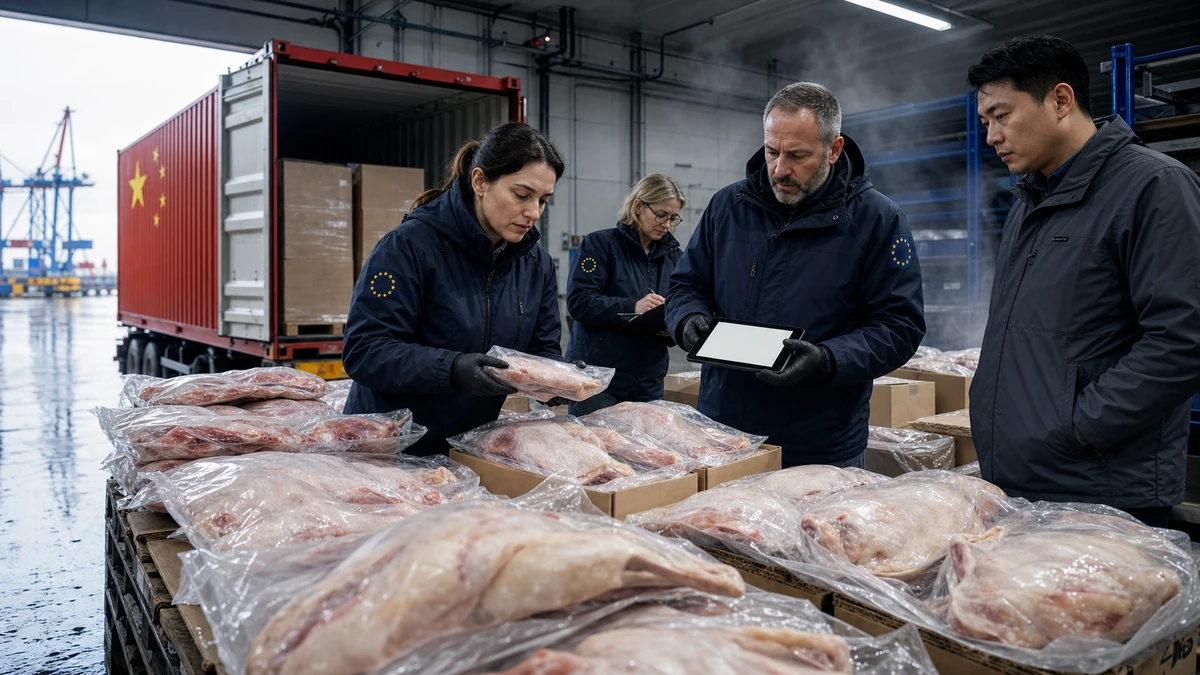
A trade dispute lands in an unexpected place: duck
The European Union has opened an anti-dumping investigation into duck meat imported from China, widening a long-running trade confrontation that, until recently, has been defined mostly by electric vehicles, batteries, solar panels and other strategic industries. On its face, duck may seem like an unusual flashpoint. It does not carry the geopolitical symbolism of semiconductors or the economic weight of automobiles. But the EU’s decision to formally examine whether Chinese duck has been sold in Europe at unfairly low prices shows how trade tensions can migrate quickly from factory floors to grocery shelves.
According to the European Commission, the EU’s executive arm, the inquiry will look at whether duck meat from China entered the European market below normal market value and whether that pricing was linked to state support. The commission’s notice cited allegations involving subsidies, low-interest loans and access to low-cost feed, all of which could reduce production costs and give exporters an edge that European producers say is not the result of fair competition.
If the investigation finds evidence of dumping and injury to European producers, the bloc could impose anti-dumping duties on Chinese duck imports. The potential scope is broad: fresh, frozen and smoked duck products are all covered. That matters because it suggests the case is not aimed at one niche processed product or a narrow loophole in the market. It is a full trade-defense procedure that could reshape a category of agricultural imports across the EU.
For American readers, the issue may sound technical, but the underlying idea is familiar. The United States has long used anti-dumping and countervailing duty laws to challenge imports it believes are being sold unfairly cheaply, whether the products are steel, lumber, washing machines or seafood. The basic argument is the same here: low prices are not automatically illegal, but if those prices are made possible by government support or below-cost selling that harms domestic producers, governments can step in.
In that sense, Europe’s duck case is about much more than poultry. It is an early sign that a broader contest over industrial policy, subsidies and supply-chain power is now reaching food markets, where politics can be even more sensitive because they touch household budgets, rural employment and national ideas about self-sufficiency.
Why this matters beyond one poultry product
Trade disputes usually attract headlines when they involve glamorous or strategic sectors. Electric cars fit a bigger story about the green transition. Advanced manufacturing raises national security concerns. Chips and telecommunications easily become symbols of who leads the next era of technology. Duck meat does not seem to belong in that lineup.
But agriculture and livestock have always been politically charged terrain. Food is not just another commodity. It is tied to inflation, farming livelihoods, land use, public health and cultural habits. In Europe, as in the United States, farmers are often a politically influential constituency, and governments are highly sensitive to complaints that imported food is undercutting domestic production.
That is one reason the EU move deserves attention. It suggests Brussels is increasingly willing to scrutinize not only China’s role in high-tech manufacturing but also the way Chinese policy may affect lower-profile sectors that are still economically and socially important. If officials conclude that state-backed pricing pressure in agriculture deserves the same kind of trade response as subsidized industrial exports, the precedent could travel well beyond duck.
The case also underscores a broader reality of today’s global economy: the line between industrial policy and ordinary consumer goods is blurring. Feed prices, access to credit, transport support and local government incentives can all shape the final price of a food product just as tax credits, cheap land and energy subsidies can shape the cost of a battery or a solar panel. Once policymakers begin looking at state support along the entire production chain, almost any sector can become a trade battleground.
That is especially true in a period when many governments are rethinking the old assumption that cheaper imports are always an unqualified benefit. After years of supply-chain shocks, pandemic disruptions and inflation spikes, officials in Washington, Brussels and other capitals are more willing to ask whether low prices come with hidden long-term costs, including weakened domestic capacity and greater dependence on foreign suppliers.
What an anti-dumping investigation actually means
For non-specialists, “dumping” can sound like a political accusation rather than a legal term. In trade law, however, it has a fairly specific meaning. Dumping generally refers to a product being exported at a price lower than its normal value, often understood as the price in the home market or a price that does not reflect fair commercial conditions. An anti-dumping investigation does not presume guilt. It is a formal process to determine whether such pricing occurred and whether it materially harmed producers in the importing market.
That distinction is important. The EU has not yet imposed new duties, and opening an investigation is not the same as concluding one. Officials must examine pricing data, cost structures, market effects and the extent to which domestic producers were injured. The investigation may also look at whether low prices were the result of efficiency and scale, which are legitimate advantages, or whether they were supported by measures such as subsidized feed, favorable financing or other government interventions that distorted normal competition.
There is also an important legal and political difference between anti-dumping duties and broader tariffs. Anti-dumping measures are presented as targeted trade remedies, not blanket punishment. They are designed to offset what authorities determine to be the margin of unfair pricing. In practice, of course, they can still carry major diplomatic consequences and intensify tensions between trading partners.
In the United States, similar cases have long been part of the trade toolkit. American industries from steel to shrimp have petitioned for relief when they believed imports were being sold below fair value. The politics follow a recognizable script: domestic producers argue that they are being squeezed by artificially cheap imports, while importers and some retailers warn that trade barriers will raise prices for consumers and reduce choice. Europe now appears poised to have that same debate over duck.
The breadth of the EU case matters here. By covering fresh, frozen and smoked duck meat, the investigation reaches across multiple points in the supply chain and retail market. That means the outcome could affect wholesalers, restaurants, specialty food sellers and supermarket channels, not just a narrow class of importers. It also increases the symbolic weight of the case. Brussels is not merely checking one obscure customs category; it is testing whether a whole stream of agricultural trade should face new barriers.
The consumer-versus-producer dilemma, in Europe and beyond
At the heart of almost every trade remedy case is a tension that elected officials rarely resolve cleanly: the interests of consumers do not always align with the interests of producers. Cheaper imports can help keep food prices down, an especially appealing outcome after years of inflation that have strained household budgets on both sides of the Atlantic. For consumers, lower-priced duck could simply mean more affordable options at restaurants and grocery stores.
For domestic producers, though, the picture looks different. If imported products are cheaper because another country’s government helped suppress costs, local farmers and processors can argue that they are competing on an uneven playing field. In that view, low prices are not the reward for efficiency but the result of policy distortion. Over time, producers say, that can hollow out local industries, reduce investment and leave markets dependent on foreign suppliers who may later raise prices after rivals have been weakened.
This debate is familiar in the United States. Americans have seen versions of it in fights over Chinese steel, Canadian lumber and imported seafood. They also see it in farm policy, where Washington itself subsidizes and protects sectors it considers politically or strategically important. Europe is navigating the same uncomfortable balance: how to defend its producers without appearing to punish consumers or close off trade too aggressively.
Food makes that balancing act even harder because it is immediate and visible. A dispute over machine tools might matter deeply to manufacturers, but a dispute over meat can eventually show up in retail prices, restaurant menus and public conversations about cost of living. In Europe, where food standards, local agriculture and regional culinary identity are often politically charged topics, a duck meat case can resonate beyond the size of the market itself.
The question for EU officials, then, is not whether lower prices are good in the abstract. It is whether those prices emerged from legitimate competition or from state-backed distortions. That may sound like a technical legal inquiry, but it gets to a central issue in modern trade politics: when does government support become so consequential that free trade no longer looks meaningfully free?
How China and the EU reached this point
The investigation arrives against a backdrop of worsening trade friction between Brussels and Beijing. For the past several years, European officials have grown more skeptical of China’s economic model, especially in sectors where Chinese producers have expanded rapidly and European competitors complain of unfair conditions. Electric vehicles have been the most visible example, with the EU examining whether Chinese EV makers benefited from subsidies that allowed them to gain share in Europe at artificially low prices.
What makes the duck case notable is that it moves the argument out of futuristic industries and into agriculture, one of the oldest and most politically protected sectors in the world. That shift matters because it suggests European concerns are not limited to one Chinese export success story. Instead, Brussels appears increasingly focused on the structure of state support itself and whether it creates systemic pricing advantages across many parts of the economy.
The European Commission’s reference to subsidies, preferential loans and low-cost feed points to exactly that concern. These are not isolated pricing quirks; they are elements of a broader production environment. If investigators conclude that such support significantly reduced the cost base for Chinese duck producers, the case could reinforce a growing European belief that Chinese state involvement in the economy is not a side issue but the central trade issue.
From Beijing’s perspective, such cases are often viewed as protectionist attempts to contain competitive Chinese industries. Chinese officials have repeatedly argued that Western governments invoke fairness selectively, especially when domestic producers struggle to match China’s scale, efficiency or manufacturing depth. That argument is likely to surface again if the duck inquiry moves toward punitive duties.
What comes next could matter beyond Europe. Other governments often watch EU trade cases for clues about legal strategy and political mood. If Brussels succeeds in building a persuasive case around state support in agriculture, it may encourage similar complaints elsewhere involving meat, seafood, grain or processed foods. In that sense, the issue is not simply whether Europe imports too much Chinese duck. It is whether agriculture is becoming the next front in a much larger contest over how open global markets should be when states play a heavy role in shaping prices.
Why Americans should pay attention
For U.S. readers, a dispute over duck imports into Europe may seem remote, but it touches several themes that increasingly define global economics and foreign policy. The first is the return of activist trade policy. For years, many policymakers treated free trade as a mostly self-evident public good, even if it produced local losers. That era is over. Washington and Brussels now speak far more openly about resilience, strategic sectors, industrial policy and the need to defend domestic production.
The second is that trade fights are no longer confined to the kinds of heavy industries that dominate traditional economic coverage. They increasingly spill into sectors that ordinary consumers notice directly, including food. Americans have already seen how vulnerable food systems can be to disease outbreaks, shipping disruptions, labor shortages and geopolitical shocks. Once governments begin framing food not only as a matter of prices but also of resilience and fairness, trade enforcement in agriculture becomes easier to justify politically.
There is also a practical U.S. angle. American farmers and food producers are deeply tied to global markets, and U.S. officials have their own long history of challenging unfair trade practices in agriculture and livestock-related sectors. If Europe broadens its use of anti-dumping tools in food markets, that could contribute to a wider global trend toward more aggressive agricultural trade defenses. Over time, that may affect export opportunities, pricing patterns and legal strategies far beyond the EU-China relationship.
Then there is the broader geopolitical lesson. The same rivalry that once seemed centered on microchips and 5G networks is now reaching ordinary goods that people buy, cook and eat. That does not mean every food dispute is a proxy war between systems. But it does show how deeply intertwined state policy, supply chains and consumer markets have become. A plate of duck in a European restaurant can now sit at the intersection of industrial subsidies, legal trade doctrines and strategic competition between major powers.
For American audiences used to thinking of trade as either a Wall Street issue or a Rust Belt issue, this is a useful reminder: trade policy increasingly shapes the everyday economy in less obvious ways. It influences what products are available, how much they cost, which producers survive and how governments define fairness in a world where markets are rarely untouched by state power.
What to watch next
The most immediate question is whether the EU investigation produces enough evidence to justify anti-dumping duties. That will depend on the data: how Chinese duck was priced, whether those prices were below normal value and whether European producers suffered measurable injury. Investigations like this can take time, and they often become battlegrounds over accounting methods, cost benchmarks and the interpretation of state support.
Another key issue is how broadly Brussels defines the role of policy assistance. Subsidies are the most obvious concern, but low-interest financing and cheap feed can be just as important in reducing production costs. If the commission places significant weight on those factors, the case could help establish a wider framework for evaluating agricultural trade under conditions of state involvement. That would be closely watched not only by China but by many countries whose farm sectors receive some form of public support.
Retaliation risk is another concern. Trade disputes rarely remain one-sided for long, especially when they involve two major economic powers. China could challenge the case politically or legally, and broader EU-China relations may become even more strained if duties are imposed. While duck is not a massive strategic commodity, disputes often matter less because of the product itself than because of the principle they establish.
Finally, there is the political optics. European leaders must show they are protecting domestic industries without appearing reflexively protectionist or indifferent to food prices. If consumer costs rise or importers complain about disruptions, the case could become part of a wider European debate over how much defensive trade policy is too much. But if local producers persuade the public that they were harmed by unfairly supported imports, Brussels may find strong backing for a tougher line.
What is already clear is that the investigation marks another stage in a changing global trade landscape. The argument over China’s role in world markets is no longer limited to cutting-edge technology or giant export industries. It is moving into sectors that feel more ordinary and more personal. A duck meat case may sound niche, but it captures a much bigger truth about the current moment: in the 21st-century trade wars, even the dinner table is now contested ground.
Comments
Post a Comment