
A school closes, but education stays
In many parts of the United States, a shuttered school building can become a symbol of decline: a town that has lost population, a district forced to consolidate, a community wondering what comes next. South Korea faces a similar challenge, especially outside major cities. Rural areas have struggled for years with falling birthrates, aging populations and the steady pull of younger families toward Seoul and other urban centers. That is part of what makes a newly opened education facility in Sunchang, a county in the country’s southwest, notable well beyond its local footprint.
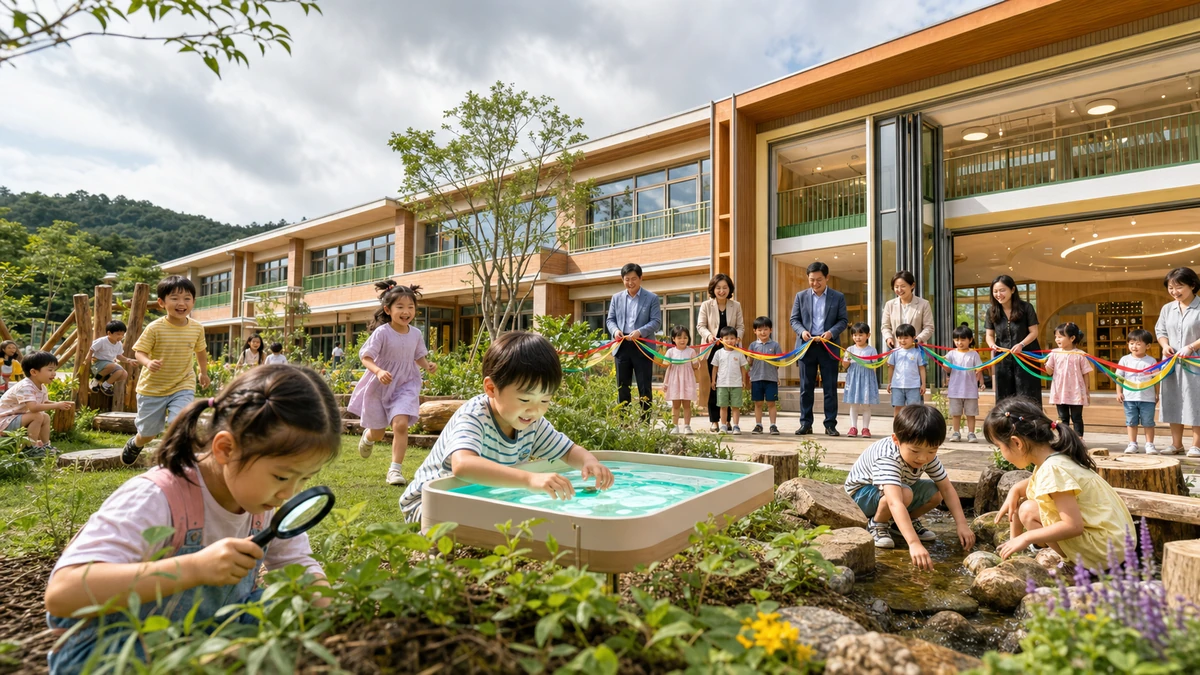
Officials in North Jeolla province, formally known as Jeonbuk State in South Korea’s recent administrative terminology, have converted the site of the former Gurim Middle School into a preschool-focused experiential learning center called the Gurim Early Childhood Comprehensive Learning Branch. The opening ceremony was held July 14, 2026, according to South Korea’s Yonhap News Agency. Rather than treating the closed campus as a relic of demographic change, the provincial education office recast it as a public space for the next generation — one designed not for teenagers preparing for exams, but for very young children learning through movement, sensory exploration and play.
That distinction matters in South Korea, where education often carries a global reputation for rigor, long study hours and fierce competition. To many Americans, the phrase “Korean education” may call to mind high-performing students, private cram schools and pressure-packed entrance exams. This project points to another side of the country’s education debate: how to build healthy, imaginative learning environments long before children reach the age of standardized testing and academic sorting.
The result is not simply an indoor playground. Provincial officials say the new center is meant to combine nature-friendly play with what they call “future education,” a broad Korean term that usually refers to teaching approaches intended to prepare children for a rapidly changing, technology-rich world. In practice, that means a facility where preschoolers can develop ecological awareness, creativity and basic digital familiarity not through lectures or rote instruction, but through activities embedded in play.
For American readers, the easiest comparison may be a hybrid of a nature center, a children’s museum and an early learning lab — except it is housed on the grounds of a former public school and built as a regional resource for kindergartens and child care centers across multiple communities.
Why this conversion stands out in South Korea
The basic facts are straightforward. The Jeonbuk State Office of Education says it invested 17.4 billion won — roughly the equivalent of about $12 million to $13 million, depending on exchange rates — into the project. The site covers 20,461 square meters, or a little more than 5 acres. The building itself has two above-ground floors and a total floor area of 2,143 square meters, roughly 23,000 square feet. The facility can accommodate up to 200 young children per day.
But the significance lies less in the square footage than in the building’s previous life. Gurim Middle School had already completed its original mission as a place for adolescents. Now, the same site has been redesigned for children at the opposite end of the educational journey. In one sense, the transformation is practical: South Korea, like Japan and parts of rural Europe, has a growing inventory of underused or closed school buildings because there are simply fewer students in some areas than there were a generation ago. In another sense, it is symbolic. A campus once organized around classrooms, desks and subject-based instruction has been repurposed around freer movement, outdoor activity and age-appropriate exploration.
That reflects a broader policy question now confronting many communities, not just in Korea: What should be done with public infrastructure built for past population patterns? Demolishing old schools can be costly and politically fraught. Leaving them empty can sap a town’s morale. Turning them into senior centers, libraries, business incubators or housing is one route some local governments take. Turning one into a specialized early childhood learning campus suggests a different answer — one that keeps the identity of the space rooted in education even as its users and methods change.
There is also an important design implication. A former school cannot simply be relabeled and reused as-is for preschoolers. Young children need different circulation patterns, safer play zones, more tactile and flexible environments and easier transitions between indoor and outdoor space. Provincial officials emphasized that this was not a matter of preserving the old school layout intact, but of reimagining the site around the developmental needs of early learners.
In the American context, the move may resonate with debates over universal pre-K, child care shortages and the role of public institutions in supporting early childhood development. While South Korea’s educational structure differs from that of the United States, the underlying issue is familiar: whether communities are willing to invest serious public money in environments that treat early childhood not as a waiting room before “real school,” but as a foundational stage of learning in its own right.
A regional resource, not a neighborhood playroom
Another reason the new center matters is that it is intended as shared infrastructure. It is expected to serve young children enrolled in kindergartens and child care centers in Sunchang and nearby Namwon, part of Jeonbuk’s eastern region. In other words, it is not an amenity for one institution or one town alone. It is a regional hub.
That may sound technical, but it reveals much about how local education systems are adapting in areas with dispersed populations. In rural communities, it is often unrealistic for each school or child care provider to build and maintain large-scale indoor and outdoor experiential facilities on its own. Pooling resources into one well-equipped center allows multiple institutions to access richer programming than they could provide independently. The daily capacity of 200 children underscores that shared model.
For Americans, a rough analogy might be a county-level science center or environmental education campus that multiple school districts bus children to during the week. The difference here is the age group: the primary users are preschool-aged children, not older elementary or middle school students. That focus reflects a growing recognition in South Korea that early education should include more than basic care or pre-academic preparation. It should also provide meaningful experiences that support social, emotional, physical and cognitive growth.
The project may also help knit together surrounding communities. A former middle school that once drew local adolescents now becomes a destination for younger children, teachers and caregivers from multiple towns. That changes the social map of the site. Instead of symbolizing a local institution that disappeared, the campus begins to function as a shared public asset with a wider catchment area.
In a country where regional inequality and population imbalance are major policy concerns, those details matter. South Korea’s prosperity has been heavily concentrated in and around the Seoul metropolitan area. Rural provinces have long worried about losing not just people, but also public services and opportunities. By investing in a high-quality early childhood facility in a smaller community, the education office is making a statement that children outside the capital region deserve robust educational environments as well.
Nature and technology under one roof
The center’s educational concept may be the most interesting part for readers outside Korea. Officials say the facility blends nature-friendly play with future-oriented education, aiming to foster ecological sensitivity, creativity and digital capability through play itself. That combination may strike some Americans as slightly contradictory. In public debates, nature-based learning and technology-based learning are often presented as competing visions: one nostalgic and outdoorsy, the other screen-centered and future-facing.
South Korean educators involved in projects like this are increasingly framing those ideas as complementary. Ecological sensitivity, in this context, does not mean formal environmental science lessons for preschoolers. It refers more broadly to helping children build familiarity with the natural world through direct experience — touching, observing, moving through and responding to living environments. Creativity is similarly understood less as a separate class than as a capacity nurtured when children are allowed to experiment, improvise and play without overly rigid outcomes.
Digital capability, meanwhile, does not necessarily mean putting tablets into the hands of 4-year-olds and calling it innovation. In Korean education policy language, “future education” can include exposure to tools, systems and problem-solving approaches that help children become comfortable in a technologically saturated society. For preschoolers, that usually needs to be translated into developmentally appropriate experiences: interactive environments, guided exploration and opportunities to connect cause and effect, rather than formal coding lessons or screen-heavy instruction.
What makes the Gurim center notable is the effort to put those strands in one setting rather than treating them as separate boxes to be checked. A child might move between outdoor ecological play, collaborative imaginative activity and technology-assisted exploration in the same day. The theory behind that approach is that young children learn best when experiences are integrated. They do not divide their world into neat subject categories the way adults do.
This may sound intuitive, but it runs against a familiar pressure in many education systems, including the U.S., to make learning legible through measurable outcomes, early benchmarks and school-readiness checklists. The language used by Jeonbuk education officials suggests a different emphasis: that important capacities can be built “naturally” through play when a space is designed carefully enough to make that play meaningful.
The politics of early childhood in a high-pressure education culture
To understand why that message is significant in South Korea, it helps to know something about the country’s educational culture. South Korea is admired internationally for student achievement, but it is also often criticized domestically for the intensity of academic competition, especially as children get older. Families can spend substantial sums on private tutoring, and there is an enduring social anxiety about educational advantage. Even very young children are sometimes drawn into that competitive logic through English academies, enrichment programs and early preparation for later school success.
Against that backdrop, a publicly funded preschool experience center centered on play, nature and individual possibility carries a subtle policy argument. It suggests that the earliest years should not be dominated by narrow academic acceleration. Instead, they should be treated as a distinct developmental period in which exploration, physical activity and diverse forms of expression are not distractions from learning, but learning itself.
Cheon Ho-seong, superintendent of the Jeonbuk State Office of Education, described early childhood as the most important starting point for lifelong learning and growth. He said he hoped the new center would be a place where play and learning come together in nature and where every child can develop his or her own possibilities while preparing for the future.
The phrasing is notable. “Every child” and “their own possibilities” signal an attempt to move away from one-size-fits-all expectations. In a country where parents often feel pressure to keep up with standardized milestones, that language emphasizes variation in children’s interests and developmental pathways. It also elevates the quality of experience over narrow performance metrics. The measure of success is not how quickly a child can demonstrate a discrete skill, but whether the environment supports curiosity, confidence and growth.
American readers may hear echoes of longstanding debates at home over play-based preschool, social-emotional learning and the risks of pushing formal academics too early. Those debates are often politically charged in the U.S. In South Korea, the vocabulary differs, but the underlying question is similar: What kinds of early environments actually help children thrive?
What it says about rural renewal
Beyond education, the conversion of a closed school into an early childhood center speaks to a larger story about rural resilience. Sunchang is best known in South Korea for its association with traditional fermented chili paste, or gochujang, and for its agricultural identity. It is not a national center of political or economic power. Projects like this can therefore serve a civic purpose as well as an educational one. They show residents that public investment is still possible in smaller communities, even in an era of demographic strain.
That does not mean one facility can reverse population decline. No single building can solve the structural challenges facing rural South Korea, where low birthrates have become a national emergency and local governments compete to attract young families. Still, infrastructure matters. Parents deciding where to live often look not only at jobs and housing, but also at the quality of schools, child care and public services. A thoughtfully designed learning center for young children can become part of the argument that rural life need not mean educational scarcity.
There is a lesson here that extends beyond Korea. In the U.S., communities from the Midwest to Appalachia to parts of New England have wrestled with what to do when school enrollment shrinks. Some closed campuses become eyesores; others are sold off piecemeal. The Gurim project offers one example of how educational buildings can be adapted without severing their public mission. It is not a template that can be copied wholesale across countries with different governance systems and funding structures. But it is a reminder that old school spaces do not have to represent only loss. They can also be used to stage a different kind of public future.
The success of that future, of course, will depend on more than a ribbon-cutting. The real test will be whether the center’s design philosophy translates into daily experience: whether children from across the region can use the site regularly, whether teachers and caregivers can integrate it meaningfully into their programs and whether the promise of nature-rich, creativity-driven, future-ready play is sustained over time rather than reduced to a slogan.
More than a building opening
At first glance, this may seem like a small regional education story from a corner of South Korea far from Seoul’s skyscrapers and K-pop’s global spotlight. But it touches several issues that are increasingly global: what to do with declining-school infrastructure, how to support early childhood development, how to balance technology with human-centered learning and how rural communities can reinvent public spaces instead of abandoning them.
That is why the opening of the Gurim Early Childhood Comprehensive Learning Branch deserves attention beyond Jeonbuk. It is a local story with wider resonance. A middle school that once served one age group has been reborn for another. A building tied to demographic contraction has been reframed as a site of possibility. And a country often stereotyped for educational intensity is using public money to make a case for something softer, slower and arguably more fundamental: that young children learn best when they can move, imagine, explore and encounter the world with both wonder and support.
For South Korea, the project reflects an effort to align physical space with a broader vision of what the earliest stage of education should be. For American readers, it offers a useful reframing of familiar questions. What does it mean to invest in children before formal academics take over? What can communities do with institutions built for past generations? And how might a place marked by closure become, with enough imagination and funding, a starting point instead?
In Sunchang, officials are betting that the answer begins with reusing what remains, trusting play as a serious form of learning and giving a former school campus a new role in the life of a region. In an age when so many education stories are framed around crisis, competition or decline, that is a quieter narrative — but a meaningful one.


0 Comments