In a Rural South Korean County, a UNICEF Certification Signals a Bigger Shift: Children Are Being Treated as Citizens, Not Just Dependents
A Local Headline With National Meaning
In the United States, news that a county government earned a child-friendly certification might sound like the sort of bureaucratic update that rarely travels beyond a local press release. But in South Korea, where local governments are under growing pressure to rethink aging populations, family life and the quality of daily civic life, the announcement from Yeonggwang County carries broader significance.
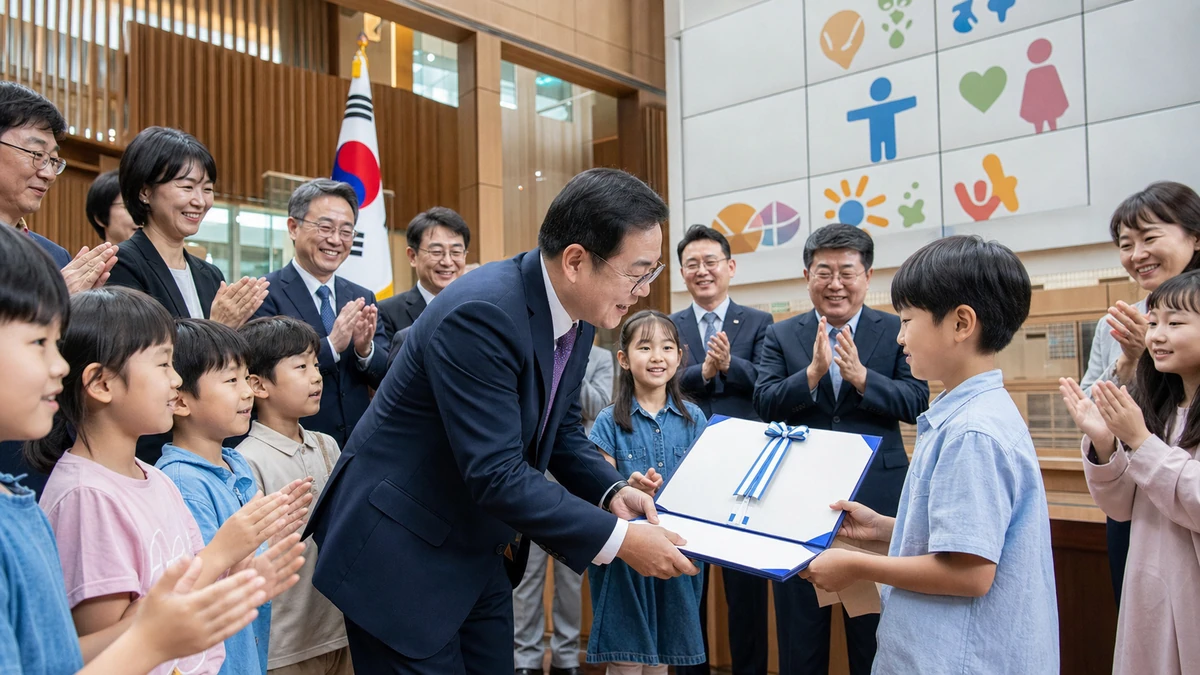
Yeonggwang, a county in South Jeolla Province in the country’s southwest, said it has received its first certification as a UNICEF Child Friendly City. The designation refers to local governments that have built administrative systems and living environments intended to uphold the rights of children under the U.N. Convention on the Rights of the Child, the international treaty that frames children not only as people who need protection, but also as individuals with the right to be heard and respected in public life.
That distinction matters. For many readers in the United States, child-centered policy often brings to mind schools, playgrounds, day care or after-school programs. South Korea’s increasingly prominent use of the phrase “child-friendly city” goes further. It asks whether a city hall, county office or district government is making decisions from a child’s point of view, and whether children themselves have a way to influence those decisions.
According to the county, UNICEF recognized Yeonggwang for building structures that bring children’s voices into local administration, including a child participation committee, the appointment of child rights advocates, and child rights education for senior public officials. On paper, those may sound technical. In practice, they represent a notable shift in the language of local government: children are no longer seen only as recipients of welfare, education and protection, but as members of the community whose views should shape the places where they live.
That makes this more than a feel-good story about one county earning a badge. It is also a window into how South Korea’s local governments are redefining what good governance looks like in a society grappling with low birthrates, intense academic pressure, widening regional disparities and a growing debate over what kind of communities families actually want to live in.
What a UNICEF Child Friendly City Actually Means
The phrase can sound deceptively simple. A “child-friendly city” may conjure images of brightly painted crosswalks, safe parks and stroller-accessible public buildings. Those things matter, and visible infrastructure is part of the picture. But UNICEF’s framework is fundamentally about governance.
At its core, the model is based on the U.N. Convention on the Rights of the Child, often shortened to UNCRC. Adopted in 1989, the convention lays out children’s rights to survival, development, protection and participation. The participation piece is especially important here. It holds that children should be able to express views on matters affecting them and that those views should be given due weight according to their age and maturity.
That principle can be easy to praise in theory and harder to put into practice. In many countries, including the United States, public institutions still tend to treat children primarily as dependents whose needs are interpreted by adults. South Korea is no exception. For decades, local policy involving children has often been organized around care, education, safety and discipline, with adults deciding what is best and children expected to adapt.
The child-friendly city model pushes local governments to ask different questions. Instead of focusing only on what services can be delivered to children, it asks how children experience their neighborhoods, schools, transit routes, parks, cultural spaces and public agencies. Do they feel safe walking to school? Are there places to rest and play that are actually designed with their daily habits in mind? Is government information understandable to young people? Are adults listening when children point out problems that adult planners overlook?
In that sense, the certification is less about a single completed project than about whether a local government has built a system for considering children’s rights across departments and over time. That is why Yeonggwang’s recognition appears to have focused not just on physical amenities but on institutional mechanisms: committees, advocates and official training.
American readers may find a loose parallel in the way some U.S. cities now use youth advisory boards, participatory budgeting or school climate councils to include younger voices in policymaking. The South Korean version is shaped by a different administrative culture, one that is often more centralized and formalized, but the underlying idea is familiar: if public policy affects young people’s daily lives, then young people should not be invisible in the process.
From Policy Beneficiaries to Community Members
The most notable part of Yeonggwang’s certification may be the change in perspective it reflects. Much of local government everywhere is built around categories of need. Children are grouped with populations that require support and protection. There is nothing wrong with that; children do need both. But that framework can also flatten them into policy targets rather than treating them as people with viewpoints, preferences and civic standing.
What Yeonggwang appears to be signaling is a move away from seeing children only as beneficiaries of adult-designed programs. The county’s child participation committee is emblematic of that shift. Such a body can function as a channel through which children speak directly about everyday conditions that affect them, from school routes and public spaces to recreational needs and access to local information.
Adults routinely miss things that are obvious to children because adults do not inhabit the same physical and social environments in the same way. A route that looks safe on a map may feel intimidating to a middle school student walking home after dark. A public plaza designed for efficiency may offer nowhere to sit, gather or play. A government notice may be technically available online but effectively unreadable to younger residents. Children often notice these gaps first because they are the ones navigating them.
That is why participation matters beyond symbolism. If a local government genuinely takes children’s observations seriously, it can gain a more accurate picture of how public systems function on the ground. Participation is not charity. It is a form of information gathering, accountability and democratic inclusion.
The appointment of child rights advocates points in the same direction. In large and small bureaucracies alike, voices with less formal power tend to be crowded out by procedure, budget constraints and competing political priorities. Children are especially vulnerable to that dynamic because they do not vote, often cannot speak the language of policy, and are usually represented indirectly by parents, teachers or administrators. Advocates can help keep children’s perspectives from disappearing into paperwork.
That role is especially important in a society like South Korea’s, where age hierarchies have historically shaped communication and authority. Deference to elders remains a powerful social norm, even as Korean society changes rapidly. In that context, building official pathways for children’s views to enter administrative decision-making is not just a managerial tweak. It can amount to a cultural adjustment in how authority listens.
Why Training Senior Officials Matters
One of the more revealing details in Yeonggwang’s announcement is that senior government officials received child rights education. That may sound like the least colorful part of the story, but from an administrative standpoint it may be among the most consequential.
In any government, frontline staff can pilot programs, but senior officials shape the rules of the game. They decide priorities, oversee budgets, coordinate across departments and determine which concerns are treated as central rather than peripheral. If child-friendly policy is understood merely as the job of a family welfare office, it tends to remain compartmentalized. If senior officials across the government are trained to view decisions through a child-rights lens, the concept can begin to influence transportation, parks, public safety, culture, housing and communications.
That kind of institutional change is often where lofty public commitments either become real or fade into slogans. A county might build a playground and hold a youth forum and still leave its deeper habits untouched. But when decision-makers start asking whether a policy affects children’s rights, whether information is accessible to young residents, or whether children had a chance to weigh in, the terms of governance begin to change.
In the American context, a rough comparison might be the difference between launching a one-off youth initiative and embedding child impact reviews into the routines of city government. One is a program. The other is a governing framework.
That distinction helps explain why Yeonggwang’s certification stands out. The county was not recognized for a single ribbon-cutting moment or flagship facility. The emphasis was on systems: a participation committee, child rights advocates and training for officials with decision-making authority. Those are the kinds of building blocks that suggest an effort to make child-friendly governance durable rather than ceremonial.
Of course, training alone does not guarantee change. Bureaucracies can absorb new language without changing old habits. But when rights-based language reaches top officials, it creates at least the possibility that questions about children will be raised earlier in the policy process, before choices are locked in and budgets are spent.
A Quiet but Important Test for Regional South Korea
For international readers, especially those whose image of South Korea is dominated by Seoul, K-pop, technology giants and high-speed urban life, Yeonggwang offers a useful corrective. Much of the country’s long-term social future will be shaped not only in its capital region but also in smaller cities, towns and counties trying to remain livable as population pressures mount.
Like many parts of rural and provincial South Korea, Yeonggwang exists within a national landscape defined by demographic anxiety. South Korea has one of the world’s lowest birthrates, and policymakers at every level have spent years searching for ways to make family life more sustainable. Governments have offered subsidies, child care support and housing incentives, yet many young adults still cite the high cost of raising children, competitive schooling, work-life imbalance and the overall stress of family formation.
That is one reason the idea of a “good place to live” has been changing. It is no longer enough for local officials to talk only about roads, commercial development and industrial investment. Families increasingly weigh whether a community is safe, supportive and humane for children. That includes visible infrastructure, but it also includes less tangible features such as trust in local institutions, the availability of public space, and whether parents believe their children will be respected by schools, agencies and neighborhoods.
In this environment, a UNICEF certification can also function as a statement about local competitiveness and identity. It signals that a county wants to be known not simply as administratively competent, but as a place where children’s everyday lives matter. That can influence how residents see their community and how outsiders assess it.
For smaller Korean localities, international frameworks can also serve another purpose: they provide a language of legitimacy. By aligning local governance with the U.N. Convention on the Rights of the Child, officials can connect municipal or county-level reforms to global norms rather than presenting them as isolated local experiments. In a country where local governments often compete for recognition and resources, that international framing carries weight.
There is also a softer political dimension. Child-friendly governance tends to be less polarizing than some other reform agendas. While debates inevitably arise over budgets and implementation, few public figures want to appear hostile to children’s rights or quality of life. That makes the issue a potentially powerful way for local governments to pursue meaningful administrative reform through a broadly acceptable public value.
The Real Question: Is Participation Genuine?
As encouraging as the certification may be, its value will depend on what happens next. That is true of nearly any rights-based initiative. The existence of a committee or advocate does not by itself prove that children are shaping policy in a meaningful way. The crucial test is whether participation moves beyond formality.
If children raise concerns, are those concerns reviewed seriously? If some suggestions are feasible, are they reflected in policy or budgeting? If others are not adopted, does the government explain why in language that children and families can understand? Those questions may sound procedural, but they are central to whether participation builds trust or cynicism.
There is a familiar pattern in public institutions everywhere: create an advisory body, hold meetings, publish photos, and then carry on with business as usual. Youth participation is especially vulnerable to that pattern because it can be easy for adults to praise children’s voices while quietly discounting their substance. Preventing that outcome requires more than goodwill. It requires feedback loops, transparency and a willingness to let young people influence decisions that adults once controlled entirely.
Another challenge is accessibility. Genuine participation depends on whether children feel comfortable speaking, whether the process includes diverse backgrounds and ages, and whether information is shared in ways they can understand. A high-achieving, articulate teenager from a well-supported family may find it easier to join a committee than a younger child, a child with disabilities or a child whose family has limited time and resources. If participation is to reflect the whole community, local governments have to think carefully about whose voices are being heard and whose are still missing.
Then there is the question of continuity. Certifications can create momentum, but sustaining it is harder. Officials rotate, priorities shift and public attention moves on. To remain meaningful, child-friendly governance has to survive beyond the enthusiasm of a single administration. That means embedding practices deeply enough that they continue even when personnel change.
For Yeonggwang, the challenge now is to turn recognition into routine. Can the child participation committee, child rights advocates and official training operate not as separate programs but as parts of a coherent system? Can the county show residents tangible examples of children’s input shaping their environment? The answer to those questions will determine whether the certification becomes a milestone or merely a moment.
Why This Story Resonates Beyond One County
Big international stories from South Korea often revolve around elections, North Korea, semiconductor supply chains or the latest global entertainment phenomenon. Those subjects matter, and they will continue to dominate headlines. But smaller civic stories can reveal just as much about where a society is headed.
Yeonggwang’s certification is one of those stories. It does not announce a dramatic political confrontation or a sweeping national law. Instead, it captures a quieter institutional change: a local government adjusting its own language and structure so that children are seen less as passive objects of policy and more as rights-bearing residents. That may sound modest, but public culture often changes in precisely this way—through the slow revision of what officials consider normal, expected and legitimate.
There is a lesson here for American readers as well. In the United States, discussions about children frequently center on schools, parental rights, child care affordability or youth mental health. Those are urgent issues. Yet the broader question of whether local government is designed with children’s lived experiences in mind often receives less attention. Sidewalk design, transit safety, access to public space, readable public information and meaningful youth input can shape a child’s life just as surely as any classroom policy.
South Korea’s local embrace of the child-friendly city model is not a ready-made blueprint for the United States, nor should it be romanticized. Every system has limits, and certification programs can become box-checking exercises if not handled carefully. Still, the Yeonggwang case underscores a valuable principle: a community’s commitment to children is not measured only by how much it spends on them, but by whether it is willing to listen to them and build institutions accordingly.
That is what makes this county-level announcement worth attention beyond regional Korea. In a country often associated abroad with speed, competition and top-down pressure, Yeonggwang is presenting a different image of governance—one that asks whether children can speak, whether adults will listen and whether public systems can be shaped from the ground up. For a small county, that is a modest but meaningful claim. For a broader society thinking about its future, it may be an important one.
Comments
Post a Comment