
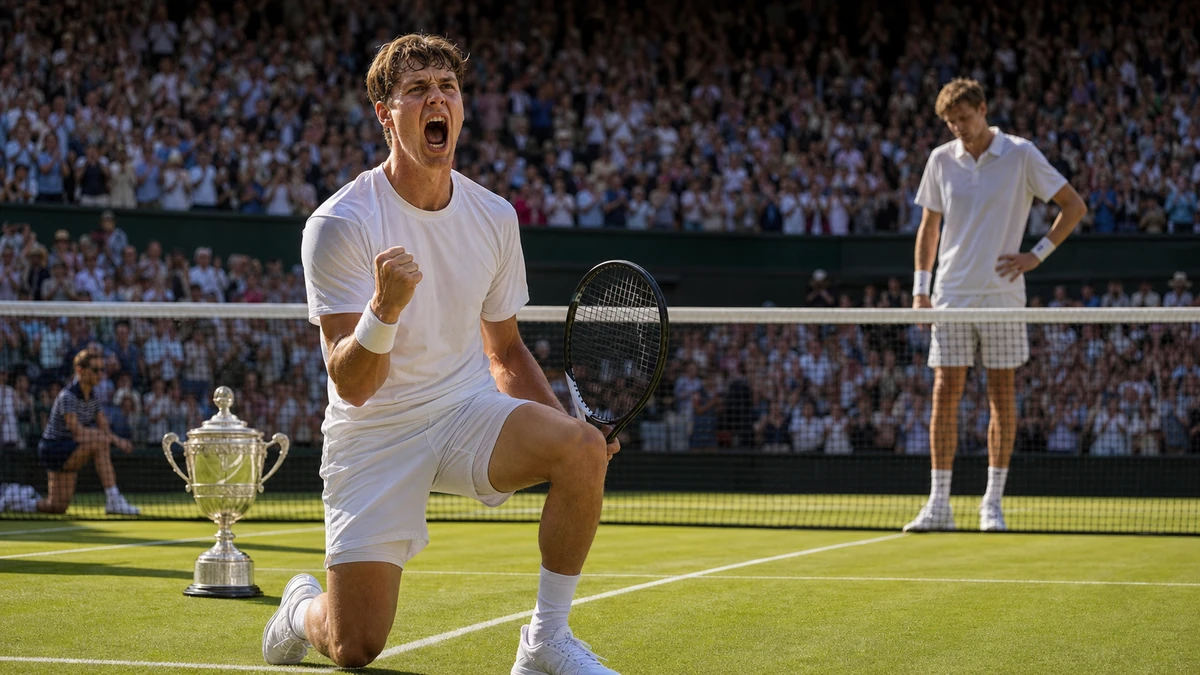
A champion’s response on tennis’ grandest lawn
Jannik Sinner, the world’s top-ranked men’s tennis player, added another defining chapter to his fast-growing career Saturday in London, rallying past Germany’s Alexander Zverev in four sets to win Wimbledon for the second straight year. The Italian star dropped a tense opening-set tiebreaker, then methodically took control of the match, winning 6-7, 7-6, 6-3, 6-4 in 3 hours, 46 minutes at the All England Club.
The victory gave Sinner back-to-back titles at Wimbledon, the oldest and most prestigious tournament in tennis, and his fifth career major championship overall. In a sport where reputations are built not just on talent but on the ability to handle pressure over two grueling weeks, Sinner’s latest title run offered a clear message: his rise is no longer a promising trend or a brief hot streak. He is now the standard everyone else must chase.
For American readers who follow tennis most closely through the U.S. Open or household names such as Serena Williams, Roger Federer and Rafael Nadal, Wimbledon still carries a special aura. It is the sport’s version of a Masters green jacket or a World Series Game 7 at an iconic ballpark: rich with ritual, history and expectations. Players wear white. Royal spectators often attend. Grass, a surface rarely used in today’s game, changes the style of play, rewarding movement, timing and nerve. To win there once is career-defining. To defend a title there is something more rare.
Sinner did it by showing exactly the sort of composure expected from a No. 1-ranked player. He did not panic after losing the first set. He did not let the occasion shrink him. And after splitting two razor-thin tiebreak sets with Zverev, he gradually bent the match to his own rhythm, taking the third and fourth sets with the steadiness of a player who has learned how to manage not just points, but moments.
That may be the biggest takeaway from this final. Sinner’s game remains explosive, but his maturity is becoming just as important. Against one of the world’s best players, in the sport’s most tradition-heavy setting, he looked like a man fully aware of what a champion must do after adversity: settle down, solve the problem and keep moving.
How the final turned after a tense opening
The score line suggests a comeback, and it was one, but the match was tighter than any straight reading of the final two sets might imply. The first set was a high-wire act from the beginning, with neither player able to break free. Zverev, ranked No. 3 in the world, edged the tiebreak 9-7 and briefly looked as if he might be on his way to the biggest title of his career.
That opening set mattered beyond the scoreboard. In a Wimbledon final, especially between elite players, taking the first set can feel like grabbing the steering wheel. The crowd senses it. The opponent feels it. Grass courts reward momentum because points can move quickly, and a player who starts serving with confidence can make entire stretches of a match feel untouchable.
But Sinner’s response in the second set was the turning point. When that set also went to a tiebreak, he did not merely survive it. He dominated it, winning 7-2. That swing told the deeper story of the final. Zverev had won the first pressure test. Sinner won the second in commanding fashion, and from there the emotional balance of the match changed.
By the third set, Sinner’s control was more visible. He took it 6-3, the first set of the match that did not require a tiebreak, and with that came a sense that he had finally found the match’s rhythm on his terms. He was striking more cleanly, handling the baseline exchanges with greater certainty and no longer looking as if he was reacting to Zverev’s game. He was dictating.
The fourth set, won 6-4, was not a stroll. Zverev continued to push, and the nearly four-hour duration reflected how demanding the contest remained. But the balance had clearly shifted. Sinner, after losing the first set, had separated that disappointment from the rest of the afternoon. That is often what defines the very best players: not avoiding trouble, but preventing one bad stretch from becoming a full unraveling.
In major finals, the difference between a very good player and a champion can look subtle from the stands. It can be one tiebreak handled better, one service game steadied, one emotional dip avoided. Saturday’s final provided all of those examples. Sinner did not just play well. He managed the match like a player who understood that the first set was an event, not a verdict.
Why a second straight Wimbledon title matters so much
Sinner won Wimbledon for the first time last year, a breakthrough that signaled his arrival as more than just another young star in a crowded generation. Repeating as champion this year gave that breakthrough a different meaning. In sports, first-time winners can be treated as revelations. Repeat winners are treated as authorities.
That distinction is especially important at Wimbledon. Plenty of players can peak for one tournament. Fewer can return as defending champion, absorb an entirely different kind of pressure and still leave with the trophy. Winning the first time means climbing the mountain. Winning again means carrying the weight of everyone expecting you to stay there.
For American fans, the easiest comparison may be the difference between a quarterback reaching the Super Bowl and then returning the next season with every defense targeting him. The second run is psychologically different. Every opponent is more prepared. Every match comes with a little more noise. Every stumble gets interpreted as vulnerability. Sinner handled that burden and turned it into confirmation.
The repeat also deepens his standing on grass, tennis’ most tradition-bound surface. Wimbledon is not simply one more stop on the calendar. It is a measuring stick. Great grass-court champions are remembered differently because the tournament itself remains so central to tennis’ identity. Sinner now has two Wimbledon titles, matching Spanish rival Carlos Alcaraz in championships at the All England Club and strengthening the sense that modern men’s tennis is headed into a defining rivalry at the top.
That point matters because a sport as global and individual as tennis is constantly searching for its next era. The so-called Big Three — Federer, Nadal and Novak Djokovic — dominated for so long that succession has been one of the sport’s most important storylines. Sinner’s second straight Wimbledon crown does not end that conversation, but it sharpens it. He is no longer merely one of the possible heirs. He is already building a résumé that belongs in the center of the new order.
And unlike a surprise champion who benefits from a favorable draw or a single brilliant fortnight, Sinner had to beat one of the best players in the world in the final after falling behind early. That gives the title extra weight. It was not a ceremonial defense. It was an earned one.
Five majors and a rivalry that could define the era
With Saturday’s victory, Sinner moved to five career major titles, a milestone that says as much about consistency as it does about brilliance. In tennis, majors — the Australian Open, French Open, Wimbledon and U.S. Open — are the events that shape legacies. Players may win dozens of tour-level titles, but the scoreboard that history remembers most clearly is built around the biggest four tournaments.
Reaching five majors places Sinner in territory where discussions naturally shift from potential to historical significance. He is still in the early portion of what could be a long career, but this is now a meaningful body of work. It suggests not only that he can win on the largest stages, but that he can do it repeatedly and under varying conditions.
His standing becomes even more interesting when placed next to Alcaraz, the electrifying Spaniard who remains one of the sport’s defining forces. According to the Korean report, Sinner has now pulled within two majors of Alcaraz while matching him with two Wimbledon titles. That does not settle anything, and it should not be framed as a finished verdict on who owns this generation. If anything, it does the opposite. It intensifies the race.
That is good news for tennis. Every era benefits from a rivalry that gives casual fans a reason to pay attention between majors. Federer and Nadal brought contrasting styles and personalities. Nadal and Djokovic added a level of attritional intensity that redefined endurance tennis. If Sinner and Alcaraz are the sport’s next sustained duel, then Wimbledon 2026 may be remembered as one of the weekends that tightened the frame around that future.
Sinner’s case rests on more than his ranking. He is the world No. 1, he now owns consecutive Wimbledon titles, and he continues to add majors with a regularity that suggests staying power. Alcaraz, meanwhile, still holds an edge in total major count. Those parallel facts are what make the rivalry compelling. Neither statistic fully closes the argument. Each supports a different side of it.
For a sport that often lives tournament to tournament, that tension is valuable. It keeps every major from feeling isolated. Wimbledon did not merely produce a champion. It added fresh stakes to the next chapter of men’s tennis.
A quick rebound after French Open disappointment
One reason Sinner’s Wimbledon run stands out is how quickly it followed a jarring result at the French Open. Earlier this season, he suffered an unexpectedly early exit in the second round in Paris while battling extreme heat. For a player of his stature, that loss was the kind that inevitably triggers overreaction. In the social media age, one bad major can suddenly become evidence of fragility, decline or some invented crisis.
Sinner answered all of that in the best way possible: by winning the next major.
The contrast between the French Open and Wimbledon is also a reminder of how surface-specific tennis can be. Clay, used at Roland-Garros, is slow and punishing, often rewarding patience, stamina and point construction over long rallies. Grass, by contrast, is faster and lower-bouncing, with points that can turn quickly and margins that feel much thinner. Great players adapt. Truly elite players reset fast enough that one tournament’s disappointment does not spill into the next.
That is what Sinner did. Instead of carrying the frustration of Paris into London, he reestablished himself as the player to beat. He arrived at Wimbledon not only with the pressure of being defending champion, but also with the added scrutiny that always follows a surprising major defeat. Leaving with the trophy makes the rebound even more impressive.
There is a broader lesson in that, one familiar to fans of American sports as well. Seasons are long. Narratives can be noisy. The athletes who separate themselves are often the ones who recover emotionally faster than everyone else. A baseball ace who gets shelled one start and throws seven scoreless innings the next week. A star NBA player who misses a game-winner, then controls the next playoff game from start to finish. Tennis is more individual and more exposed, but the principle is the same.
Even inside Saturday’s final, Sinner showed that same pattern on a smaller scale. He lost the first set, reset, won the next tiebreak and then finished stronger. The ability to rebound from a bad tournament and from a bad set are obviously different challenges. But both demand a common skill: emotional compartmentalization. Sinner is showing more and more of it.
Zverev pushed hard, but the matchup keeps leaning one way
The final also underscored a difficult truth for Zverev. He remains one of the best players in the world, good enough to trouble anybody and accomplished enough to reach the sport’s biggest stages. Yet against Sinner, the recent pattern has become increasingly one-sided. With Saturday’s result, Sinner improved to 11-4 against Zverev overall and has now won their last 10 meetings, according to the Korean summary.
That kind of head-to-head run is not an accident. It reflects more than confidence. It usually means one player consistently finds solutions the other cannot sustain over time. Still, the final showed that even a lopsided recent record can coexist with a highly competitive match. Zverev took the opening set. He pushed the second to another tiebreak. He stayed in the contest for nearly four hours. This was not a blowout disguised by the score.
And that distinction matters. In American sports terms, this was less like a top seed steamrolling an overmatched opponent and more like a familiar postseason problem: a contender that keeps running into the same star and cannot quite solve him, even when the game script briefly breaks its way. Zverev had openings. Sinner was simply better at the points and stretches that decided the championship.
For Zverev, there is frustration but not embarrassment in that. Losing to the world No. 1 in a Wimbledon final after taking the first set is painful, but it also confirms that he remains firmly in the elite tier. The challenge now is whether he can break the psychological loop that seems to emerge whenever he faces Sinner. Repeated losses, especially in major moments, have a way of becoming their own opponent.
For Sinner, the matchup trend adds another layer to his authority. Dominating a peer over time is one thing. Doing it again in a major final, after being pushed early, is something stronger. It suggests his edge is not situational. It is structural.
What this means for men’s tennis now
The biggest effect of Sinner’s victory may be what it does to the shape of the men’s game going forward. He remains world No. 1. He now owns consecutive Wimbledon titles. He has five majors. He has narrowed the gap in the broader major race with Alcaraz while matching him in Wimbledon titles. And he has again beaten a top-three opponent on the sport’s most tradition-rich court.
Put simply, the hierarchy looks clearer than ever, even if the rivalry at the top remains unresolved.
That combination — clarity and tension — is ideal for the sport. Sinner has established himself as the current benchmark, the player whose consistency and title count demand first billing. At the same time, the presence of Alcaraz and the continued threat posed by players such as Zverev ensure that the next major will not feel prewritten. Tennis thrives when the favorite is formidable but not untouchable, when dominance exists but suspense survives. Right now, men’s tennis appears to have found that balance.
For audiences in the United States and other English-speaking markets, where tennis can drift in and out of the mainstream between majors, Sinner’s rise offers a storyline easy to follow. He is not just winning. He is building a pattern: recover from setbacks, perform on the biggest stages, and make the sport’s most prestigious tournament feel increasingly familiar. Those are the traits that turn excellent players into era-defining figures.
Saturday’s final did not settle every argument about the future of men’s tennis, and that is part of what made it compelling. What it did settle, at least for now, is the question of who owns Wimbledon’s grass. For the second straight year, that answer is Sinner. After an uneven start, after a difficult French Open, and after one more tense test from one of the world’s best, he walked off the All England Club’s center court with the trophy again.
In a sport built on weekly turnover and constant pressure, repeating yourself at Wimbledon is one of the hardest things to do. Sinner just made it look like the beginning of something even bigger.


0 Comments