Jeju’s Hydrogen Car Boom Runs Into a Problem Familiar to Clean-Tech Dreams: There’s Only One Place to Fill Up
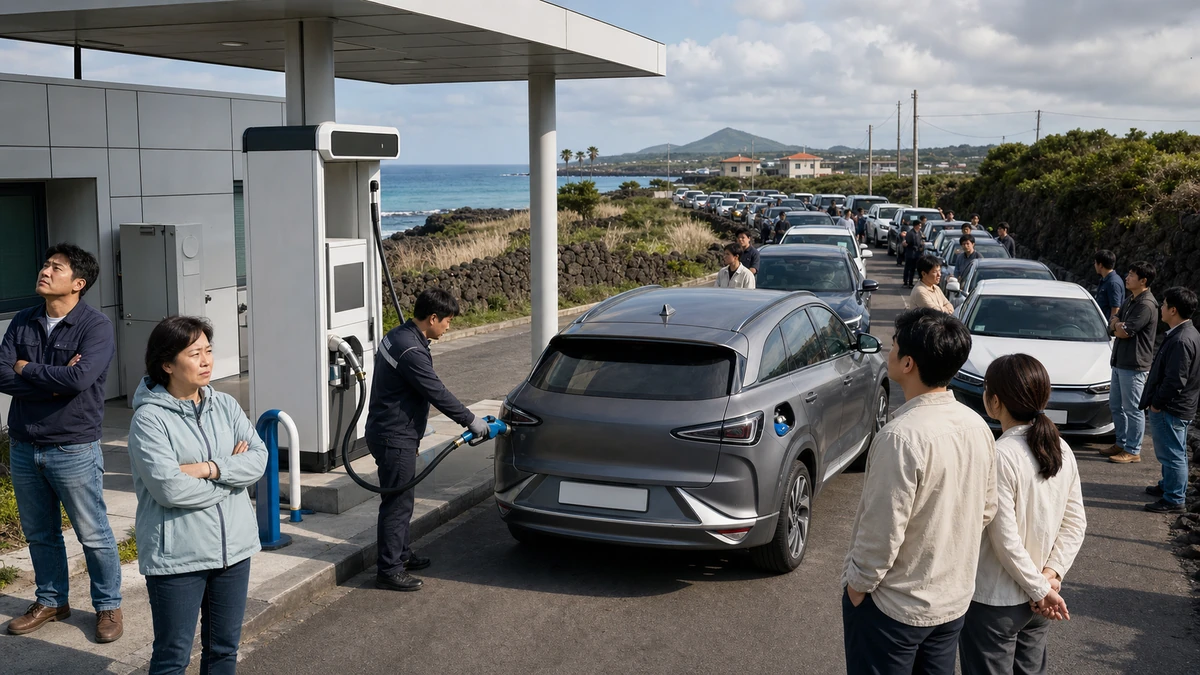
A rush to buy into the future
On South Korea’s Jeju Island, one of the country’s most recognizable tourist destinations and a longtime test bed for green policy, public interest in hydrogen-powered cars is outpacing the infrastructure needed to make those vehicles practical. That mismatch is now drawing scrutiny from local lawmakers and offering a case study in a problem that Americans would recognize from their own energy transition debates: It is one thing to subsidize cleaner vehicles, and another to build the everyday systems that let people actually use them.
The immediate numbers tell the story. Jeju authorities opened applications this year for subsidies covering 79 hydrogen passenger vehicles for private buyers. A total of 174 people applied, according to details raised during a meeting of the Jeju Provincial Council’s Future Economy and Industry Committee. In other words, demand was more than double the available supply. The subsidy is generous, amounting to 39.5 million won per vehicle, or roughly tens of thousands of U.S. dollars at current exchange rates, with funding split between the national government and the provincial government.
But while the financial incentive appears strong enough to attract buyers, the island currently has only one operating hydrogen fueling station: the Hamdeok Green Hydrogen Station in Hamdeok-ri, a community in Jocheon-eup, on the northern side of Jeju City. For would-be owners scattered across the island, that means access to fuel depends on a single site. It is the kind of bottleneck that can turn a headline-grabbing green initiative into a daily inconvenience.
The debate unfolding in Jeju is not simply about whether hydrogen vehicles are a good idea. It is about sequencing. Policymakers succeeded in stimulating interest. What they have not yet done, critics say, is ensure that the supporting infrastructure expands at the same pace. That gap matters because car ownership is judged less by the moment of purchase than by the routines that follow: how long a commute takes, how easy it is to refuel, and whether the system can be trusted to work on ordinary days, not just in pilot projects or policy presentations.
For American readers, the dynamic may sound familiar. It echoes the early rollout of electric vehicles in parts of the United States, where tax credits and automaker marketing sometimes moved faster than charging networks, especially outside major metropolitan areas. In Jeju’s case, the technology is different, but the policy challenge is similar. A cleaner vehicle without convenient access to energy is not just inconvenient. It can undermine public confidence in the larger transition.
Why Jeju matters in South Korea’s green ambitions
Jeju is not just any local jurisdiction. The island province occupies a special place in South Korea’s environmental imagination. Known to many outsiders as a volcanic resort destination with beaches, lava tubes and Hallasan, the country’s highest mountain, Jeju has also spent years branding itself as a forward-looking region for renewable energy and low-carbon transportation. Korean officials have often treated the island as a place where future-facing policies can be tested before broader expansion.
That makes the hydrogen vehicle debate more significant than it might appear at first glance. If a place like Jeju, with its relatively contained geography and strong policy interest in sustainability, struggles to align vehicle subsidies with fueling access, the challenge could be even greater elsewhere. Islands are often seen as ideal laboratories for transportation experiments because travel patterns can be more predictable and distances more limited. But Jeju also demonstrates that geographic containment does not automatically solve infrastructure problems. Even on an island, where you might assume a single station could go a long way, residents do not all live or work near the same town.
That point is central to the criticism raised by the provincial council. Jeju is one administrative region, but daily life is not concentrated in one neighborhood. Residents’ commuting patterns, school runs, work obligations and family routines are spread across multiple communities. A fueling station in Hamdeok may be workable for some drivers, especially those living nearby or frequently traveling through Jeju City’s northern corridor. For others, it may represent a significant detour that makes ownership feel less like a convenience and more like a commitment to planning each trip around a scarce resource.
In South Korean local politics, provincial councils play a role somewhat analogous to state legislatures or county boards in the United States, depending on the issue. Their oversight meetings can be important venues for exposing gaps between a government’s stated goals and what residents actually experience. In this case, lawmakers did not question whether the public wants hydrogen vehicles. The application numbers made that clear. Instead, they zeroed in on whether the government has built enough of the practical ecosystem to support those buyers after the subsidy is awarded.
That distinction is important. A successful application campaign is politically useful because it demonstrates public interest. But a successful transition in transportation requires more than an oversubscribed sign-up sheet. It requires confidence that the technology will fit into ordinary life. Jeju’s current predicament suggests that, at least for now, infrastructure remains the weak link.
The promise and limits of subsidies
The subsidy itself helps explain why interest is so high. Jeju is offering 39.5 million won per hydrogen vehicle, with 22.5 million won from the national government and 17 million won from the provincial government. That kind of assistance dramatically lowers the upfront cost for consumers. In clean transportation policy, subsidies are often the quickest way to generate demand because they address the most visible barrier: sticker price.
And by that measure, the policy worked. When 174 people apply for 79 available slots, it is hard to argue there is a lack of consumer curiosity or willingness. The island received 160 general applications and 14 priority applications for a combined total that far exceeded supply. Authorities ultimately selected recipients by lottery, a reminder that scarcity exists not only in infrastructure but also in the subsidized inventory itself.
Still, subsidies can create a misleading impression of policy success if they are treated as the whole program rather than one piece of it. For a buyer, the purchase is the beginning of the experience, not the end. Hydrogen vehicles require a specialized fueling network, and unlike gasoline, which is ubiquitous, or battery charging, which at least can sometimes happen at home, hydrogen depends heavily on dedicated commercial stations. If those stations are sparse, the cost savings at the dealership may be offset by time, uncertainty and inconvenience afterward.
That is where Jeju’s numbers become especially revealing. The government has demonstrated that enough people are willing to take a chance on hydrogen technology when the price is right. What remains unresolved is whether those same buyers will feel satisfied once they begin using their cars in real life. A system that looks attractive on paper can quickly feel fragile if refueling depends on one facility’s location, hours, maintenance schedule or temporary outages.
In the United States, policymakers have seen versions of this problem in both electric and alternative-fuel programs. Early adopters may tolerate inconvenience because they are motivated by environmental values, technology enthusiasm or the prestige of being ahead of the curve. But mainstream consumers usually require something simpler: reliability. If a green vehicle demands too much extra planning, public excitement can fade. Jeju’s oversubscribed subsidy program may therefore be both good news and a warning sign. It proves interest exists, but it also increases the urgency of making the ownership experience workable.
One operating station for an entire island
The heart of the controversy is stark: Jeju currently relies on a single operating hydrogen station. That reality compresses the island’s growing hydrogen demand into one physical point. Officials and lawmakers have not, based on the information publicly highlighted in this discussion, presented evidence of system-wide breakdowns or long lines. But the structural concern is obvious even without dramatic incidents. As more vehicles enter circulation, refueling demand will inevitably converge at the same place.
That concentration risk would concern transportation planners anywhere. If a region wants residents to adopt a new fuel technology, redundancy matters. A single station may be enough for a demonstration project or a limited fleet, but it is a precarious base for broader consumer adoption. Any disruption, whether mechanical, logistical or operational, has outsized consequences when there are no nearby alternatives. Even when the station functions normally, drivers may still have to factor its location into decisions about work trips, family schedules and weekend travel.
Jeju’s geography sharpens the issue. Though the island is not vast by American standards, it is large enough that driving across it for fuel is not trivial. Tourists often imagine Jeju as a compact getaway, but for residents it is a lived-in region with its own traffic patterns, neighborhood differences and time costs. A person living or working far from Hamdeok cannot treat fueling as a minor errand. It becomes a logistical calculation.
This is why local lawmakers focused on the gap between vehicle supply and fueling access rather than merely celebrating strong application numbers. The problem is not abstract. If public policy encourages residents to buy a car that depends on a rare fueling network, then access to that network becomes part of the public policy itself. In other words, the government is not just helping people buy hydrogen cars. It is implicitly promising that those cars can be used without unreasonable burden.
That promise becomes harder to keep when infrastructure lags. The symbolism of a clean-energy fleet can be powerful, especially in a place like Jeju that has long tried to position itself as environmentally innovative. But symbols do not replace service networks. In transportation, the most successful systems are often the least noticed. They work so reliably that people stop thinking about them. Hydrogen in Jeju does not seem to be there yet.
A stalled second site shows the politics of infrastructure
Jeju’s challenge is not simply that no one has tried to expand capacity. Another hydrogen fueling facility had been established in Dodu-dong, within the grounds of a liquefied petroleum gas station in Jeju City. But according to the account raised in the council discussion, that mobile hydrogen station is not currently operating because of continued opposition from local residents.
That detail adds a deeper layer to the story. Building clean-energy infrastructure is not just an engineering problem or a budget line. It is also a social and political one. Communities do not always welcome facilities associated with new fuels, even when those fuels are promoted as environmentally beneficial. Concerns can range from safety perceptions to traffic, noise, land use, distrust of authorities or a sense that residents were not adequately consulted.
The available summary does not specify the exact reasons behind the local opposition in Dodu-dong, so it would be inappropriate to overstate them. But the outcome is significant regardless of the precise motivations. A station can exist on paper or even in physical form without becoming a dependable part of the public system. That distinction matters. Announcing a facility and operating one are not the same thing.
Americans have seen comparable tensions in debates over wind farms, transmission lines, solar arrays, battery storage sites and even EV charging hubs. The broad public may support clean energy in principle while resisting specific projects nearby. This is sometimes described as a "not in my backyard" dynamic, though that phrase can oversimplify legitimate local concerns. Jeju’s stalled Dodu-dong site suggests hydrogen faces its own version of that challenge. Even when a government wants to scale infrastructure, it must navigate neighborhood-level politics and public trust.
That complicates any assumption that the solution is simply to "build more stations." In practice, expansion requires financing, permitting, technical expertise, safety assurance and local acceptance. If any one of those pieces breaks down, the wider strategy suffers. For Jeju, the consequence is immediate: A province with strong buyer interest remains dependent on one operating station because another site has not transitioned into sustained service.
In policy terms, the Dodu-dong example underscores why infrastructure should be evaluated not only by how many projects are announced, but by how many are truly usable. From a resident’s perspective, the difference is everything.
What this says about hydrogen’s broader future
The Jeju case arrives at a moment when hydrogen occupies an intriguing but unsettled place in global transportation policy. Advocates argue hydrogen can play a valuable role, especially for commercial fleets, heavy-duty transport and regions seeking alternatives to battery-only systems. Supporters also point to the possibility of producing cleaner hydrogen using renewable energy, a concept that appeals to governments trying to pair decarbonization with industrial strategy.
Critics, however, often question whether hydrogen makes sense for mass-market passenger cars when compared with battery electric vehicles, which have gained wider consumer traction and a more rapidly expanding charging ecosystem in many countries. Those debates can become highly technical, involving energy efficiency, production pathways, storage costs and long-term infrastructure economics. Jeju does not resolve those arguments. But it does illustrate one practical reality: No matter how promising a technology may look in strategy documents, consumers judge it by convenience.
For South Korea, hydrogen has been more than just a niche technology. The country has promoted it as part of a national industrial vision, with major automakers and policymakers seeing potential competitive advantage. In that sense, Jeju’s experience has implications beyond one island. It provides a local snapshot of what happens when enthusiasm for adoption runs ahead of the everyday systems users need.
For American readers, the lesson may be less about hydrogen specifically and more about the universal logic of infrastructure transitions. Whether the technology is EV charging, public transit expansion, broadband internet or renewable power transmission, incentives alone rarely carry the transformation. The backbone matters. People need places to plug in, fuel up, connect or travel that fit into normal routines.
Jeju’s oversubscribed application process could be read optimistically as proof that public willingness exists when governments lower the financial barrier. It could also be read more cautiously as a stress test the current system may not yet be ready to pass. Both interpretations can be true at the same time. Demand is real. So is the infrastructure shortfall.
The next test is not sales, but daily use
Now that the lottery for subsidies has moved forward, the most important phase of the program is beginning. The central question is no longer whether people want hydrogen cars. It is whether the selected owners will be able to use them with reasonable ease. That distinction may determine whether Jeju’s hydrogen push becomes a model or a warning.
If drivers find the experience manageable, the current shortage could be viewed as an early-stage growing pain in a sector that will mature over time. But if owners begin to feel that refueling is too cumbersome, the reputational damage could outlast this year’s program. In emerging transportation systems, user experience matters disproportionately because early perceptions shape future demand. One bad rollout can make later expansion harder, even if infrastructure eventually improves.
Local lawmakers appear to understand that risk. Their criticism was not aimed at low public interest; quite the opposite. They were responding to evidence that interest has already arrived. In that sense, the debate is a sign of policy pressure created by success. The subsidies worked well enough to attract buyers. Now the government has to show that its infrastructure planning can keep pace.
Jeju’s situation also points to a larger truth often overlooked in climate policy discussions: The transition to cleaner transportation is not just about technology adoption. It is about designing systems around how people live. Residents do not experience environmental policy as an abstract target or a glossy presentation slide. They experience it through detours, wait times, reliability and convenience. A program that ignores those daily realities may still produce impressive statistics, but it will struggle to win durable public trust.
For now, Jeju offers a vivid snapshot of an energy transition at an awkward middle stage. The public has shown up. The government has put money on the table. The cars are coming. But the supporting network remains thin, and one attempted expansion site is offline. That leaves a famous island known for selling visions of the future confronting a stubbornly present-day question: What good is a cleaner car if the island still has only one dependable place to fill it up?
Comments
Post a Comment